Henrik Kristoffersen Uses Protern to Find Where Speed Is Gained and Lost

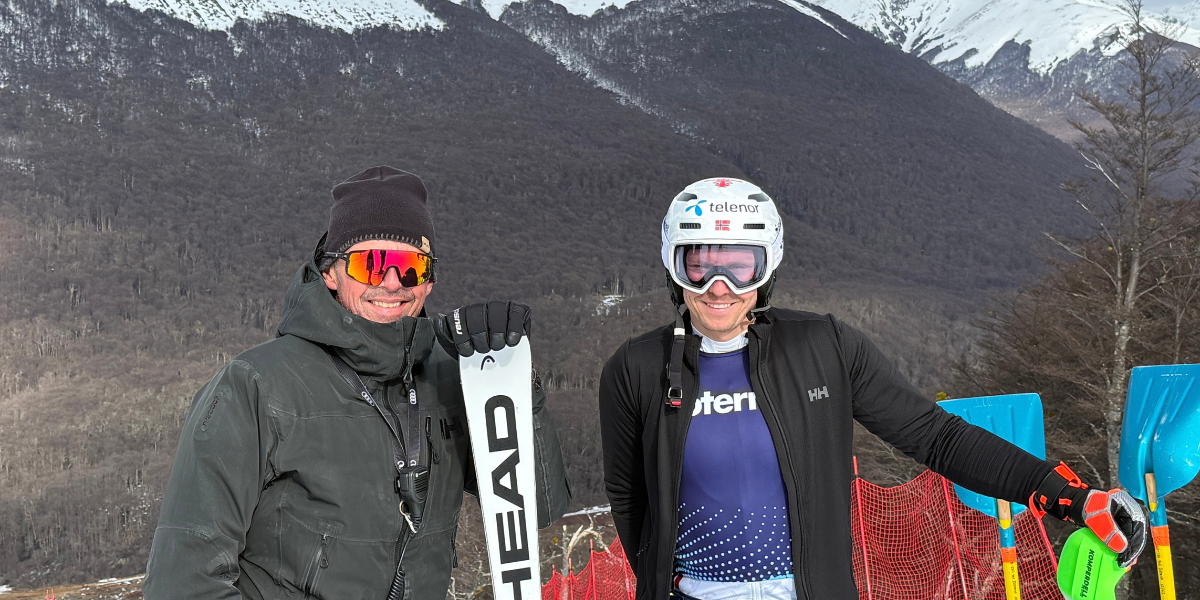
Lars and Henrik Kristoffersen
Henrik Kristoffersen does not need a computer to tell him when he has made a mistake.
After 34 World Cup victories, 102 podiums, five discipline globes, three Olympic medals and two World Championship gold medals, the Norwegian knows what a fast turn feels like.
But knowing that he made a mistake is different from knowing exactly what it cost.
How much speed disappeared? Where did he begin accelerating again? How long did it take to recover? Would a slightly rounder line have carried more speed onto the flat? Did a ski that felt aggressive actually make him faster?
Those are different questions.
They are also the questions Kristoffersen and his father and longtime coach, Lars, increasingly answer with Protern, a GPS-based performance analysis and video system developed specifically for ski racing.
“If you make a mistake, you can see the speed you have at any point on the course,” Kristoffersen said. Traditional timing may provide one or two intermediate splits. “But they are still 15 seconds apart.”
Protern allows him to look much deeper inside those 15 seconds.
And that may be where the technology becomes most interesting.
The stopwatch tells you what happened. Then what?
Ski racing has always been measured by time. The fastest racer wins.
Coaches have also spent generations standing beside courses, studying movement, line, balance and ski behavior. Video added another layer. Timing splits added another.
Protern connects those pieces.
Kristoffersen can overlay performance information with video and compare speed or time throughout different sections of a run. Instead of relying only on fixed timing points, the team can create analytical sections wherever something interesting happened.
A mistake does not simply appear as a slower split 10 or 15 seconds later.
Kristoffersen can examine where the speed disappeared and what happened next.
“How much did you really lose from it?” he said. “How to come back to speed, how long it takes to come back to speed.”
That becomes especially useful during transitions from steep terrain onto flatter sections, where the fastest route to the gate may not produce the highest speed exit.
Sometimes a shorter line creates more pressure and reduces speed. A slightly rounder approach may allow a racer to carry more momentum.
Kristoffersen can put numbers next to that tradeoff.
Seeing where the turn creates speed

Kristoffersen also studies where forces develop within the turn.
He wants the ski loaded before the gate rather than carrying the bulk of the pressure below it. In other words, he is looking to complete more of the work early enough that the ski can release and accelerate toward the next turn.
“I want to ski with the forces and not against,” he said.
The data can also help identify what Kristoffersen describes as a “double turn” — loading the ski, releasing and then loading it again — rather than producing one effective arc.
That matters tactically, but it also matters when testing equipment.
A ski may feel powerful. It may turn quickly. But if it engages too aggressively and forces Kristoffersen into the wrong movement pattern, the data can help expose what is happening.
“Testing skis has a lot to do with feeling,” Kristoffersen said.
But for Kristoffersen, speed ultimately outranks sensation. He would rather have “a bad feeling and be fast” than trust a setup simply because it feels good.
Feel still matters. Protern does not eliminate it. The data provides another piece of evidence.
When equipment testing becomes less like guessing
That same distinction resonates at Stratton Mountain School.
Mike Morin, SMS director of sport, and Matt Prendergast, the academy’s head FIS coach, have used Protern for approximately five years. The program has gradually expanded its use as the system has evolved.
Prendergast has used it for equipment testing, including comparisons involving ramp-angle changes.
Morin sees enormous value in bringing objective information into a process that can otherwise depend heavily on perception.
He joked that much of what ski racers call equipment testing should sometimes be called “equipment guessing.”
Protern does not make the decision for the coach or athlete. Instead, it can show where one setup accelerates, where another loses speed and how a change affects different sections of the course.
That creates an interesting combination.
Athlete feel matters.
The coach’s eye matters.
The stopwatch matters.
But now each can be compared against another source of information.
What happens when the data disagrees with your eyes?
Prendergast experienced that with a young FIS racer during training.
Watching the athlete ski, Prendergast saw technical issues he believed needed considerable work. His first instinct was that the skier needed significant changes.
Then he looked at the Protern data.
On the pitch, the first-year FIS racer was beating a considerably more advanced athlete.
The result was so unexpected that the other racer told Prendergast the data had to be wrong.
It wasn’t.
For Prendergast, that mattered. Without the data, he believes he might have tried to change skiing that was already producing speed.
Rather than using video only to identify movements that looked unconventional, he now had another question to ask:
Was the athlete actually slow?
That does not mean the data replaces coaching. It gives the coach more evidence before deciding what needs to change.
Morin has experienced a similar shift in understanding where skiers actually generate speed.
A coach may believe an athlete accelerates in one part of a turn. The data can reveal that it happens somewhere slightly different.
Now the conversation changes from identifying a movement to understanding its consequence.
One athlete accelerates.
Another slows down.
Why?
That “why” is where coaching begins again.
Making sophisticated analysis practical
None of that matters much if coaches do not have time to use it.
That may be one of the more important parts of Protern’s evolution.
Lars Kristoffersen said the system initially felt complicated when the team began experimenting with it roughly five or six years ago.
His description of his role provides some context. When asked for a title, Lars simply said “coach.” Then he offered a Norwegian expression that describes someone who handles almost everything.
A potato.
“Potato is useful for everything,” he joked.
Lars handles virtually everything around the private team’s operation, from coaching responsibilities to travel, finances and logistics. A performance tool that creates another hour of work every night has limited value.
He said that was more of a concern with earlier versions.
Over the past several years, however, he has watched Protern become more stable, reliable and easier to use.
“Time is a factor,” Lars said.
That same issue matters at SMS, where coaches may be handling video from 15 athletes rather than one.
Prendergast said a session involving roughly 15 athletes and multiple clips of each skier can produce 60 to 80 videos. With Protern’s current workflow, he estimated he can process the group’s video and connect it with the performance information in roughly 15 to 20 minutes.
That changes how frequently useful analysis can happen.
Something that once might have been practical once a week can become part of the normal training process.
Two cameras, three cameras — one run
Video itself has also become part of the story.
Kristoffersen said he previously relied on Dartfish for video analysis. He now uses Protern Video to review his training runs.
His team commonly shoots from two or three positions. Protern Video can connect those views into a single sequence.
Prendergast described the same advantage at SMS.
A GS session may use two cameras. Downhill training can require three or four.
Because the cameras and athlete data share synchronized timing information, Protern can identify the sequence and connect the different views of the run.
“You don’t even have to do anything,” Prendergast said. “It just goes from camera A … into the next.”
For coaches who have spent years manually sorting, labeling and matching video, that may be more exciting than GPS analytics.
It may also be one of the features they appreciate most.
The athlete can see the answer
There is another advantage that has little to do with elite-level analytics.
The information is visual.
Kristoffersen believes that could make it valuable even for developing racers.
A young skier may consistently attack straight toward the gate before completing most of the turn below it. A coach can explain why that creates problems, but the athlete can also watch the video while seeing the speed trend change.
“It is visual,” Lars said.
Kristoffersen agreed.
“A picture says more than a thousand words.”
That does not mean SMS believes young racers should spend their days buried in data. Morin and Prendergast emphasized that technology does not replace fundamental skiing, particularly with younger athletes.
The value grows as athletes begin asking more performance-oriented questions.
Where am I fast?
Where am I losing speed?
What happens when I change the line?
What did that mistake actually cost?
Which ski is faster?
Why was that run better?
From World Cup podiums to an academy training hill
That may ultimately be what makes Protern worth watching.
The same system can serve two very different environments.
At Stratton Mountain School, coaches use it across a group of developing racers. GPS units record both course runs and free skiing. Video can be organized quickly. Coaches can compare athletes, evaluate equipment and investigate where speed changes.
At the other end of the sport sits Kristoffersen, one of the most accomplished men’s technical racers of his generation, looking for differences that may decide World Cup races by hundredths of a second.
The questions are surprisingly similar.
What made that run faster?
Where was the speed created?
Where did it disappear?
And what should we do differently next time?
For decades, ski racing coaches have answered those questions with their eyes, experience, video and a stopwatch.
None of those tools is going away.
Protern simply gives them something they have rarely had before:
A way to look inside the time.
About the Author: Peter Lange
Related Post