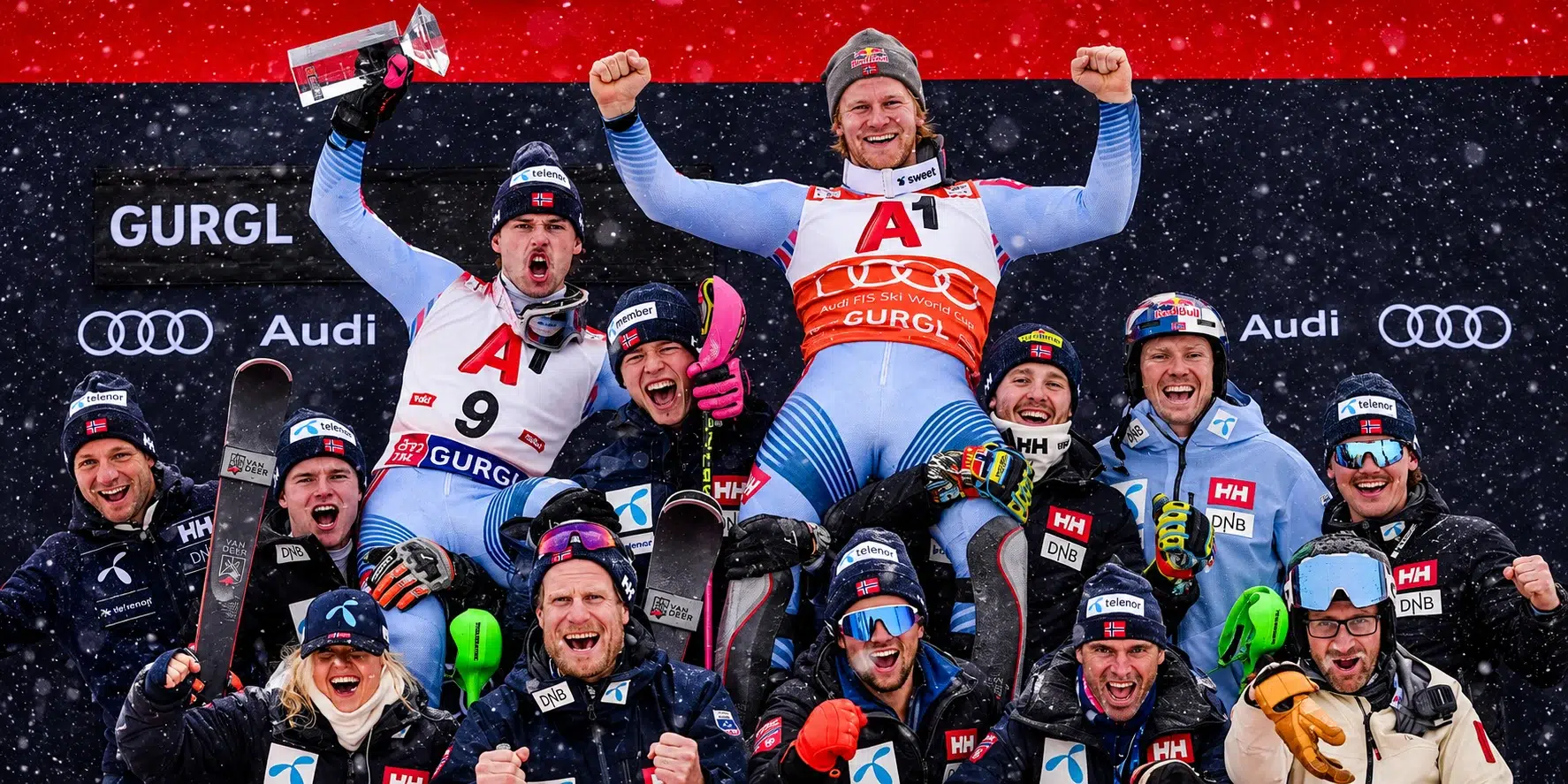
Haugan Wins Gurgl Slalom as Solberg and Nef Celebrate First World Cup Podiums
GEPA pictures
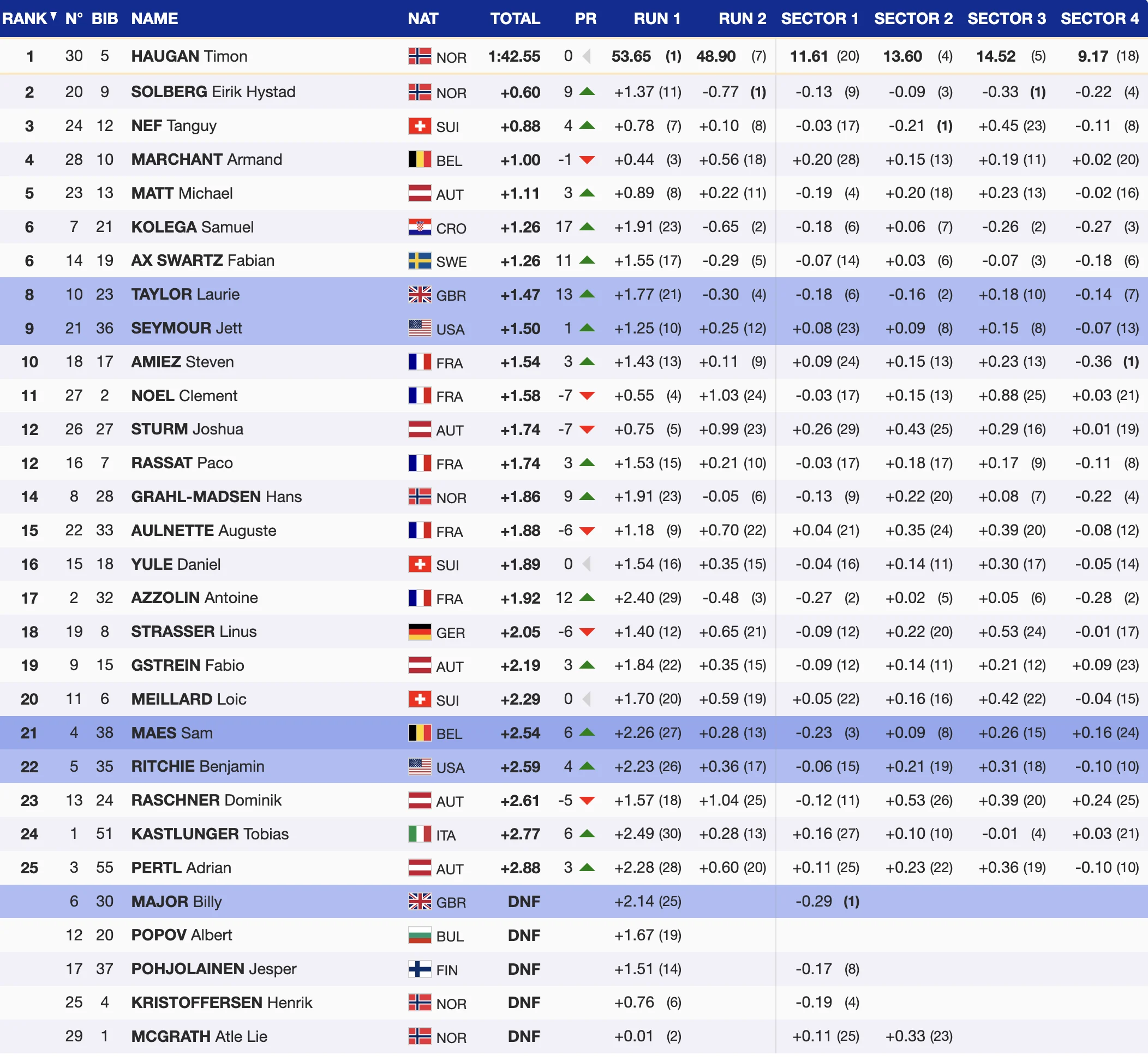
Norway’s Timon Haugan won Sunday’s Gurgl World Cup men’s slalom, defeating teammate Eirik Hystad Solberg by 0.60 seconds. Switzerland’s Tanguy Nef finished third, completing a remarkable podium featuring two first-time individual World Cup podium finishers.
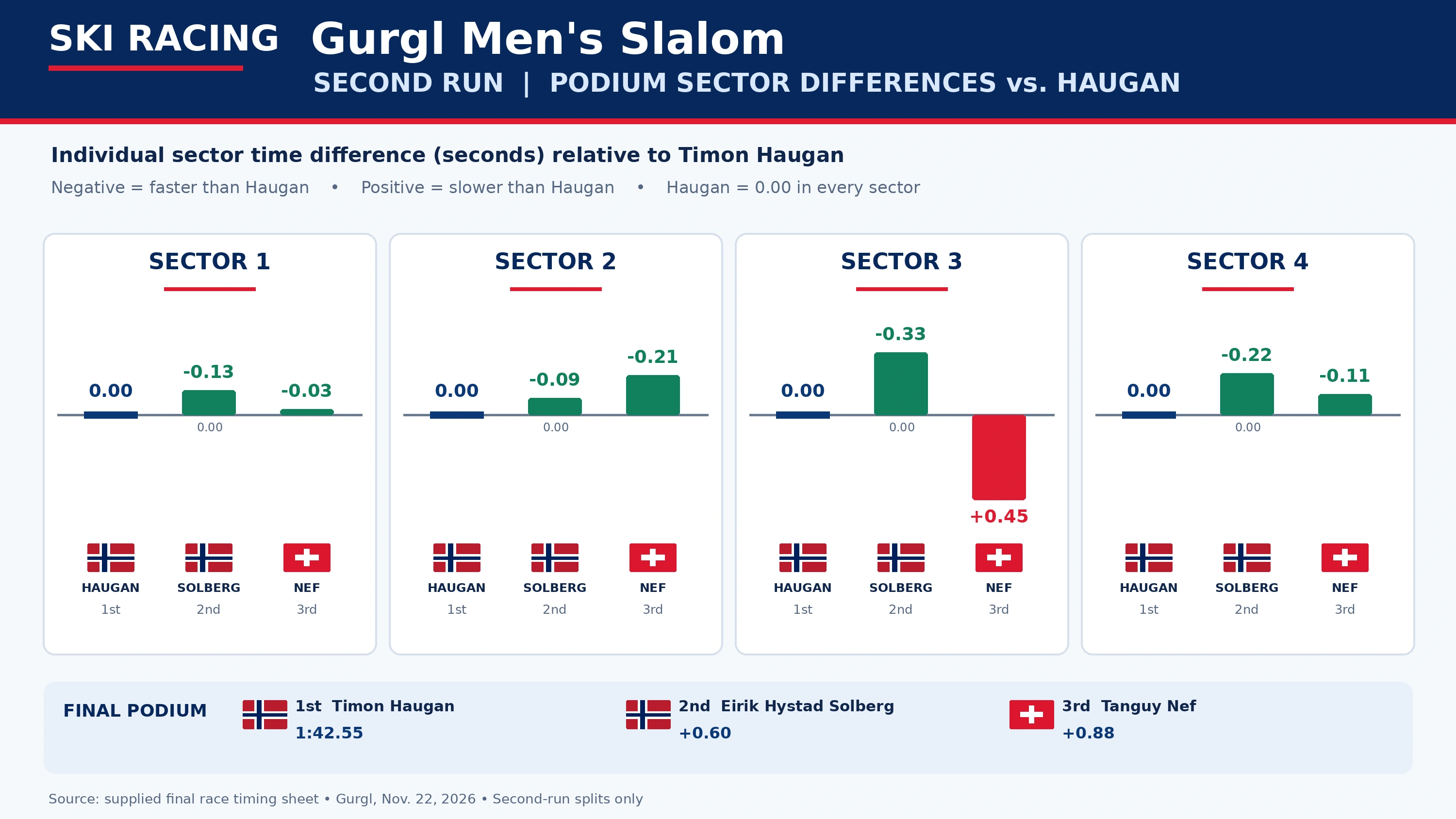
Solberg delivered the fastest second run, climbing from 11th to second. Nef moved from seventh to third, while Haugan held his nerve as the final starter to win in 1:42.55.
The race also produced a spectacular 17-place climb by Croatia’s Samuel Kolega, a heartbreaking mistake by Norway’s Atle Lie McGrath and top-10 finishes for American Jett Seymour and Britain’s Laurie Taylor.
Gurgl Men’s Slalom — Podium
- 1st 🇳🇴 NOR Timon Haugan (Bib 5) — 1:42.55
- 2nd 🇳🇴 NOR Eirik Hystad Solberg (Bib 9) — +0.60
- 3rd 🇨🇭 SUI Tanguy Nef (Bib 12) — +0.88
Haugan Finds His Speed and Confidence
Haugan’s victory carried special meaning after preseason struggles and a disappointing slalom opener in Levi.
“I’m very happy. Very, very happy,” Haugan said in his post-race interview. “This one felt extra good after some struggles in the preseason.”
He led the opening run by just 0.01 seconds over Norwegian teammate McGrath. Yet that narrow advantage meant more than the lead itself.
“I was just so happy after the first run to see that the speed is there,” Haugan said. “That gave a lot of confidence for the second run.”
His confidence proved justified.
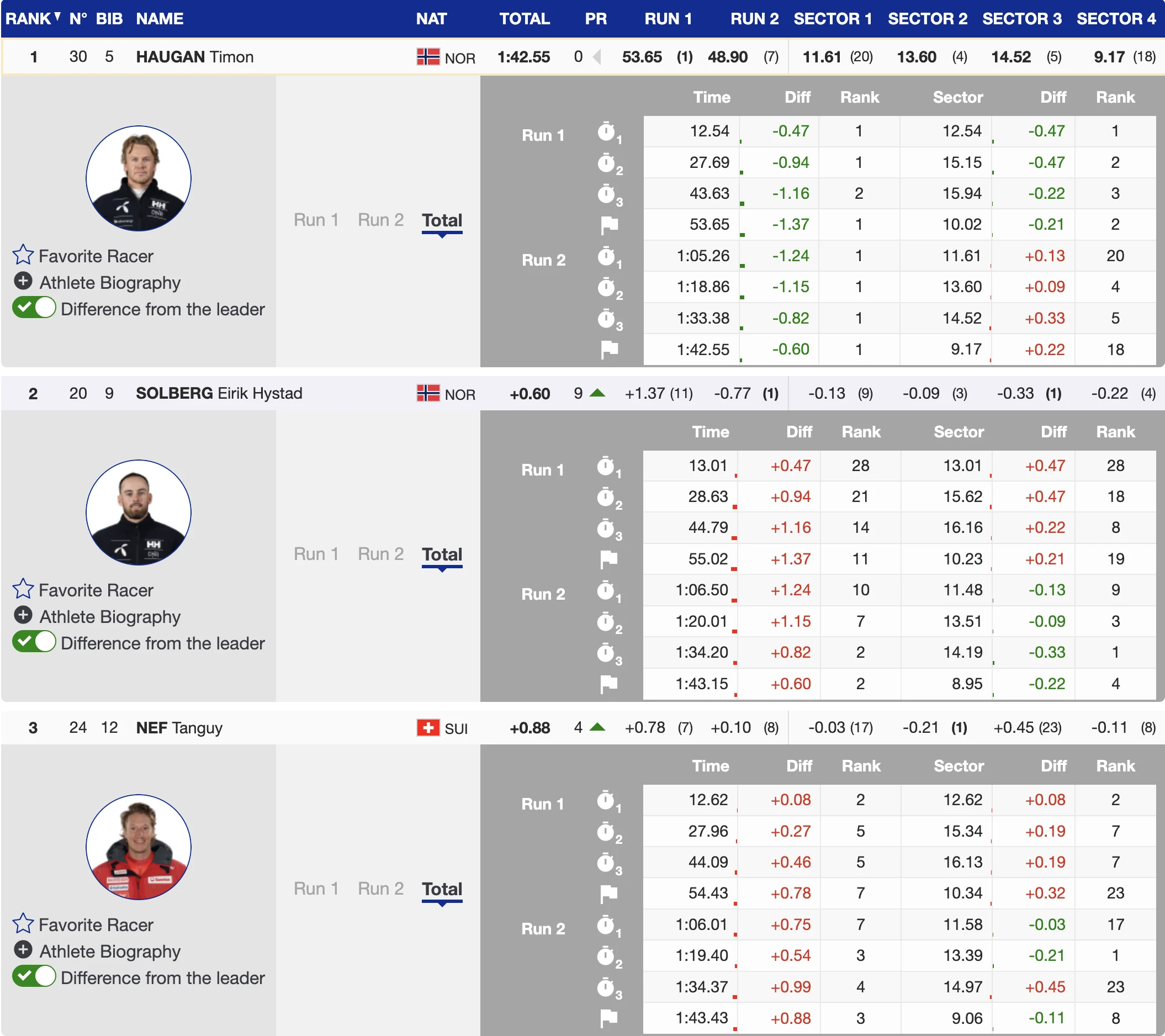
Haugan delivered a 48.90-second final run. Although six racers were faster, his opening-run advantage allowed him to defeat Solberg by six-tenths.
Solberg’s Sensational Second Run Changes Everything
The two courses presented dramatically different challenges. The second produced considerably faster times, creating opportunities for major moves.
Solberg seized his chance.
Starting the final run in 11th, the Norwegian attacked the course and stopped the clock at 48.13 seconds — the fastest second run of the race.
His combined time of 1:43.15 became the benchmark.
One by one, the remaining competitors failed to match it. Solberg continued climbing until only three racers remained.
Belgium’s Armand Marchant finished behind him, guaranteeing Solberg his first career World Cup podium.
“Pretty amazing, it is what we worked for and to finally take that step is pretty nice,” Solberg told FIS.
The 24-year-old credited an important equipment adjustment between runs.
“First run, I missed a little with the equipment, so happy to change that up for the second and do the right thing.”
His decision paid off spectacularly. Solberg climbed nine positions to finish second, securing the first World Cup podium of his career.
McGrath’s Mistake Ends Norway’s Sweep Hopes
Norway briefly appeared capable of sweeping the podium.
McGrath, just 0.01 seconds behind Haugan after the opening run, attacked the second course with victory within reach.
However, he straddled a gate in the second sector while challenging for the lead. Frustrated, McGrath threw his poles beyond the safety fencing.
His DNF ended Norway’s sweep hopes and guaranteed Solberg at least second place. It also secured Nef’s first individual World Cup podium.
Only Haugan remained.
Starting last, he delivered the winning performance, securing a Norwegian 1-2 finish and turning Solberg’s breakthrough into a team celebration.
“Two first-timers on the podium is always cool,” Haugan said. “Cool to share it with Eirik.”
The two Norwegians train and work together.
“He is on my team, and same skis, and we work together,” Haugan said.
He also celebrated Nef’s achievement.
“He’s been close many times, so well deserved.”
Click on the images to enlarge
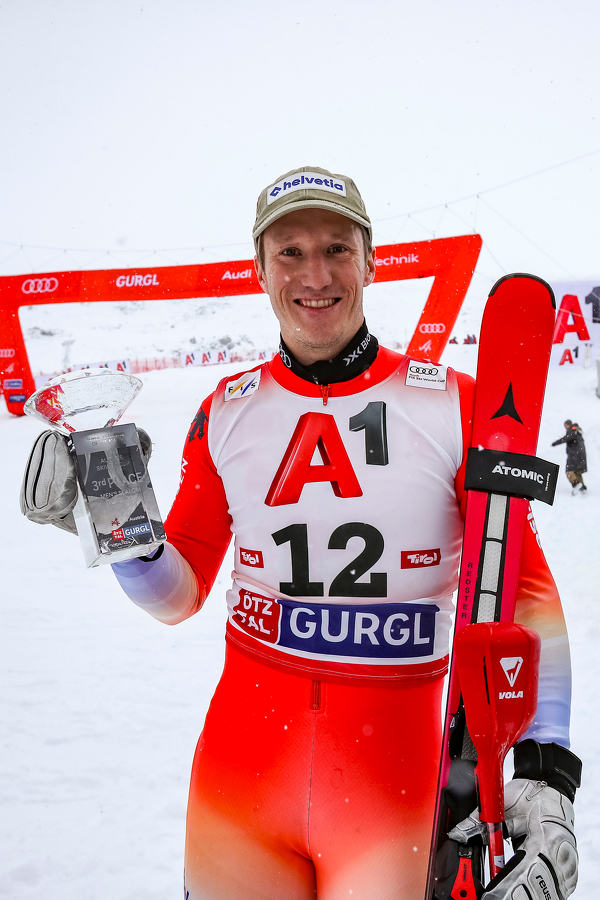
Dartmouth All-American Nef Earns His First World Cup Podium
Switzerland’s Tanguy Nef added another chapter to the success of NCAA-trained athletes on the international stage.
The 30-year-old had recorded 22 World Cup top-10 finishes over more than eight years without reaching an individual podium, according to FIS.
On Sunday, his patience finally paid off.
Nef finished seventh in the opening run before moving into third overall. Despite difficult visibility, falling snow and challenging course conditions, he limited his mistakes and secured his long-awaited breakthrough.
A former Dartmouth College standout, Nef earned four NCAA All-America honors. He also claimed two individual national championships, winning the 2018 slalom and 2019 giant slalom.
His achievement follows another significant result by an NCAA All-American earlier this season.
Stifel U.S. Ski Team’s Paula Moltzan, a former University of Vermont standout, won the women’s World Cup giant slalom in Sölden on Oct. 24.
Moltzan earned three NCAA first-team All-America honors and won the 2017 NCAA slalom championship.
Two former NCAA All-Americans have now reached World Cup podiums this season, with Moltzan winning in Sölden and Nef celebrating his breakthrough in Gurgl.
Their performances demonstrate the value of NCAA skiing in developing world-class athletes.
Kolega’s Remarkable Comeback Headlines Second-Run Movers
Croatia’s Samuel Kolega delivered the second-fastest final run, stopping the clock at 48.25 seconds.
Starting the second run in 23rd place, Kolega climbed 17 positions to finish tied for sixth with Sweden’s Fabian Ax Swartz.
Ax Swartz moved from 17th to tied sixth, while Britain’s Laurie Taylor surged from 21st to eighth.
France’s Antoine Azzolin also made a substantial move, climbing from 29th to 17th.
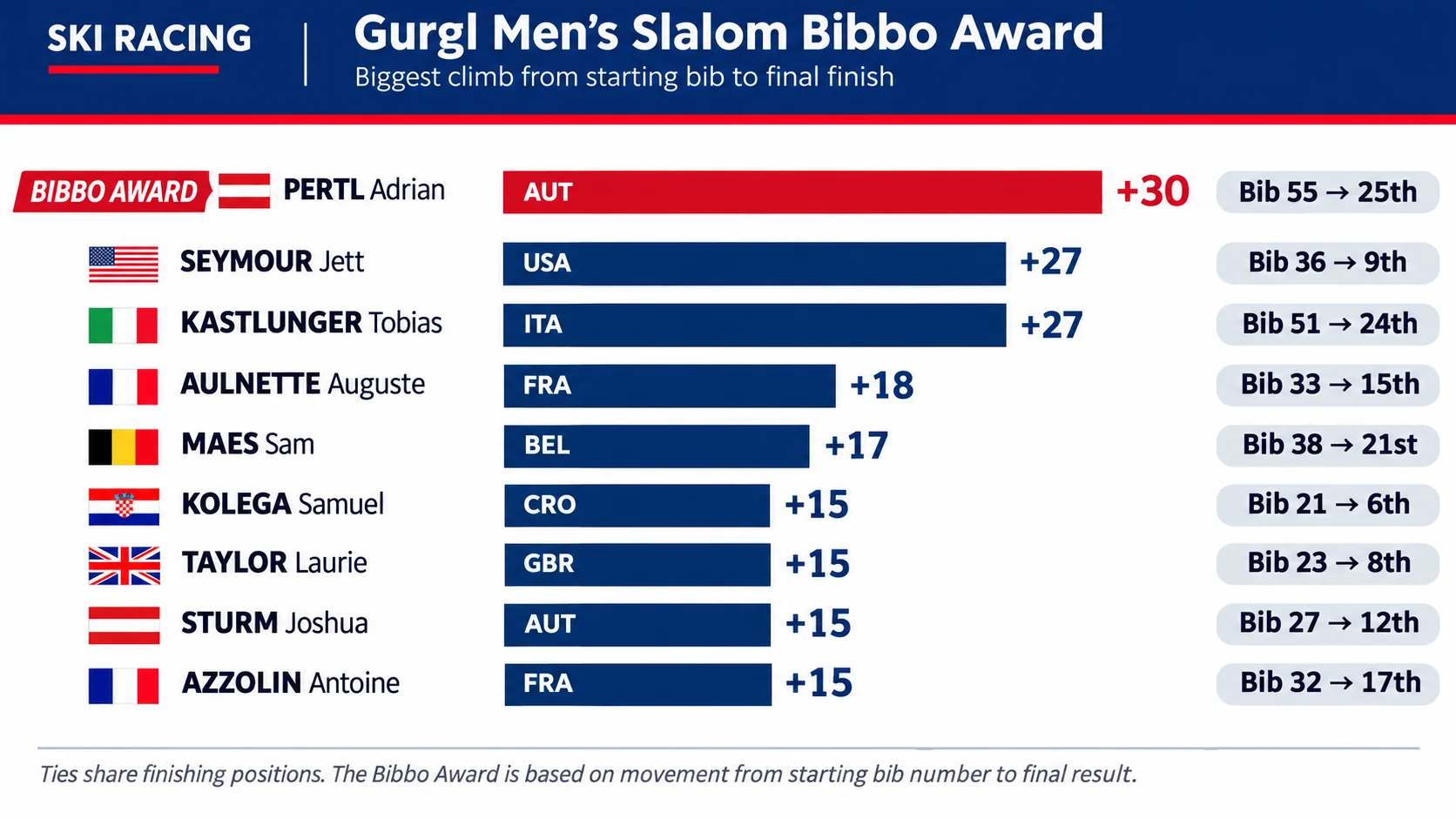
Bibbo Award: Austria’s Adrian Pertl
The Bibbo Award recognizes the athlete who makes the biggest climb from starting bib number to final finishing position.
🇦🇹 Adrian Pertl wins the Gurgl Bibbo Award, climbing from bib 55 to 25th place — a 30-position improvement.
🇺🇸 Jett Seymour and 🇮🇹 Tobias Kastlunger each gained 27 places from their bib numbers, the next-largest improvements.
The Bibbo Award measures a different achievement: position gains between the two runs. Kolega led that second-run comeback category with his 17-place improvement.
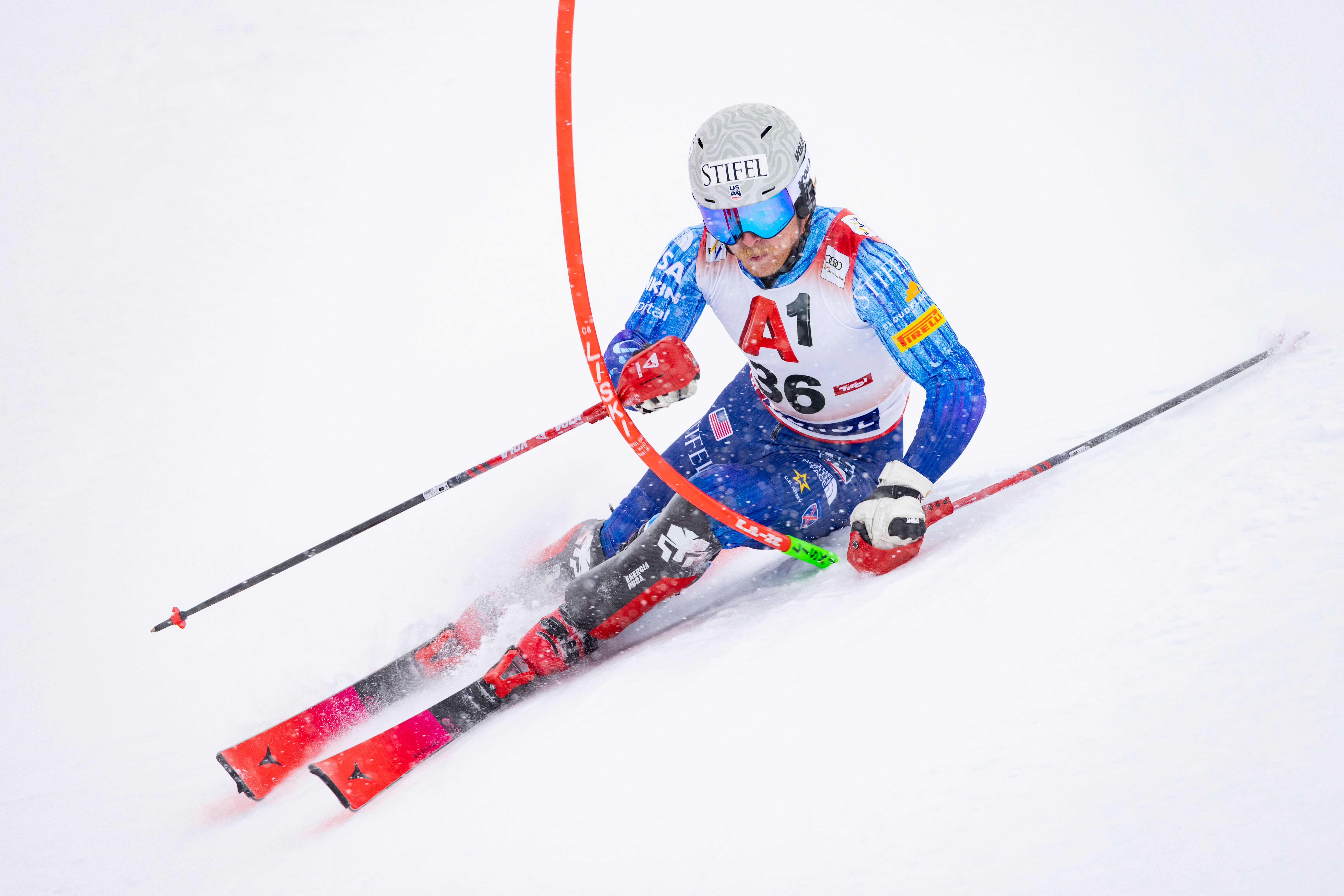
Seymour Ninth, Taylor Eighth as North Americans and British Racers Score
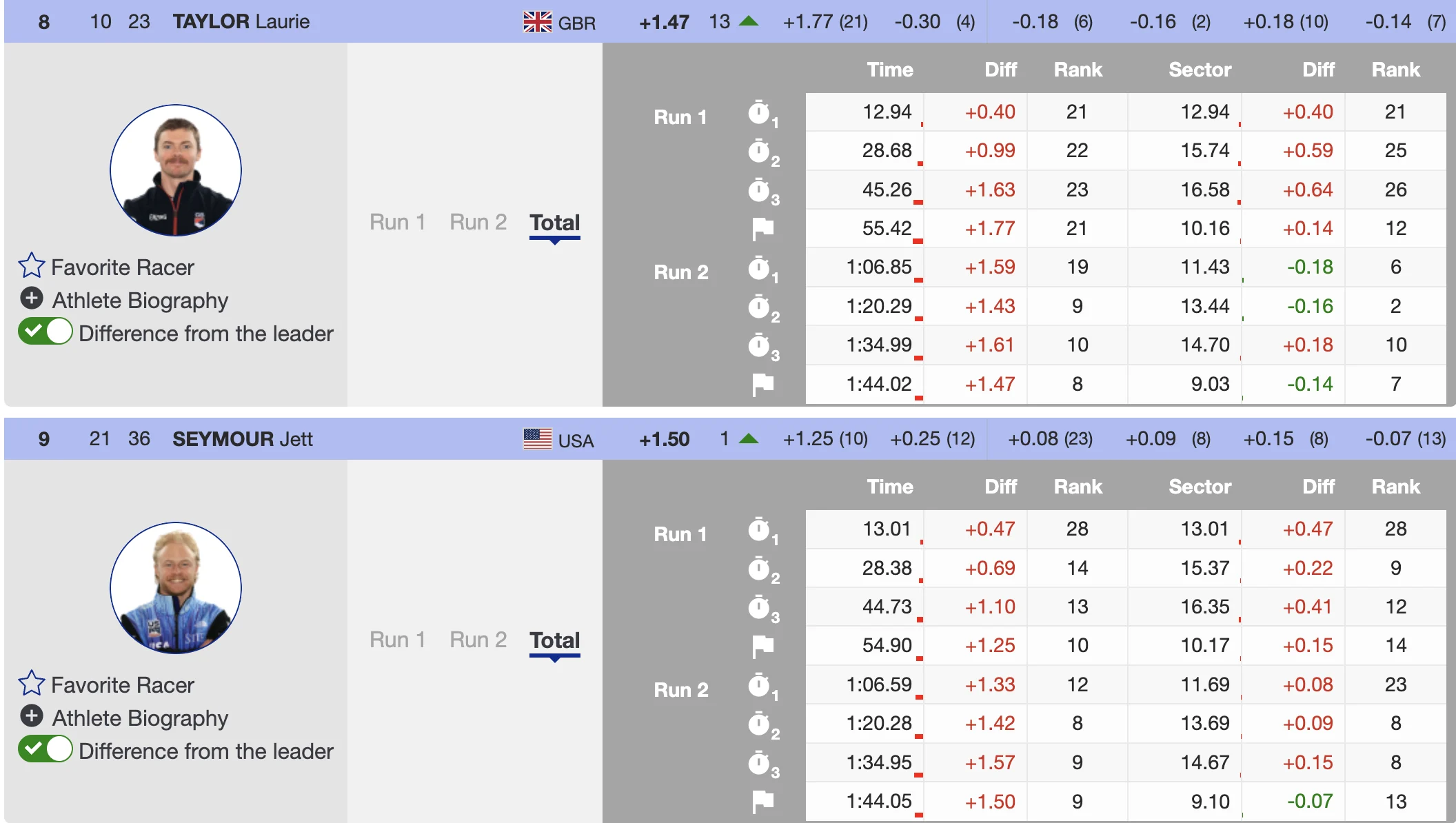
Stifel Headgear Athlete Jett Seymour led the Americans with ninth place, 1.50 seconds behind Haugan.
Starting bib 36, Seymour established himself in 10th during the opening run. He skied comfortably again in the second, although the first course better emphasized his strengths.
His ninth-place finish delivered valuable World Cup points.
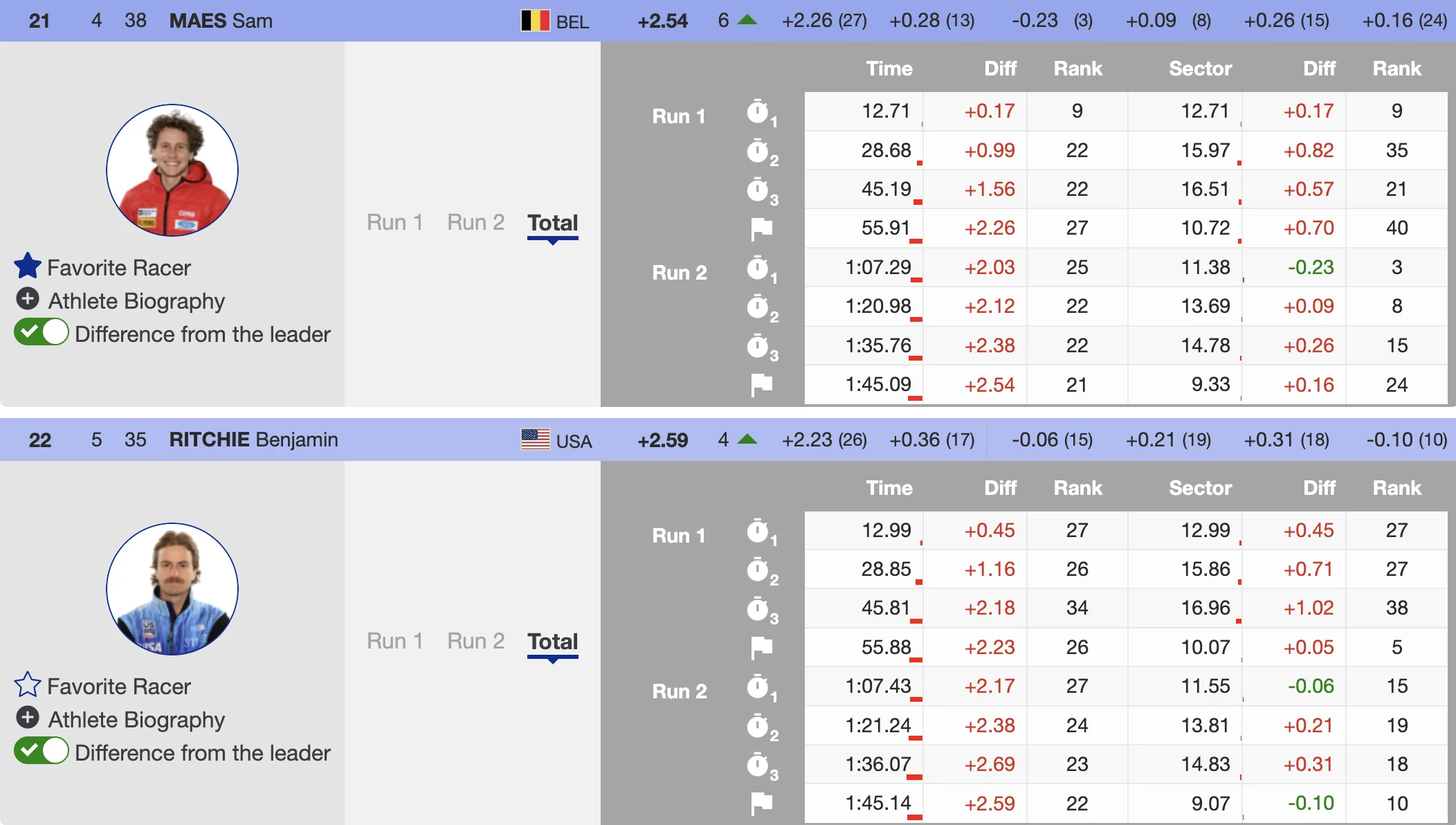
Fellow Stifel Headgear Athlete Ben Ritchie finished 22nd after qualifying 26th. He gained four places in the final run.
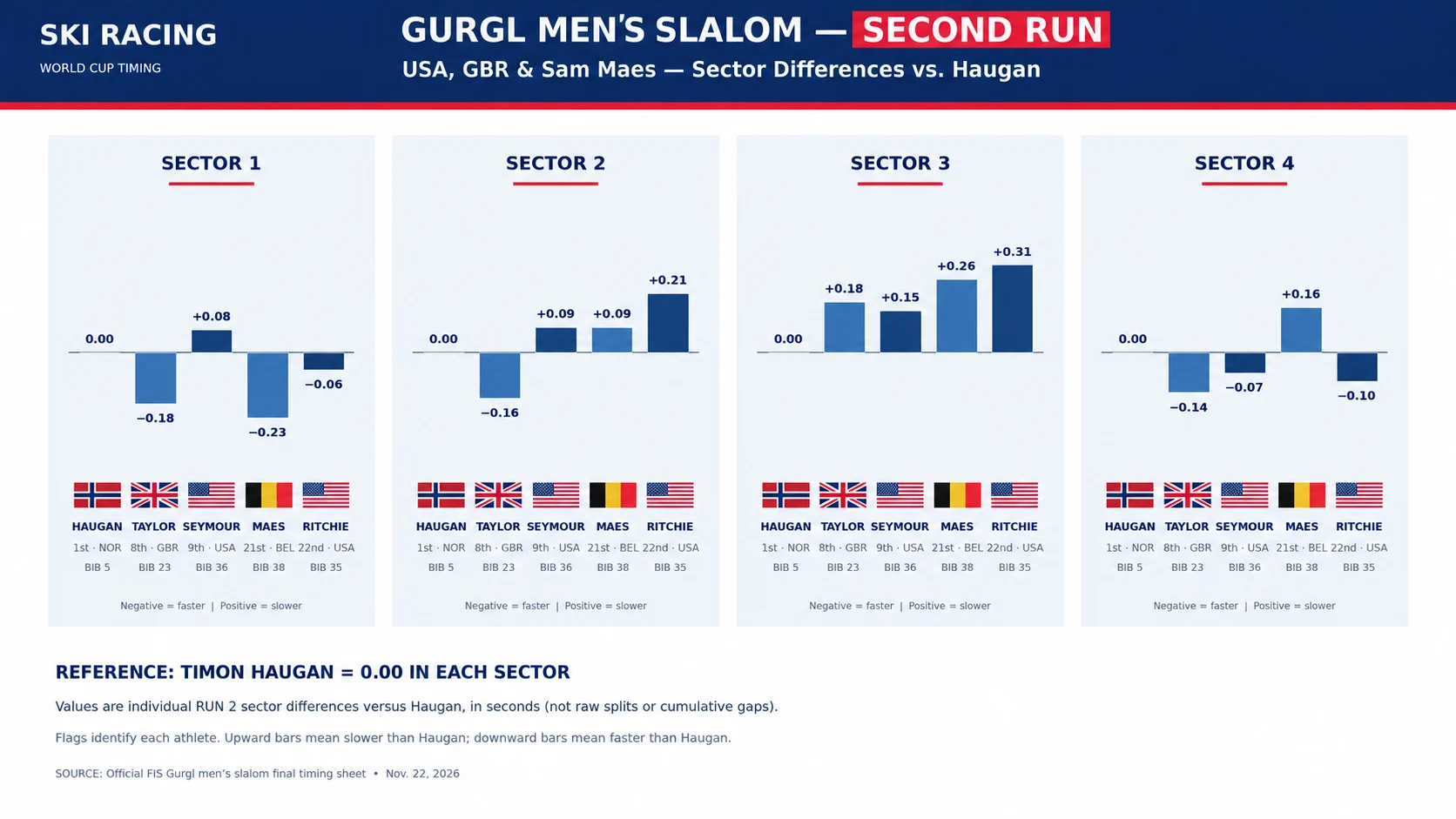
Britain’s Laurie Taylor produced one of the strongest second-run performances. His 48.60-second effort ranked fourth-fastest and lifted him from 21st to eighth overall.
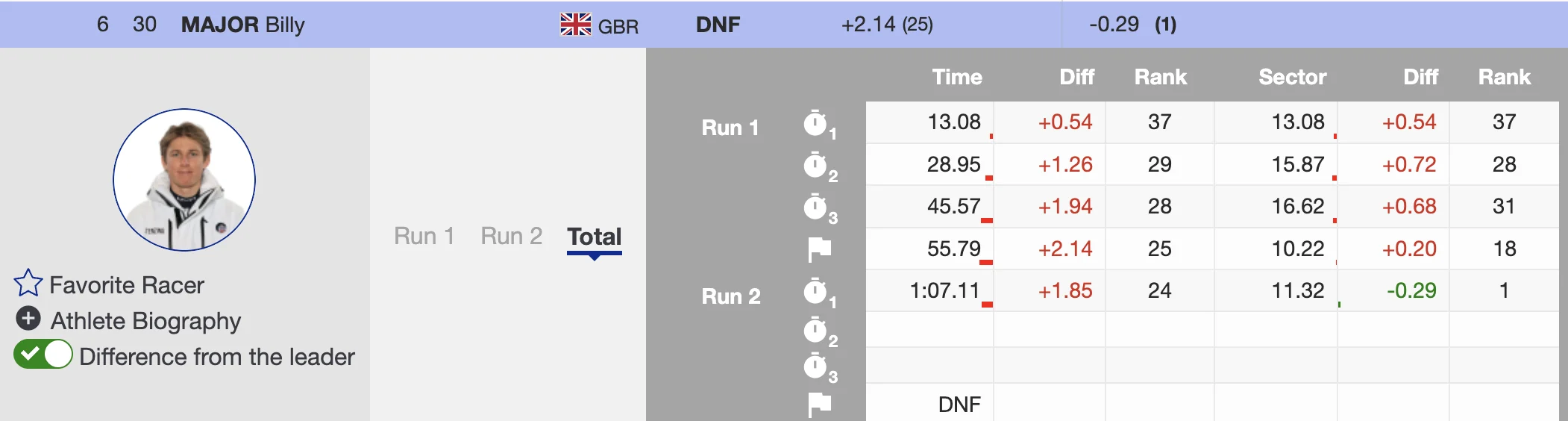
Teammate Billy Major was less fortunate. Major recorded the fastest opening sector of the second run before falling onto his right hip and failing to finish.
Belgium’s Sam Maes, who trains with the Stifel U.S. Ski Team, improved from 27th to 21st. Gurgl marked his 100th World Cup start.
Maes races with Völkl, Marker and SHRED equipment.
USA, GBR and Sam Maes — Final Results
- 🇬🇧 GBR Laurie Taylor: Bib 23 | Run 1: 21st | Final: 8th | ↑ 13 places
- 🇺🇸 USA Jett Seymour: Bib 36 | Run 1: 10th | Final: 9th | ↑ 1 place
- 🇧🇪 BEL Sam Maes: Bib 38 | Run 1: 27th | Final: 21st | ↑ 6 places
- 🇺🇸 USA Ben Ritchie: Bib 35 | Run 1: 26th | Final: 22nd | ↑ 4 places
- 🇬🇧 GBR Billy Major: Bib 30 | Run 1: 25th | Final: DNF2
No Canadian racers entered the Gurgl slalom.
Five Second-Run DNFs Add to the Drama
Five athletes failed to complete the final run: Billy Major, Albert Popov, Jesper Pohjolainen, Henrik Kristoffersen and Atle Lie McGrath.
Major’s early exit was particularly disappointing after his fastest opening sector. Kristoffersen also straddled, ending his challenge after entering the final run sixth.
However, McGrath’s mistake carried the greatest consequences. His exit ended the possibility of a Norwegian sweep and transformed the podium battle.
Two Different Courses, One Decisive Victory
The contrast between the two courses helped define the competition.
Haugan’s first run took 53.65 seconds. His second required just 48.90, a difference of 4.75 seconds.
Solberg’s 48.13-second final run was 6.89 seconds faster than his opening effort. His performance helped him climb nine positions.
The changing course demands reshuffled the standings and created opportunities for racers who had struggled in the opening run.
Yet Haugan had built just enough advantage to protect his lead.
His reward was a victory made sweeter by preseason challenges, renewed confidence and the opportunity to share the podium with two athletes celebrating career milestones.
2026-27 Men’s World Cup Slalom Podiums
| Event | 1st | 2nd | 3rd |
|---|---|---|---|
| Levi — Nov. 15 | 🇧🇷 Braathen | 🇫🇷 Noël | 🇨🇭 Meillard |
| Gurgl — Nov. 22 | 🇳🇴 Haugan | 🇳🇴 Solberg | 🇨🇭 Nef |
Ski Racing Media partner Liski supplied the race gates and safety protection equipment for the Gurgl World Cup slalom.
Race Results
click to enlarge
Run Analysis: Leaders & Qualified North Americans
About the Author: Peter Lange
Related Post