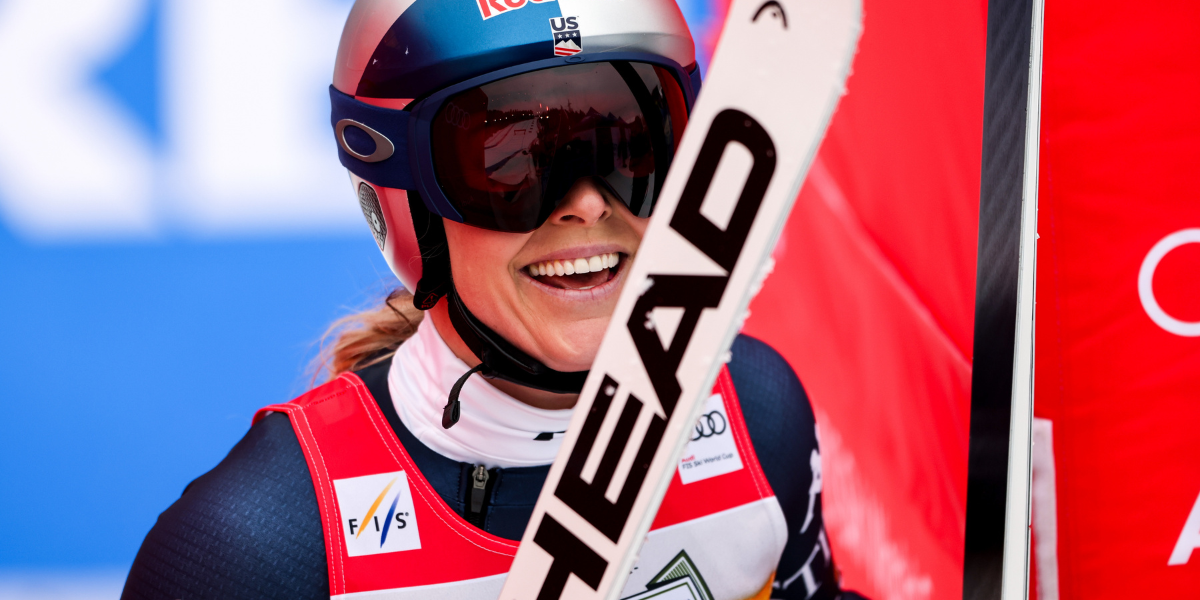
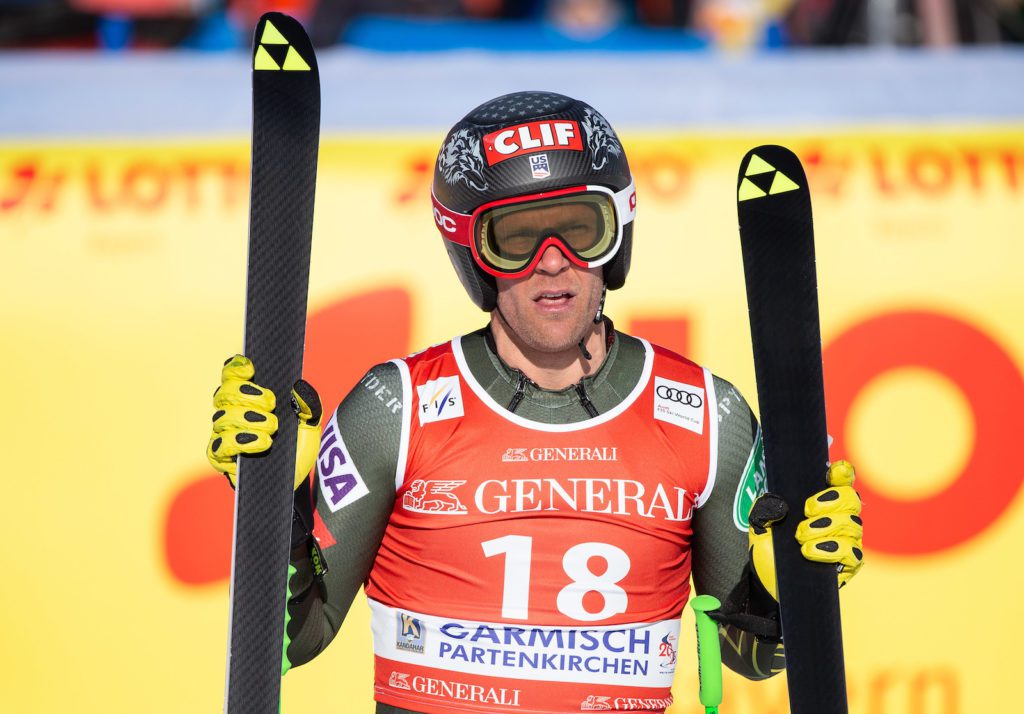
Steven Nyman Lake Louise training, credit : GEPA PHOTO
Steven Nyman isn’t ready to throw in the towel just yet.
The U.S. Ski Team veteran turns 41 this winter. After 20 years in the World Cup, he still has more to give.
“I love what I do,” Nyman said following a training stint at Copper Mountain this November. “I love the tour. I love the effort of trying to become the best I can be and being among a bunch of people pursuing the same thing. I want to continue to do it as long as I can.”
Early surprises
Growing up skiing at Sundance, where his dad ran the ski school, Nyman has defied the odds since entering the sport. Despite his stature (standing 6’4), Nyman initially made his global mark in slalom. Although he was a discretionary pick at the 2002 Junior World Championships, he landed slalom gold. He beat most of the field (except for fellow podium finishers Marc Berthod and Aksel Lund Svindal by well over a second), then took silver in combined the next day. After that, at the finals, he notched 15th place in the first World Cup race of his career (a slalom in Flachau, Austria). That was half of his life ago.
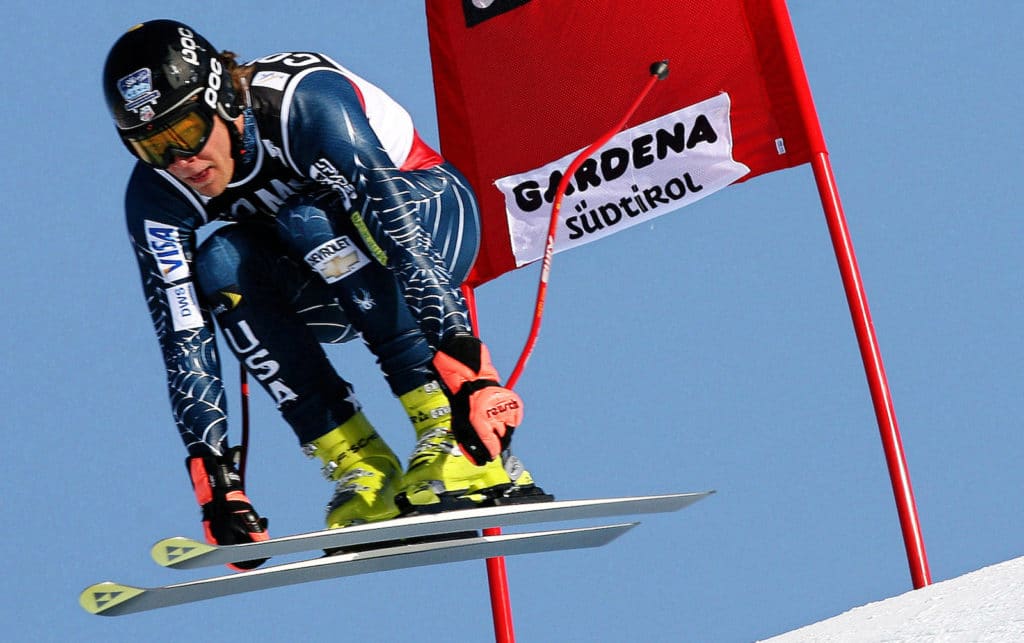
Since then, Nyman has become one of America’s most decorated downhill racers. From 2006 to 2016, he landed on 11 World Cup downhill podiums, including three victories, all on the notorious Saslong track in Val Gardena, Italy.
He’s notched a handful of top tens in the meantime but has spent the last decade overcoming injuries and the last year struggling to dial in equipment.
Injury list
His slew of setbacks began with a left Achilles rupture that sidelined him for the 2011-2012 season. He bounced back in 2013 for his second career Cup victory in Val Gardena and was riding high until blowing out his left knee in January 2017 and his right knee a year later, forcing him to miss the 2018 Olympics.
Rupturing his right Achilles in August 2020, Nyman relaunched the comeback train last season. With his top performances in the Beaver Creek downhill early season and the Kvitfjell downhill late season (he finished 18th in both), Nyman failed to qualify for the 2022 Olympics and World Cup Finals.
“Last year, I was actually pretty disappointed,” he says. “There was a lot of stuff that didn’t line up and frustrated me. This spring, we rebooted the equipment. I softened my skis and boots. With the torn Achilles, that’s what I was dealing with last year. I didn’t have the strength I’m used to under my feet. I couldn’t flex the boots. We changed the flex to be softer. I’m skiing a lot better now.”
Challenges continue
Nyman was pleased with his training times at camps in Chile at the end of summer and Copper this November. However, he has been plagued with intermittent back pain that began with a crash last spring while skiing at Deer Valley after the race season. . The nagging pain forced Nyman to bow out of a set of stacked FIS races that recently took place at Copper Mountain. Before leaving Colorado, he stopped for injections at The Steadman Clinic and hopes they help ease the pain before his race season kicks off this week in Lake Louise.
“The thing is my back looks good. There’s not a degenerative issue. I just flared up some nerves. Hopefully, it’s not a pattern,” he says. “I was skiing well before that. I’m happy with the way things are feeling.”
Career goals
Thus, Nyman is approaching every race with his best effort, beginning with Lake Louise, where he notched his first top 15 downhill in 2005. It’s also where not only he but the rest of the World Cup are likely to compete for the last time, according to rumors (https://skiracing.com/lake-louise-easily-passes-fis-snow-control)
“Every stop is unique in itself. Last year I went through it thinking this could be the last. I’m here for another year,” Nyman says. “Lake Louise is a place that’s been part of my career for a long time, going back to the NorAms. It was my first World Cup downhill. Hopefully, I can put down a career-best effort there.”
Juggling family
A father of two (ages 5 and 2), Nyman plans on tackling the tour without his family in tow. That, he says, will also present a test as to whether he makes this World Cup season his last.
“Typically, I pick them up and move them to Europe for the winter,” he says. “My wife doesn’t work for the US Team anymore. She has to be back in Utah. They’ll come to Europe for two stints. Training this summer and fall hasn’t been too bad. I’m the only guy on the U.S. Team that has kids. A lot of those guys in Europe have children. They go home to their families and have a normal life after each race.”
Although Nyman is the only dad on the U.S. Team, he’s grateful for his role as mentor and his continued ability to hang with his teammates on and off the hill.
“I have a totally different life than those guys. To be able to see that I’m right there, or I’m pushing more weight than them – it shows me, hey, I can be competitive,” he says. “I’ve always worked hard and I’ve always been focused. The torn Achilles was tough on me. It’s nice to see your weight numbers go up, your balance, and your progress. I love being a leader for my team, teaching the young guys what I know. Maybe that turns into a coaching thing later.”
Leading and believing
Nyman says the highlight of last season was witnessing teammate Bryce Bennett land his first World Cup win. It happened on the veteran’s most winning track in Val Gardena. Among the wisdom Nyman has to impart, it’s how to get on podiums. As well as continuing his leadership role on the team this season, he’s also hoping to lead by example.
“I fought my way to the U.S. Team. I was taught by Daron and Bode and Schlopy. I got to rise to the top. Hopefully, I’m passing that on to others. It’s cool to see the cohesion within our group, the information shared and the language developed. We’re a band of brothers that really supports each other,” he says.
“Honestly, I’ve already left a good mark, I think. I think I have the third most downhill podiums in American history. I’ve really been enjoying being a part of this team, the energy of the youth and how they’ve pushed me. Hopefully, I can end it with another podium or two. The biggest thing is I want to be able to do what I believe I’m able to do in my head. I have this image in my head of how I want to ski and what I want to feel. I really believe I can be in there.”
About the Author: Shauna Farnell