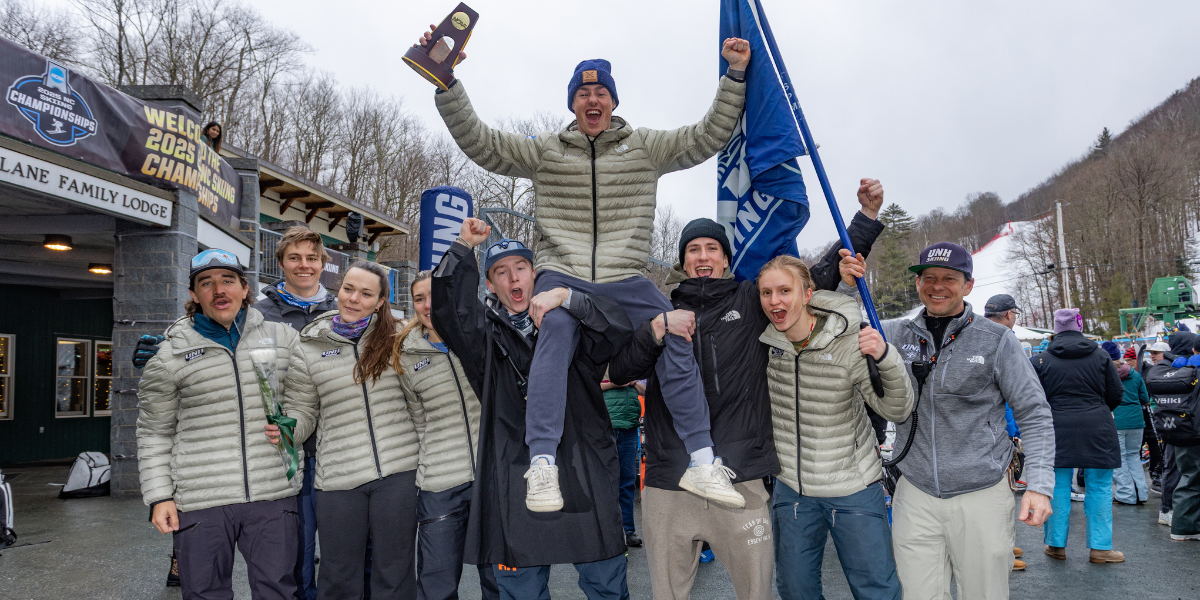
UNH celebrates Jayden Buckrell’s NCAA Nationals Slalom victory: Photo Stephen Cloutier
From the coaches’ keyboards: What it takes to ski in the NCAA
A lot of writers have written about NCAA skiing — the age exception, the influx of Europeans, and the limited number of schools with NCAA teams. In such a competitive, niche sport, the funnel to the top is narrow. Thus, everyone seems to have an opinion about elite skiing and NCAA skiing in particular — either why it’s great or why it’s broken.
But this article will focus on navigating the path from high school to NCAA skiing as it is — with the age exception, with competitive Canadians, Europeans, and Americans vying for spots, and with limited teams. There are 20 teams (21 including one NCAA affiliate program).
If none of the above makes sense, go to SkiRacing Media and read the article I wrote a few years ago titled, “So you want to ski in the NCAA?” It details the NCAA skiing age exception, including which teams are in the East and West, the number of available spots, and the general criteria.
Straight from the coaches
Here, we’re going straight to the sources — NCAA college coaches — to hear what it takes to be a recruit on their teams and a successful student-athlete at their schools. I partnered with SkiRacing and sent a survey to all 20 NCAA coaches, asking everything from the necessity of a postgraduate (PG) year and what they look for in a recruit, to what they wish parents and athletes understood better about the process.
We received responses from ten coaches: Colby-Sawyer College, Harvard University, Middlebury College, Montana State University, Plymouth State University, St. Lawrence University, the University of Alaska Anchorage, the University of Colorado Boulder, the University of Denver, and the University of New Hampshire.
Thank you to all the coaches for your thoughtful and honest responses; we appreciate your time and effort. Below, readers will find each question, a summary of the prominent themes in the ten responses, and then select answers from the surveys. Readers should note that the schools differ in admission rates, team competitiveness, and NCAA division affiliations.
Note: NCAA skiing comprises teams from Division I, Division II, and Division III schools. Although they all compete against each other as equals, each school must follow the guidelines of its specific division and other affiliations, such as the NESCAC (New England Small College Athletic Conference) or Ivy League.
Financial aid and scholarships
Note: Ivy League and NESCAC schools offer financial aid based on need and do not offer athletic or academic merit scholarships. Division III schools do not offer athletic scholarships; however, some Division III schools offer generous academic merit scholarships.
How many roster spots exist for freshmen recruits?
Most answers ranged from one to four per gender, depending on the number of seniors graduating in a given year. The average among all schools was two. With 21 teams, there are between 40 and 50 spots per gender per year in NCAA skiing. All coaches agreed that securing an NCAA spot on any team is challenging.
What metrics can rising high school seniors and PGs use to identify if they are on track to be a competitive recruit?
The coaches of the most competitive teams reported head-to-head results with current team members in FIS and Nor-Am races. All coaches stressed the importance of character, including a dedicated work ethic, a commitment to fitness, and being a great teammate.
University of Colorado Boulder
In the last three years, newcomers on our team have had world rankings between 100–250. There are also a lot of intangibles. Individuals who succeed in college skiing are typically highly independent and self-driven.
Montana State University
Top 20 RMISA FIS U results; Nor-Am top 30 men, top 15 women.
University of New Hampshire
Men should have FIS points under 40; women under 50. Some Nor-Am experience is important, along with consistency in results and variety in race schedule.
University of Denver
We look at results in Nor-Am, college, and FIS races, along with FIS points. We also consider coaches’ recommendations and make a point to get to know the athlete personally. We seek exceptional overall athletes with a high ceiling in skiing.
University of Alaska Anchorage
We look closely at head-to-head results and high school GPA. We also like to see positive recommendations from peers, coaches, and educators.
Harvard University
Head-to-head rankings with current college athletes and Nor-Am results in tech are important. We also value tenacity, discipline, and resiliency.
Middlebury College
We look for points in the 30s and 40s entering a skier’s senior year. We also expect exceptional grades and a transcript that shows AP or honors courses.
St. Lawrence University
We look for great grades, a well-rounded person, and a strong FIS point profile. We also value athletes who are supportive teammates and come from families that foster a positive environment.
Plymouth State University
We consider FIS points and look for a positive trajectory in results. Fitness and work ethic matter, and we look for athletes who are the right fit socially. Community and collaboration are key to our culture.
Colby-Sawyer College
We want to see progressive improvement. For high school athletes, we look for FIS points under 90 for men and under 120 for women. For postgraduate athletes, the ranges are 75 for men and 90 for women. Beyond results, we want athletes with grit and determination who show positive support for teammates.

What do you wish athletes and parents understood better about this process?
The coaches from Division I schools emphasized the competitiveness and difficulty of securing a spot on an NCAA Division I team. Coaches also noted that if a student-athlete wants to ski in college, they should consider all their options and find the team that best fits their skiing profile, even if that means taking a spot on a less competitive team. All coaches echoed that athletes and parents should focus on progression and the value of ski racing beyond making an NCAA ski team.
University of Alaska Anchorage
Look beyond the draw to the trendy big shiny programs. It’s about where your child will find success both in the classroom and with an athletic program. Athletes should also consider their scholarship offer within the context of the total cost of attendance. Attending a school with a high cost of tuition, even with an athletic scholarship, may cost more than attending a school with a lower cost of tuition and less scholarship.
Middlebury College
We have limited spots available every year. Academics are extremely important — students can’t just have good grades; they need to be taking a challenging course load and have great grades. We do not provide athletic scholarships. It is much harder to make an NCAA team, such as Middlebury’s, than many parents think — the athletes we recruit are highly committed and very close to meeting national team criteria.
St. Lawrence University
These spots are tough to acquire. There are not many NCAA varsity ski team openings across the country, and competition is intense. Coaches want student-athletes who are not only fast but also good people and strong teammates.
University of Colorado Boulder
The best advice I can give is to not put pressure on yourself to make a team to validate what you are doing. So many of you are 4.0 students, hard workers, and great kids. But it is super competitive, and the spots are limited. Do your research about what level the people on the team you want to ski for are at, and that is basically where you’ll need to be. There are lots of great schools to ski for, and you’ll have the best experience if you find the right fit.
Parents: Skiing is awesome. Help your kids focus on the process and find enjoyment in the sport. It’s really sad to see the pressure parents put on their kids to make a Division I team or the national team to validate the time, effort, and money invested. If your kid loves to ski, learns important values through competition, and makes great relationships through the sport, the investment is worth it.
Plymouth State University
There’s a lot of competition for spots. We get many European and Scandinavian athletes, as their countries don’t have a structure in place for university-based, high-level skiing. Coaches want to talk with athletes, not parents. There’s no “secret.” It’s all about hard work!
Colby-Sawyer College
Start the conversation and get on the radar, even if you think your FIS points are too high. I’m looking for a rounded athlete, person, and student who wants to work hard and improve. I read and respond to every student-athlete who reaches out to me. And make sure you understand how many college carnivals you’re likely to get into. For large, strong teams, you may have limited starts — just understand what the options are if you’re not at the carnivals, and whether that works for you.
Parents: Understand that it’s the student-athlete who should be driving the conversation. Parents are important in helping the student find the right fit — they know the student best — but let the student-athlete lead.
What advice would you give rising seniors (second-year U18s and first-year U21s) who want to ski NCAA?
In response to this question, the coaches’ advice centered on the importance of focusing on the ski racing journey rather than the end outcome, working hard in the classroom as well as on the hill, and enjoying the ride. Coaches also stressed that students should research each team and school.
Plymouth State University
Develop excellent fundamental ski skills. Learn to overcome adversity and use it to improve. Embrace the journey!
University of New Hampshire
Do your research and look at rosters. There is a wide range of Division I teams. Don’t focus too much on points. Instead, focus on the plan your coach lays out for you.
University of Denver
Work hard to be the best version of yourself and don’t stress about the future. You will find the path and the program where you belong. Focus on the whole picture, not just results. Coaches look at points and consistency, but they also pay close attention to how you interact with others, your work ethic, attitude, and how you handle setbacks. Athletes who succeed in college racing bring resilience, excitement, and team spirit — not just raw speed.
Middlebury College
Don’t slack on academics in your senior year. Middlebury will not admit students whose grades drop. Don’t just go after the easy point races to lower points. We want to see athletes scoring at competitive events. Race a carnival and see where you stack up.
University of Alaska Anchorage
Keep hammering. Look for head-to-head opportunities against current NCAA athletes not just at FIS-U races, but also at spring series and other venues where the seeding isn’t stacked against non-NCAA athletes.

What should potential recruits understand about your program that differentiates it from others?
Plymouth State University
We are a small Division III school, but we have excellent training facilities both for strength/conditioning and on snow. We are just 30 minutes away from our on-snow training environment at Mittersill. Our Athletic Director was the ski coach for many years; she understands the unique challenges of the sport. Professors are also very supportive of our athletes. The team consistently has the highest GPA average of all sports on campus.
Harvard University
We keep a small roster. Everyone races carnivals. Our academic calendar allows us to get a tremendous amount of training and racing completed before the second semester starts at the end of January.
University of Colorado Boulder
We have amazing resources and an incredible athletic department behind us. However, what makes CU special is the pride and tradition within the program and the athletic department. It is a special place, and it’s the athletes that make it what it is. They buy into the culture and commit to add value to the program and leave it better than they found it. It’s truly a family and something I’m grateful to be a part of.
University of New Hampshire
The team culture sets us apart from many schools. The men and women on the team are very close, creating a very supportive and competitive environment. We train at a variety of venues and support travel and entry fees to most FIS races.
University of Alaska Anchorage
While Alaska is certainly beautiful and unique, we are not a remote location. We spend less time in transit than every other RMISA program. Our sponsorship by Alaska Airlines affords us tremendous flexibility in targeting races. The University of Alaska is a fantastic school with a proven track record of placing our graduates into top law, medical, and business graduate degree programs around the world.
University of Denver
What sets the University of Denver ski team apart is the combination of tradition, location, balance, and fun. DU has one of the most successful legacies in NCAA skiing, and we are equally focused on preparing athletes for life beyond racing. Being in Denver gives us access to world-class training venues, and our roster brings together top talent from around the world, creating a competitive and supportive culture that pushes everyone higher. Add in DU’s strong academics and proven track record of sending athletes to the World Cup and Olympics, and you have a program that develops the whole person, not just the skier. And yes, we have a lot of fun.
Colby-Sawyer College
First, we’re a very small school with an intimate learning environment — very small class sizes and close relationships. Our training hill (Sunapee) is less than 20 minutes from campus — you can train/race six days a week. Our focus is on building complete individuals through hard work. We’re looking for athletes who are hungry to ski fast and be part of a vibrant, close-knit team. Give us a look!
St. Lawrence University
We are an NCAA Division III school, so we do not offer athletic scholarships. Instead, we provide financial aid based on family need and merit awards based on academic performance. Beyond academics, we have built a strong team culture within our ski program. Training at Whiteface, a world-class racing venue, gives our athletes outstanding opportunities to develop and compete at a high level.
Middlebury College
We don’t give athletic scholarships, and we follow Division III rules even though we race in a non-divisional league. We want to continue to develop athletes to get them to their eventual goal of making the national team.
Is a postgraduate year necessary?
The coaches agreed that, because Division I athletes remain eligible until age 25, it is challenging to secure a spot as an 18-year-old, especially for men. Twenty- and 21-year-old freshmen are common and taking one or two PG years is the norm. The birth years of freshmen on NCAA alpine rosters confirm this. Because of this, some coaches added that it is common for students to apply or reapply in the fall of their PG year.
Admissions and recruitment flexibility
Students should also understand how each ski team works with its admissions officers. Some Division I schools are exempt from standard application deadlines and can recruit athletes in the spring.
Final thoughts
There is no doubt that the path to NCAA skiing can be complex and nonlinear. However, the athletes I’ve spoken with highlight the value NCAA skiing adds to their college experience, and many say it has brought back the joy for racing they felt as kids. As the coaches noted, NCAA skiing is one path to continue in the sport, and athletes determined to ski will find a way.
Stay tuned for a second article on the United States Collegiate Ski & Snowboard Association (USCSA).
About the Author: Jesse James McTigue