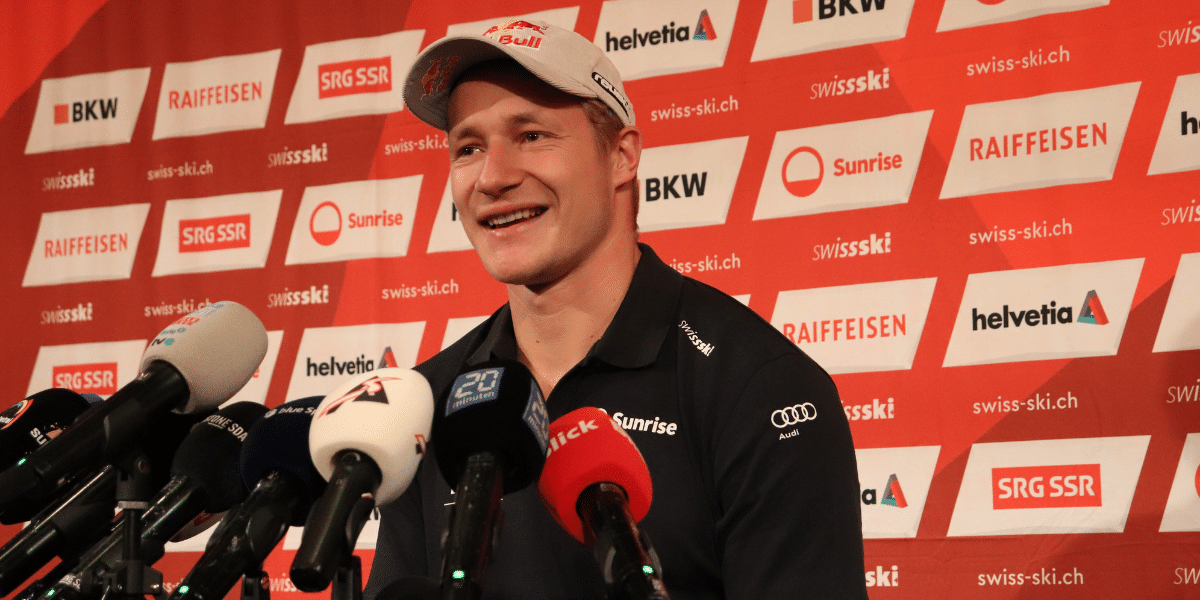
Marco Odermatt SwissSki Media day Photo Peter Gerber Plech
From Vienna Spotlight to Sölden Start Gate
Over the past few days, Austria played a central role in Stöckli athlete Marco Odermatt’s life. On Monday, Oct. 13, the 28-year-old Swiss star traveled to Vienna for a special mission. After a weekend of sightseeing in the Austrian capital, he joined fellow World Cup racers Cyprien Sarrazin, Dominik Paris, Vincent Kriechmayr, and Aleksander Aamodt Kilde on Kärntner Strasse near St. Stephen’s Cathedral to present the new film Downhill Skiers — Ain’t No Mountain Steep Enough.
The movie premiered that evening at Vienna’s historic Gartenbaukino Cinema after earlier festival showings in Zurich. Less than two weeks before the World Cup opener in Sölden, Odermatt traded his race suit for formal wear—just another reminder of how widely he now connects with audiences beyond the slopes.
A Growing Following in Austria
For years, Odermatt has built a massive fan base in Austria. His appeal extends well past his results. Social media posts and widespread coverage in Austrian newspapers highlight the respect he shows both fans and rivals.
“That maybe has something to do with my personality and the respect I have for other athletes,” he said. “But respect runs deep in our sport. Everyone knows the opponent takes the same risks you do.”
His humility and sportsmanship have only strengthened his standing as the sport’s dominant male racer
Entering the Olympic Season as the Target
As the four-time overall World Cup champion, Odermatt begins the 2025-26 Olympic winter as the man everyone is chasing. That role is familiar, but he recognizes subtle changes compared with earlier years.
“As an all-rounder, I’ve probably reached my peak,” he said recently in Zurich. “Last winter, I became stronger in downhill—especially in long gliding turns like you see in Gröden, Kvitfjell, or Crans-Montana. Because that feeling improved, I lost a bit in giant slalom. If you want to get better in one area, you sometimes have to give something up in another. That’s the narrow path of an all-rounder.”
Looking ahead, he expects his focus to shift gradually toward the speed disciplines, where he still sees untapped potential. “There’s more room for growth in downhill and super-G,” he said.
Returning to Sölden with Confidence
Despite not finishing last year’s Sölden race, Odermatt carries no sense of unfinished business.
“I’ve already won there twice,” he said. “Even last year, I was in good form and started well—something just didn’t work that day. I still go to Sölden with a good feeling.”
He knows the next step is rediscovering race mode. Early-season snow camps in August sharpened his technique, while high-volume sessions in South America added intensity. The final days before Sölden, he said, are about switching fully into competition rhythm—mentally preparing to push from the start gate and finalizing the right equipment setup.
“You really get into race mode when you arrive at the venue,” he said. “Then, once you’re up on the glacier, the routines and rituals on race day create the focus you need.”
Goals Beyond Medals and Globes
With a trophy case already packed with World Championship medals and double-digit crystal globes, setting new goals is not simple. Still, he offered a clear answer to the traditional journalist’s question.
“Winning the downhill in Kitzbühel is still one of the big dreams,” he said. “But I’ve already won there in super-G, I have the golden chamois trophy at home, and a gondola with my name on it goes around in Kitzbühel—so half a check mark is done. This year, the Olympic Games are the big highlight.”
A fifth consecutive overall title also remains a target, though Odermatt stays realistic. “The field has become tighter,” he said. “If you don’t get the points, your biggest challenger usually does.”
Respecting Limits and Longevity
Finally, he reassured Austrian fans that chasing Marcel Hirscher’s record of eight overall titles is not on his agenda.
“To win the overall five more times in a row is very, very far away,” he said. “I’d rather ski two or three extra seasons with a lighter schedule than drain every bit of energy just to fight for one more overall title.”
Marco Odermatt remains the defining athlete of modern alpine skiing—respected not only for his dominance but also for his balance, self-awareness, and deep appreciation for the sport’s demands. As the Olympic winter approaches, he once again stands ready at the edge of possibility.
About the Author: Peter Gerber Plech