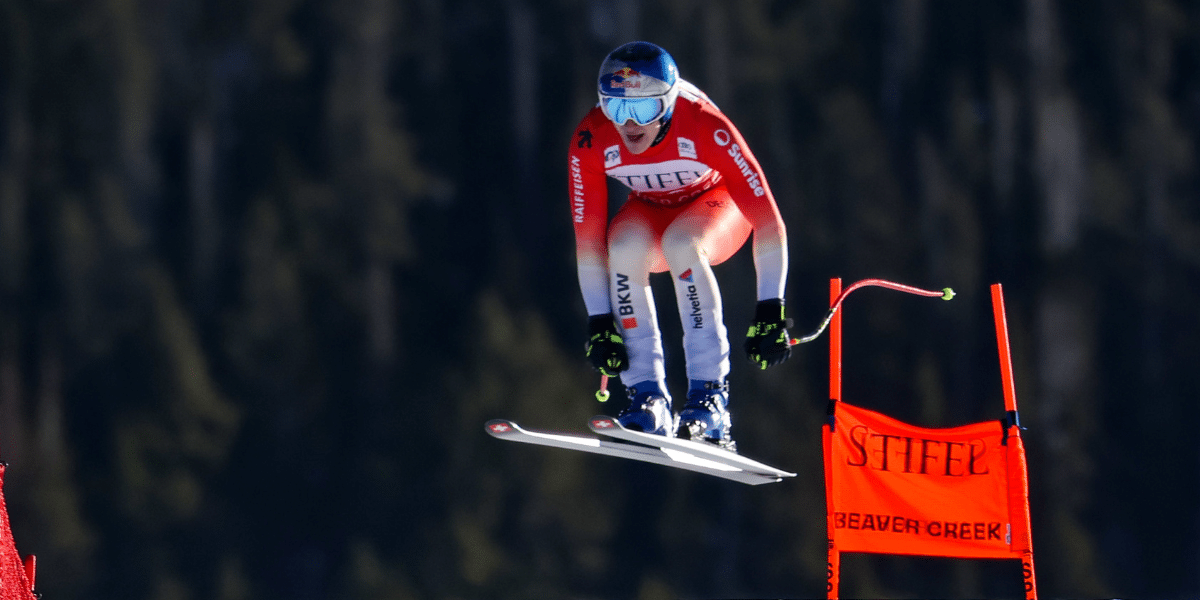
Marco Odermatt: GEPA pictures
When most people think about speed in alpine skiing, they picture downhillers charging the Streif in Kitzbühel or the Lauberhorn in Wengen. But skiing fast applies to every discipline — slalom, giant slalom, super-G, and downhill — because the modern sport demands that racers handle more velocity with control. And here is the part that often gets overlooked:
The ability to ski at your personal top speed is not innate. It is a skill that must be learned, trained, and mastered.
Some racers appear naturally comfortable going fast, but very few are. Even the most successful skiers in the world had to train themselves to accept, trust, and ultimately commit to more speed.
Skiing Fast Isn’t Automatic, Even for the Best
You can have exceptional technique, sound tactics, and strong fitness, yet still ski below your speed potential. That is because skiing fast has its own learning curve. Technical skill alone rarely produces fast skiing. You can carve perfect turns and still lose a race to someone who is willing and able to push harder and carry more velocity.
Mikaela Shiffrin is the most technically precise skier of her generation, yet her rise as a multi-discipline champion came when she developed the capacity to manage higher speeds in GS and, later, in speed events. She has spoken often about needing time and repetition to feel confident at those increased velocities.
Alexis Pinturault entered the World Cup known for his impeccable technique. What turned him into an all-event threat was his commitment to skiing closer to his absolute fast-skiing limit, even when that meant accepting more mistakes and more risk as part of the developmental process.
Marco Odermatt is another example. His dominance does not come only from talent and superior technique. He pushes closer to his personal speed ceiling than anyone else. Many racers take a similar line, but he carries more speed because he trained the ability to stay balanced, calm, and powerful at extreme velocity.
Why Skiing Fast Must Be Learned
Skiing at your top speed rarely feels good at first. When you push into faster skiing, you experience:
• A feeling of instability or imbalance
• Timing that feels rushed
• Movements that lag behind the forces
• A sense that your brain cannot process information quickly enough
This is normal. Increasing speed forces your balance, your timing, your reactions, and your emotional control to level up. Just as you once learned to carve a clean turn, you must learn to stay composed, accurate, and confident at higher velocities. It is a physical and psychological adaptation, not a personality trait.
1. Understand What It Takes to Ski Fast
Skiing fast is not simply a matter of “trying harder” or “taking more risk.” True fast skiing is the alignment of technique, tactics, timing, strength, and decision-making — all executed under greater pressure and higher forces. Sustained fast skiing on a race course requires:
• Technical ability to stay balanced and manage pressure at high forces
• Tactical / timing decisions that generate and preserve speed rather than shut it down
• Physical strength and conditioning to maintain form late in the run
• Mental readiness to commit fully when the course gets fast
• Equipment that inspires trust and stability
Athletes such as Odermatt, Shiffrin, Kilde, and Federica Brignone do not just let their skis run. They have trained stability, timing, and balance at speeds that stretch their limits.
2. Practice Skiing Fast and at Your Limit
You cannot learn to ski fast by skiing comfortably. To improve your fast-skiing capacity, you must regularly ski at a pace where you feel stretched and challenged. Training needs intentional segments of higher speed that force your skills to adapt under realistic race pressure. Examples include:
• Timed sections or full-length runs at full intensity
• Drills that encourage “letting them run” in specific sections
• Environments that elevate pace, such as head-to-head training or chasing a faster teammate
3. Identify and Raise Your Skiing-Fast Threshold
Every racer has a threshold: the fastest pace at which they can still execute their skills effectively.
To raise that threshold, you occasionally need to go beyond it.
This means you will sometimes get late, lose the line, or even ski out. That is not failure; it is part of the adaptation process. Aleksander Aamodt Kilde is a clear example. Watch his training, and you will see him intentionally flirting with the edge of control. That willingness to explore the edge is one reason he continues to progress.
The key is not recklessness. It is structured, informed exposure to slightly more speed than you are comfortable with, so your body and brain can recalibrate what “fast” feels like.

What Holds Racers Back from Skiing Fast
Even highly skilled racers struggle to achieve true race-winning velocity because of mental barriers, not technical ones.
Fear of mistakes or crashing.
Concern about negative outcomes creates tension, defensive movements, and conservative choices.
Lack of trust.
If you do not trust the snow surface, your preparation, your setup, or yourself, you will unconsciously brake.
Outcome-focused thinking.
When the brain fixates on results — finishing, qualifying, selection — it defaults to safety instead of skiing fast.
Overthinking technique.
Skiing fast requires instinct. The race course is not the place to think about mechanics. Technical thoughts belong in training; racing requires flow and commitment.
Developing the Mental Skill of Skiing Fast
Trust is central. You must trust your training, your body, your instincts, and your equipment.
Use imagery before training and races to mentally rehearse skiing fast. Imagery should include not just the line and terrain, but also the sensory reality: acceleration, vibration, noise, pressure, and the commitment to attack.
Develop a race-day mindset that supports skiing fast rather than skiing carefully. Breathing, activation, and self-talk shape your readiness. Sofia Goggia is the model of full commitment the moment the wand drops.
Accept that skiing fast will feel uncomfortable at first. The goal is not to eliminate that feeling but to expand your comfort zone until high speed feels normal.
In Closing
The best racers are not simply the most technically gifted or the strongest. They are the ones who commit to skiing at the fastest pace they can control. They develop the skill of skiing fast over time, through intention, repetition, trust, and courage.
Every athlete, in every discipline, must learn and continually refine the skill of skiing fast.
The question for every racer is this:
Are you skiing as fast as you can, or as fast as you are comfortable skiing?
The difference between the two is where races are won.
About the Author: Dr. Jim Taylor