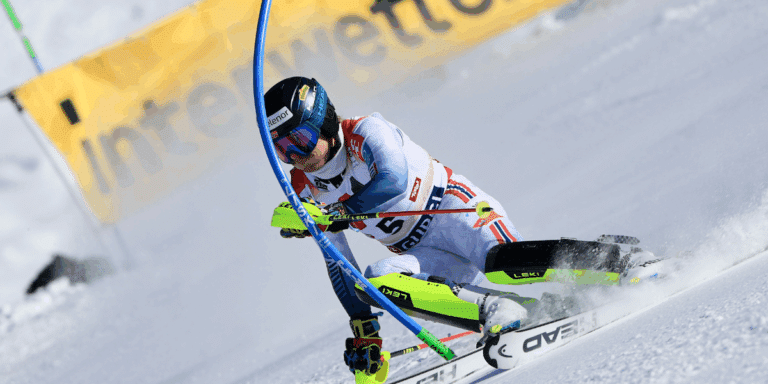
Atle Lie McGrath, Gurgl: GEPA pictures
GURGL, Austria — Sunshine broke through the morning clouds above Gurgl, revealing a race surface that held firm despite three days of snowfall and more than 40 centimeters of new snow removed Friday. The watered slope stayed solid from start to finish, producing one of the tightest, most dramatic first runs in early-season World Cup slalom history.
McGrath Sets the Standard
Norway’s Atle Lie McGrath delivered the most complete run of the morning, attacking with clean arcs, great timing, and powerful movements to stop the clock in 52.12. He never owned a sector, but he stayed close in every split, producing a balanced, confident run that gave the field a high bar to chase.
Nef and Hallberg Share Second
Tanguy Nef brought Switzerland back into slalom relevance with a sharp, dynamic run that put him 0.17 behind McGrath. Later, Finland’s Eduard Hallberg — last week’s surprise Levi podium finisher — matched Nef to the hundredth, proving his early-season form is real. Hallberg attacked the pitch with fast reactions and clean rhythm, confirming that his Levi success was far more than home-snow magic.
With Nef and Hallberg tied for second, the podium fight tightened instantly.
Austrian Charge Ignites the Crowd
Austria packed the front of the race with aggressive, energized skiing.
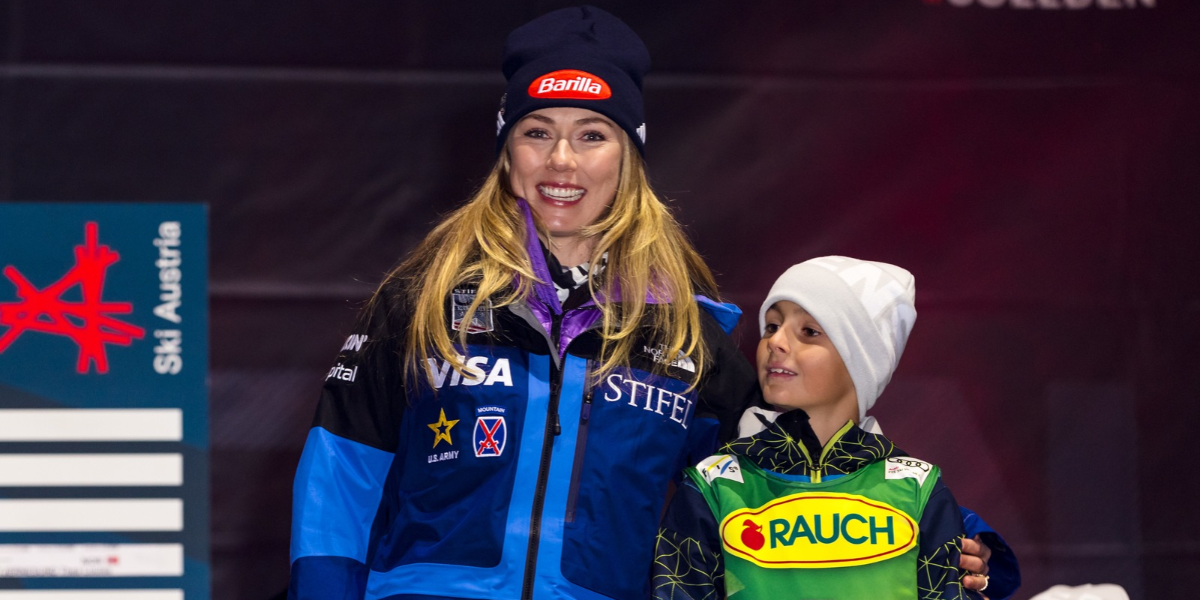
Manuel Feller powered into 6th (+0.43) with his strongest run of the season. Fabio Gstrein held 7th (+0.64) after attacking the steep middle section. Marco Schwarz added another Austrian in the top group, finishing 12th (+0.81).
But the biggest home-nation eruption came late in the run.
High Bibs Light Up the Race
As the start list climbed into the 30s, clouds rolled back over the slope and visibility softened. Yet the course continued to reward good skiing.
Belgium’s Sam Maes (bib 38) skied with impressive tempo and pushed into 17th (+0.88). Then, with bib 42, Austria’s Simon Rueland thrilled the home crowd by charging into 11th (+0.73) — the fastest of all high-bib athletes.
Even deeper in the field, Japan’s Yohei Koyama (bib 49) attacked the course with clean timing and battled into 26th (+1.26), becoming the highest bib to qualify for the second run.
Seven athletes with bibs above 30 qualified — an extraordinary number in World Cup slalom and a defining storyline of the morning.
Strasser, Marchant, and Vinatzer Join the Fight
Linus Strasser, in his first season on HEAD skis, delivered a wild, attacking run that put him 5th (+0.41).
Belgium’s Armand Marchant (bib 23) continued his strong comeback with an aggressive run into 9th (+0.65).
Italy’s Alex Vinatzer found confidence again and skied into 10th (+0.66), his best result of the season so far.
The front of the field remained packed and dangerous.
A Rarely Tight Leaderboard
By the end of the first run, the race had become historic:
- 19 racers inside one second
- The entire top 30 inside 1.47 seconds
- Only two DNFs among the first 30
- A second-run starting field stacked closer than most modern World Cup slaloms
The course held, the set flowed, and the entire field responded with fearless, attacking skiing.
North Americans Struggle
It was a difficult morning for the Stifel U.S. Ski Team.
Benjamin Ritchie lost all his speed after a major mistake in the third sector and finished well off the pace at +3.61.
Jett Seymour (bib 41) struggled for rhythm in every sector and landed outside the top 30.
Luke Winters fought for speed but eventually skied out in the final sector.
For the first time this slalom season, no U.S. skier qualified for the second run, a tough moment in the opening stages of the Olympic year. Cooper Puckett’s breakthrough in Levi remains the lone men’s slalom highlight so far.
Canada’s only hope, veteran Erik Read, straddled in Sector 2 and did not finish.
British Team Places Two in the Second Run
Britain again delivered a respectable performance.
Dave Ryding skied smoothly to finish 23rd (+1.23), while Billy Major — charging late with bib 32 — advanced in 28th (+1.33). Laurie Taylor, last week’s fourth-place finisher in Levi, slid outside the qualification zone after finishing +1.57.
High-Bib Qualifiers
- Simon Rueland (AUT) — bib 42, 11th (+0.73) fastest high-bib finisher
- Sam Maes (BEL) — bib 38, 17th (+0.88)
- Fabian Ax Swartz (SWE) — bib 46, 24th (+1.24)
- Erik Hystad Solberg (NOR) — bib 39, 25th (+1.25)
- Yohei Koyama (JPN) — bib 49, 26th (+1.26) highest bib to qualify
- Dominik Raschner (AUT) — bib 22, 27th (+1.26) (note: bib >30 list excludes him — he remains here for completeness)
- Billy Major (GBR) — bib 32, 28th (+1.33)
- Oscar Andreas Sandvik (NOR) — bib 40, 29th (+1.36)
Seven bibs above 30 qualified — a rare and important result that mirrors the trend first seen in Levi.
A Second Run Built for Chaos
With McGrath leading, Nef and Hallberg tied for second, and an unprecedented cluster of skiers within tenths — including multiple late-bib threats — the afternoon promises a volatile, leader-changing fight for the podium.
This race is far from decided. In Gurgl, nearly everyone is still in it.

Run Analysis: Leaders, Qualified North Americans and British Skiers


First Run Top 30 results

About the Author: Peter Lange