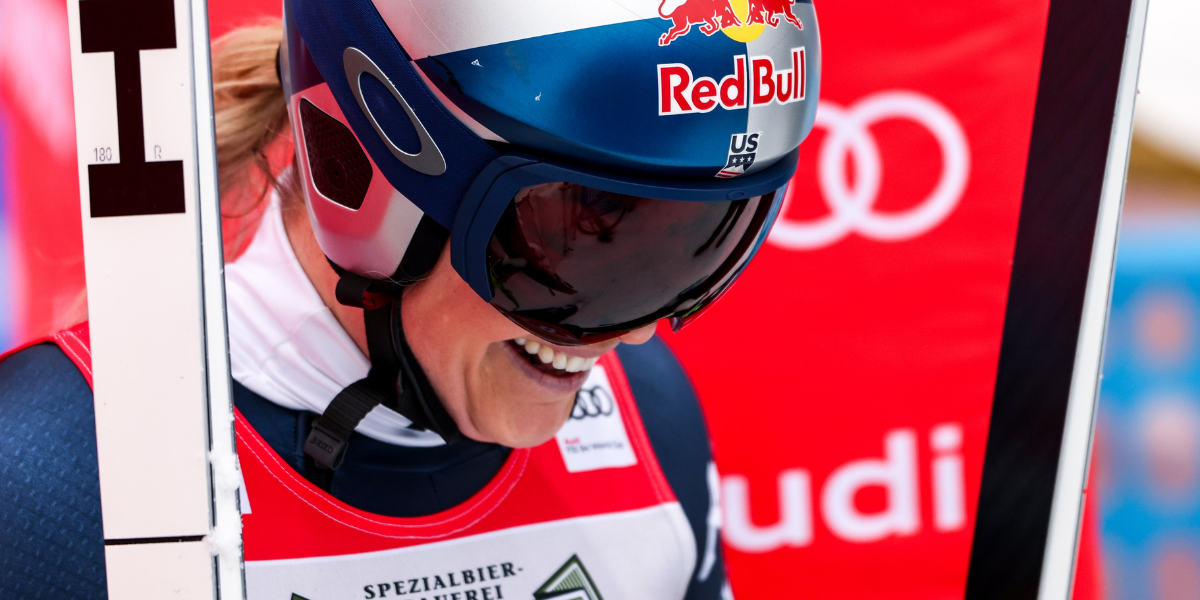
CORTINA D’AMPEZZO, Italy — Lindsey Vonn never came to Cortina looking for comfort. She came because the Olympia delle Tofane demands commitment, rewards execution and exposes hesitation. That exchange has always suited her.
Even after rupturing her ACL and sustaining bone bruising and meniscal damage in a January 30th crash, Vonn arrived in Cortina intent on racing if her body allows it. She did not minimize the injury. She did not dramatize it either. She assessed it.
“This isn’t my first rodeo,” Vonn said. “It’s hard for me to lose faith in myself and what I know I’m capable of.”
She draws that confidence from experience, not denial. Vonn has raced through severe injuries before, including competing at the 2019 World Championships without an LCL and with multiple fractures. Years of recovery cycles taught her how to distinguish pain from instability and risk from recklessness.
Each day in Cortina, she evaluates swelling, strength and joint stability with her medical team. A brace adds support, but judgment determines the final decision. Vonn has made it clear she will not step into the start gate unless she believes she can ski competitively and safely.
“I don’t want to go home regretting not trying,” she said. “I will do everything in my power to be in that starting gate.”
A course built for her instincts
Few courses in alpine skiing align as naturally with Vonn’s approach as Cortina. The Olympia delle Tofane rewards speed, trust and aggression at full commitment — the same qualities that defined her career.
Vonn has won 12 World Cup races in Cortina, split evenly between six downhill victories and six Super-G wins. That record reflects more than longevity. It reflects fit.
“I like risk. I like going fast. I like pushing myself to the limit,” Vonn said. “I love being on the mountain.”
Cortina amplifies that mindset rather than resisting it. The hill asks racers to build speed early, stay disciplined through technical sections and remain decisive over terrain that punishes second guesses.
Beyond the layout, Vonn trusts the venue itself. Course preparation and snow consistency have long defined racing in the Dolomites.
“I would love to have the normal Cortina compact, amazing snow that is always here,” she said.
Even within an Olympics spread across multiple Italian locations, Cortina stands on its own. The setting does not distract her. It sharpens her focus.
“I’m in Cortina, so there’s really nothing to complain about,” Vonn said. “I’m very happy being here. It’s one of the most beautiful places in the world.”
Standing in the start gate still carries meaning. The view reminds her why she continues to take on challenges few athletes would accept at this stage of a career.
“Every time I stand in the starting gate, I realize that I am lucky to be able to do something I love so much,” she said. “And I don’t take that for granted.”

A veteran presence on a deep team
Vonn has leaned heavily on coaches, trainers and teammates throughout her comeback. This U.S. women’s speed team, she believes, has reinforced her sense of belonging.
“This is definitely one of the strongest teams I’ve ever been a part of,” Vonn said. “When one of us does well, it elevates the whole team.”
Rather than assume a traditional leadership role, she chooses something quieter and more deliberate. Vonn shares information, opens video sessions and offers perspective built over decades on the World Cup.
“I don’t feel like I’m in a leadership role,” she said. “I feel like I’m in a mentorship role.”
Downhill racing rewards accumulated knowledge as much as raw ability. Understanding terrain, timing, snow and risk separates fast from fearless. Vonn sees that understanding as her most valuable contribution.
“I feel like I have a lot of that to pass down,” she said. “It gives me pride to be able to do that.”
Cortina continues to demand everything from those who race it. For Vonn, that demand still feels worth answering. Experience, confidence and belief guide the decision now — just as they always have.
If she steps into the gate again, she will do so for the same reason she always has: because the hill asks the question, and she still wants to give the answer.
About the Author: Peter Lange