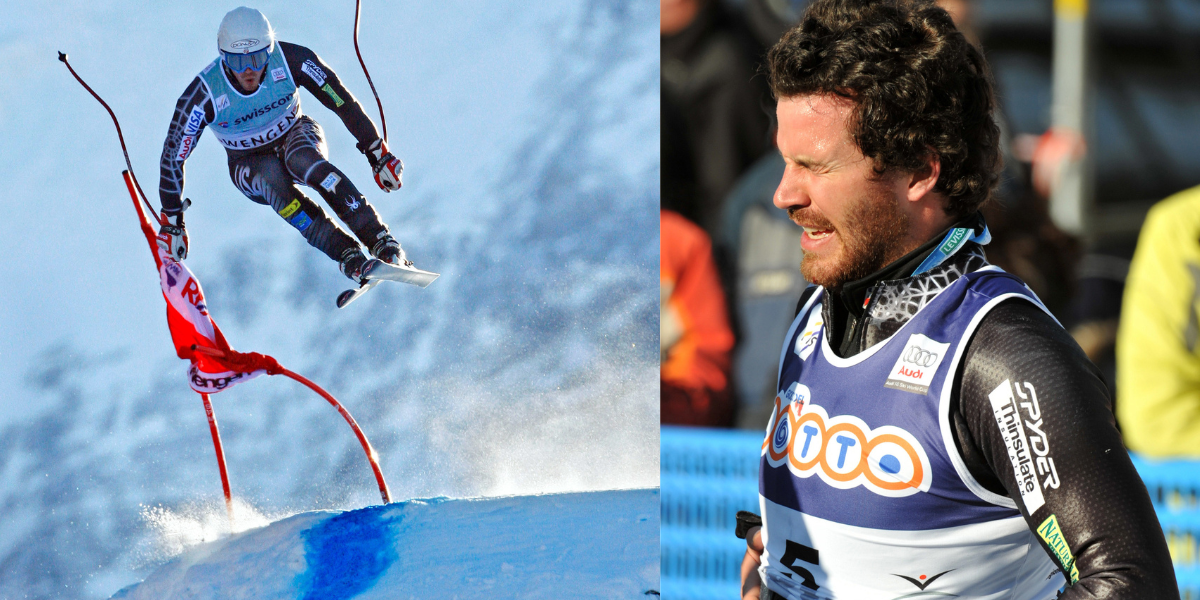
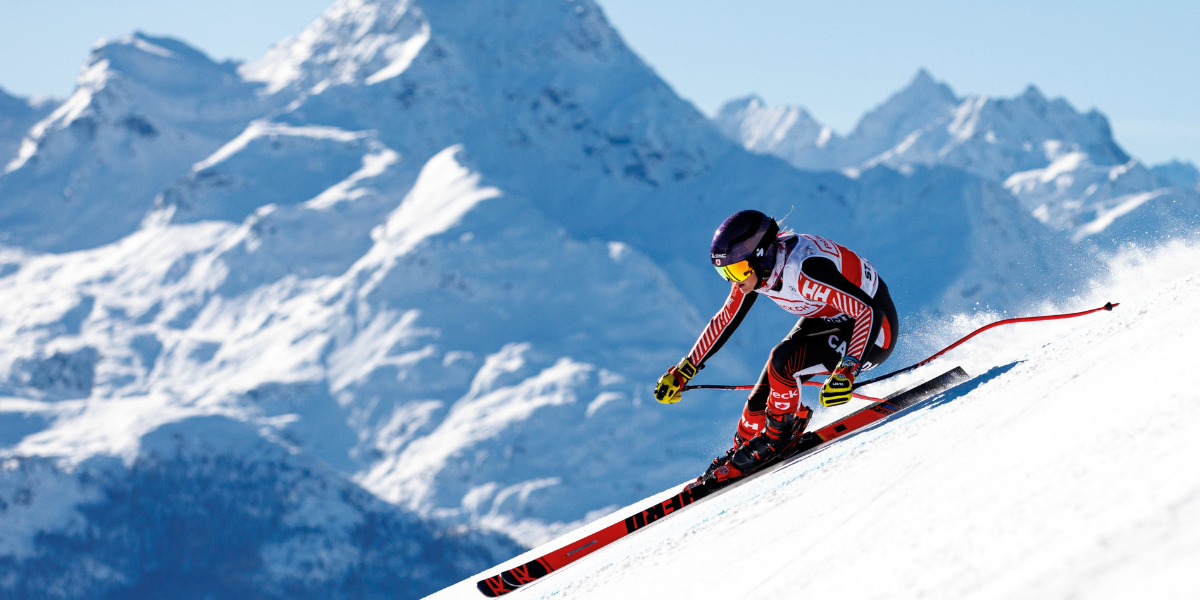
Featured Image: Stef Fleckenstein competing in the Downhill at St. Moritz two years ago. (GEPA Pictures)
There are moments in ski racing that divide everything into before and after.
For Canadian speed skier Stef Fleckenstein, the story now begins in a place few could have imagined two years ago: NorAm downhill overall champion, with a guaranteed start spot in every World Cup downhill for the 2026/2027 season. It is the kind of result that signals arrival, momentum, and opportunity.
But that result only tells you where she is now, not what it took to get there.
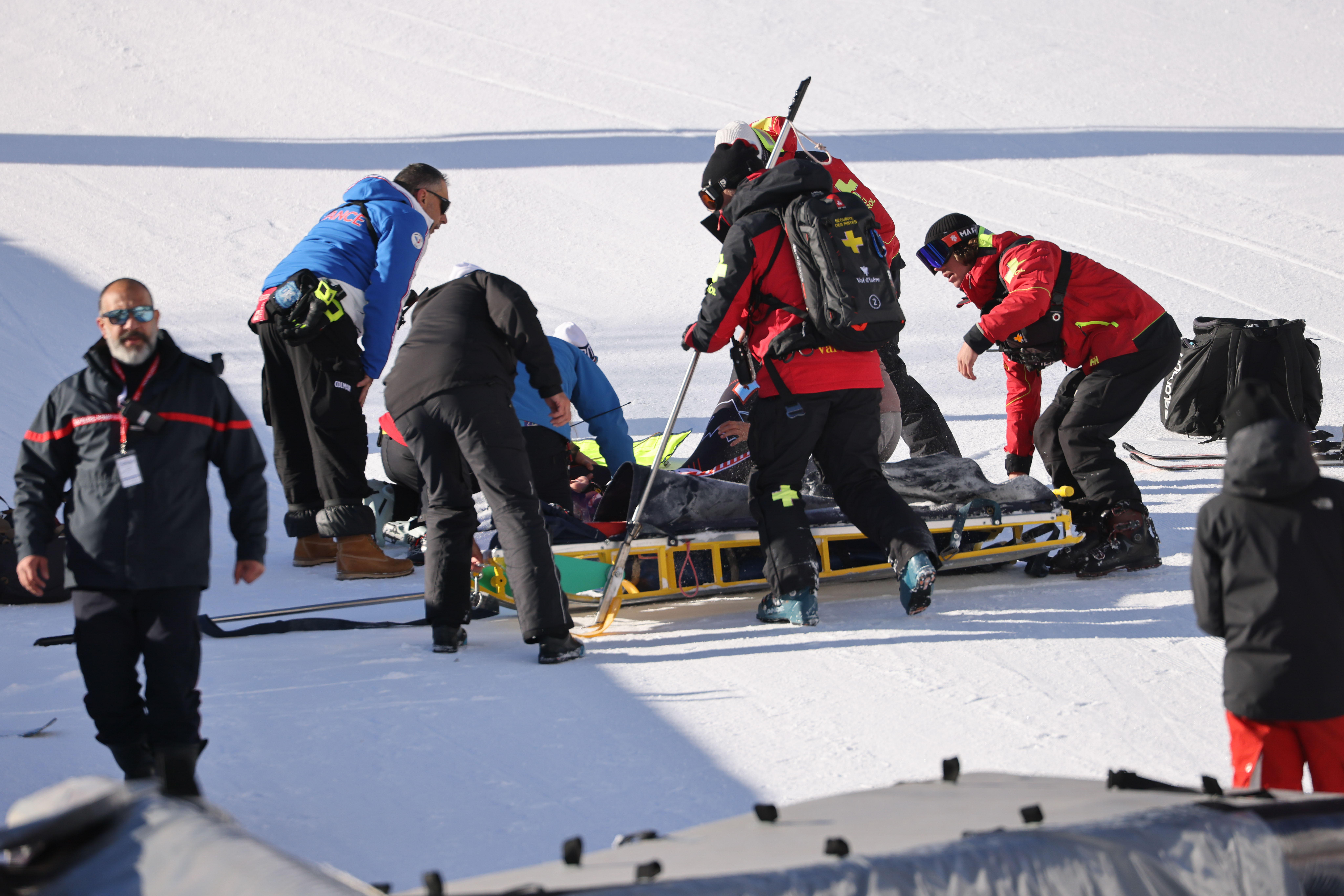
Because before the title, before the return, there was Val d’Isère. A crash that nearly cost her leg, followed by seven surgeries and a two-year fight defined by uncertainty, setbacks, and small, hard-earned progress. It was a journey that reshaped not just her career, but her understanding of risk, resilience, and what it means to keep moving forward when the outcome is anything but guaranteed.
“I Thought My Leg Was Gone”
In the moments after the crash, everything felt strangely clear.
“I honestly felt like my leg was just gone. I couldn’t feel anything,” Fleckenstein says. “I looked at it and could see the top of my tibia and the end of my femur. It was just scary.” It was a scene most athletes would struggle to process, let alone make sense of in real time.
And yet, even in that moment, her mind went somewhere unexpected. Instead of panic, there was a kind of immediate clarity, a rapid assessment of what had and had not been lost. “I was just so happy I could feel everything else. I didn’t hit my head. I was fully conscious,” she says. “I remember thinking, okay, it is just my leg.”
That thought, simple and almost matter of fact, became the foundation for everything that followed. In the middle of chaos, it gave her something to hold on to, a way to frame what had happened not as an end, but as something she could survive and, eventually, fight her way back from.
A Race Against Time
What came next unfolded quickly, and with far more urgency than anything she had faced before.
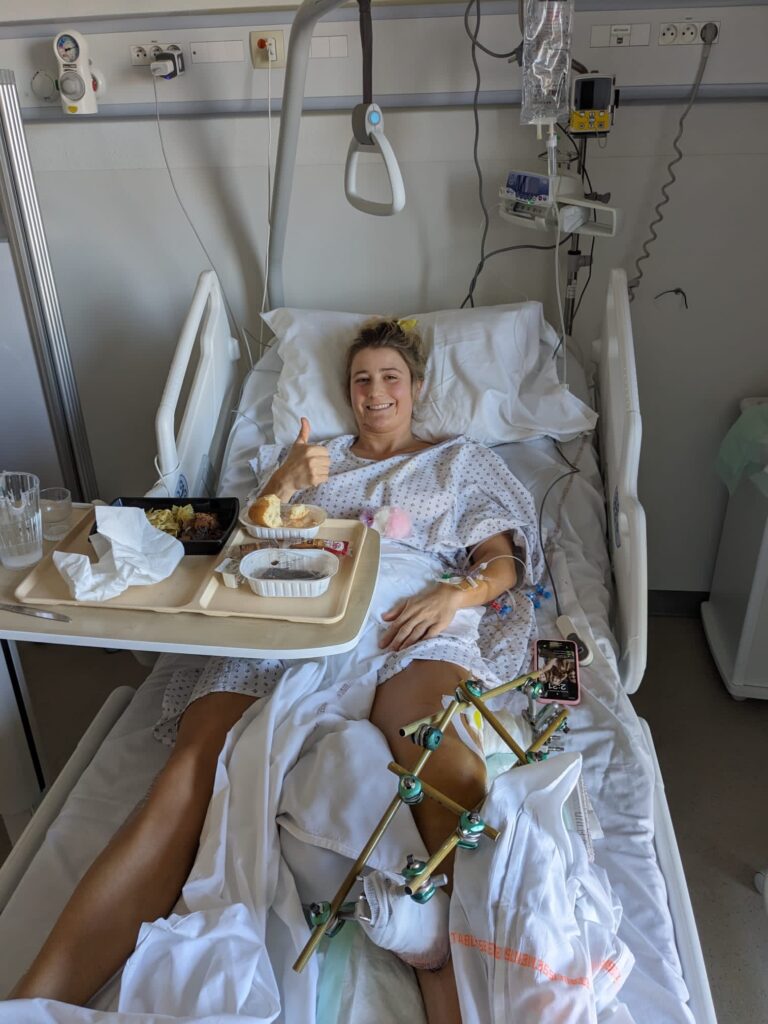
After developing compartment syndrome, Fleckenstein was rushed into emergency surgery. Her leg was left open, and in an instant, the situation shifted. This was no longer just about recovery or returning to sport. It became a fight to save her leg. “They told me I basically had five days to come up with a plan or I was going to lose my leg.”
With little time and no margin for error, her family stepped in, working alongside the Austrian federation to get her to a specialist in Austria. She was flown to Austria and taken straight into what would become a 17-hour surgery, an attempt to repair as much damage as possible. “It was honestly a miracle,” she says. “They fixed everything except my ACL. At that point it was just about saving my leg.”
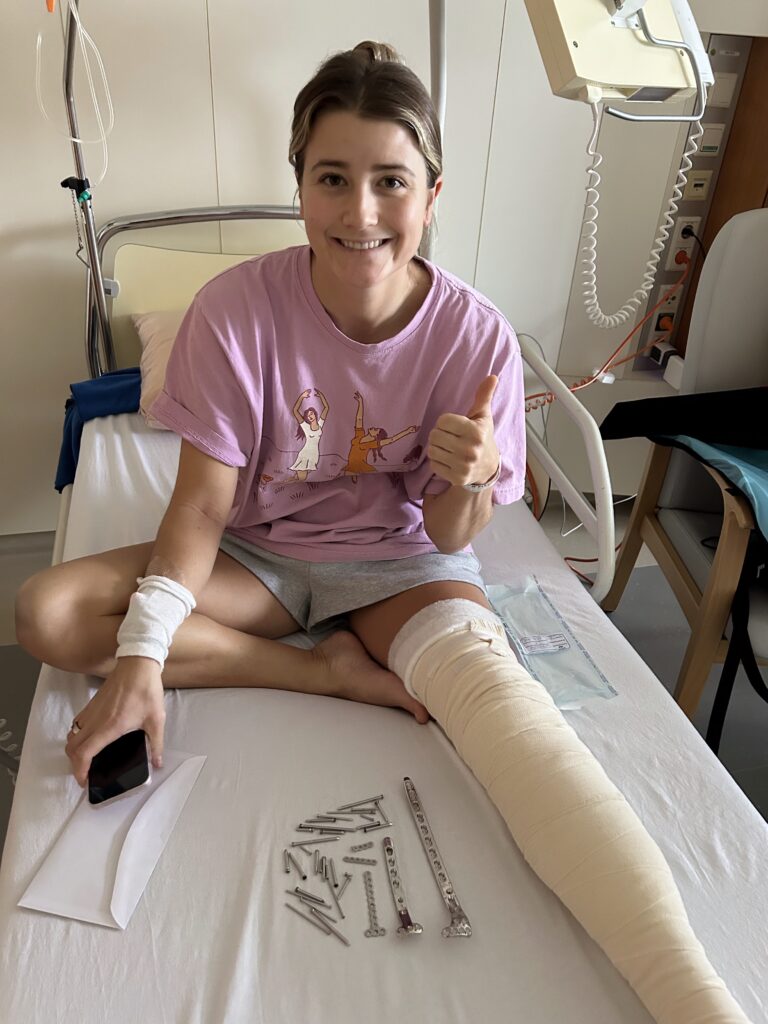
The surgery was only the beginning. She spent nearly six weeks in the hospital, her world reduced to recovery, uncertainty, and waiting. Rehab followed, along with more procedures. In total, seven surgeries. There was no single turning point, no moment where everything suddenly improved, just a long, grinding stretch where progress came slowly and the outcome was never guaranteed. Every step forward had to be earned, one decision, one day at a time.
Rebuilding from the Ground Up
Recovery did not come in dramatic breakthroughs. It came in moments so small they might have seemed insignificant from the outside, but carried enormous weight for her. Progress was measured not in milestones most would recognize, but in simple movements regained after being lost. “The first day I took three steps on crutches was crazy to me,” she says. “The first time I could lift my leg on my own. Even being able to stand up.” Each step forward, no matter how small, marked a shift from survival toward independence.
That independence, something most people rarely think about, became everything. Tasks that once felt automatic suddenly required effort, patience, and focus. “Being able to take a shower on my own or walk with one crutch, those were huge milestones,” she says. “When you lose that, you realize how much you take it for granted.” Those everyday moments reshaped her understanding of her body and what it meant to function normally.
At the same time, the mental side of recovery never really switched off. Even as her body healed, the awareness stayed with her, sharp and constant. “You have to be locked in all the time,” she says. “I still don’t walk down stairs without thinking about every step.” That vigilance has not disappeared, but instead has become part of how she moves through the world, a lasting reminder of what she has been through and how far she has come.

Learning What Gratitude Actually Means
Fleckenstein talks about gratitude often, but she is also honest about how it has evolved over time. In the early stages of her recovery, it was something she felt she should say more than something she fully understood. “At the beginning, my gratitude was very surface,” she says. “I would say I am grateful for my family or my life, but it was repetitive.” It was a mindset shaped more by circumstance than by true perspective.
That began to shift slowly, not through one defining moment, but through the daily reality of recovery. As progress came in small, hard-earned steps, she found herself noticing things she had never given a second thought to before. “I started to realize that everything your body gives you is something to be grateful for. Some days it was as small as being able to sit without pain or make it up the stairs.” Those incremental victories reframed how she saw both her body and her progress.
Over time, that deeper awareness became one of the most meaningful parts of her comeback. It grounded her through the uncertainty and reminded her how close everything had come to being very different. “A lot of what happened could have gone very differently,” she says. “There were a lot of moments that were honestly miracles.”
Finding Her Way Back
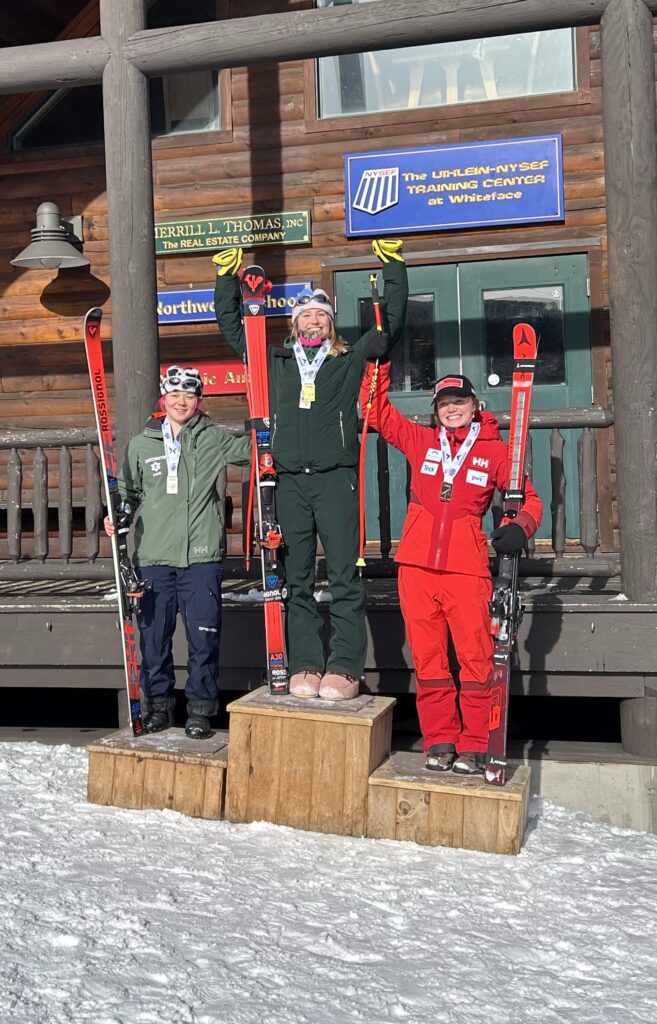
Nearly two years after her crash, Fleckenstein returned to racing at a NorAm downhill in Whiteface, NY, a moment that carried both excitement and uncertainty. The nerves were immediate and impossible to ignore. “I was so nervous I felt like I was going to throw up at the start,” she says. It was her first real test back in a race environment, where the stakes, the speed, and the pressure all return at once.
But the feeling shifted the moment she left the gate. As the run unfolded, instinct began to take over, and by the time she crossed the finish line, the doubt had given way to something else entirely. “When I got to the bottom of that first training run, it was probably the most euphoric moment. I was like, I can do this.” It was not just relief, it was belief, the realization that she could still compete at the level she had fought so hard to return to.
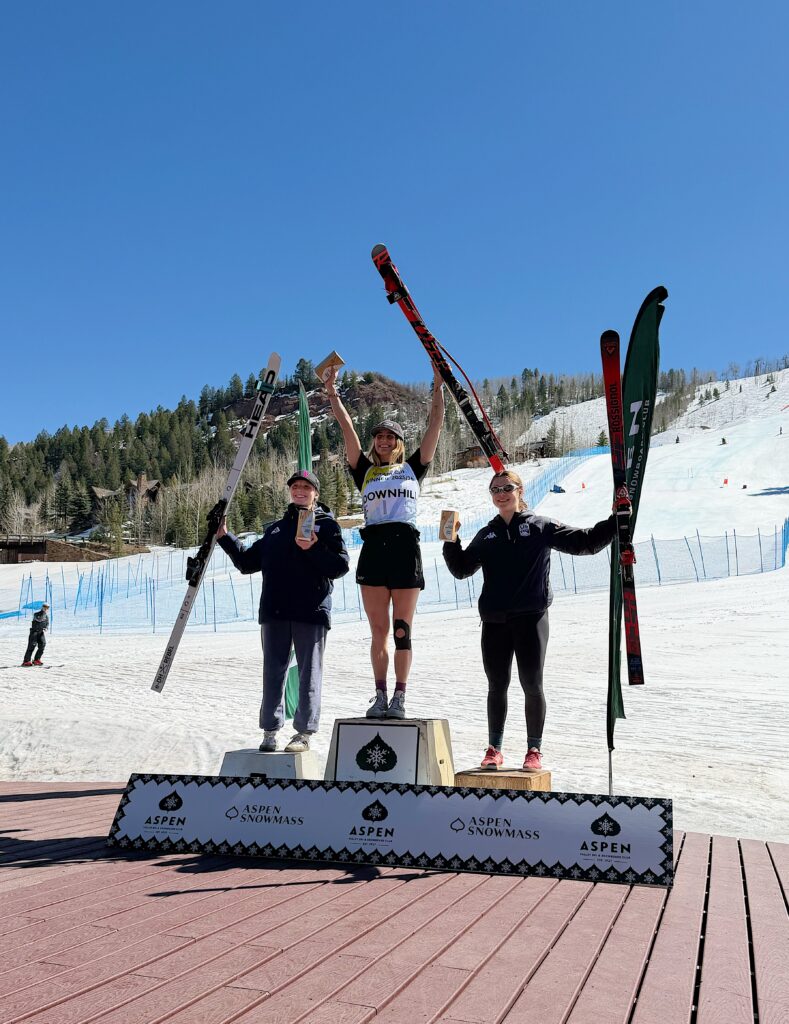
What followed came quickly, perhaps even faster than expected. Within weeks, she was not just back in the field, she was winning, building momentum with each start and proving that her comeback was more than symbolic. Taking the NorAm downhill overall was not just a result, but a powerful confirmation of what was possible. “It was very validating,” she says. “But more than that, it just means I have a path again.”
A Different Kind of Athlete
The version of Fleckenstein returning to the World Cup is not the same one who left it. Before her injury, speed skiing was driven by instinct and commitment, where risk felt simple and often unquestioned. “I think I used to just go full gas with no thought,” she says. It was a mindset common in downhill, where pushing limits is part of the job, but one that she now sees with more clarity.
Coming back from a life-altering injury has reshaped that perspective. Risk is no longer something to ignore, but something to understand and manage with intention. “I have a different understanding of risk. I don’t think you have to go beyond your ability to be fast. It can be technical and tactical.” That shift reflects not just experience, but a more sustainable approach to the sport, one that balances speed with precision and awareness.
Her relationship with skiing itself has evolved just as much. What was once purely about performance and progression now carries a deeper appreciation for everything around it. “I always loved skiing, but now I understand how special this life is,” she says. “The community, the people, the support. I feel very lucky to be part of it.” In many ways, the time away gave her a perspective that is hard to gain otherwise, one that she now carries with her as she steps back into the intensity of the World Cup.
Forging a Path Forward
Looking ahead, Fleckenstein is stepping back into a system where the pathway for women in speed is still evolving, particularly in Canada where a dedicated World Cup speed team does not currently exist. Athletes like Valérie Grenier and Cassidy Gray have taken on speed events, but alongside technical disciplines, often without the singular focus that downhill and super-G typically demand at the highest level.
Rather than viewing that as a limitation, Fleckenstein sees an opportunity to be part of that evolution.
“We have proven that you can do it on your own. It is hard, but it is possible.”
Her return to the World Cup also comes with a hope that the next step is not taken alone. As she prepares for a full downhill season, there is a sense that greater alignment and support from Alpine Canada could help not just her trajectory, but the future of Canadian women in speed as a whole.
For her, the focus extends beyond her own career.
“There are young Canadian athletes who want to race speed. They are putting in the work and taking those risks,” she says. “They need to be able to see that there is a future for them in it.”
Visibility matters. Representation matters. And sometimes, progress comes from athletes willing to show what is possible before the structure fully exists. But lasting progress, she knows, comes when that momentum is met with support.
“If I can help make that path clearer, even just a little bit, then that is something I am really proud of.”
A Second Chance
In the end, what defines Fleckenstein’s story is not just the injury, or even the comeback, but the way she now sees the opportunity in front of her. “I just feel so lucky to be getting a second chance,” she says. “A lot of people with injuries like mine do not get that.” That perspective has not taken away her ambition. If anything, it has sharpened it. “I still have big goals. I am not doing this just to participate. I want to compete,” she says. “But at the same time, everything now feels like a bonus.”
Two years ago, she was fighting to keep her leg. Now, she is preparing for a full 2026–27 World Cup downhill season, every start earned, carrying with her a deeper resilience, a sharper perspective, and a hard-earned gratitude built step by step along the way.
About the Author: Katie Twible