GEPA pictures
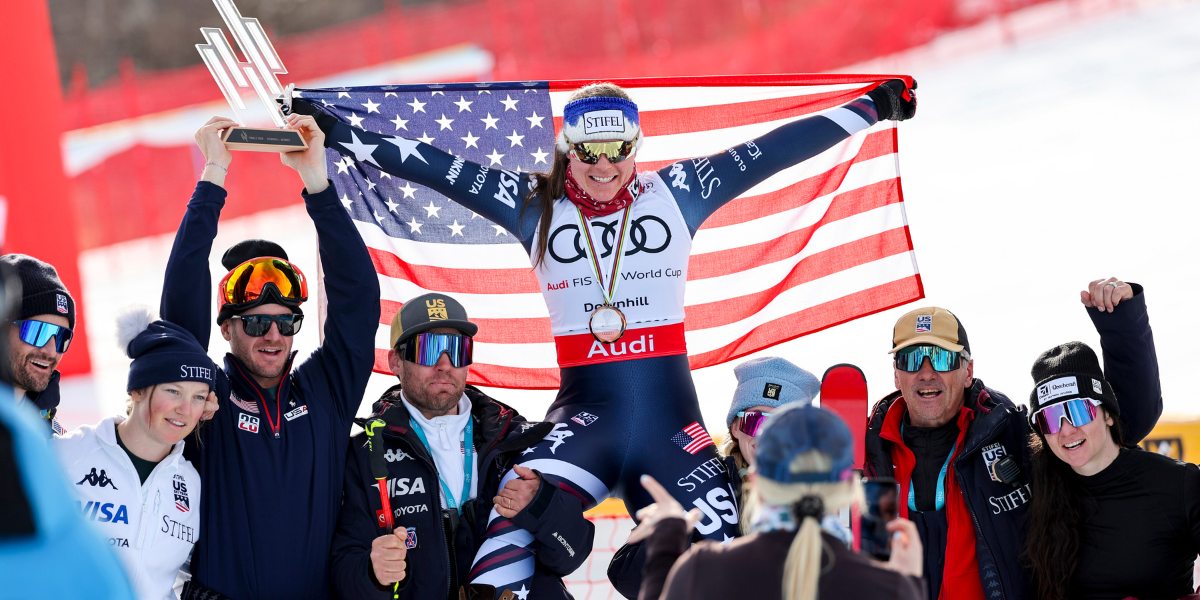
The Olympic and World Downhill champion says summer testing has not revealed a difference yet. But she says racers cannot know how the new setups will perform until they reach World Cup courses and surfaces.
Breezy Johnson has tested several ski models under the new FIS weight limits. So far, on smooth, soft snow, she has not felt a difference.
But summer training cannot settle the question. “Summer training is not as bumpy or rattly as racing,” Johnson told Ski Racing Media. Until racers test the new setups on World Cup courses and surfaces, she said, it is impossible to know how they will perform in competition. That challenge is especially pronounced in the speed disciplines, where training conditions are difficult to replicate.
Johnson has only had a few pairs of the affected race skis, and she did not bring them to summer camps. She plans to test more as the season gets closer at Copper Mountain, though she cautioned that Copper’s training conditions are also less bumpy than a typical racecourse.
For Johnson, an Atomic athlete and Stifel U.S. Ski Team member, the debate reaches beyond how the skis feel. She said her main concern is the rule’s rationale and its effect on a small number of racers.
“I will note that this is less about the actual implementation of how I can ski and more an issue with the sentiment behind it,” Johnson wrote.

A rule with an uneven effect
FIS introduced maximum weights for alpine ski systems for the 2026-27 season. The limits include the ski, plate and binding. In World Cup downhill, the maximum is 5.2 kilograms per women’s ski system and 5.3 kilograms per men’s system. FIS has described lighter equipment as a safety measure.
Johnson said she believes FIS knew the rule would affect only one or two athletes. She compared it with hypothetical rules that could have restricted equipment used by individual racers, including Lindsey Vonn’s use of men’s skis.
“Would banning women using men’s skis when only Lindsey Vonn was using them have been just?” Johnson asked.
Johnson also questioned whether national federations supported the rule because they believed it would limit competitors without affecting their own athletes. That is her characterization of the decision-making; the published FIS equipment specifications establish the limits but do not explain which athletes or manufacturers they were expected to affect.
Race conditions will provide the first real test
Blick reported that some models from Atomic and Salomon required changes or withdrawal to meet the limits, while models from Stöckli, Head and Rossignol already fell within them last season.
Johnson said she plans to write more about the issue in a Substack post.
About the Author: SR Staff Report