
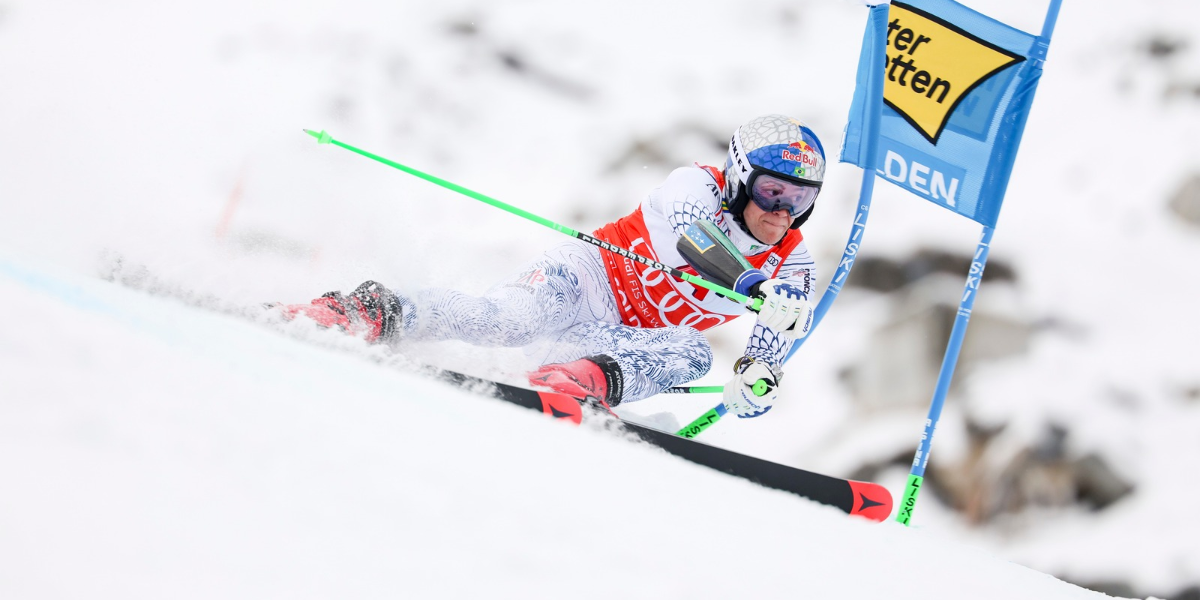
Sölden Men’s GS 2026: Pinheiro Braathen Leads Run 1
Lucas Pinheiro Braathen / GEPA pictures
Lucas Pinheiro Braathen returned to Sölden on Sunday, Oct. 25, and delivered the fastest first run of the men’s 2026-27 Alpine World Cup opener. Behind him, seven racers starting bib 31 or higher fought their way into the second run, transforming the battle for qualification.
A year after failing to finish the opening giant slalom on the Rettenbach glacier, the Brazilian Olympic champion and reigning World Cup GS titleholder showed exactly why he enters the new season as the skier to beat.
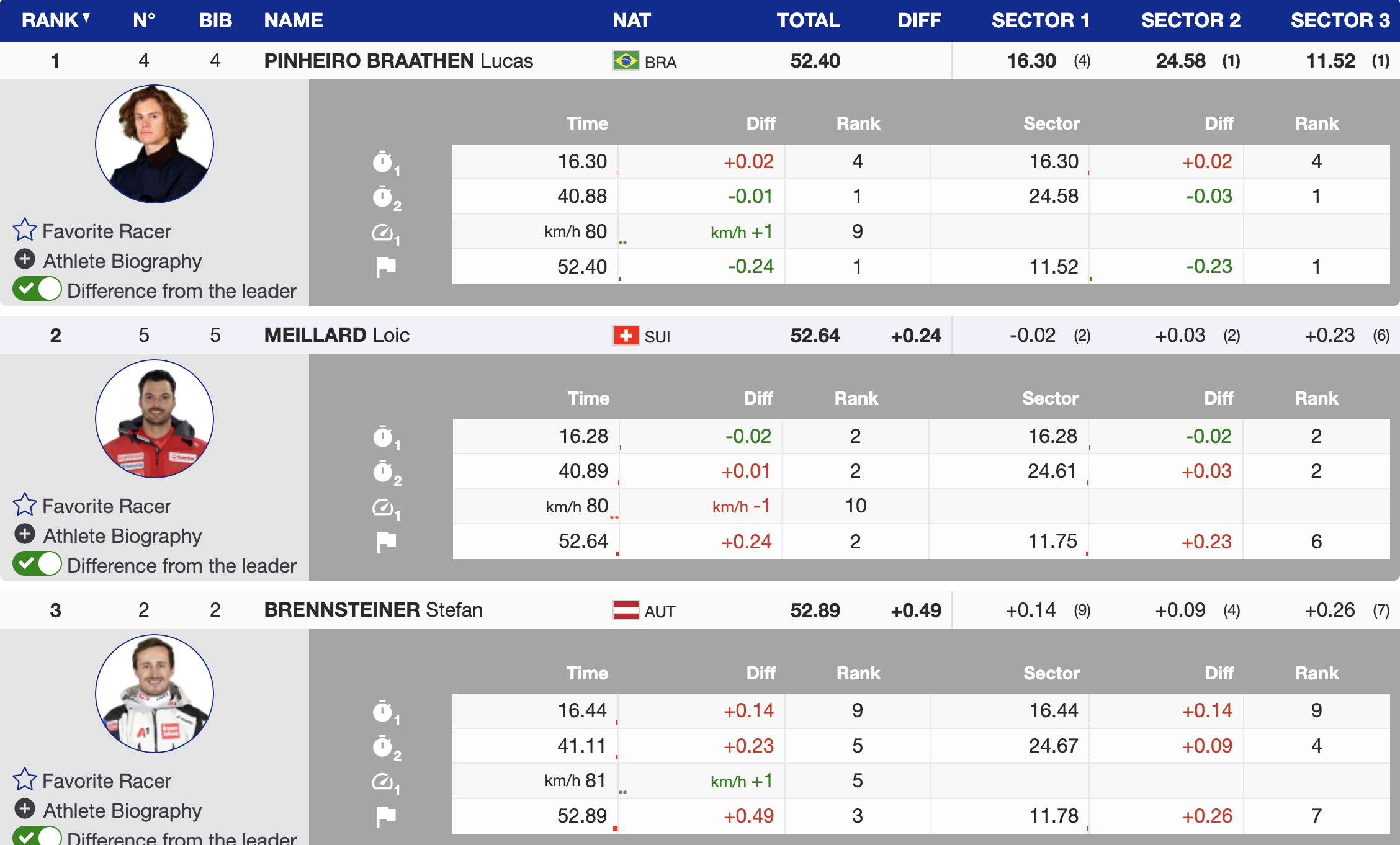
Racing on Atomic skis and wearing Oakley eyewear, Pinheiro Braathen clocked 52.40 seconds. Switzerland’s Loïc Meillard finished just 0.24 seconds behind, while Austria’s Stefan Brennsteiner took third at +0.49.
Defending Sölden champion Marco Odermatt sits fourth, 0.55 behind the leader, setting up an intriguing second-run battle.
Sölden Men’s GS First Run: Top Seven
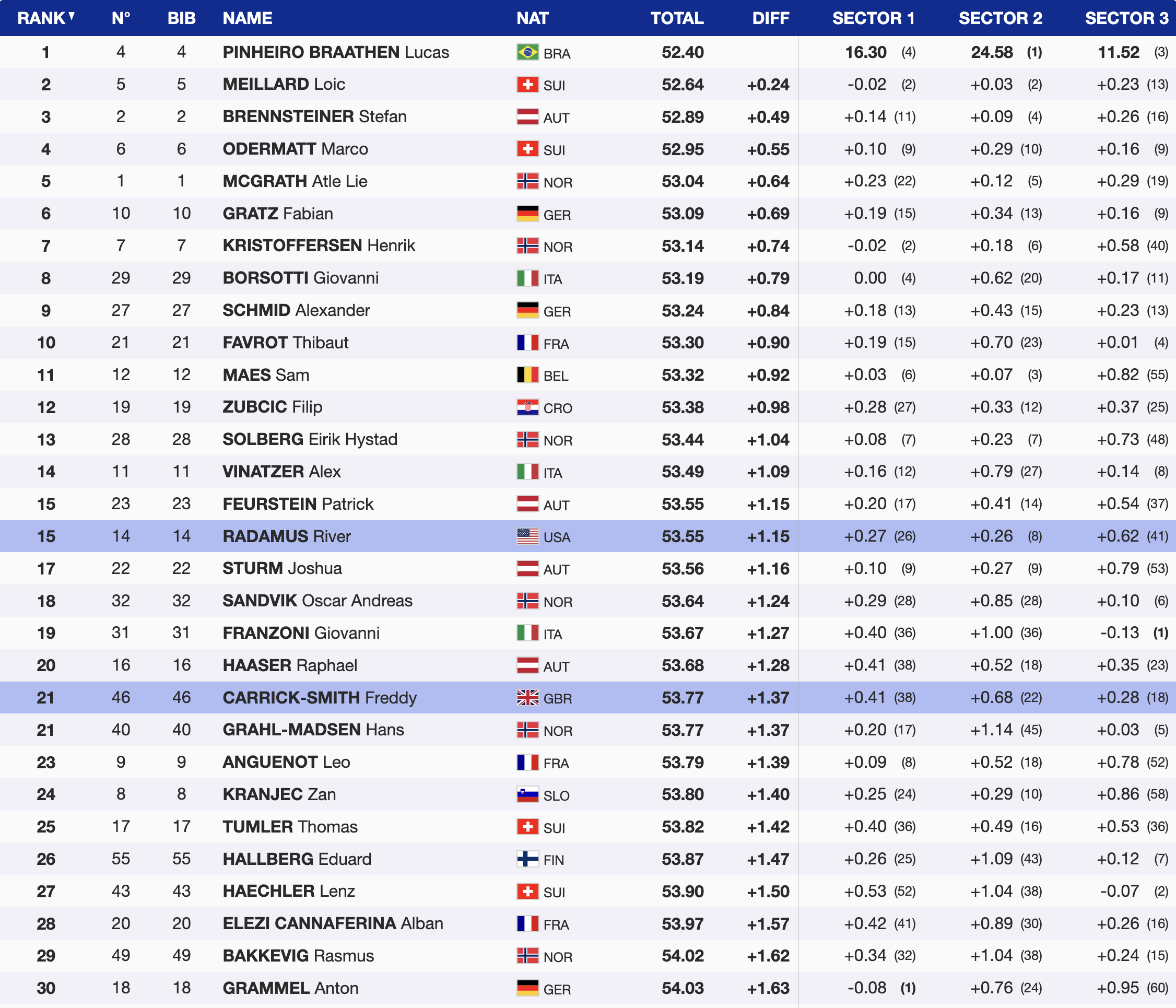
- 🥇 🇧🇷 1. Lucas Pinheiro Braathen (BRA) — Bib 4 | 52.40
- 🥈 🇨🇭 2. Loïc Meillard (SUI) — Bib 5 | +0.24
- 🥉 🇦🇹 3. Stefan Brennsteiner (AUT) — Bib 2 | +0.49
- 🇨🇭 4. Marco Odermatt (SUI) — Bib 6 | +0.55
- 🇳🇴 5. Atle Lie McGrath (NOR) — Bib 1 | +0.64
- 🇩🇪 6. Fabian Gratz (GER) — Bib 10 | +0.69
- 🇳🇴 7. Henrik Kristoffersen (NOR) — Bib 7 | +0.74
Second run: 1 p.m. CET / 8 a.m. ET / 5 a.m. PT.
Pinheiro Braathen Establishes the Benchmark
Strong winds forced organizers to start at the top of the steep pitch, shortening the first run to about 53 seconds. Overcast skies reduced visibility, and organizers removed the usual banner above the finish due to wind concerns.
U.S.-born Norwegian Atle Lie McGrath, racing on HEAD skis, became the first man to start a World Cup race in the new season. Austrian Stefan Brennsteiner quickly set a faster benchmark before his teammate, Marco Schwarz, disappointed the home crowd with an early mistake that ended his run. Schwartz said, “Conditions are great, no issue, good work. I just wanted to be in a very straight line and it didn’t work.”
Then Pinheiro Braathen took control.
Starting fourth, the Brazilian delivered the fastest middle sector and established a lead that survived all 69 starters.
Meillard offered the closest challenge. After struggling to find his best form early last season, the Swiss star produced an encouraging performance. He matched the fastest opening-sector time but surrendered most of his 0.24-second deficit near the finish.
Odermatt, racing on Stöckli skis and Salomon boots, remained within striking distance but lost 0.29 seconds in the middle sector alone.
Henrik Kristoffersen provided another revealing contrast. The Norwegian matched the fastest opening split but lost 0.58 seconds in the final sector, leaving him seventh.
The opening group established the early contenders, but improving visibility soon created opportunities for the racers starting behind them.
Improving Visibility Brings Unexpected Challenges
As the light improved, several later starters demonstrated that the early leaders were not beyond reach.
Germany’s Fabian Gratz, wearing bib 10, moved into sixth. Then Italy’s Giovanni Borsotti delivered one of the morning’s strongest performances, charging into eighth from bib 29, just 0.79 seconds behind Pinheiro Braathen.
Germany’s Alexander Schmid followed from bib 27, finishing ninth at +0.84. France’s Thibaut Favrot, starting 21st, claimed 10th after producing a final sector just 0.01 seconds slower than the leader.
Croatia’s Filip Zubčić also offered an encouraging sign. After a difficult season and a switch to Nordica skis and Marker bindings, the proven GS contender finished 12th, only 0.98 seconds behind.
Belgium’s Sam Maes, who trains with the Stifel U.S. Ski Team and races on Völkl skis, finished 11th at +0.92.
Radamus and Carrick-Smith Earn Second Runs
River Radamus was the lone American to qualify, finishing tied for 15th, 1.15 seconds behind Pinheiro Braathen.
The Stifel U.S. Ski Team racer initially crossed in 10th but gradually slipped as later starters delivered faster performances. Radamus has demonstrated the ability to produce exceptionally fast individual runs, leaving him an opportunity to attack in the afternoon.
Great Britain’s 19-year-old Freddy Carrick-Smith delivered an even more dramatic performance.
Starting bib 46, the young British racer charged into a tie for 21st, just 1.37 seconds behind the leader. He finished 25 positions ahead of his starting number, securing a rare World Cup giant slalom second run for Britain.
The achievement recalls Charlie Raposo’s performance at Kranjska Gora in March 2022, when the British racer advanced to the second run and finished 27th.
USA and GBR Second-Run Qualifiers
- 🇺🇸 T-15. River Radamus (USA) — Bib 14 | +1.15
- 🇬🇧 T-21. Freddy Carrick-Smith (GBR) — Bib 46 | +1.37
No Canadian, Japanese or South Korean racers qualified.
High-Bib Impact: Seven Racers Break Into the Top 30
The final starting group delivered one of the morning’s biggest surprises.
With only one of the opening 30 racers failing to finish, opportunities appeared limited for those starting farther back. Yet seven racers wearing bib 31 or higher qualified for the second run, displacing several established competitors.
Improving visibility helped create opportunities, but these athletes still needed exceptional execution to capitalize.
High-Bib Qualifiers — Ranked by First-Run Finish
- 🇳🇴 18. Oscar Andreas Sandvik (NOR) — Bib 32 | YOB 2004 | +1.24 | 14 places gained
- 🇮🇹 19. Giovanni Franzoni (ITA) — Bib 31 | YOB 2001 | +1.27 | 12 places gained
- 🇳🇴 T-21. Hans Grahl-Madsen (NOR) — Bib 40 | YOB 2003 | +1.37 | 19 places gained
- 🇬🇧 T-21. Freddy Carrick-Smith (GBR) — Bib 46 | YOB 2007 | +1.37 | 25 places gained
- 🇫🇮 26. Eduard Hallberg (FIN) — Bib 55 | YOB 2003 | +1.47 | 29 places gained
- 🇨🇭 27. Lenz Hächler (SUI) — Bib 43 | YOB 2003 | +1.50 | 16 places gained | Stöckli skis
- 🇳🇴 29. Rasmus Bakkevig (NOR) — Bib 49 | YOB 2005 | +1.62 | 20 places gained | Atomic skis
Fastest high-bib qualifier: Sandvik, who finished 18th from bib 32.
Highest bib to qualify: Hallberg, who started 55th and finished 26th.
Biggest improvement: Hallberg also made the largest move, gaining 29 positions relative to his starting number.
Italy’s Franzoni provided another remarkable highlight. Despite losing a full second in the middle sector, he produced the fastest final sector of the entire field, beating Pinheiro Braathen’s split by 0.13 seconds.
The battle for qualification proved unforgiving. Ryder Sarchett of the Stifel U.S. Ski Team initially moved into 27th from bib 34, but later finishers pushed him outside the top 30.
Seven successful high-bib qualifiers demonstrated the depth of the field and ensured that the opening race delivered drama well beyond the fight for the lead.
Sölden Men’s GS Run 2
Brazil’s Nick Cooper sets the second-run course.
The fastest 30 return in reverse order, with Pinheiro Braathen starting last.
The Brazilian holds the advantage, but Meillard, Brennsteiner and Odermatt remain close enough to challenge. After a first run filled with surprises, the fight for the season’s opening World Cup victory is far from decided.

First Run Results
click images to enlarge
First-Run Analysis: Fastest Three



About the Author: Peter Lange
Related Post




