Sölden Men’s GS 2026: Pinheiro Braathen Wins, Radamus Fourth
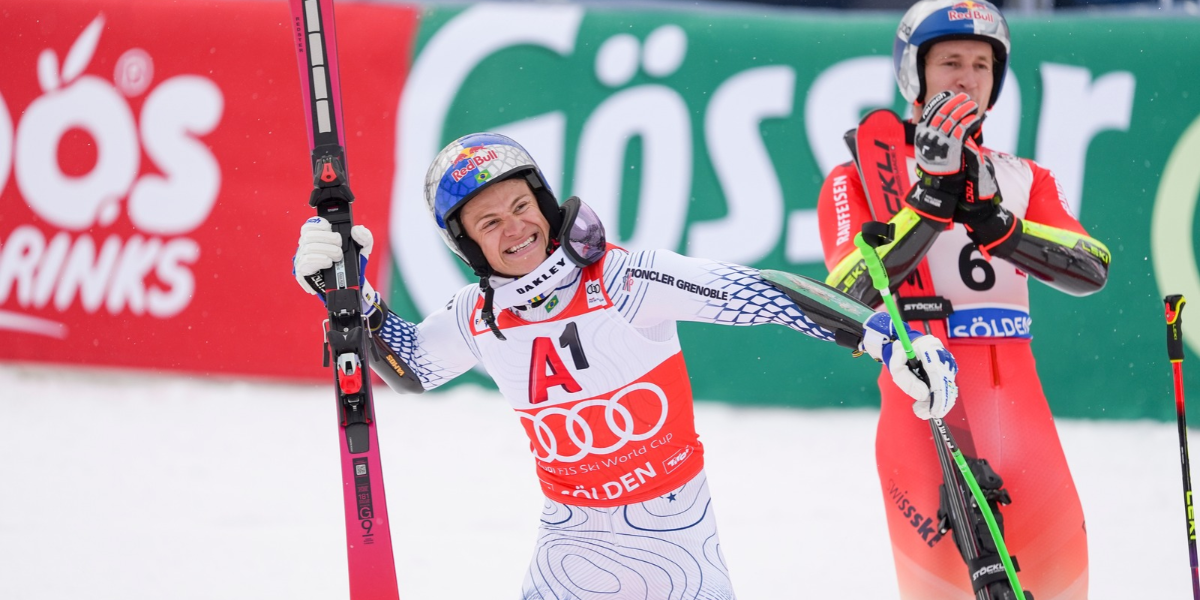
Lucas Pinheiro Braathen, Marco Odermatt / GEPA pictures
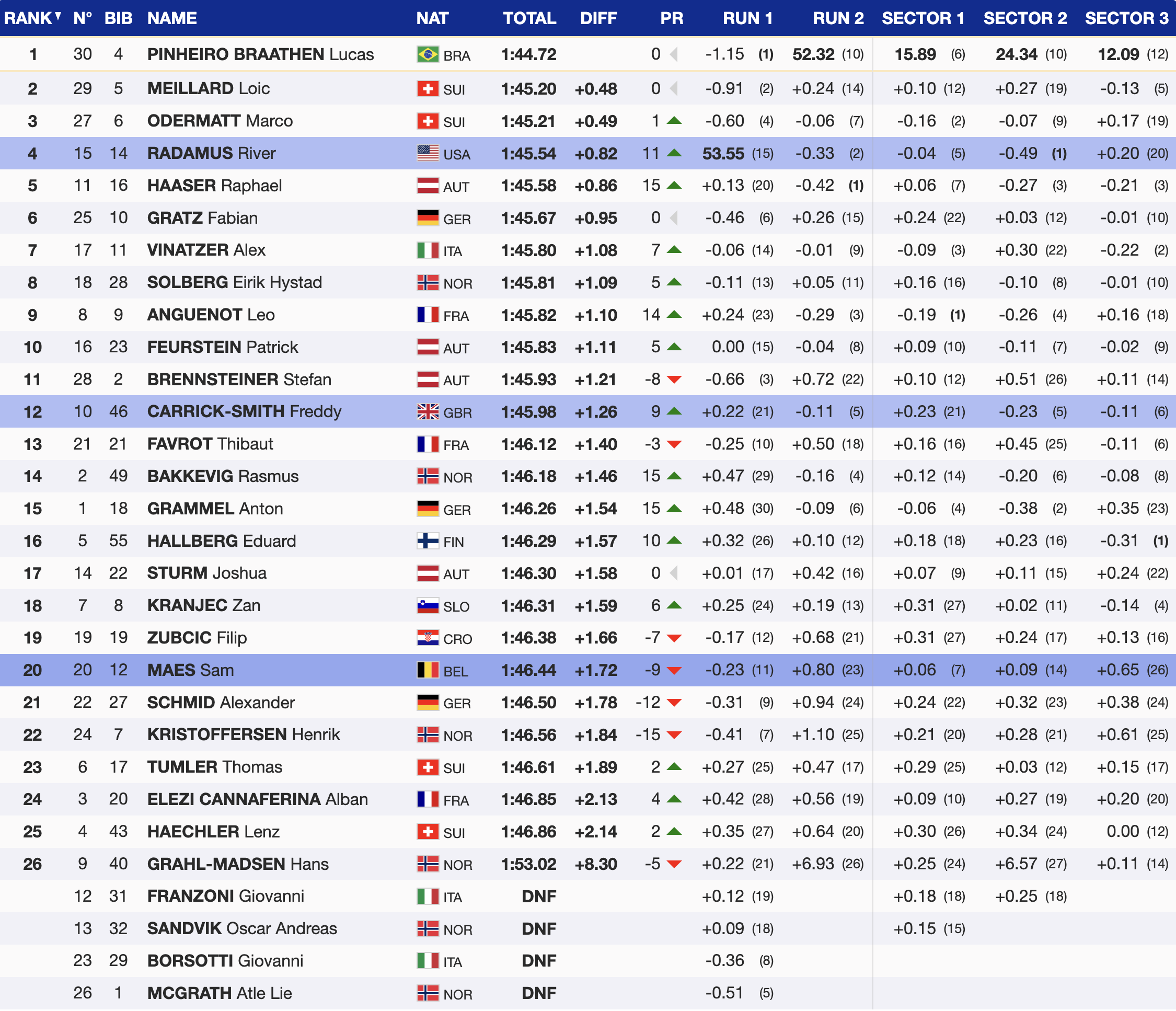
Three of the final four racers took the lead. The last man down the mountain won.
Brazil’s Lucas Pinheiro Braathen delivered a commanding victory in Sunday’s Sölden men’s World Cup giant slalom, defeating Switzerland’s Loïc Meillard and Marco Odermatt in a thrilling opening to the 2026-27 season.
The reigning Olympic and World Cup GS champion entered the second run with a 0.24-second advantage. What followed was an extraordinary battle on the Rettenbach glacier. American River Radamus held the leader’s chair deep into the final seven before three of the last four starters took turns moving into first place.
Pinheiro Braathen eventually prevailed by 0.48 seconds, while just one hundredth separated the two Swiss podium finishers.
Sölden Men’s GS 2026 — Top Five Results
- 🥇 🇧🇷 Lucas Pinheiro Braathen (BRA) — 1:44.72 | Atomic skis, Oakley eyewear
- 🥈 🇨🇭 Loïc Meillard (SUI) — +0.48
- 🥉 🇨🇭 Marco Odermatt (SUI) — +0.49 | Stöckli skis, Salomon boots
- 4th 🇺🇸 River Radamus (USA) — +0.82 | Stifel U.S. Ski Team
- 5th 🇦🇹 Raphael Haaser (AUT) — +0.86 | Atomic skis
The Final Four Deliver Extraordinary Drama
The reverse-30 second run had already produced remarkable performances and several lead changes before the leading contenders prepared to challenge.
Radamus, who had started the afternoon tied for 15th, remained the overall leader when only seven racers were left. His exceptional second run had forced the biggest names in giant slalom to chase his time.
Henrik Kristoffersen, seventh after Run 1, couldn’t find the necessary speed and eventually finished 22nd. Germany’s Fabian Gratz also fell short of Radamus’ mark.
Norway’s Atle Lie McGrath, fifth after the opening run, fell on the upper pitch and failed to finish.
Then came the final four.
Odermatt, fourth after Run 1, delivered the seventh-fastest second run. The Swiss star finally ended Radamus’ extended stay in the leader’s chair.
“I made a big step in the second run: I found the race gear and that’s the most important thing,” Odermatt told FIS.
His third-place finish would ultimately become his 47th World Cup GS podium, establishing a Swiss record. It was an encouraging start after an offseason affected by injury.
Meillard Turns the Swiss Battle Into a Thriller
Austria’s Stefan Brennsteiner was next. Third after the opening run, Brennsteiner couldn’t match the pace. His second run ranked 22nd, dropping him to 11th overall and guaranteeing Odermatt a podium.
Then came Meillard.
The Swiss skier had finished the first run 0.31 seconds ahead of his teammate. He needed to protect that advantage to take the lead.
Although Odermatt recorded a faster second run, Meillard delivered a strong finishing section and crossed just 0.01 seconds ahead.
The result was especially satisfying for Meillard, who had never previously finished higher than fifth at Sölden.
“Sölden and me haven’t been friends in the last few years so to start the season with a podium and some solid skiing feels good,” Meillard told FIS.
The narrow margin over his teammate added another layer of satisfaction.
“I had a few times when I was one-hundredth behind, so now it’s my turn to be in the front,” Meillard said.
Odermatt recognized that the ultimate challenge remained the Brazilian who had dominated the opening run.
“Lucas was too fast in the first run for the victory today,” he acknowledged afterward.
Meillard had the lead. Odermatt was guaranteed third.
Only one racer remained.
Lucas Pinheiro Braathen, the reigning Olympic and World Cup GS champion, stood at the start knowing the entire race would be decided by his final run.
Pinheiro Braathen Answers the Ultimate Challenge
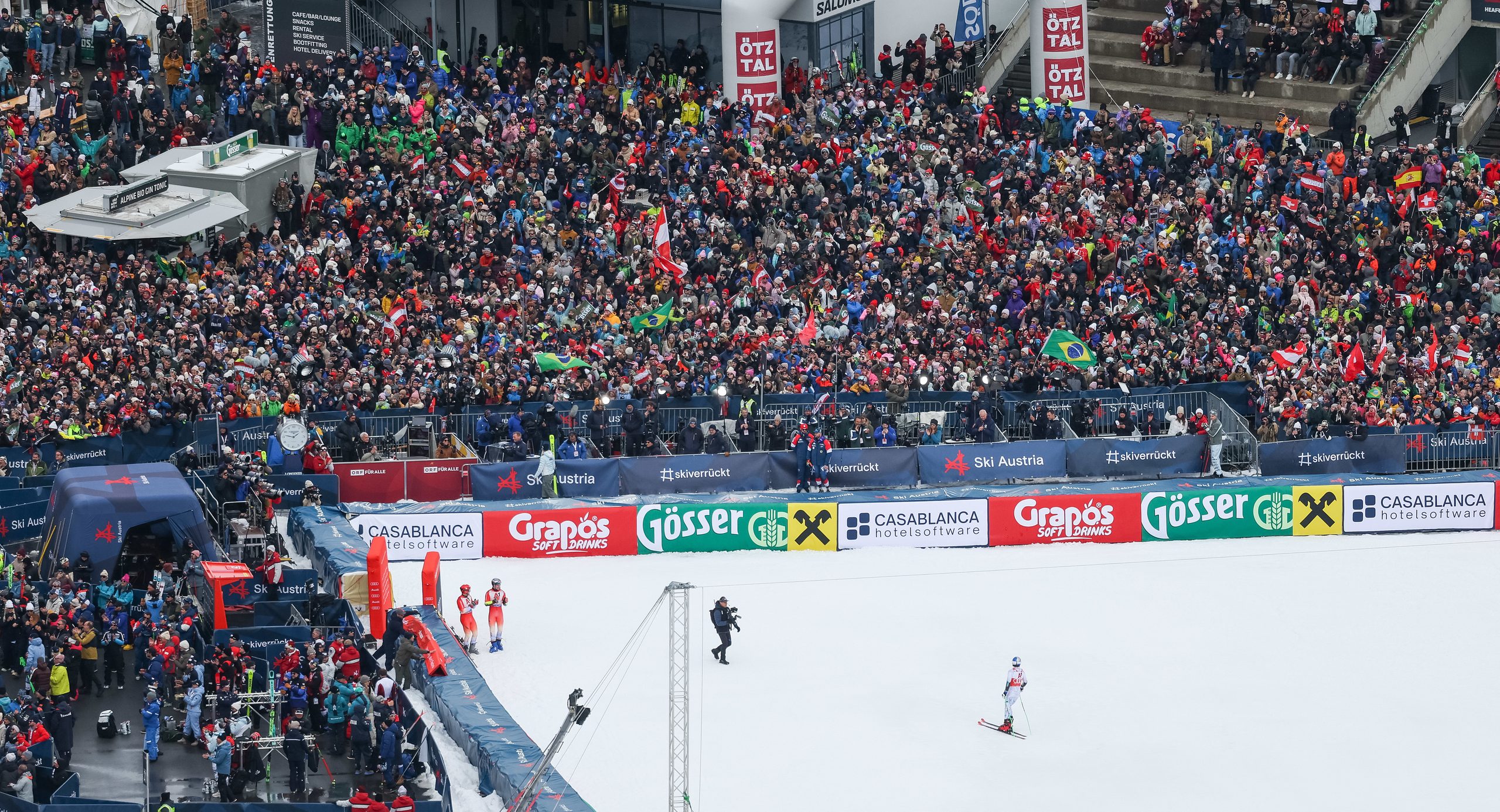
Lucas Pinheiro Braathen stood at the start knowing he was the only racer who could deny Meillard victory.
The 26-year-old Brazilian had already established himself as the world’s leading giant slalom racer, winning Olympic GS gold and the discipline’s World Cup crystal globe last season.
Now he faced another test.
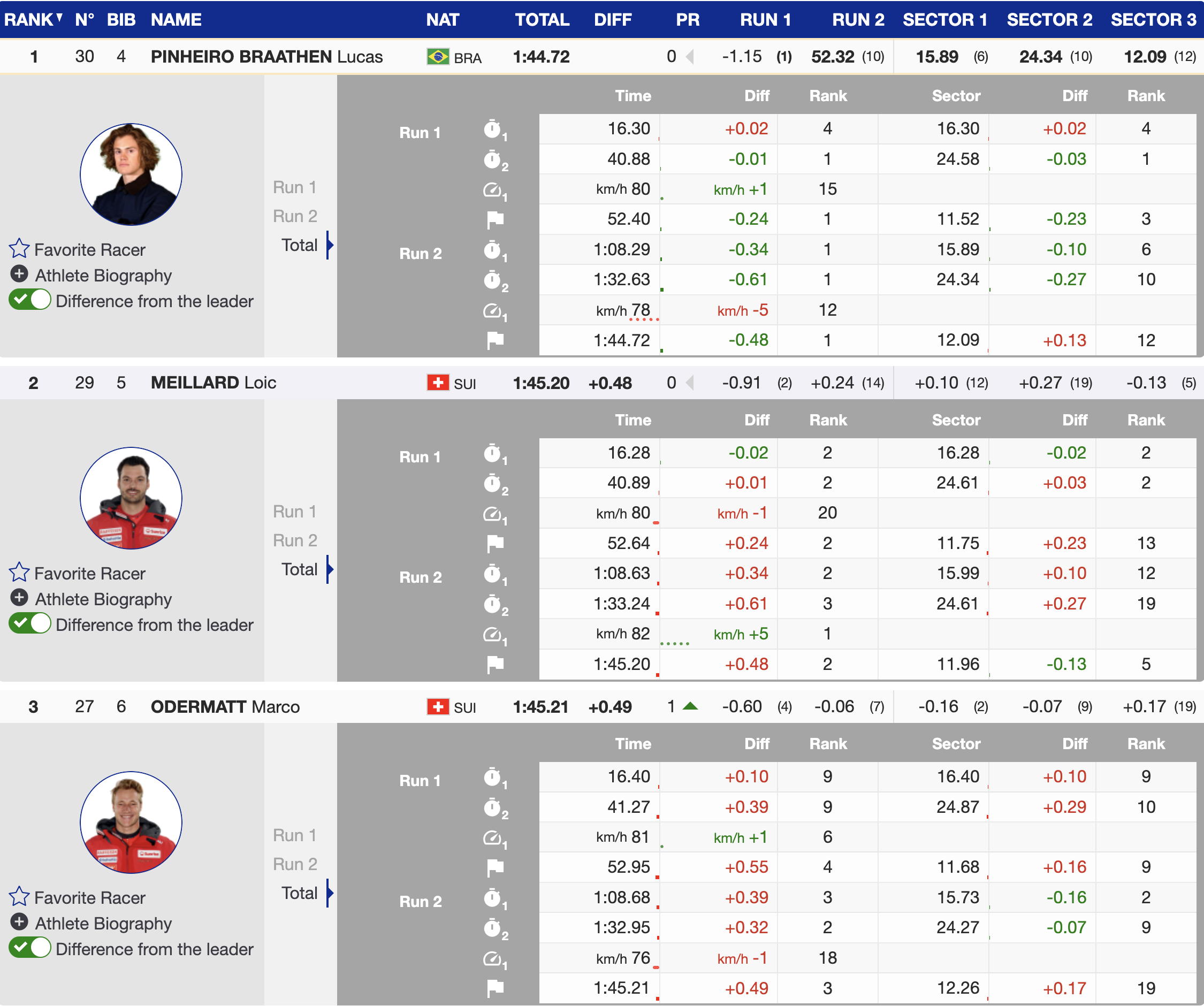
Pinheiro Braathen had dominated the shortened first run, opening a 0.24-second advantage over Meillard and a 0.55-second lead over Odermatt.
The same reduced course length was used for Run 2. Both runs had become intense sprints, with less accumulated fatigue but little opportunity to recover lost time.
The Brazilian committed from the start.
He increased his overall advantage through the opening and middle sections, reaching the final sector with 0.61 seconds in hand over Meillard.
The Swiss skier had been particularly strong on the closing stretch, and Pinheiro Braathen surrendered some of his advantage approaching the finish.
But he had created enough separation.
Pinheiro Braathen crossed 0.48 seconds clear, securing his fifth World Cup giant slalom victory and 12th podium in the discipline.
His second-run time ranked 10th fastest. Combined with his exceptional opening performance, however, it was more than enough.
Three of the final four racers had taken the lead. The final starter had won.
“Pressure Is Privilege”
Pinheiro Braathen acknowledged the expectations he carried into Sölden.
“There was a lot of pressure on my shoulders today,” he said in his finish-area interview.
“Pressure is privilege, and I was able to capitalize off of that.”
The victory marked a remarkable contrast to the previous year’s Sölden opener, when Pinheiro Braathen failed to finish.
This time, the Atomic and Oakley athlete arrived as the reigning Olympic champion and World Cup GS titleholder.
“What a relief to be able to open the show in this way,” he said.
“I’ve worked so hard this whole summer.”
Pinheiro Braathen explained that he had spent the offseason searching for new ways to improve following his Olympic gold and crystal globe.
Those achievements brought confidence rather than hesitation.
“I didn’t want to hesitate. I knew what I had in me,” he said.
The Brazilian also thanked his family, team and supporters, recognizing their contribution to his latest victory.

Radamus Turns First-Run Disappointment Into Fourth Place
Click on images to enlarge

For the United States, River Radamus delivered one of the most impressive performances of the afternoon.
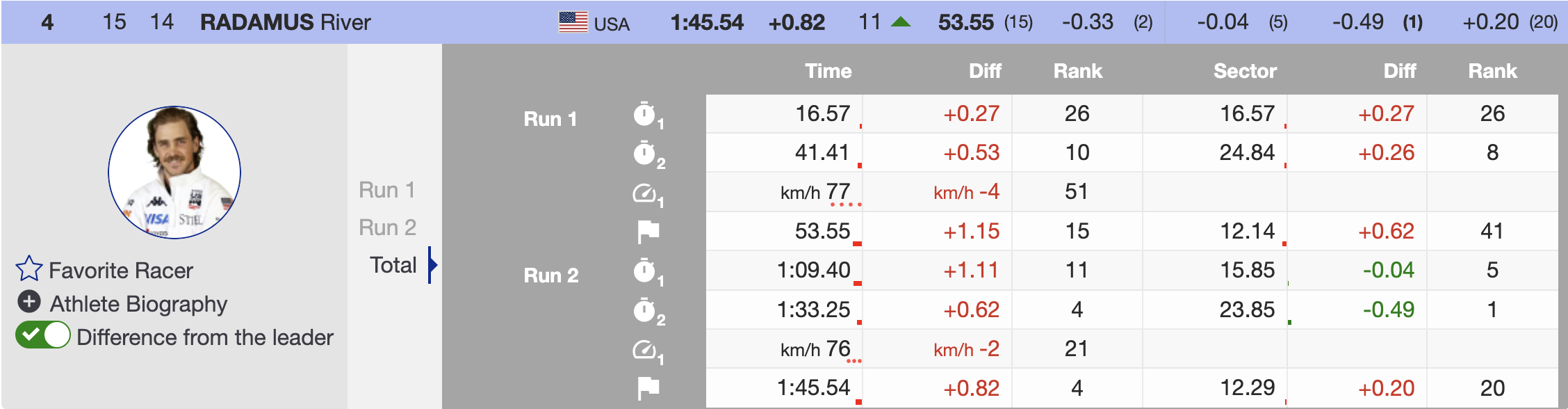
The only Stifel U.S. Ski Team racer to qualify for the second run, Radamus finished the opening run tied for 15th, 1.15 seconds behind Pinheiro Braathen.
He was not satisfied.
“I was disappointed in my first run because I don’t think that I showed the skiing that I’ve been working towards,” Radamus said afterward.
His second run told a different story.
With some of the pressure lifted, the American attacked and produced a time of 51.99 seconds, the second fastest of the afternoon. Only Austria’s Raphael Haaser, who recorded 51.90, skied faster.
“But the pressure was off a bit the second run, and I was able to connect some of the good turns that I’ve been working on,” Radamus said. “I’m happy with the progress we’re showing.”
The American was particularly effective through the middle sector, where he posted the fastest time in the field.
Against Haaser, who was leading when Radamus started, he built a 0.45-second advantage by the final intermediate split.
The finish became considerably tighter.
Radamus lost 0.41 seconds of that cushion on the final stretch but crossed just 0.04 seconds ahead of the Austrian.
Then came the wait.
One challenger after another failed to beat his combined time of 1:45.54.
When the final seven racers prepared to start, Radamus was still leading. His performance had transformed the race, forcing the sport’s biggest stars to beat a time established by a racer who had finished the opening run in 15th.
Eleven subsequent starters failed to displace him before Odermatt finally took the lead.
Radamus ultimately finished fourth, climbing 11 positions and missing the podium by 0.33 seconds.
An Open Course Rewards Aggressive Skiing
Radamus offered valuable insight into why the second run produced so many impressive climbs.
“The course was almost the exact same,” he said. “We were in the same grooves for a lot of it, so we knew what to expect.”
The shortened course featured relatively open turns, allowing racers to maintain speed and attack.
“It was very easy, very open. The snow was great,” Radamus explained.
“You couldn’t afford to slow yourself down at all. You had to go at it.”
That approach proved particularly effective for racers who had started the afternoon outside the leading group.
Radamus also acknowledged that conditions changed between runs. The snow became more mixed, while visibility and wind remained considerations on the mountain.
“The snow changed a bit between runs. It was like sort of a spring mix in the second run,” he said.
Rather than dwell on the changing conditions, Radamus focused on making the most of them.
“I tried to take advantage and make the most of it.”
His result provided an outstanding start to the season. Radamus said he planned to remain in Europe for super-G training before returning to the United States to prepare for the upcoming World Cup races at Copper Mountain.
Carrick-Smith Earns First World Cup Points for Great Britain
Click on images to enlarg
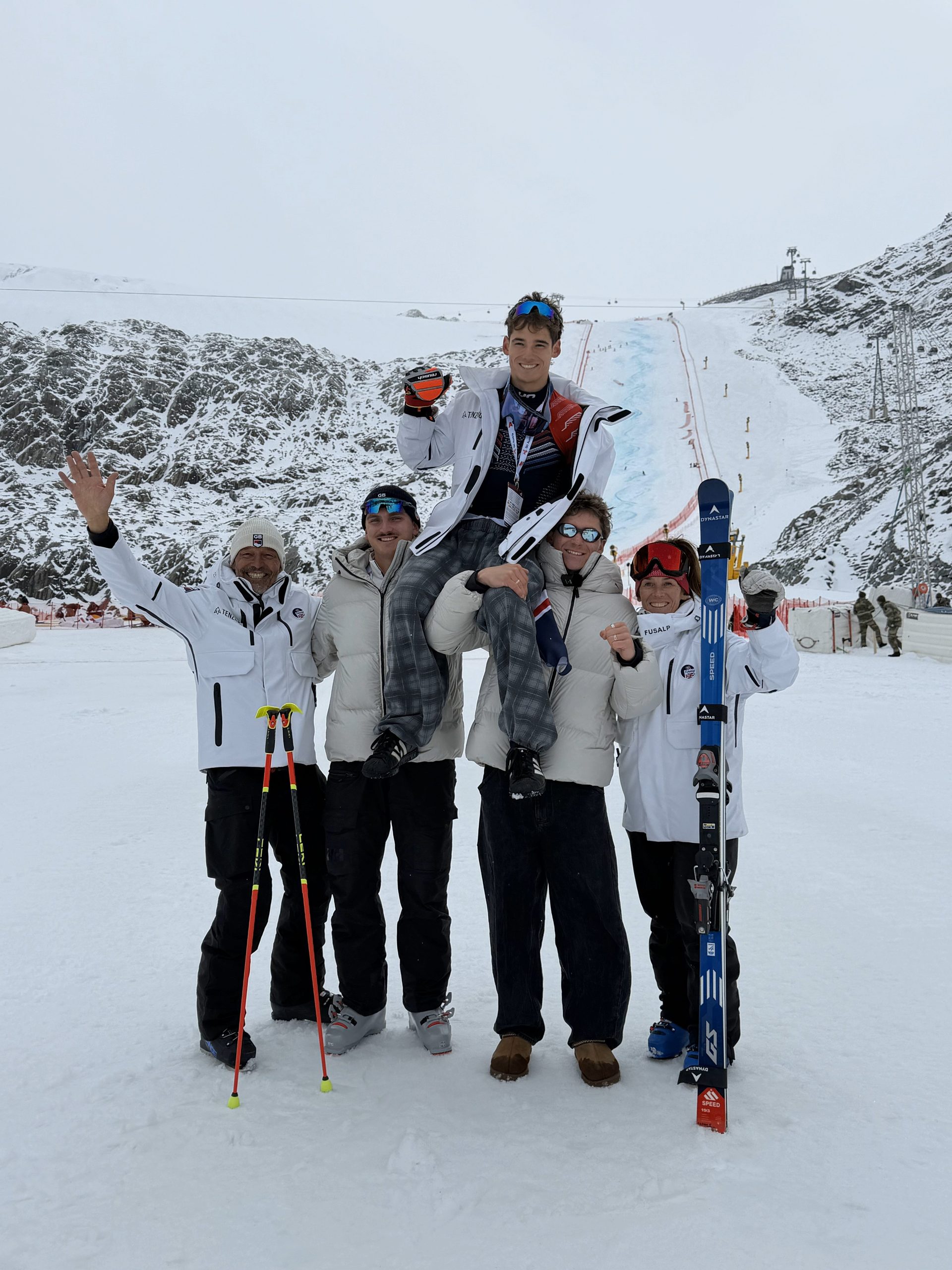
Britain’s Freddy Carrick-Smith provided another of the afternoon’s memorable performances.
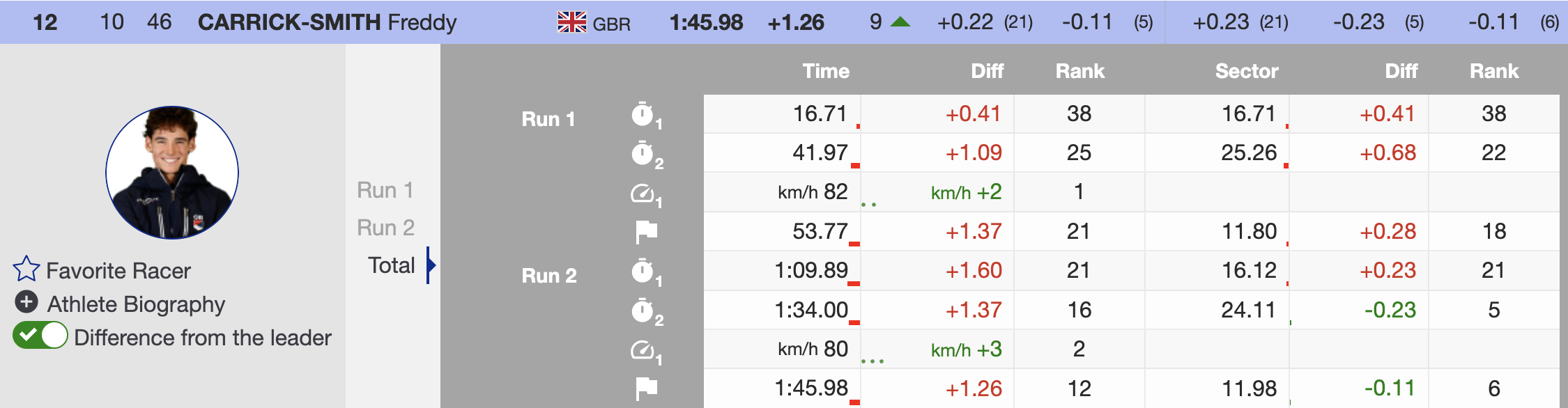
The 19-year-old started the opening run wearing bib 46 and qualified for his first World Cup second run in a tie for 21st place.
That achievement alone was significant for British alpine racing. His afternoon performance made the occasion even more memorable.
Carrick-Smith produced the fifth-fastest second run, stopping the clock at 52.21 seconds. He climbed nine positions to finish 12th, earning his first World Cup points.
“Yeah, it was amazing,” Carrick-Smith said afterward. “I guess I couldn’t have asked for much more out of my first run and second run.”
The young Briton acknowledged that finishing his second run had been a priority. He held back slightly rather than risk losing the opportunity.
Even so, his competitive time ranked among the day’s strongest performances.
His breakthrough recalls fellow British racer Charlie Raposo’s World Cup giant slalom results at Kranjska Gora in March 2022.
For a teenager competing against the world’s best, 12th place represents a significant career milestone.
Carrick-Smith also spoke about representing a country with relatively few World Cup alpine competitors.
“There’s not many GB skiers. It’s just good to be an influence, I guess.”
USA, GBR and U.S. Team Training Group Results
- 🇺🇸 River Radamus (USA) — Bib 14 | Run 1: tied 15th | Final: 4th (+0.82) | Up 11 places | Stifel U.S. Ski Team
- 🇬🇧 Freddy Carrick-Smith (GBR) — Bib 46 | Run 1: tied 21st | Final: 12th (+1.26) | Up nine places
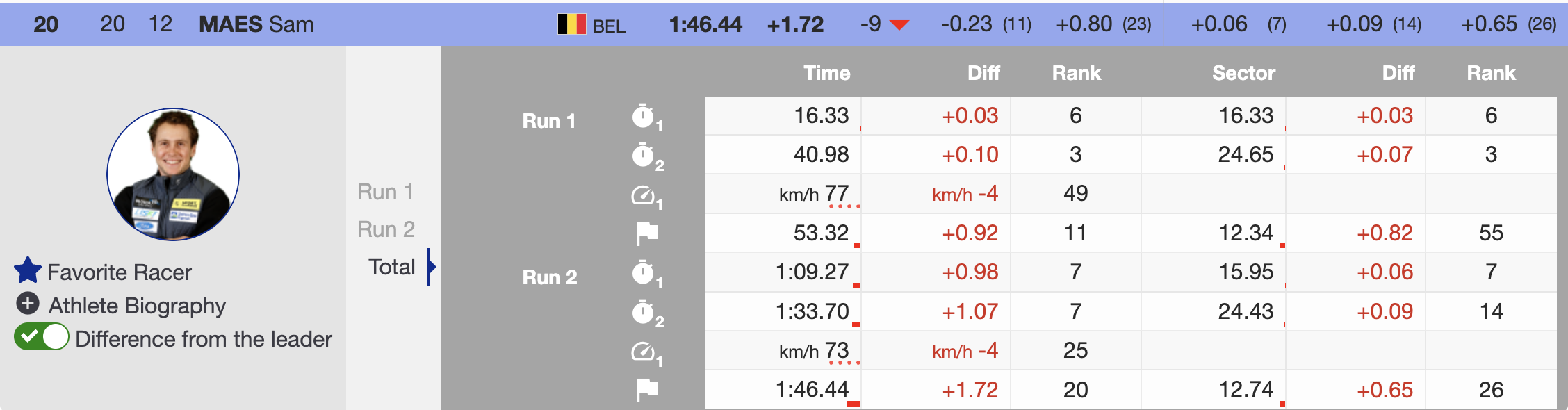
- 🇧🇪 Sam Maes (BEL) — Bib 12 | Run 1: 11th | Final: 20th (+1.72) | Völkl skis. The Belgian trains with the Stifel U.S. Ski Team.
Haaser and the Biggest Movers of Run 2
Austria’s Raphael Haaser delivered the fastest second run of the competition, recording 51.90 seconds.
Starting the afternoon in 20th, Haaser climbed 15 places to finish fifth, just 0.04 seconds behind Radamus.
France’s Léo Anguenot also enjoyed a remarkable afternoon. The French racer temporarily occupied the leader’s chair before finishing ninth, improving 14 places from his first-run position.
Norway’s Rasmus Bakkevig, the reigning Junior World GS champion, delivered another exceptional performance.
Starting with bib 49, Bakkevig qualified 29th in the opening run. He then produced the fourth-fastest second run, taking an early lead and holding it through five subsequent challengers.
He eventually finished 14th, climbing 15 positions.
Six athletes moved up at least 10 places during the second run.
Biggest Movers of Run 2 — 10 or More Places Gained
- 🇦🇹 Raphael Haaser (AUT) — Bib 16 | Run 1: 20th | Final: 5th | Up 15 places
- 🇳🇴 Rasmus Bakkevig (NOR) — Bib 49 | Run 1: 29th | Final: 14th | Up 15 places
- 🇩🇪 Anton Grammel (GER) — Bib 18 | Run 1: 30th | Final: 15th | Up 15 places
- 🇫🇷 Léo Anguenot (FRA) — Bib 9 | Run 1: 23rd | Final: 9th | Up 14 places
- 🇺🇸 River Radamus (USA) — Bib 14 | Run 1: tied 15th | Final: 4th | Up 11 places
- 🇫🇮 Eduard Hallberg (FIN) — Bib 55 | Run 1: 26th | Final: 16th | Up 10 places
Bibbo Award: Hallberg Makes the Biggest Climb
Finland’s Eduard Hallberg earns the Ski Racing Media Bibbo Award, recognizing the greatest numerical improvement from original starting bib to final finishing position.
Hallberg started with bib 55 and finished 16th, a difference of 39 positions.
The Finn also recorded the fastest final sector of the second run, demonstrating impressive speed over the closing stretch.
Bakkevig deserves recognition as well. The young Norwegian started bib 49 and finished 14th, a difference of 35 positions.
Both performances illustrate the opportunities available to racers starting deep in the field.
Swiss Podium Strength and Norway’s Emerging Talent
Switzerland left Sölden with two podium finishers, while Norway failed to place a racer in the top 10 despite qualifying six athletes for the second run.
For a nation accustomed to success in men’s giant slalom, the absence of a Norwegian among the leaders was unusual.
Kristoffersen dropped from seventh to 22nd, while Lie McGrath failed to finish.
However, Norway’s younger athletes delivered encouraging performances.
Eirik Hystad Solberg climbed from 13th to eighth, while Bakkevig’s remarkable second run demonstrated the potential of the next generation.
Germany also showed improving depth in giant slalom.
Three German racers qualified for the second run. Gratz finished sixth, Grammel climbed from 30th to 15th, and Alexander Schmid placed 21st.
Norway led all nations with six second-run qualifiers. Austria and Switzerland each qualified four, while seven nations had just one racer advance.
A Champion Sets the Early Standard
The 2026-27 World Cup giant slalom season opened with seven overall lead changes, remarkable climbs and an extraordinary battle among the final four racers.
But when the competition reached its decisive moment, the reigning champion delivered.
Pinheiro Braathen defeated two of Switzerland’s most accomplished racers and demonstrated that last season’s Olympic gold and crystal globe had not diminished his ambition.
“I didn’t want to hesitate,” he said.
He didn’t.
The Brazilian opened the season with victory, leaving his rivals with an immediate challenge: finding a way to beat the world’s leading giant slalom racer.
Special thanks to Ski Racing Media journalist Darka Sefcik Starnova for her on-site reporting in Sölden and finish-area interviews, bringing the athletes’ voices and perspectives directly into this story.

Race Results
click on images to enlarge
Race Analysis
About the Author: Peter Lange
Related Post