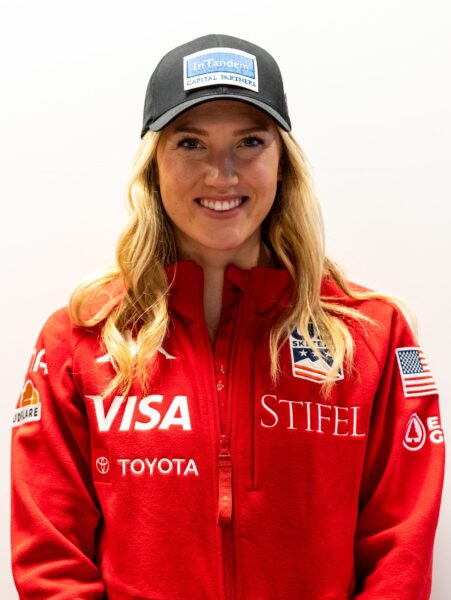
Nina O’Brien / GEPA Pictures
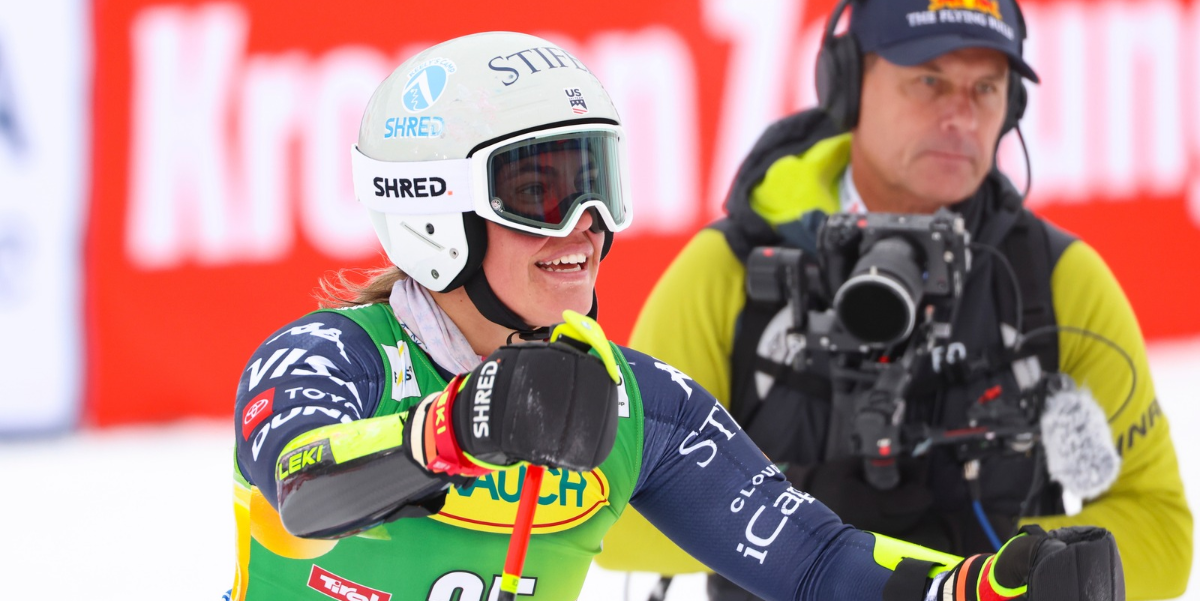
After back-to-back top-11 Sölden World Cup giant slalom seasons, the Stifel U.S. Ski Team veteran returns to the Rettenbach Glacier with proven speed, hard-earned experience, and a growing appreciation for ski racing.
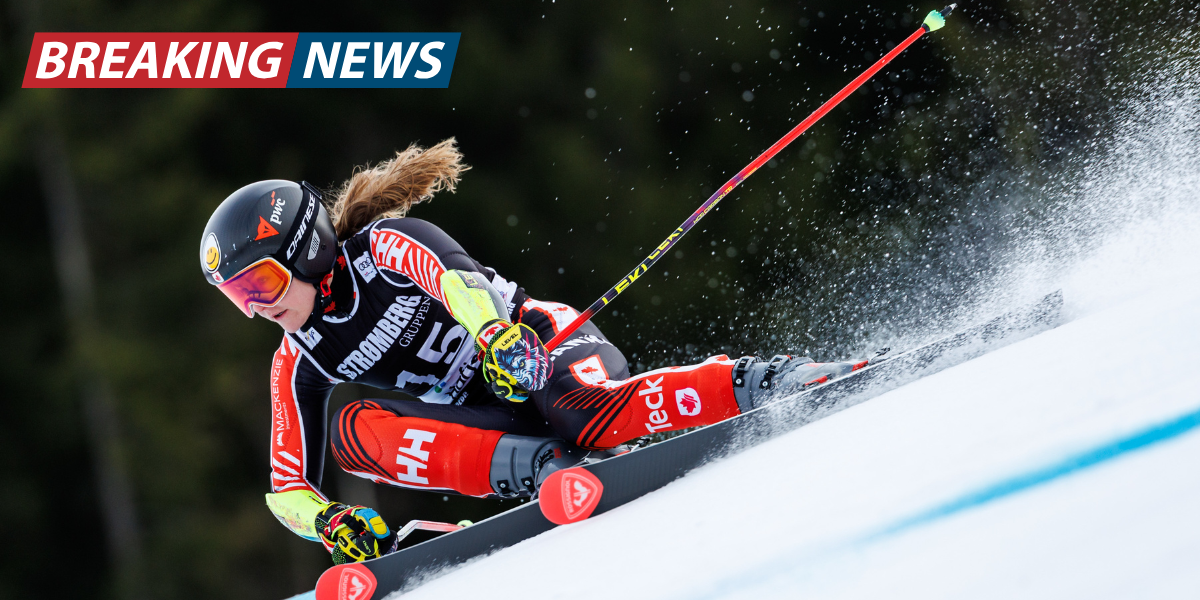
Nina O’Brien knows the Rettenbach Glacier rewards courage. She also knows that attacking Sölden’s famous steep pitch is only part of producing a fast giant slalom run.
There are places to build speed, sections where control matters as much as aggression and a critical transition where racers can gain valuable time or watch it disappear.
Few racers understand those demands better than O’Brien.
The 28-year-old Stifel U.S. Ski Team veteran returns for the Oct. 24 World Cup opener with 12 individual World Cup top-10 finishes and consecutive seasons ranked among the world’s top 11 giant slalom racers.
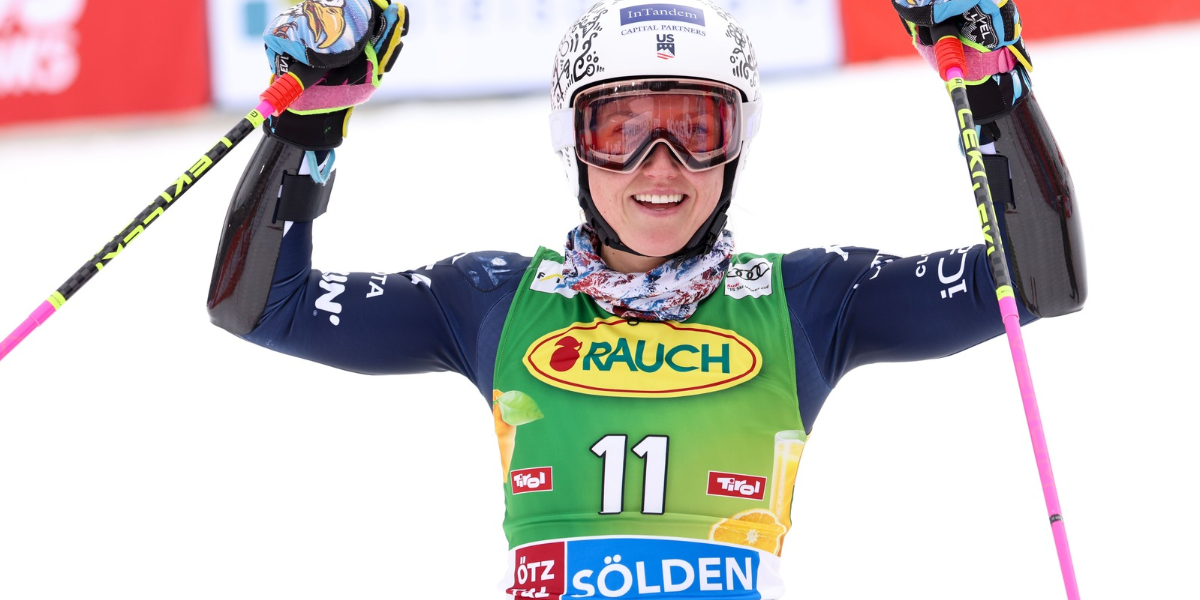
Her last three Sölden appearances have produced ninth, seventh, and sixth finishes.
“I think it rewards a little bit of gutsy skiing,” O’Brien told Ski Racing Media during an exclusive interview from Sölden.
She has repeatedly demonstrated the speed to challenge the world’s best. Her first individual World Cup podium remains a compelling possibility.
But after years of competition, serious injuries and remarkable recoveries, something else stands out.
O’Brien seems to love ski racing more than ever.

World Cup Success Built on Speed and Perseverance
O’Brien enters the 2026-27 season following the two strongest giant slalom campaigns of her career.
She finished 11th in the 2024-25 World Cup GS standings with 220 points, then improved to 10th last season with 215.
Her 2025-26 results included sixth at Sölden, fifth at Špindlerův Mlýn and eighth at both Kranjska Gora and the World Cup Finals in Norway.
Her international experience includes two Olympic Games and four World Championships. In 2023, she helped the United States win gold in the world championship mixed team parallel event.
Yet success has not come without adversity.
O’Brien suffered severe leg fractures during the giant slalom at the 2022 Beijing Olympics. After recovering, she fractured the same leg again during September 2023 training in New Zealand.
The second injury cost her another World Cup season.
Rather than simply regaining her previous form, O’Brien returned to establish herself among the world’s leading GS racers over two consecutive winters.
Now, healthy and experienced, she approaches another season as an established contender.
From Burke Mountain Academy to the World’s Highest Levels
O’Brien began racing with the Squaw Valley Ski Team, now Palisades Tahoe, in California before attending Burke Mountain Academy in East Burke, Vermont.
Her potential became evident early.
In March 2015, the 17-year-old Burke athlete won the U.S. national giant slalom championship at Sugarloaf, Maine, defeating established World Cup racers Paula Moltzan and Megan McJames.
The victory foreshadowed her international success.
O’Brien graduated from Burke in 2015 and joined the U.S. Ski Team in 2016. Three years later, she won the NorAm overall title along with the giant slalom, slalom and super-G discipline titles.
Her progression from Burke Mountain Academy to the World Cup demonstrates the role specialized ski academies play in developing American international competitors.
She also pursued an economics degree at Dartmouth College while continuing her ski racing career.
Today, the former Burke racer brings years of experience to an American women’s team with a growing number of talented younger athletes following similar development pathways.
Weather Challenges Preparation in New Zealand and Chile
O’Brien described the American women’s preseason as productive but unpredictable.
The team began its principal Southern Hemisphere preparation in late July with approximately five and a half weeks in New Zealand.
Training started at Roundhill, where athletes progressed from free skiing and drills into gates. They then moved to Ōhau for more demanding terrain before finishing the camp at Coronet Peak.
“We had some great days with really good feelings and challenging conditions that were pushing us,” O’Brien said.
However, heavy rain cost the Americans valuable training time.
The challenges continued during October training in Portillo, Chile, where an enormous snowstorm interrupted preparations.
O’Brien described the snowfall as one of the biggest storms she had experienced.
Nevertheless, the group accumulated valuable training across different terrain and snow conditions.
At the time of the interview, O’Brien had not yet trained on the Rettenbach this fall. Although she had heard the race hill was in good condition, she wanted to evaluate the surface herself before developing her race plan.
Why Sölden Brings Out Her Best
Few World Cup venues have rewarded O’Brien’s skiing as consistently as Sölden.
She has qualified for the second run in every appearance except her 2018 debut, and her most recent results show she’s comfortable on the demanding Austrian hill.
Yet when asked why the Rettenbach suits her, O’Brien initially emphasized the atmosphere rather than the terrain.
The enormous crowd, the excitement of returning to competition and the uncertainty surrounding the season opener all contribute to her enjoyment.
“I don’t know, there’s something fun about not knowing exactly where everyone stands and just going for it,” she said.
The course rewards that mentality.
Racers must attack the steep middle pitch while maintaining enough control to carry speed through the lower section.
For O’Brien, that challenge is exciting.
She enjoys aggressive skiing, but experience has taught her that success demands more than simply pushing harder.
The Rettenbach requires different technical and tactical approaches as the terrain changes.
Recognizing when to make those adjustments can separate an exceptional run from an ordinary one.
Three Sections, Three Different Challenges
O’Brien divides the Rettenbach into three distinct sections.
The relatively moderate upper portion requires racers to accelerate quickly. O’Brien believes athletes sometimes concentrate so heavily on the steep pitch that they overlook opportunities to gain time elsewhere.
The middle section presents a different challenge.
“The pitch is steep, but I think what’s even harder than the actual degree of steepness is just how many turns are back and forth on a sustained pitch,” she explained.
That combination demands balance, timing and the ability to maintain an effective line through repeated turns.
Too much caution costs speed. Excessive aggression can compromise the line.
The lower section requires another adjustment as racers preserve their momentum toward the finish.
However, the transition from the steep pitch onto the lower flat creates one of the race’s most important tactical decisions.
O’Brien believes the fastest approach depends on the course setting.
Sometimes racers can release their skis earlier. Other settings require maintaining control for another turn or two.
“It’s easy to say you got to let it go at the bottom of the pitch,” she said.
The challenge is recognizing the correct moment during course inspection and executing that decision under race pressure.
“When you make that switch, you’ve got to do it with commitment.”
For O’Brien, successful racing on the Rettenbach combines tactical awareness, skilled execution and the courage to attack.
American Teammates Raise the Standard
O’Brien’s confidence also reflects the growing strength of the Stifel U.S. Ski Team women’s technical program.
The World Cup training group has added talented younger athletes, increasing its depth and competitive intensity.
“People are always pushing the pace. You never know who’s going to be the fastest in training,” O’Brien said.
That uncertainty creates a demanding environment where everyone must continually improve.
O’Brien believes skiing well against teammates who regularly demonstrate World Cup-level speed provides valuable reassurance.
She also enjoys watching younger American racers succeed.
During the Southern Hemisphere training period, the women produced strong results in both Australia-New Zealand Cup and South American Cup races.
O’Brien followed those performances from afar, encouraged by the success of athletes competing in different locations.
The results reinforced her confidence in the depth of the American women’s program.
The Europa Cup athletes have since reunited with the World Cup group in Sölden, bringing additional competition and camaraderie.
O’Brien enjoys seeing the younger women challenge established racers.
For a veteran who has spent years developing within the American system, their success offers another reason for optimism.
The competition makes everyone better, while the friendships make the demanding schedule more enjoyable.
The First Race Still Feels Different
Despite her years on the World Cup, O’Brien acknowledges that Sölden produces a different level of anticipation.
During the winter, athletes develop a rhythm. Strong results create momentum, while disappointing performances bring opportunities to respond at the next race.
Sölden stands apart.
Months of preparation lead to the first opportunity to measure progress against the international field.
“For me, I would say I feel an added level of anticipation and adrenaline, both,” O’Brien said.
She accepts those emotions as part of competition and tries to use that energy positively.
Returning to Sölden also means reconnecting with friends throughout the international ski racing community.
O’Brien recently walked into town for coffee with teammate Katie Hensien. At a bakery, they encountered Norwegian racer Mina Fürst Holtmann and caught up on their summers.
Those informal reunions reflect another part of World Cup life that O’Brien values.
Athletes compete fiercely, but many develop lasting friendships through years of traveling, training and racing together.
For O’Brien, those relationships have become an important part of her career.

More Passionate Than Ever
O’Brien has spent much of her life pursuing speed on a pair of skis.
Along the way, she has experienced the satisfaction of competing among the world’s best and the frustration of serious injuries that temporarily took the sport away from her.
Yet after years on the World Cup, her enthusiasm appears stronger than ever.
“I don’t feel like a veteran,” she said, reflecting on how quickly the years have passed.
But her perspective has changed.
“As I get older, I appreciate that I get to do this as a job more and more,” O’Brien said.
She spoke warmly about her teammates, the friendships she has developed and the extraordinary places ski racing has taken her.
Her appreciation extends well beyond the results.
“And the fact that I get to go to these beautiful places around the world and ski race and push myself to get better is pretty damn cool,” she said.
Plenty is still left to accomplish.
O’Brien has repeatedly demonstrated the speed to challenge the world’s best. Her first individual World Cup podium would represent another significant achievement.
The Rettenbach offers the first opportunity of the new season.
She knows the hill, understands its tactical challenges and has produced some of her strongest results there.
But perhaps the most revealing moment in the interview came when the conversation shifted from results to what ski racing means to her.
O’Brien said she feels fortunate to spend her life doing something she loves.
“For sure feeling more passionate than ever,” she said.
After two Olympics, four World Championships, serious injuries, and years of competition, those words say as much about Nina O’Brien as any scoreboard result.
Her achievements have established her as one of the World’s leading giant slalom racers. Her passion continues to drive her forward.
About the Author: Peter Lange