Photo: Tobias Roevde
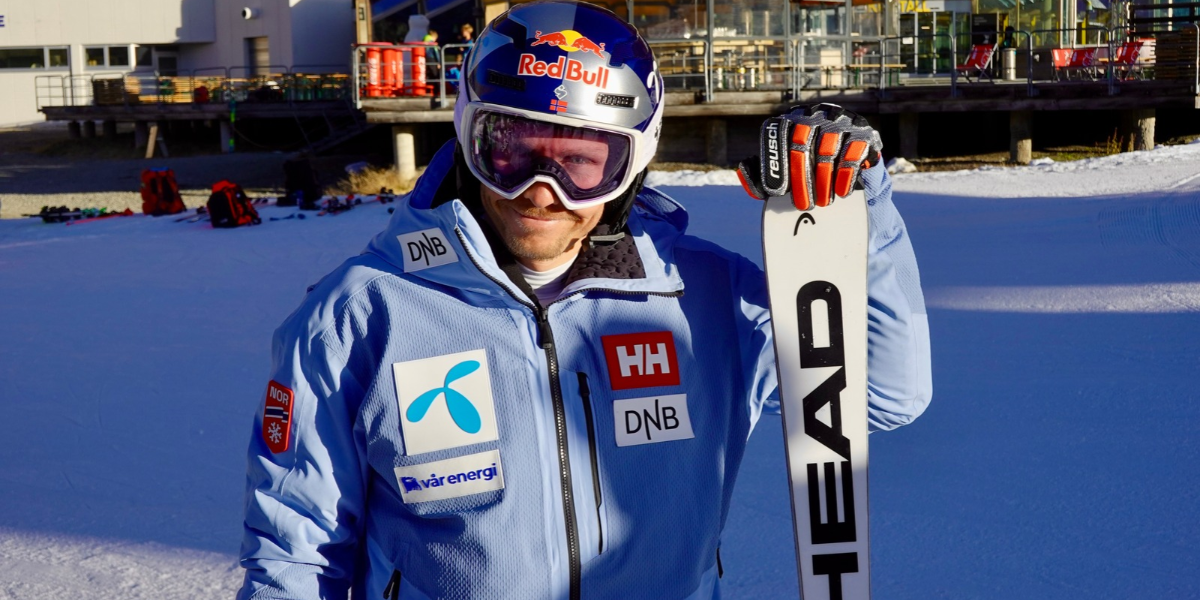
Henrik Kristoffersen did some serious spring cleaning after last season; he swapped out most of his gear. The holder of 102 World Cup podiums, 34 World Cup victories and six Olympic and World Championship medals has moved from Van Deer to HEAD. He enters the 2026-27 season with new skis, bindings and boots.
Recently, Kristoffersen and his father and coach, Lars Kristoffersen, spoke with Ski Racing Media about their equipment testing process and progress, as well as their goals heading into the new season.
Still More to Be Learned
Kristoffersen has changed equipment brands only twice during his extensive career. First, he skied 18 years with Rossignol, through the 2021-22 season (in a previous story), before racing on Van Deer for four years.
However, when he signed with Van Deer, he changed only his skis and bindings in the first season, while the switch to Van Deer boots came after the second season.
Now is the first time Kristoffersen has changed all three — skis, bindings and boots — at once.
“We are not experienced in changing brands,” Coach Lars said. “So, you never stop learning.”
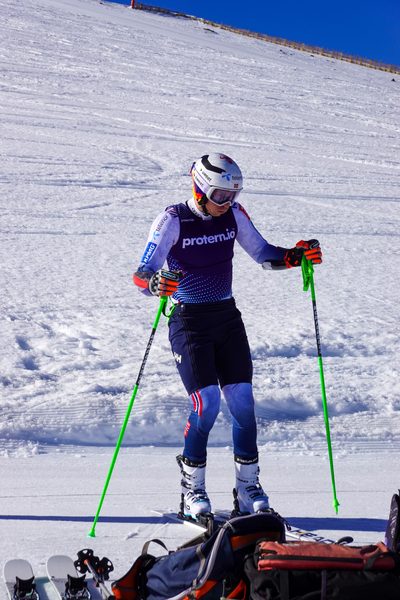
Comfortable Beginning
Has Kristoffersen found what he’s looking for in his new equipment?
“Yes, it feels pretty comfortable at the moment,” the experienced racer said.
“With the boots, it was very easy, slid pretty much straight in there. I had a little bit of problems the last four years with some numbness in the toes. When switching, it went away right away, and the boot suited me well.
“With the skis as well, no problems, felt pretty smooth from the beginning. And now, with the new service guy, everything feels quite comfortable at the moment,” Kristoffersen told Ski Racing Media.
“As long as I have things working 80 percent on 80 to 90 percent of the conditions, I’ll be fine,” Kristoffersen elaborated.
Searching for a Solid Base
His coach and father also sounded positive when discussing the preseason equipment testing:
Lars called the early results promising. He said Kristoffersen still has to adapt to the new equipment while the team makes small adjustments to suit him.
Finding a good base to continue working from is the current priority.
“I think it’s important to find a base. Now, we only use the basic models from HEAD; boots and skis. And then, it’s a little change of the plates and bindings, and we play a little bit with the setup as well.
“Trying to find this base — because if you get a little bit lost sometimes — you can always go back to something that probably works 80 percent, and then you can go from there. But if you get lost and you don’t have this base, then everything becomes difficult. So that’s the goal at the moment,” Lars explained.
Keeping things simple is also a goal, according to the coach:
“I think if you can keep it simple, it’s the best. The more complicated, the more chance of errors, the more chance of getting lost. So, if you can keep it simple and it works, that’s the best.”
The Equipment-Testing Process
How do you start testing with entirely new equipment? What process have you been through? Ski Racing Media asked Kristoffersen.
“First, you start with talking. And then, with me, I’ve been around for a long time; people know a little bit how I ski,” the 32-year-old racer said.
“I’m particular about some things, some small things. But I’m quite easy on other things. For instance, stiffness on the boots — as long as it’s not too stiff, I don’t really care that much.
“In terms of the angle of the boots, I’m a little bit more particular and switch a bit more when it comes to different types of conditions. And a little bit with the edges,” he explained.
After the initial talks comes the actual equipment testing.
“Sometimes, you try something that doesn’t work, but that’s part of the process. But I haven’t tried that many different things,” Kristoffersen said regarding the new HEAD equipment.
“Actually, starting skiing in August, I’ve skied on one sidecut in slalom and two in giant slalom, and that’s it. I’ve had some different constructions, but as long as it works, I don’t have to play around too much.”
Kristoffersen Feels Calmer
Kristoffersen seems to have found some peace of mind after the equipment change.
“I’m a bit calmer than I’ve been for quite some time. And the communication and philosophy are a bit different, which actually suits me really well,” he said during the Oct. 7 kickoff for the Norwegian Alpine Team.
One piece of the puzzle is his cooperation with new ski technician Niclas Cronsell. Cronsell previously worked as the technician for Lindsey Vonn, former Norwegian alpine skier Leif Kristian Nestvold-Haugen, and Loïc Meillard. Kristoffersen also knows him from the past:
“The first ski brand I signed a deal with was Rossignol, and Niclas was working for Rossignol in Norway and Sweden at the time. So, when I was nine years old, the person who actually gave me my first pair of Rossignol skis was Niclas, and now he is my serviceman,” Kristoffersen told the audience during the Norwegian kickoff.
Preseason Ski Camps
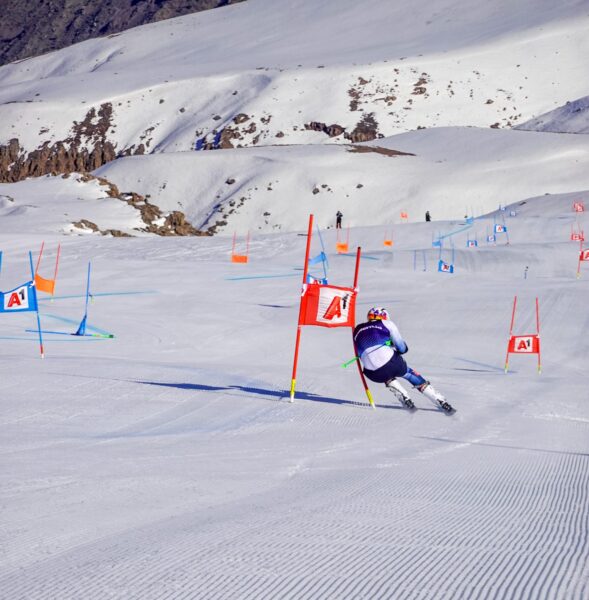
Kristoffersen and his team have skied and tested equipment for a few weeks since early August.
Like many other teams, they planned to train in Saas-Fee, Switzerland, but had to alter their plans when the area closed due to warm weather. Instead, they started the preseason skiing indoors in Wittenburg, Germany, for three days.
Next followed a three-week camp in El Colorado, Chile, before a one-week break at home. Then, the team spent two weeks of training in Ushuaia, Argentina, and returned home from South America in early October.
They had a mix of quality training and challenging weather.
“That’s just how it is at that altitude,” Lars explained. “The weather on 3,000 meters can be a challenge with snow and wind. But we got some good days in for sure.
“Ushuaia is always Ushuaia; it’s always difficult. Challenging to train there, but with the days we had from El Colorado, it was nice to come to Ushuaia to challenge a bit more,” he elaborated.
Ready for the Ice?
Has Kristoffersen been able to do the amount of testing he needs to find what works most of the time in most conditions?
“I think it’s looking quite good. Of course, we haven’t tested on pure ice, like Schladming. That’s difficult to get during preseason; that’s something you have to do during winter.
“Also, my new service guy has a lot of experience and has had athletes before who had a lot of grip on ice, so I think we’ll be fine there as well. I feel pretty comfortable at the moment,” Kristoffersen said positively.
Can Kristoffersen Catch Svindal’s Record?
Kristoffersen has always been interested in race-result statistics, and, to him, winning races is the most important goal.
Aksel Lund Svindal is the winningest Norwegian alpine skier with 36 World Cup victories. Kristoffersen has 34 so far. Will he surpass Svindal’s record this winter?
Kristoffersen believes he can still win races.
“You have to set priorities in life, and when you have a wife, two children, and travel for X number of days… I wouldn’t be doing this if I didn’t still believe in it. I would have prioritized other things in life, given everything I’ve achieved and everything I’ve been through,” he said while smiling during the team presentation in October.
Has Family Life Changed Kristoffersen’s Perspective?
In July, Kristoffersen’s wife, Tonje, gave birth to their second child, daughter Linnea. Tonje later developed a blood clot, and the couple shared the complications on social media to normalize the fact that childbirth is not always uncomplicated.
Kristoffersen told Ski Racing Media that the clot was discovered and treated quickly, and that Tonje is doing well.
He said becoming a father for the first time changed his perspective more, because he began thinking about how his choices could affect someone else.
“Of course, you always do that when you get a girlfriend, a fiancé or a wife as well, but it’s something different when you get kids, that’s for sure.”
The Road Ahead for Kristoffersen
Kristoffersen plans to continue racing through 2030, as long as he achieves the results he wants, namely podiums.
“I won’t keep racing if I can’t compete for wins and podium finishes. Every time I don’t make the podium, it’s a disappointment. As Aksel [Lund Svindal] once said, ‘Expectations rise in proportion to results.’ So, if you achieve good results, expectations are higher,” he shared during the team kickoff.
Kristoffersen has 271 World Cup starts, while Svindal finished his career with 387. Kristoffersen is ahead of Svindal in podiums, 102 to 80.
If Kristoffersen continues racing through 2030, his schedule could include the 2027 World Championships, the 2029 World Championships on Norwegian snow in Narvik, and the 2030 Olympics.
In terms of championship medals, Norwegian Kjetil André Aamodt leads alpine skiing’s combined Olympic and World Championship medal count with 20 medals: nine gold, six silver and five bronze. Mikaela Shiffrin and Anja Pärson trail Aamodt with 19 medals each.
Kristoffersen’s Strengths This Season
Kristoffersen has been in the game for a long time, making his first World Cup start in March 2012 and securing his first World Cup victory in 2014.
What does he see as his strength going into this season?
“Good question; I think there are a lot of things. The ability to adapt has always been one of my strong sides, so I think I will be able to adapt pretty quickly. As long as I have something that works 80 percent on 90 percent of the conditions, I’ll be fine. So, I don’t need things to be perfect, but, of course, there is a limit for me as well.
“At the moment, I think we are far within those limits, but training is training and racing is racing. You never really get the answer before you start racing.”
Kristoffersen has sometimes struggled to find an equipment setup that works best for him in races. For the upcoming season, he hopes for something different:
“I hope that I don’t have to talk that much, and that I can just let the skiing and the results talk for themselves.”
About the Author: Bente Bjørnsen Sherlock