
Someone in Your Corner: Inside World Cup Dreams’ Mentorship Program
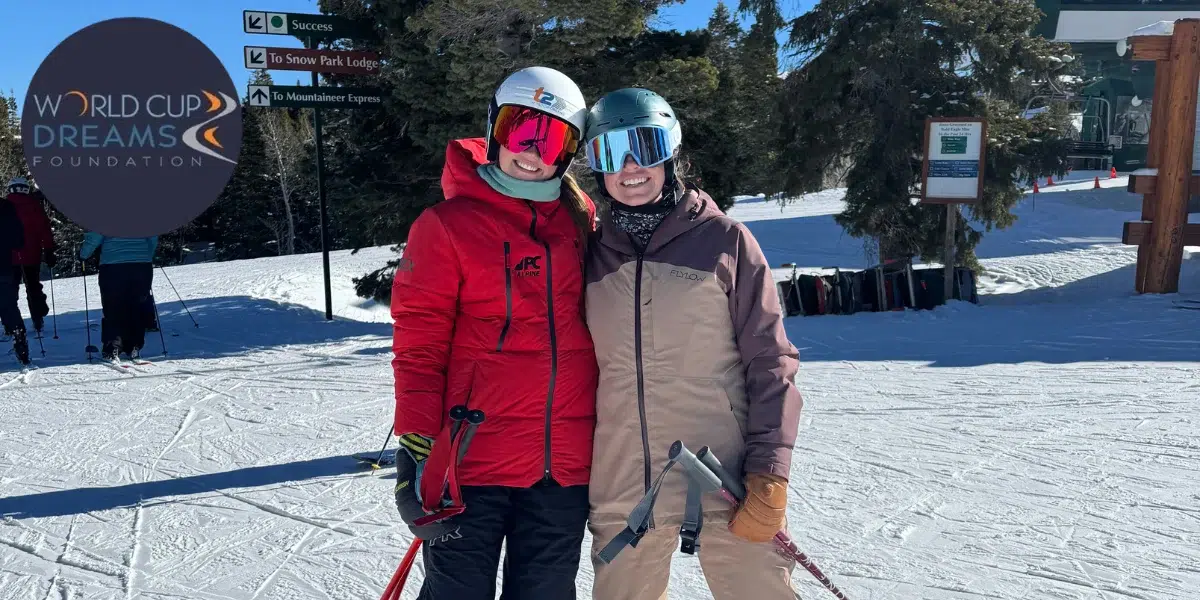
Featured image: World Cup Dreasms Mentee Dyllan Guay skiing alongside her mentor, Abby Ghent.
Led by former World Cup speed skier Alice Merryweather, the program connects young racers with athletes who understand the decisions, setbacks and uncertainty that come with chasing the next level.
When Dyllan Guay started to panic before her first super-G race of the season at U.S. Nationals, she knew who to call.
She had not raced the discipline in more than two years. She needed skiing advice, but she also needed someone who could help her settle her nerves.
She called Abby Ghent.
“She gave me both technical skiing advice and the reassurance I needed to calm my nerves,” Guay said.
The two were connected through the World Cup Dreams mentorship program. What began as an opportunity to learn from an experienced racer has become a relationship Guay now considers one of the most important in her skiing career.
For Alice Merryweather, the former World Cup speed skier who developed and leads the program, that kind of connection is the point.
Young racers have plenty of questions. Sometimes, what they need most is someone they trust enough to ask.
Building the Support Merryweather Wished She Had
The mentorship program became Merryweather’s first major project after joining World Cup Dreams as an intern following her retirement from racing.
She was given the freedom to build it around the athletes she felt could benefit most. She chose the foundation’s On the Rise group, young racers navigating the early FIS years and decisions about school, postgraduate seasons and their future in the sport.
Those were familiar questions.
As a student at Stratton Mountain School, Merryweather had supportive parents, strong coaches and friendships throughout the racing community. Still, traveling to Nor-Ams and following a different schedule from many of her school teammates could feel isolating.
“Despite being surrounded by other ski racers, a lot of times I felt really alone,” Merryweather said.
She remembers trying to decide whether to attend college after high school, take a postgraduate year or commit to another season. The people around her cared, but she wanted to hear from someone who had already faced those choices.
“I didn’t have anyone telling me what they had done and what their experience had been,” she said.
The program creates that opportunity. Now in its third year, it includes 31 mentors working with 37 athletes, according to Merryweather. Mentors include current racers and retired athletes, with pairings shaped by discipline, geography, career goals and interests beyond skiing.
A Relationship That Takes Time
Connecting two people is only the beginning.
During the first year, Merryweather gave pairings considerable freedom to find their own rhythm. Some connected easily. Others needed more help getting the conversation started.
The program now includes an introductory meeting, time for pairs to establish how they want to communicate, and suggested monthly conversation topics. Those resources encourage mentors to ask about school, friendships and how athletes are feeling physically and mentally, alongside their skiing.
The goal is to help a relationship develop naturally.
“It takes a lot of buy-in on both sides,” Merryweather said. “But when they make that work and when they stay in touch really frequently and consistently, that’s when we see the most success.”
The program’s 2026 post-season survey, which drew responses from 19 athletes and 15 mentors, offers a similar picture. Athletes who reported frequent communication, including texting, gave the program an average benefit rating of 6.43 out of 7. Those who reported no meetings with their mentor averaged 2 out of 7.
That contact can be simple: a text after a race, a message before a difficult training block or a conversation that has little to do with skiing.
Over time, those exchanges make it easier to ask harder questions.
When an Injury Changes the Season
Guay grew up in Ogden, Utah, with skiing built into family life. Her parents met while racing for the University of Utah and later coached her on the Snowbasin ski team.
She attended the Winter Sports School in Park City and spent the past five years training and racing with the Park City ski team. This year, she earned a place on the University of Utah team, taking another step toward her goal of racing on the World Cup.
When she first joined the mentorship program, she expected to connect with someone who understood that ambition. She did not yet know how much she would need that support.
During her first year working with Ghent, Guay injured her back in preseason. Initially, she did not think it would become a major setback. As the season progressed, she realized she would miss her second year of FIS racing.
“Abby became one of the most important people in my life during that time,” Guay said. “She understood my frustration while keeping me grounded and focused on the bigger picture.”
Their relationship was still new, but Ghent became someone Guay could turn to through the uncertainty of a lost season.
“It was one of the most difficult periods of my career, and I could not have gotten through it without her,” Guay said.
Since then, Ghent has helped her plan seasons, narrow her focus and find inspiration away from the hill, including through reading.
The lesson Guay returns to most is patience.
“Not everything has to happen right away, good things take time.”
Knowing When to Listen
Ghent has been a mentor since the program began. She describes the role in familiar terms.
“Being a mentor feels like being an older sister,” she said. “We gab, we vent, we get down to business.”
Understanding when to listen and when to offer direction has been part of her own learning.
Ghent grew up with parents who coached, two older sisters who raced and a strong support network at her home club in Vail. Looking back on her career, she still wishes she had asked more questions and found more people within the system who believed in her.
“I wish I could have understood the whole picture better and advocated for myself better,” she said.
That experience shapes how she supports young racers now. Often, she finds the most valuable moments are the ones without an immediate solution.
“The ‘small’ moments are where I feel my impact is strongest,” Ghent said.
A coach may be focused on helping an athlete move forward. A parent may offer reassurance that they are proud regardless of the result. A mentor can also make room for disappointment.
“Sometimes it feels good to hear that it’s ok to be sad or mad or disappointed in that moment,” she said.
Merryweather sees particular value in having someone outside an athlete’s daily training and selection structure. Mentors offer experience without deciding who gets a race start or how a season is funded.
“They’re not the ones making any decisions, financial or selection related,” she said.
That can give athletes room to speak openly.
Helping Athletes Find Their Own Direction
One question comes up repeatedly in Ghent’s conversations with young racers: Which direction do I go?
It is a question she understands, while recognizing that the options keep changing. The path that worked for her sisters was different from her own. Today’s athletes face another set of decisions, particularly around postgraduate racing and NCAA opportunities.
Her experience gives her perspective, but each athlete needs room to work through their own circumstances.
Merryweather also considers interests beyond racing when making pairings. For athletes exploring college majors or future careers, a retired racer can offer a useful view of what comes next.
“I think for the athletes to see their mentors thriving post-ski racing is really important to show them that your life doesn’t end when ski racing ends,” Merryweather said.
That broader perspective also emerged in the post-season feedback. Mentality and psychology were the most frequently reported discussion topics, cited by 12 athletes, followed by general ski career guidance, cited by 11.
Although only four athletes reported discussing life beyond sport, that group gave the program the highest average benefit rating of any topic group: 6.5 out of 7. Conversations about school, strength and conditioning, and injury rehabilitation were also associated with average benefit ratings above 6 out of 7.
The responses suggest that much of the program’s value lies in helping athletes navigate the demands surrounding their racing.
Mentors can also help athletes find additional support when needed. Merryweather encourages them to reach out when a concern requires expertise beyond their role, and she has helped connect mentors with appropriate resources for their athletes.
The relationship provides another person paying attention and willing to help.
Support That Lasts Beyond a Season
Merryweather surveys mentors and athletes midway through the season and again at its conclusion.
In the report’s year-over-year comparison, athletes’ average rating for help toward their goals increased from 4.40 out of 7 in 2025 to 4.89 in 2026. About 61 percent of athlete respondents said they planned to stay in touch with their mentor after the program.
Some pairings have continued through all three years of the program. Others maintain their relationship even after an athlete moves beyond the On the Rise group or changes direction.
For Guay, the value is clear. Ghent has become someone she can call about a race, a setback or a decision she is struggling to make.
“It’s not that I have ever been uncomfortable asking an experienced racer for advice,” Guay said. “I just never had the opportunity until I met Abby.”
Now, she has someone in her corner.
About the Author: Katie Twible
Related Post





