
Could Neck Training Improve Ski Racing Performance and Reduce Concussion Risk?

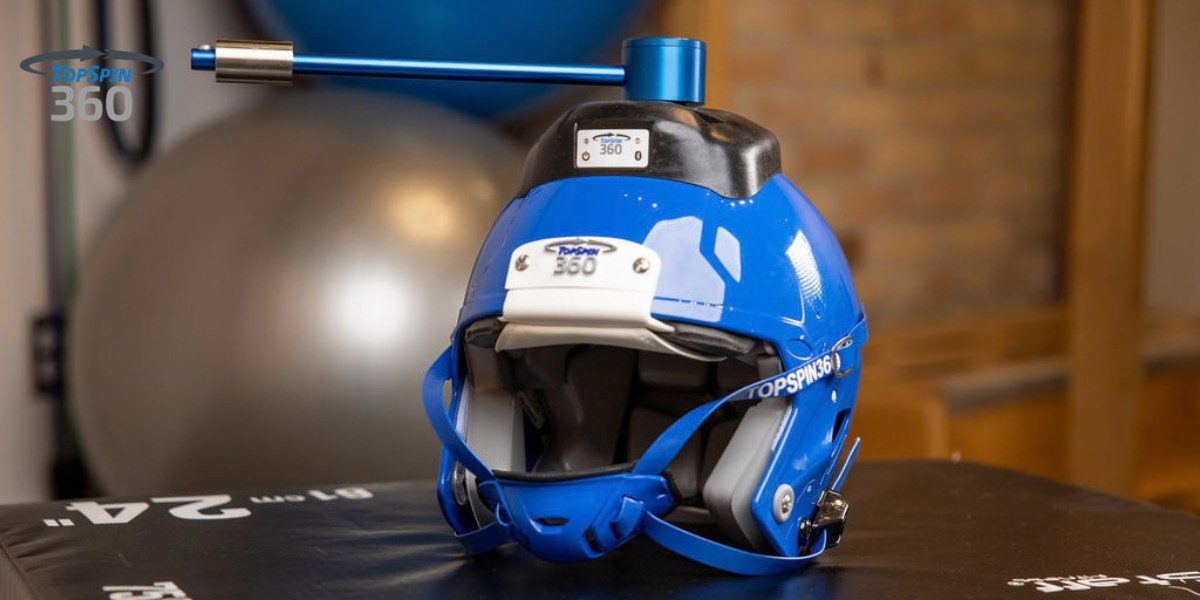
Featured image: TopSpin360 training equipment.
Dr. Theo Versteegh believes dynamic neck training could help racers control their heads, keep their eyes steady and respond to terrain, while adding another tool to injury prevention efforts.
Ski racers spend countless hours training their legs. We build strength to hold a turn, power to get out of it, and the ability to absorb whatever the course throws at us. We train balance on unstable surfaces and practice reacting to things we cannot predict. But how much time does a racer spend specifically training the neck?
I first came across TopSpin360 when I was coaching the Ontario women’s provincial team. We had a group of athletes returning from serious injuries, and I was looking for every bit of support I could give them. TopSpin360 became one piece of that broader approach. What stuck with me was that the athletes noticed a difference in how their helmets felt, and it made me think differently about a part of the body we rarely discuss in ski racing.
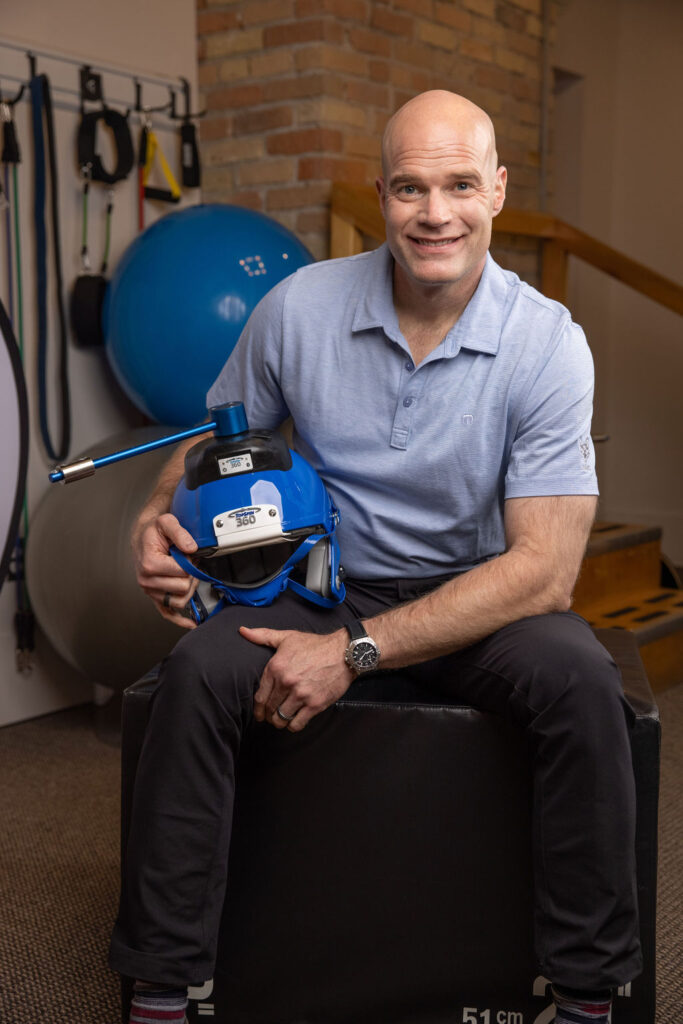
I recently spoke with Dr. Theo Versteegh, a physiotherapist and the inventor and co-founder of TopSpin360, about why he believes the neck deserves a place in a racer’s training program. Versteegh has spent more than 20 years in sports medicine. Before his work as a physiotherapist and researcher, he played football for Western University in London, Ontario, Canada, as part of a national championship team. He went on to study physiotherapy and neuromuscular training, earning his PhD in 2016. His interest in neck training grew out of both the demands athletes face and the question of how they can prepare for them.
We talked about concussions, but the performance side of the conversation interested me just as much. A racer can know exactly where they want to go and still struggle to get the skis there when the course starts pushing back.
What the neck has to do on snow
Think about a speed skier coming through a compression, or a slalom racer hitting a rut midway through a turn. The skis and legs may change direction abruptly, but the athlete still needs to see what is coming and organize the next movement. Versteegh’s point is that the neck has a role in keeping the head controlled while the body underneath it accelerates, rotates and reacts to terrain.
Balance and spatial orientation draw on information from the eyes, the vestibular system in the inner ear and proprioception, our sense of where the body is and how it is moving. The neck supplies information about where the head is relative to the torso. A racer needs those signals to work together at speed, often while the point of contact with the snow is several feet below the head.
“As you’re going down, you’ve got to keep your eye line and horizon to know exactly where your body is in relationship to gravity,” Versteegh told me. He argues that a steadier head and visual reference could help an athlete respond more accurately to what the course is doing. We ask racers to keep their eyes up and look ahead even when the terrain is doing everything it can to pull them out of position. It makes sense to consider whether the neck is prepared to help them do that.
Versteegh describes it as the difference between being able to “see your line” and being able to “ski your line.” A racer may recognize the right path through a section but still need to organize the head, torso and skis quickly enough to take it. That connection can be especially difficult for an athlete dealing with symptoms after a concussion or neck injury, which calls for proper clinical assessment. Even for a healthy racer, it raises a useful performance question: are we training all the systems involved in turning what the eyes see into movement on snow?
Training more than raw strength
The neck is made up of layers of muscles that produce force, control movement and help stabilize the head. Yet neck work, when it appears in a training plan at all, often means pushing against a band, a partner’s hand or another fixed resistance in one direction at a time. Those exercises can build strength. Versteegh is interested in how quickly and effectively the neck responds when the load changes.
He compares conventional neck training to holding a camera steady on a tripod. A ski racer has to keep that camera steady while the ground moves beneath it. The forces arriving through a turn, compression or landing do not wait for the athlete to brace in one predictable direction. If the head is moving around, the racer still has to pick up the next gate, read the terrain and place the skis accurately.
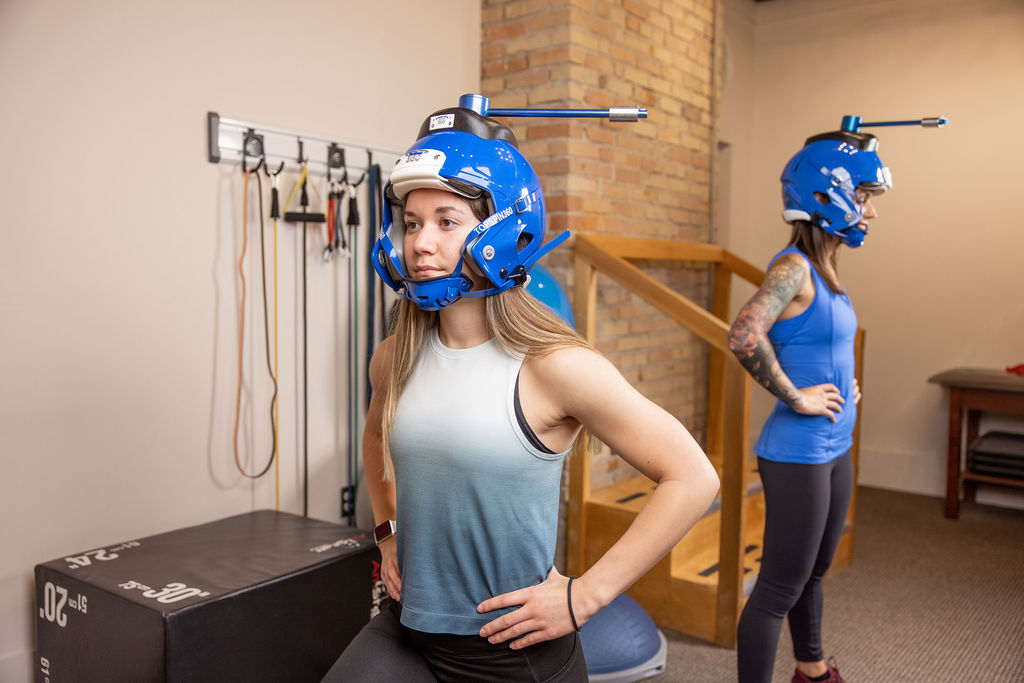
TopSpin360 is designed around that changing load. It resembles a training helmet with a weighted arm mounted above it. The athlete generates the movement needed to keep the weight rotating and works to control the head as the resistance shifts. Versteegh likens starting the rotation to getting a hula hoop going.
“That is really where TopSpin360 fits,” Versteegh explained. “Instead of training one direction at a time, it challenges the neck dynamically across all three planes of motion while the athlete tries to maintain head control and keep their vision stable. As the athlete becomes more proficient, the rotational speed and rate of directional change can increase, requiring faster and more coordinated neuromuscular responses.”
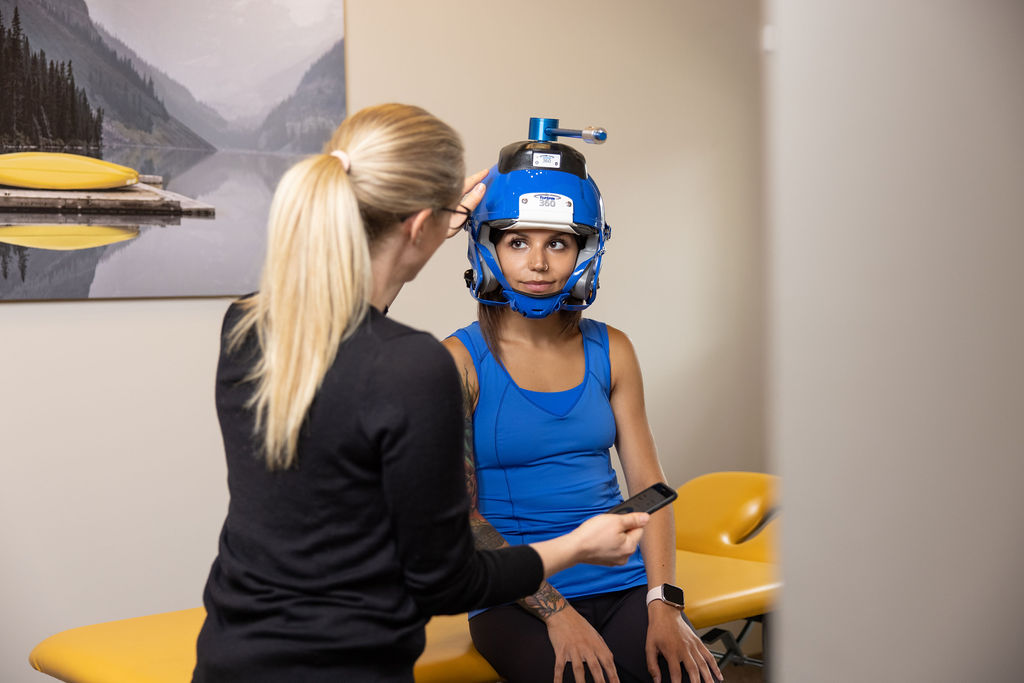
The device’s app records training sessions and measures such as rate of force development: how quickly the athlete can produce force, rather than only how much force they can produce. That distinction is easy to picture on snow. A skier may be strong enough to hold a position when everything is predictable. When a ski catches an unexpected rut, though, the adjustment has to happen immediately.
“In that sense, the objective is not simply to build a stronger neck; it is to build a better stabilization system,” Versteegh said. “One that can respond quickly and efficiently when the forces are multi-directional, unpredictable and constantly changing.”
Versteegh believes dynamic neck training can better prepare that response, giving the racer a steadier platform for vision and spatial awareness. He says a team could fit TopSpin360 into dryland training with sessions of about two minutes, two or three times a week, after coaches and athletes have been shown how to use the equipment. For a team already spending hours on strength and movement quality, it is a relatively small addition aimed at a job the neck performs on every run.
Performance and prevention
The injury question is what first draws many people to neck training. Concussions have ended seasons and altered careers in ski racing, and coaches want to know whether there is anything useful they can do before an athlete crashes. But Versteegh does not see performance and prevention as separate reasons to train. The ability to control the head quickly as forces change matters when a racer is fighting to stay on line, as well as when a run goes wrong.
Research provides another reason to give neck training a place in athlete preparation. A 2014 study of more than 6,700 high school athletes found that greater neck strength was associated with lower odds of concussion. For Versteegh, that relationship is part of the rationale behind TopSpin360: developing a neck that can produce force and respond quickly as the load changes. For ski programs, it adds an injury prevention reason to explore training a part of the body that also helps racers control their heads and maintain their visual reference on snow.
A published 14-week pilot study using TopSpin360 found improvements in dynamic neck strength, including rate of force development, a measure of how quickly force is produced. That finding supports the training principle behind the device: preparing the neck to respond to changing loads. Versteegh sees that ability as particularly relevant to ski racing, where athletes must control their heads and maintain a clear visual reference while reacting to ruts, compressions and sudden changes in terrain.
My own experience in Ontario is part of why I wanted to have this conversation. After seeing so many injuries, I wanted to find every way I could to help our athletes train, improve their performance and reduce their risk of getting hurt again. We were already working hard to make them stronger and more confident in their return to snow, and TopSpin360 offered another way to prepare them for the physical demands of racing.
That is the case Versteegh is making to ski programs now. He sees a quicker, more coordinated neck response as valuable throughout a run, helping athletes keep their eyes steady through rough terrain, stay organized over their skis and react to the next turn. For coaches, TopSpin360 offers a practical way to train a part of the body that racers rely on every time they leave the start gate.
Versteegh has made me reconsider a gap in the way we prepare ski racers. We ask the neck to help keep the head and eyes organized through every turn, rut, compression and landing, while we devote far more training time to the legs doing the work below. TopSpin360 offers teams a practical way to start training that part of the system, with the potential to support both performance and injury prevention.
About the Author: Katie Twible
Related Post





