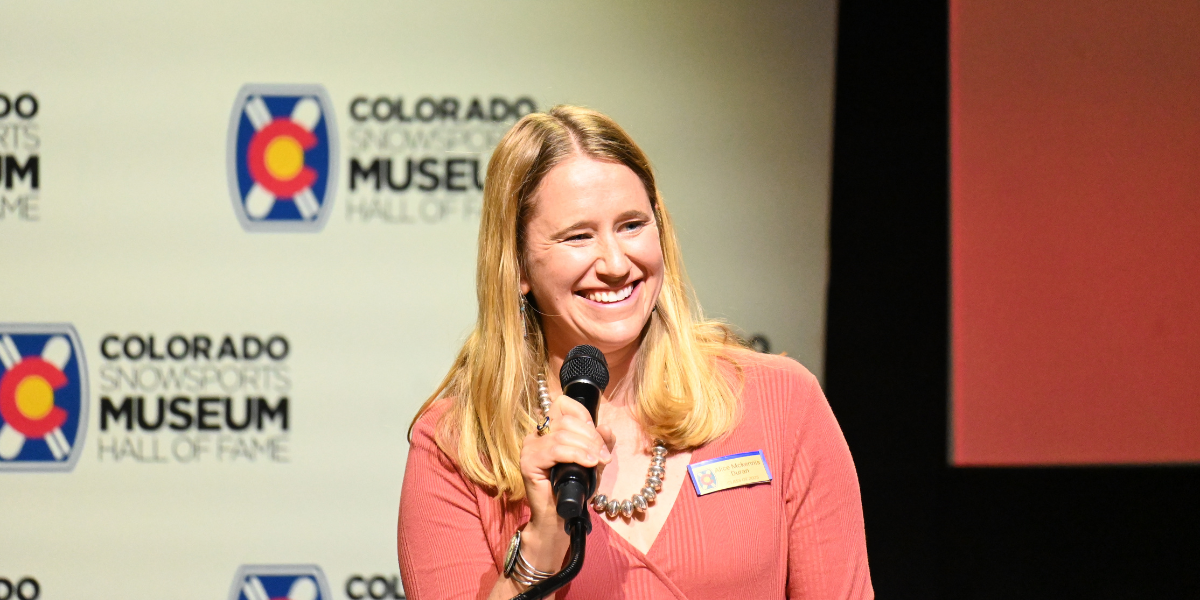
Alice McKennis Duran Photo/ Meredith Guinan
Former ranch hand Alice McKennis Duran, known in her racing days as Alice McKennis, is among America’s most resilient downhillers and one of only three Colorado-born alpine skiers to win a World Cup.
In 2014, around the time of the Sochi Olympics, McKennis was in Vail rehabbing from one of her many career injuries. She wandered into the Colorado Snowsports Museum and saw an exhibit for the Vancouver Olympics. Inside was a plaque with her name on it along with her teammates from the 2010 U.S. Olympic Alpine Team. She took a photo.
“I still have a picture of it on my phone,” she said. “I thought it was so cool, so badass, seeing my name in there.”
Now her name is permanently etched in the museum—and in Colorado ski history.
One of America’s lowest-profile yet most impactful downhill skiers, Duran joined a select group of historic greats this September when she was inducted into the Colorado Snowsports Hall of Fame.
From spurs to ski boots
Growing up on a ranch in Newcastle, Colo., Duran’s rise to success on skis was far different than most World Cup-level athletes.
“Our house was about a half mile from the main barn and corrals. As a kid, I remember mornings, riding my bike down and being there all day, clearing the irrigation ditch, cleaning corrals, whatever else needed to be done,” says Duran, who at age 5 lost her mother to a car accident and tackled the ranch chores alongside her father, Greg, and older sister, Kendra.
“I grew up on a ranch, not in a ski community. Skiing was something my dad was passionate about, but he was not a ski racer, not a ski coach. It was a setting where no matter what happened, you picked yourself up by your bootstraps and got on with the work,” she said.

Finding her way onto snow
In the winter, the ranch chores subsided and Greg McKennis took his daughters to the nearest slopes – Sunlight Mountain Resort, an independently owned ski hill about 25 miles away.
“I attribute a lot of my early success to my dad,” Duran says. “He saw that I had some talent and put me in various clubs that could support it. It shows you don’t have to be from Vail or Aspen or a big, iconic ski racing community. It’s totally possible to make it to the highest level being from a place like New Castle, skiing at a place like Sunlight.”
Duran started racing gates with Sunlight Winter Sports Club, then explored racing in Vail, Aspen and Steamboat Springs while her father homeschooled her and her sister. She fell in love with downhill and super-G at age 13 and by 16 was scoring points on the NorAm circuit.
“With the nature of ranching, winter was an easy time to be away. We did Vail, Steamboat, Aspen, Summit County. A lot of times, ski racing meant commuting from New Castle. There was a lot of time in the car. Still, skiing for my dad, my sister and I, it was a positive outlet, something we latched onto after the tragedy of losing my mom.”
Huge highs and long lows
Named to the U.S. Ski Team, she made her World Cup debut in 2008 and by the following year scored her first top 10 in a World Cup downhill at Lake Louise. Although she skied off-course in the 2010 Olympic downhill, Duran continued landing top 15 results on the World Cup downhill circuit up until the first of many major injuries.
She broke her left leg – a terrible tibial plateau fracture – in a training crash in Austria that took her out for the entire 2011 season. Duran bounced back, landing a then-career-best eighth place in her first World Cup after injury—the Lake Louise downhill in December 2011. She struggled with consistency through most of that season, but by spring 2012, she notched another pair of top 10s.
Breakthrough season
Click Images to enlarge
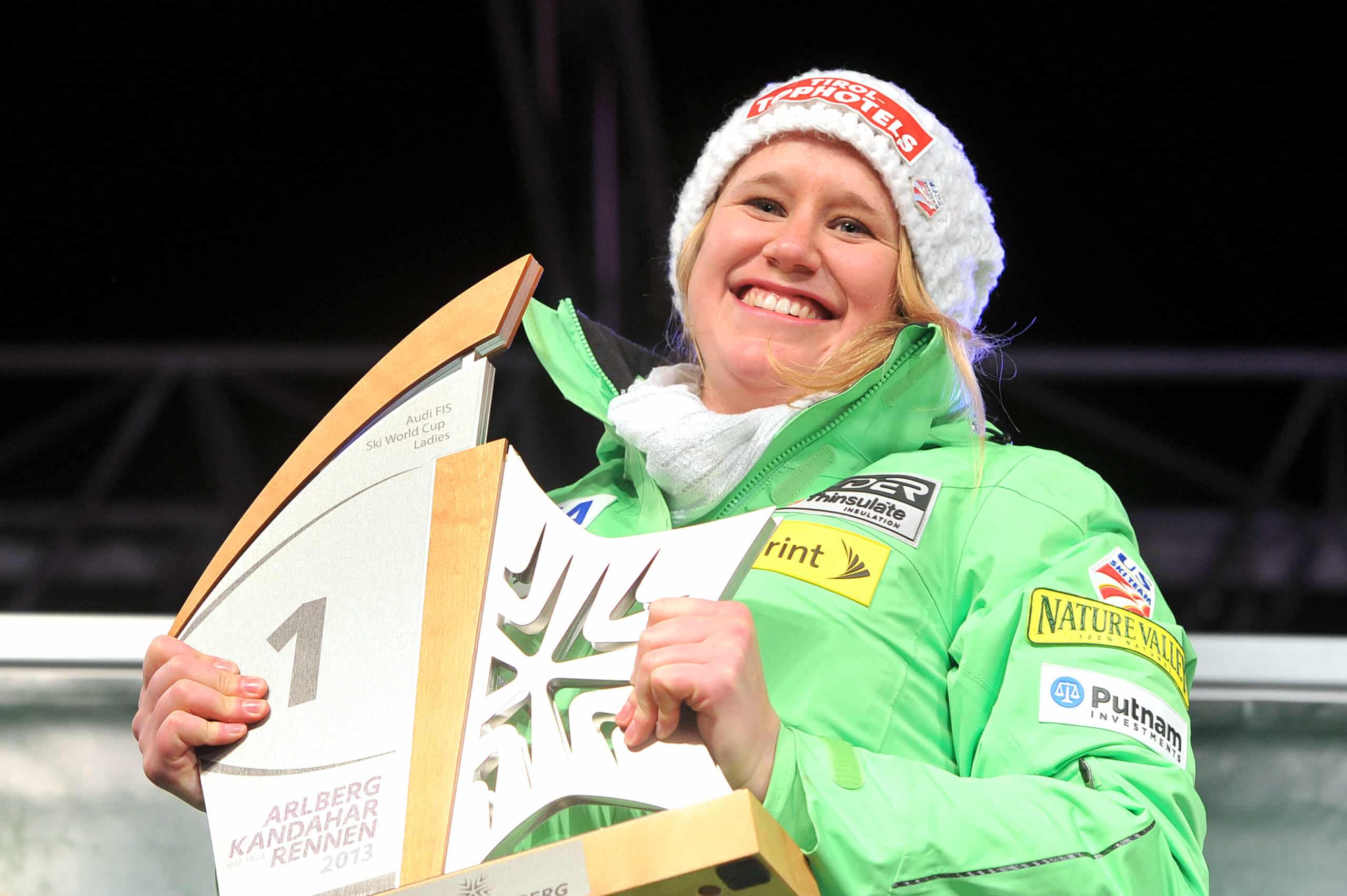
The most successful season of her career came in 2013. Duran, who would take on the nickname “The Aligator,” landed the only World Cup victory of her career in the notoriously steep and technical St. Anton downhill—what her former U.S. ski coach Chip White described as “the Kitzbuhel of women’s ski racing.” In doing so, she became one of only three alpine skiers (along with Mikaela Shiffrin and Sarah Schleper) born in Colorado to win a World Cup race.
Less than two months later, a crash in Garmisch-Partenkirchen shattered her right tibial plateau. Doctors sidelined her for nearly a year, and she missed the 2014 Olympics. Once again implementing the “bootstraps” ethos she grew up with on the ranch, Duran put her head down, did months of physical therapy and strength building, and charged back.
She returned to top 12 World Cup finishes until another crash in February 2016 shattered her elbow. She returned to the surgery table and recovery room. In 2016-17, The Aligator struggled with consistency on the World Cup but built some confidence in NorAm, landing a couple of wins and podiums. With another Olympics looming in 2018, Duran surged back to form, landing her first top 15 in World Cup super-G and missing an Olympic medal by just 0.15 seconds in the 2018 Pyeongchang downhill.
Chutes in her honor
“If you look at that accomplishment, it was like one tenth of a second difference between fifth and third. We were blown away when we watched. She claimed Sunlight as her home mountain. She could have claimed Aspen or Vail,” said Troy Hawks, formerly of Sunlight Mountain, who, along with letters from Sunlight’s former General Manager Tom Jankovsky and former U.S. Team President Bill Marolt, nominated Duran for the Colorado Snowsports Hall of Fame.
Following her 2018 Olympic performance, Sunlight named three steep, gladed chutes—some of Duran’s favorite childhood lines—“Aligator Alleys” in her honor.
“She made it back to the ski area that March to be with our ski racing kids,” Hawks said. “That was huge, to see this U.S. Ski Team jacket zipping around Sunlight. She had a posse of like 30 or more kids, plus a bunch of 60-year-old men chasing her around the mountain.”
The last crash
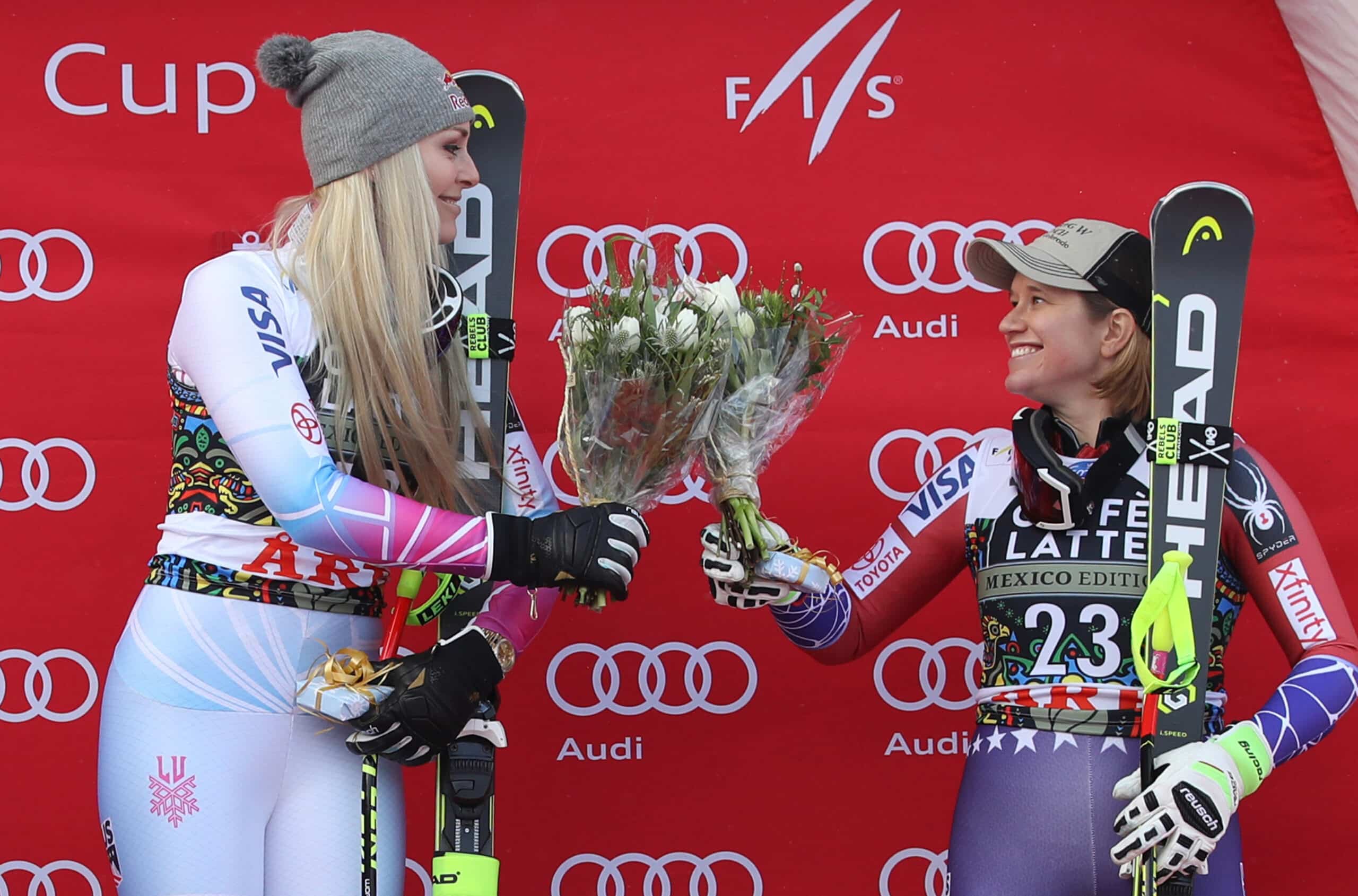
By the end of that 2018 season, Duran was back on the World Cup podium. She took third at the World Cup Finals downhill in Åre, Sweden, sharing the podium with winner and teammate Lindsey Vonn.
That rise to glory was followed by a painful plunge. She broke her left leg in May 2018, requiring five surgeries over several months. Nonetheless, she returned to the gates more than a year later in December 2019, saying at the time that she felt strong and like she was skiing better than she ever had.
She threw down a 10th in downhill and 13th in super-G back-to-back at the Lake Louise World Cups and proceeded to build back to consistent speed before the world shut down in March 2020.
Final comeback and retirement
The next season, a crash in Val d’Isere that caused a broken ankle and torn knee ligaments was the last setback Duran wanted to endure. She announced her retirement in spring 2021 at age 31.
Grit and recognition
Although her racing career was riddled with injuries and at least 13 surgeries—more than almost any U.S. alpine skier in history—her resilience gave her work ethic even greater depth and respect.
“Her journey is incredible,” Hawks said. “It really defines the grit and determination of rural America. All the surgeries she went through and came back from, she stuck with it. She’s tough as nails, but so soft-spoken and modest. Her grit and determination, she’s a perfect representative for the Hall of Fame.”
A lesson in determination
Duran expressed her appreciation for joining such ranks during her induction speech at Beaver Creek this September.
“Reflecting on my ski racing career, I’m filled with so much gratitude,” she said. “It was never easy, but it was mostly a lot of fun. I had many challenges, incredible highs, and just countless memories I’m going to take with me forever.”
Following retirement, Duran coached for Ski and Snowboard Club Vail and recently took a coaching job with the U.S. Development Team. She and her husband, Pat Duran, had a baby—Darby Duran—a year and a half ago, and live in Minturn. She says that coaching has given her a fresh perspective on the sport.
“It’s nice to share your knowledge and have an impact on athletes,” she says. “It’s rewarding in a different way as a coach. You’re seeing them succeed, seeing them figure it out. It’s cool to see some of these young people see the passion they have for it. You never know where it leads. I think back to when I was their age, going through these steps.”
Looking back
In her acceptance speech, Duran said that coaching has also widened her reflective lens on her own career.
“Back then, the focus was so constant and the urgency was relentless,” she said. “It was so intense, it never felt like I was achieving enough or pushing myself fast enough. But now I see how extraordinary it was. I can say it was incredible, and I was incredible. I see how razor thin the margin is to make it to the top and make it to where I was, and how grueling that path can be. It leaves me thinking, how on Earth did I do that?”
She did. And now she has the Hall of Fame status to prove it.

About the Author: Shauna Farnell