Featured image: FIS Para Snow Sports
Three Paralympic Games. A Paralympic gold medal. Years as one of the most recognizable and fearless racers on the World Cup circuit.
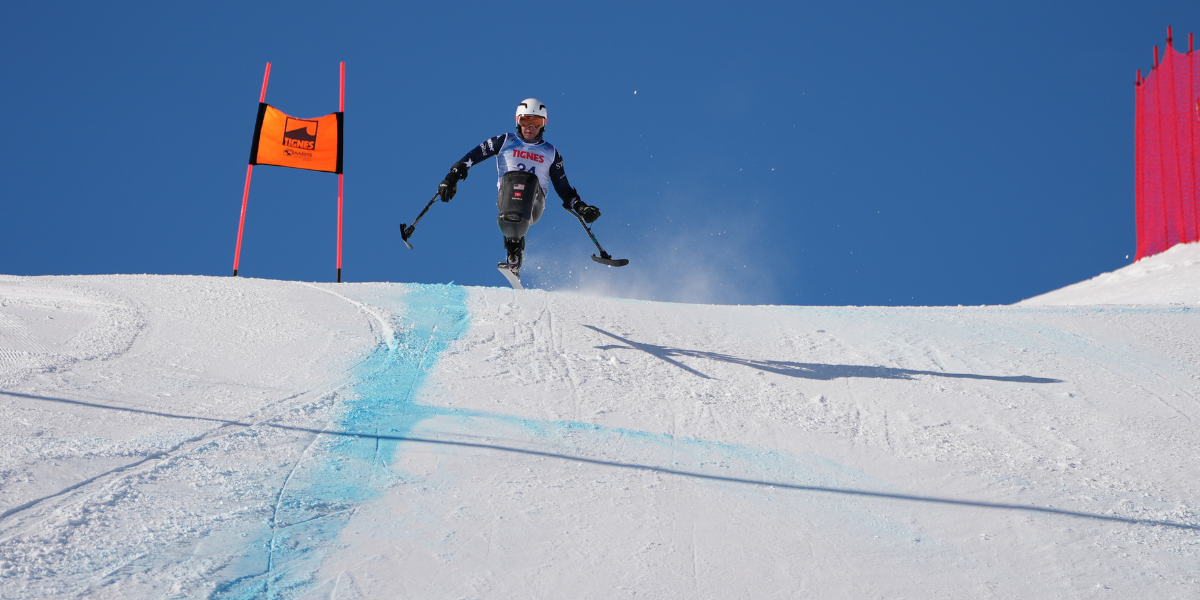
For U.S. Para alpine skier Andrew Kurka, the journey from a fearless young athlete to a seasoned competitor has been shaped by injuries, adversity, and an unwavering determination to keep moving forward. A native of Palmer, Alaska, the 34-year-old was a dominant wrestler in his youth, claiming six state championships before an ATV accident at 13 left him with a spinal cord injury. While recovering, he discovered mono-skiing through Challenge Alaska, turning what began as therapy into a new competitive pursuit.
Now a three-time Paralympian, Kurka most recently claimed bronze in the men’s super-G at the Milano Cortina Paralympic Winter Games, adding to a career that already includes a Paralympic gold medal and years as one of the most fearless competitors on the World Cup circuit.
“When I went to my first Games, it was all about racing as fast as I could from top to bottom,” Kurka said. “Danger didn’t really represent who I was. It wasn’t something I focused on.”
That mindset has evolved over time. Today, Kurka approaches racing with a deeper understanding of risk and recovery. The focus is less about reckless speed and more about purposeful progression.
“I’ve taken that method of fear and turned it into something logical,” he explained. “Through injuries, I learned that the way you recover is by taking the next step. Overcoming the next challenge. Slowly but surely, you gather your thoughts and get better.”
That same philosophy now defines his approach to ski racing.
Racing for Something Bigger
Kurka has long been a consistent force on the World Cup circuit, but his motivation extends beyond podiums and medals.
“My family keeps me motivated every single day,” he said.
That family includes not only those closest to him, but also the young athletes who look up to him.
“For a long time, I thought failure wasn’t an option,” Kurka said. “But after failing an uncountable number of times, I realized this career might be about something more. It’s not just about my family back home or my future family. It’s also about the young athletes I’m able to inspire. I consider them family too.”
Built in Alaska
Kurka’s relentless work ethic traces back to his upbringing in Alaska.
Raised on a homestead in a Russian village on a 640 acre farm, his childhood revolved around hard work and the outdoors.
“You wake up early and you work hard until it’s bedtime,” Kurka said. “That built me into the man I am today.”
Those values shaped the foundation of his athletic career.
“Grit, tenacity, and work ethic are the things I’ve carried into life and into ski racing,” he said.
Fearless Lines
Kurka’s reputation in the sport has often been defined by his willingness to push limits.
One of the most memorable examples came when he became the first person to mono ski the Christmas Chute at Mount Alyeska, a steep and intimidating line in Alaska.
His mindset at the time was simple.
“Hell yeah, let’s do it,” he said.
Looking back, Kurka admits that youthful fearlessness has softened with experience.
“I was young and wanted to prove I had everything it took,” he said. “Now I’m older and wiser. But whenever I see a challenge, I still love it and I take it.”
Life Beyond Racing
While ski racing remains central to his life, Kurka has also built a future beyond the sport.
Using prize money and sponsorship earnings from the PyeongChang Paralympics, he created a bed and breakfast in Alaska designed to help people with disabilities experience the outdoors.
The inspiration came unexpectedly when a follower on Instagram, an individual with a disability, visited and joined him on a fishing trip.
“When I took him fishing, I noticed my passion for life changed his,” Kurka said. “He’s come back every year since.”
That experience helped shape the vision behind the lodge.
“I realized I love giving others the opportunity to enjoy the outdoors the way I do.”
Finding Freedom
Outside of racing, Kurka finds freedom in activities that still allow him to explore nature. Fishing, boating, and flying, the latter made possible by his pilot’s license.
“For someone with a disability, freedom is getting back to your new normal,” he said. “There are things I can’t do anymore the way I used to, like hiking up a mountain or rock climbing on my own.”
But the ocean and the sky provide their own sense of adventure.
“Fishing, flying, boating. Those things give me the adventure I seek,” he said. “That’s where I find peace in nature.”
A Message to the Next Generation
After three Paralympic Games and years of elite competition, Kurka’s advice to young para athletes is simple.
“Work harder than everybody else and don’t quit,” he said. “That’s how I got here.”
The Legacy of Not Quitting
When Kurka reflects on the legacy he hopes to leave in para alpine skiing, the answer comes down to two words.
Grit and tenacity.
“I want to be remembered as the person who simply didn’t quit,” he said.
His aggressive style and fearless line choices have already earned him a reputation on the World Cup circuit.
“I’ve kind of grown a legacy of being the crazy one,” Kurka said with a smile. “I’d run lines nobody else would run, even if it meant crashing or breaking bones.”
Today, he sees those moments differently.
“Those broken bones equal grit,” he said. “They equal tenacity. The fact that I kept coming back is what makes me who I am.”
For Andrew Kurka, success has never been defined only by winning races.
It is about pushing boundaries, inspiring others, and proving again and again that perseverance can carry you through anything.
About the Author: Katie Twible