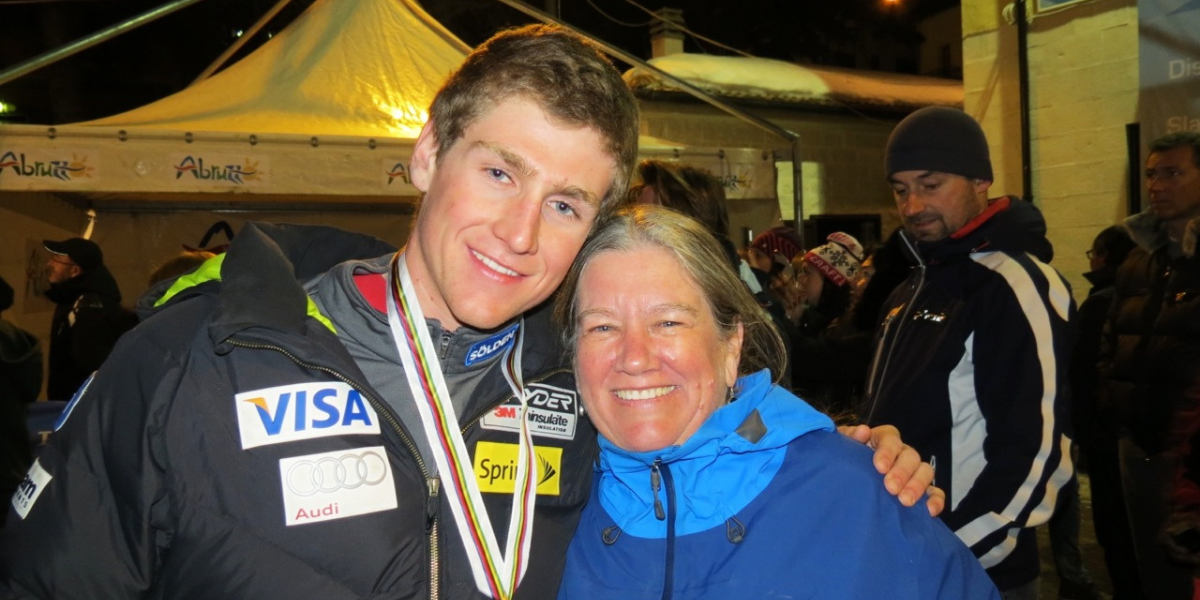
Ryan Cochran-Siegle and his mother, Olympic Gold Medalist Barbara Ann Cochran. Photo source Barbara Ann Cochran
Before Mikaela, before Lindsey, before the sport catapulted to prime time, Barbara Ann Cochran—Olympic slalom champion and Vermont trailblazer— was the heartbeat of U.S. ski racing’s first family.
You can’t tell the story of U.S. ski racing without the Cochrans. And you can’t talk about Olympic champions without Barbara Ann.
On Feb. 8, 1972, in Sapporo, Japan, Barbara Ann Cochran won the Olympic slalom by two-hundredths of a second—the narrowest margin in alpine skiing history at the time. Her victory was one of only 11 Olympic gold medals ever won by nine U.S. women in alpine skiing, and she became just the third American woman to reach the top of the Olympic podium, following Gretchen Fraser in 1948 and Andrea Mead Lawrence, who won two in 1952.
More than 50 years later, Cochran remains an icon of the sport—and a member of one of the most exclusive clubs in American skiing.
“I’m actually surprised that I’m one of only nine U.S. women,” she said. “I had never thought about how many there are of us. From that context, it’s amazing!”
A Family Built on Snow
Born into America’s first family of ski racing, Barbara Ann was raised on snow. The rope tow her father Mickey built behind their home in Richmond, Vermont, became the training ground for generations of Cochrans. Her siblings Bob, Marilyn, and Lindy also raced at the Olympic level—Bob and Marilyn joined her at the 1972 Games, and Lindy competed in Innsbruck in 1976.
Barbara Ann and Marilyn both competed in the Olympic slalom in Sapporo. Marilyn started her first run but fell and did not finish. She later returned to the start of the second run to support her sister. Just before Barbara Ann pushed out of the gate, Marilyn called out a final good luck. Their brother Bob also raced in Sapporo, and when Barbara Ann crossed the finish with a gold-medal-winning time, Bob jumped the fence to celebrate with her.
“I can’t imagine what it’s like to not have family there,” she said.
Skiing Was Different Then
Barbara Ann didn’t block out nerves—she knew how to handle them. On the way to the mountain, she welcomed the chance to read and stay relaxed before shifting into race mode.
“I remember riding up to the mountain in a tour bus and reading Hawaii by James Michener,” she said. “I was in a really good place and couldn’t put the book down!”
“I always got butterflies and was nervous in the start,” she added. “But I was able to handle it. On the bus, my focus wasn’t on the race. I would handle that when it was time.”
She would soon face one of the most challenging days of her career. But first, she followed the rituals of her era—those modern ski fans might not recognize.
At the time, slalom racers inspected the course by hiking it on skis. Long before course slipping became standard, athletes climbed every gate to memorize the rhythm and terrain. That’s what Barbara Ann means when she writes about “hiking the course.”
Each slalom gate also once included a small flag mounted at the top—a feature that helped with visibility and gate identification. That detail, referenced in her writing, has long since disappeared, replaced by modern flexible poles without flags.

Understanding the Moment—Years Later
Cochran didn’t immediately realize the scope of what she had achieved.
“It took me a decade or more to think that, one day during my life, I was the best in the world at something,” she said.
“I never thought of it as being the best in the world. I just thought of it as the slalom race at the Olympics.”
Even the feeling of victory itself was unexpected.
“It was almost a letdown,” she said. “I think it’s like watching kids open their presents on Christmas morning and then get to the point where they feel like, ‘Is that all there is?’ I did feel excitement and happiness, but I thought I would feel more.”
Still, she entered that day with conviction.
“I remember thinking the night before, ‘Somebody’s got to win! Why not me?’ But I didn’t feel I would. What I did know was that I was capable of winning.”
Her Words: The Race That Changed Everything
What follows is Cochran’s personal essay—written years later for a University of Vermont class—describing every moment of that unforgettable day.
Sapporo 1972: My Olympic Slalom Story
By Barbara Ann Cochran
The Stage in Japan
I competed in the 1972 Winter Olympics in Sapporo, Japan.
The new stars in ski racing were there—Annemarie Proell, Michèle Jacot, Marie-Thérèse Nadig, and my sister Marilyn—along with a few of the veterans: Wiltrud Drexel, Annie Famose, and Isabelle Mir.
For some, these Games would mark the beginning; for others, the end.
Hiking the Course
My last race was the slalom. Cold, wet flakes fell as I hiked up the hill. Step by step, gate by gate, I memorized the course. It was smooth and rhythmical, with only a few tricky bumps.
I skied a couple of runs and felt good. All I could do now was wait.
I would run number one.
Countdown to the Start
Ten minutes before the race, the rep checked my bindings. My coach spread wax on my skis. I pumped my legs to get the blood flowing.
Seven minutes left, I unzipped my warm-ups and handed them to my coach.
The wind whipped snow into my face. I slid into the tent.
At four minutes, the first forerunner stepped into the gate. My coach rubbed my legs. I tried to relax.
Three minutes—the second forerunner moved into place.
Two minutes—I pulled off my parka and was alone.
One minute—I stepped to the gate.
Twenty seconds—I planted my poles.
Ten seconds—three deep breaths.
Five, four, three, two, one—go.
First Run Fire
I lunged out of the start. The first turns felt impossibly slow.
I swung through the open gates, climbed under the hairpin, and cut across the hill. Then came the bumps—through them clean.
The flags blurred. I reacted without thinking.
Three quick turns, then skating and straining to the line.
Britt Lafforgue, who had won the last slalom, started third. She finished two-tenths behind me.
Danièle Debernard, young and fearless, crossed three-hundredths back.
Marilyn started but fell.
I watched more racers come down and my excitement grew.
I led after the first run. I had a chance to win.
Fighting the Mind Game
I tried to focus on the second course, but my mind kept racing: I could win an Olympic gold medal!
Then the doubts came. What if I fall? What if I mess up?
Tension crept in. I knew that would hurt my skiing.
I gave myself a pep talk: “Come on, B.A.! Change your thinking. If the French girls can win, I can too. Even if I don’t win, I’ve led the first run—and not many people can say that.”
I thought of my father. Two years earlier, at the World Championships, he had told me I was the “cool cucumber” in the family.
Remembering that calmed me.
Preparing for Run Two
I hiked the rest of the course. It was straighter and a little faster than the first.
I felt ready.
By the time my second run came, fog and wind had moved in. Snow still fell. From the start, I could see only five gates.
I didn’t know how anyone else had done, and I didn’t care. My focus was on skiing my best.
The Final Push
Marilyn called out a last good luck. I pushed out of the gate, numb to everything but the turns ahead.
Gate after gate, I kept moving. No thoughts—just skiing.
I crossed the finish and stopped. For a moment, there was silence.
Then Rick and my brother shouted. They leapt the fence, ran to me, and hoisted me on their shoulders.
Victory by Inches
I had won—by the closest margin in Olympic history at that time. Debernard, three-hundredths behind after the first run, beat me by a hundredth in the second. But overall, I was two-hundredths ahead.
I didn’t know she had beaten everyone else by about a second in that run. I’m glad I didn’t.
That knowledge might have shaken my confidence and tempted me to try too hard.
Instead, I believed in my own skiing—and it was enough.
The Lesson That Lasts
The Olympics taught me this: Doing your best is all that counts, and your best is always enough.
Beyond Gold: A Champion’s Legacy
Today, Barbara Ann Cochran channels her Olympic experience into coaching and public speaking. She runs B.A. Cochran Coaching, a performance and mindset training business based in Vermont, where she helps athletes gain confidence, focus and perspective.
“In my business, when I’m making a point, if there’s a story that demonstrates the concept I’m explaining, I’ll share experiences from my racing days.”
That storytelling—and the wisdom behind it—reminds the next generation what a lifetime of purpose looks like.
“You didn’t have to be the best as long as you did your best.”
To learn more about her work with athletes, visit sportssuccesscoaching.com.
About the Author: Peter Lange