USA’s Breezy Johnson / Olympic Champion / GEPA pictures
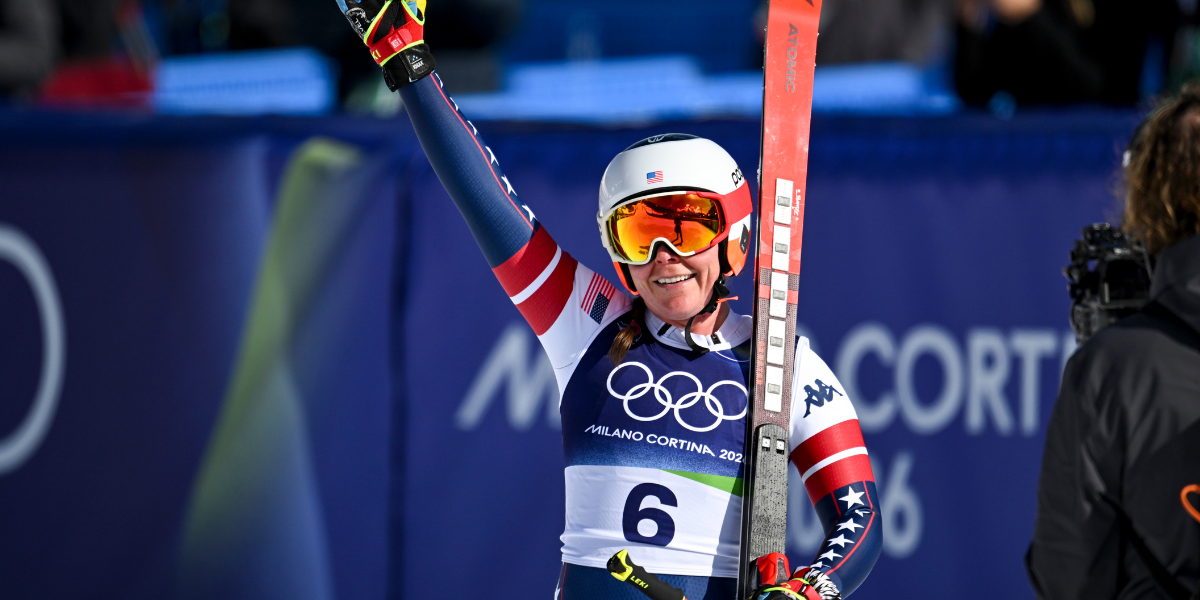
CORTINA D’AMPEZZO, Italy — Breezy Johnson of Jackson Hole, Wyoming, skied on the edge of control when it mattered most, charging down the Olimpia delle Tofane on Sunday to win Olympic gold in the women’s downhill at the Milan-Cortina Games — a race shaped by raw power, courage and a stark reminder of how quickly everything can change.
Johnson’s victory came on a day when global attention was also fixed on Lindsey Vonn, the worldwide fan favorite whose long-awaited Olympic return ended in a violent crash that silenced the venue and cast a long shadow over the competition.
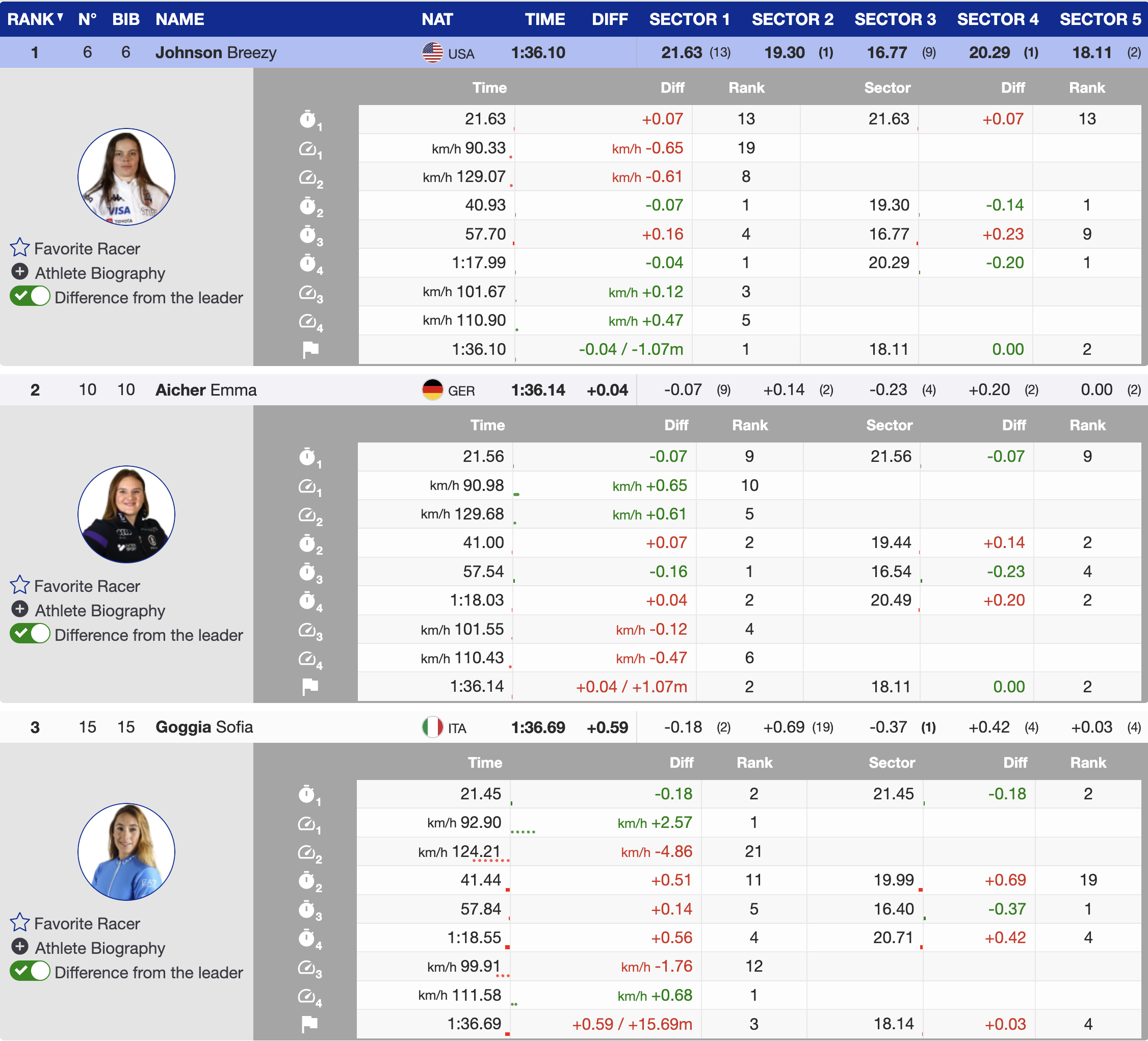
Still, when the focus returned to the clock, Johnson stood alone. The 2025 world champion delivered a relentless run of 1 minute, 36.10 seconds, a time that survived every challenge on a course that rewarded those willing to attack and punished even the slightest hesitation. Germany’s Emma Aicher announced herself on the sport’s biggest stage by earning silver, just 0.04 seconds back, while Italy’s Sofia Goggia ignited the home crowd with bronze, 0.59 seconds behind the winner.
With the victory, Johnson added Olympic gold to her world championship title, completing one of the rarest doubles in alpine ski racing.
In doing so, she became just the second American woman to win Olympic downhill gold, joining Vonn, who captured the title in 2010. The rarity of the achievement underscored the magnitude of Johnson’s run — a performance built on total commitment on a course that offered no margin for restraint.
Click Images to enlarge
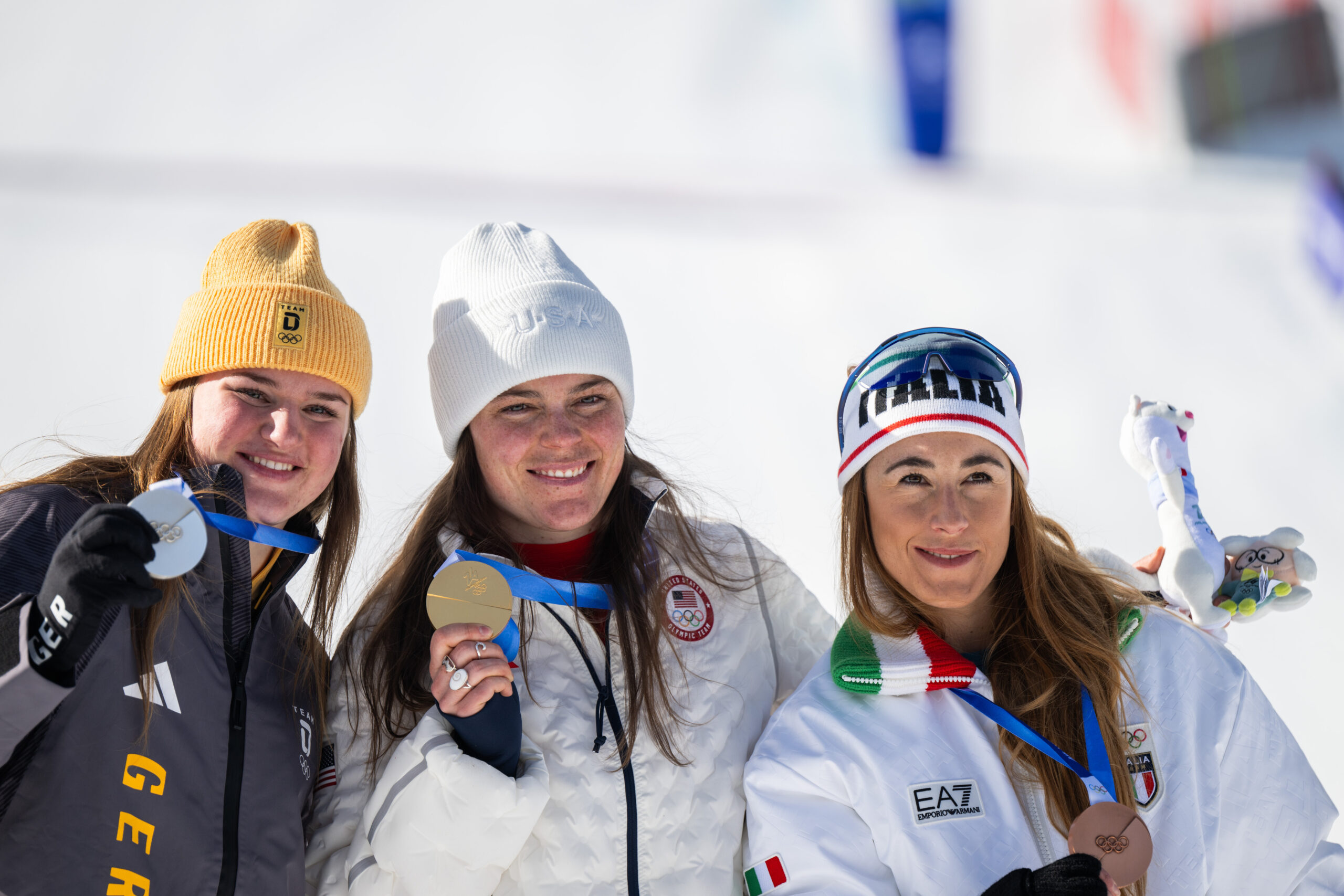
🏅 Olympic Women’s Downhill — Top Five Results
- 🥇 Breezy Johnson (USA) — 1:36.10
- 🥈 Emma Aicher (GER) — +0.04
- 🥉 Sofia Goggia (ITA) — +0.59
- 4th: Jacqueline Wiles (USA) — +0.86
- 5th: Cornelia Hütter (AUT) — +0.86
A familiar course with no margin for safety
The race opened under clear skies after days of difficult weather, with Swiss racer Malorie Blanc becoming the first woman to ski a competition run of the 2026 Olympics. Blanc set the opening benchmark at 1:38.77, officially launching the women’s alpine events in Cortina.
These Games marked the first Olympics in which alpine skiers competed on a course raced annually on the World Cup circuit rather than a purpose-built Olympic venue. Familiarity offered no comfort. Olimpia delle Tofane demanded full commitment from start to finish and punished even the smallest lapse.
Italian star Federica Brignone was among the fan favorites despite her recent return from injury and limited racing before the Games. Expectations were tempered, but the approach was not. From the opening section onward, Brignone — like the rest of the elite field — attacked relentlessly, knowing anything less would not survive to the finish.
Pressure builds through the heart of the field
As the start list moved deeper into its most competitive stretch, the margins tightened quickly and the pressure intensified. First, Italian Nicol Delago, winner of the final downhill before the Olympics, was unable to replicate that form. Soon after, Laura Pirovano briefly seized an early lead, but as the course wore on, she gave back time in the middle section and finished 0.94 seconds back, buoyed by the roar of the home crowd.
From there, Norway’s Kajsa Vickhoff Lie carried speed through the middle of the course, only to lose ground late, crossing 0.98 seconds behind the lead. Next, Austria’s Cornelia Hütter showed blistering pace early, but again, the lower section took its toll, and she slid out of medal contention.
Then came Aicher. Just 22 years old, the German attacked the course with fearless commitment, throwing herself into the terrain and skiing on the edge from top to bottom. In the end, a small mistake late proved decisive, and she crossed the line only 0.04 seconds behind Johnson — a remarkable silver-medal performance on the Olympic stage.
Aicher said the magnitude of the moment had yet to fully sink in.
“It feels unbelievable,” Aicher said. “It’s going to take a while to realise, but I’m so, so happy.”
She said her approach remained simple despite the Olympic stage. “I just focused on my own stuff like any other race,” Aicher said. “The waiting afterward is the hardest part because you can’t do anything anymore.”
Johnson rises above the chaos
Johnson’s run remained the benchmark. While she was not dominant at the very top, she grew stronger as the course unfolded, unleashing speed through the decisive middle and refusing to give anything back on the run-out.
As the contenders kept coming, one skier after another came close. Still, none could knock her from the leader’s chair.
By the time the race reached its final stretch, Johnson sat at the finish visibly emotional, wiping away tears as the reality of Olympic gold came into focus — a moment shaped both by triumph and by what had already unfolded earlier on the hill.
Long before the result was final, Johnson said she felt something special building.
“I had a good feeling about today,” Johnson said. “I still can’t believe it yet. I knew I had to push, go harder than I did in training, and I hoped it would be enough.”
She also acknowledged the emotional weight of the day following Vonn’s crash. “My heart goes out to Lindsey,” Johnson said. “I know how difficult it is to ski this course, and when you crash and it hurts, it hurts that much worse.”
Johnson on Olympic gold
With the medal finally secured, Johnson reflected on the run itself, knowing it was not flawless but trusting the speed she carried through the course.
“I felt like it was solid,” Johnson said. “There were definitely some places that weren’t the best, but I hoped it would be enough. I just tried to keep it rolling. Sometimes you don’t know if you made a mistake or if it just felt that way because you were going fast, and today that line was enough.”
As the waiting stretched on, Johnson said she believed the run could hold.
“I thought it might be enough when I came down,” Johnson said. “I was pretty sure it would be enough for a medal. When Emma was coming down, I was a little stressed, but otherwise it was really nice.”
Looking back more broadly, Johnson said the long road to Olympic gold gave the moment added meaning.
“People are jealous of Olympic gold medals, but they’re not jealous of the journey it takes to get there,” Johnson said. “It’s been a tough road, but sometimes you just have to keep going. If you’re going through hell, you keep walking.”
The Lindsey Vonn crash that stopped everything
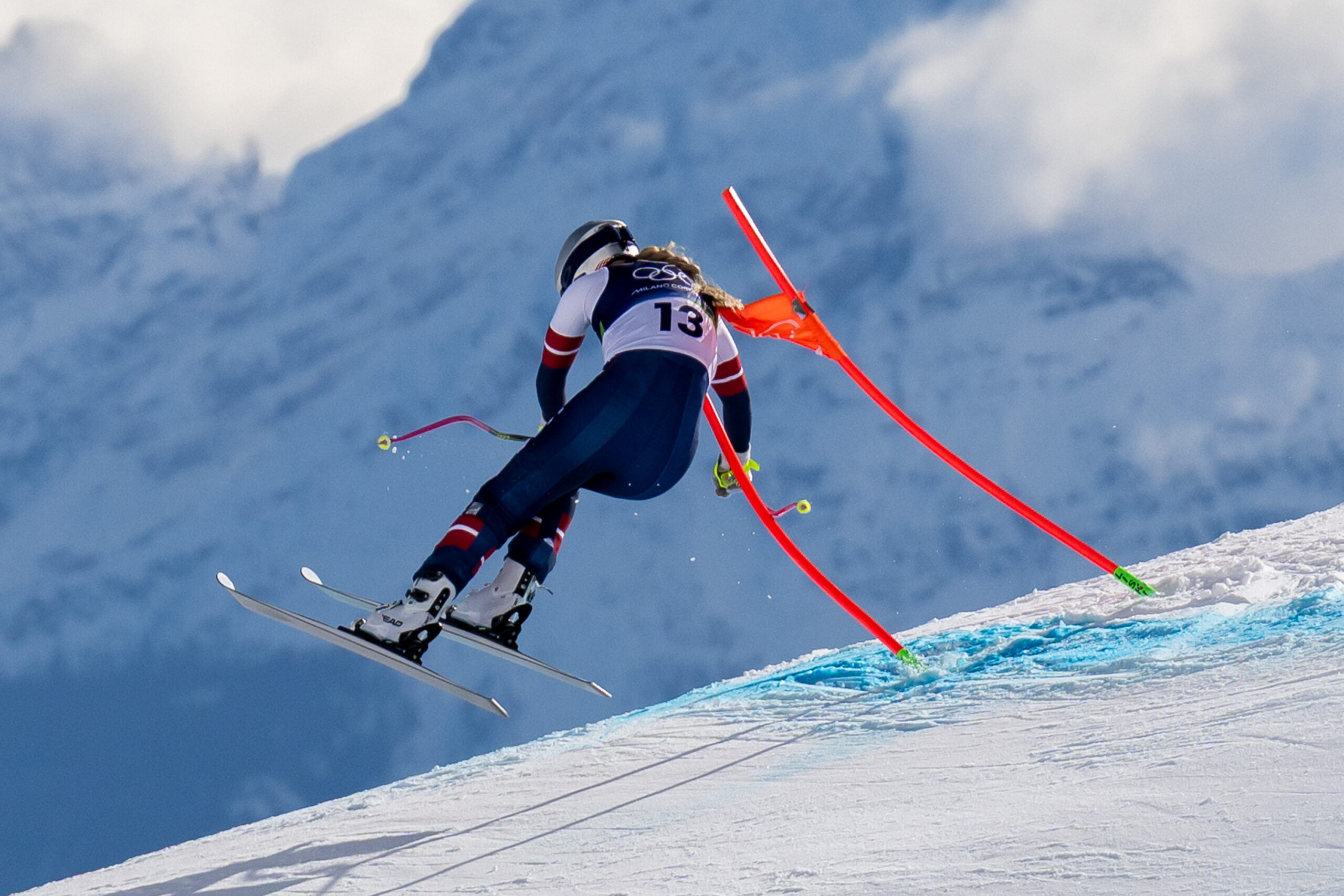
The race took a sobering turn when Lindsey Vonn launched out of the start gate and crashed violently near the top of the course. Replays showed Vonn slightly off line on a jump, striking a gate with her hand while airborne before landing sideways at high speed.
Almost immediately, the venue fell completely silent as medical personnel rushed to her side. A medical evacuation helicopter eventually arrived, and for the second consecutive week, Vonn was flown to a hospital.
Vonn, the most recognizable figure in women’s speed discipline alpine skiing, had returned to World Cup racing at age 40 after a partial knee replacement and produced a remarkable 2026 season at 41. In that moment, however, the competition faded into the background as concern for her health took over. Her crash unfolded in full view of a global audience and became one of the defining moments of the Games.
Regardless of the outcome, it was a reminder of how fragile even the longest Olympic journeys can be.
From the start area, U.S. teammate Isabella Wright said it was “heartbreaking” to witness. Wright and Jacqueline Wiles were held in the gate during the delay, watching the scene unfold in real time.
“Things just happened so quick,” Wright said. “She had incredible speed out of that turn, and it was over just like that. After all the preparation, years of hard work and rehabilitation, it’s the last thing you want to see somebody go through.”
Even so, Wright said Vonn’s return itself remained an inspiration. “She should be really proud of everything she’s gone through to get back here,” Wright said. “She’s an inspiration to all of us.”
At the same time, Wright pointed to the performance that ultimately defined the race, praising Breezy Johnson’s gold-medal run as the best she had ever seen from her longtime teammate. “She had some wild moments, but she was so gritty,” Wright said. “She nailed it and showed she can handle that pressure and perform when it counts most.”
Goggia delivers on home snow
At that point, Italy’s final hope rested with Sofia Goggia, the leading downhill skier of her generation and the Olympic champion from 2018, who added silver in 2022. With the weight of the home crowd behind her, Goggia attacked relentlessly, skiing on the edge from the first turn to the finish.
Through the upper and middle sections, she carried speed with her trademark aggression. Yet as the course continued, she was unable to displace Johnson from the top of the standings, crossing the line 0.59 seconds back.
Still, the run proved enough. As the remaining contenders finished, Goggia’s time held, securing bronze and completing a full Olympic downhill medal set — gold in PyeongChang, silver in Beijing and bronze on home snow in Cortina.
Goggia said the bronze carried special meaning, even with imperfections in her run.
“I know I made some mistakes here and there,” Goggia said. “But overall, it’s my third medal in my third Olympics. That’s huge.”
She added that completing the set on home snow made the moment even more significant. “It’s a privilege,” Goggia said.
🇺🇸 United States results
- 🥇 Breezy Johnson (USA) — 1st
Jackson Hole, Wyoming — Rowmark Ski Academy - 4th: Jacqueline Wiles (USA) — +0.86
Portland, Oregon — White Pass Ski Club - Isabella Wright (USA) — 21st, +2.75
Salt Lake City, Utah — Snowbird Sports Education Foundation - DNF: Lindsey Vonn (USA)
Vail, Colorado — Ski & Snowboard Club Vail
Jacqueline Wiles came agonizingly close to joining Johnson on the podium. Skiing with bib 17, Wiles built her run from the middle of the course down and delivered the fastest final sector of the race, charging hard through the last pitch. Earlier losses, however, proved just enough to keep her off the medals, and she finished fourth, 0.86 seconds back, narrowly behind Goggia’s bronze. It was a powerful, aggressive run that underscored Wiles’ ability to contend on the biggest stage, even if the margins once again fell the wrong way.
Wiles said the moments before her run were emotionally charged, shaped by both Johnson’s gold-medal performance and Vonn’s crash.
“There were a lot of emotions before I even ran,” Wiles said. “I was so pumped watching Breezy ski an incredible run, and then seeing Lindsey go down was pretty awful. We’re a family, and when it’s someone you care about that much, it really hurts.”
Despite the shock, Wiles said the responsibility to race remained. “We still had a job to do,” Wiles said. “I know Lindsey would want us to stay in it and give it our best.”
After finishing just off the podium, Wiles said the result was difficult to process. “Of course it’s hard being in fourth,” she said. “At my age, I don’t have many chances left, so it hurts. But I’m proud of the way I skied.”
Looking ahead, Wiles said the performance left her encouraged. “I feel like I have a lot of speed on this hill,” Wiles said. “I’m grateful I get another shot, and I’m proud to represent our country and keep going.”
🇨🇦 Canada results
- Cassidy Gray (CAN) — 26th, +5.89
- Valerie Grenier (CAN) — disqualified (missed gates)
Medals, momentum and meaning
At just 22, Aicher and Johnson earned their first Olympic medals, while Goggia added another chapter to one of the most complete Olympic downhill careers in history.
Although no World Cup points are awarded at the Olympics, the top 15 finishers earned World Cup Start List points, a meaningful bonus that will influence start positions later in the season.
Johnson’s run stood to the end — a champion forged by courage on a course that demanded everything.

Olympic Downhill Results
Click Images to enlarge
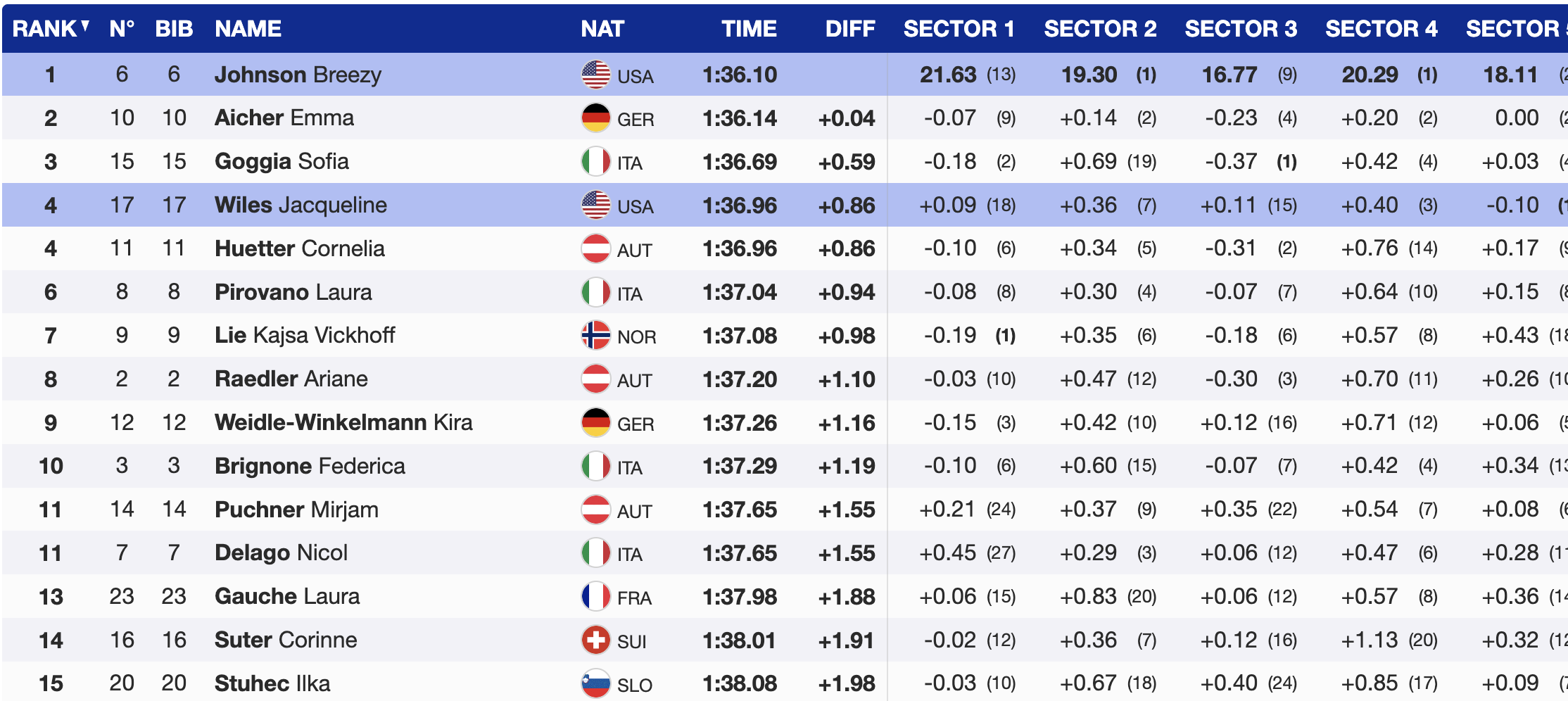
Analysis of the Olympic Podium and Other North Americans among the top 15

About the Author: Peter Lange