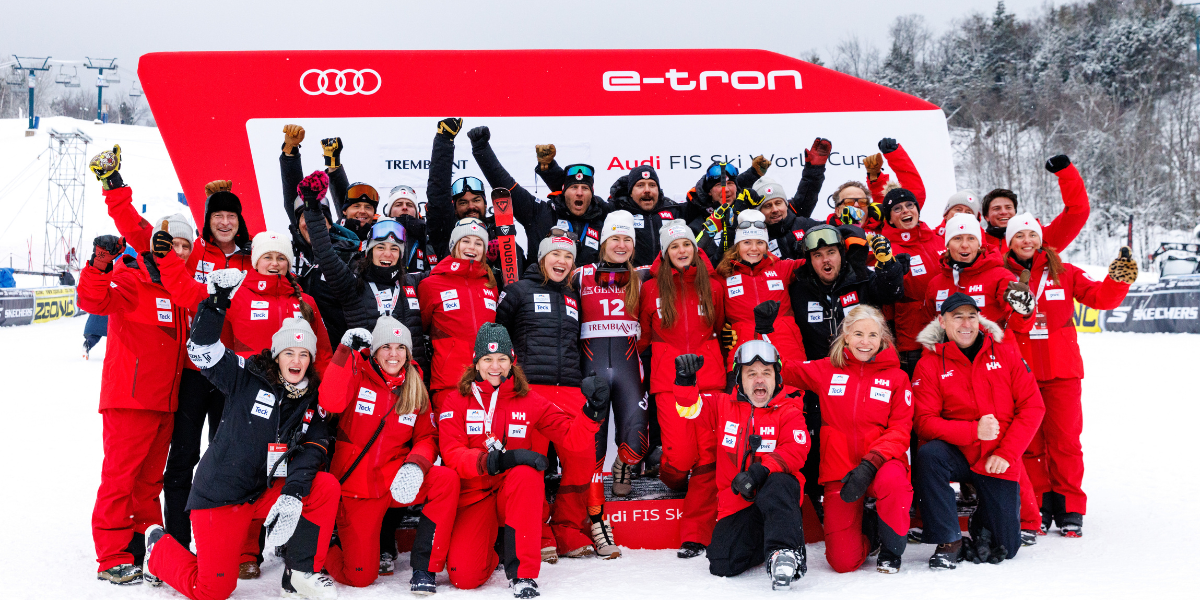
Featured Image: Alpine Canada celebrates Val Grenier’s third-place finish at the FIS Alpine Ski World Cup in Mont-Tremblant./ GEPA
Canada is investing millions in high performance training centres with the goal of creating better athletes and more Olympic success. For alpine skiing, the real test will be whether Canada builds the coaching, programming and athlete support required around those facilities.
Canada has never struggled to produce great ski mountains.
From Whistler and Panorama in the west to Mont Tremblant in the east, the country has world class terrain, Olympic venues and a long history of developing talented ski racers. Canada continues to produce world class athletes, but sustaining success on the World Cup circuit and at the Olympic Winter Games remains difficult in one of the world’s most competitive sports.
That is one reason governments and sport organizations are investing millions of dollars in a new generation of National Training Centres.
On July 27, the federal government announced up to $3.652 million for the National Alpine Ski Training Centre Network. The funding will support upgrades at the Panorama Mountain National Alpine Training Centre and the Dave Murray National Alpine Training Centre in Whistler, British Columbia.
The thinking is straightforward. Give athletes better places to train, more reliable access to snow and stronger daily support, and better performances should follow.
It is an appealing idea, and one that few would argue against. Better facilities almost certainly create better training environments.
The harder question is whether better training environments, on their own, create more medals.
A Strategy Years in the Making
The recent funding announcements may have appeared to come together quickly, but the work behind them has been unfolding for years.
Beginning in October 2020, Own the Podium brought together Canada’s winter national sport organizations and other stakeholders to develop the Pan Canadian Winter Sport Infrastructure Roadmap. Published in 2021, the roadmap identified the infrastructure projects considered most important to the country’s high performance winter sport system.
Own the Podium began refreshing that work in 2024. The updated report, published in February 2025, considered changing medal projections, evolving sport priorities, the condition of existing facilities and the growing challenges that climate change presents for winter sport.
Projects were not chosen simply because they needed upgrades. Each proposal was evaluated against a range of criteria, including the quality of the daily training environment, athlete access, long term financial sustainability, climate resilience and the projected impact on Olympic and Paralympic performance.
When the federal government announced its infrastructure funding in July 2026, several projects identified through that process were positioned to move forward. The broader announcement included up to $33.676 million for Canadian sport infrastructure, with $3.652 million directed to the National Alpine Ski Training Centre Network. The funding remains subject to contribution agreements and other federal requirements.
The recent announcements were not the beginning of Canada’s infrastructure strategy. They were the next phase of a plan that had already been carefully developed.
What Makes a National Training Centre?
When people hear the phrase “National Training Centre,” they often picture a single building filled with workout equipment.
In alpine skiing, it means something much bigger.
The roadmap and Alpine Canada’s planning materials describe an entire training environment built around the daily needs of athletes. Depending on the venue, that can include reliable snowmaking, dedicated training lanes, safety systems, timing equipment, lift access, equipment facilities, strength and conditioning space, athlete support services and long term agreements that guarantee teams access to the mountain when they need it most.
For alpine skiing, one of the most valuable investments is not a new building at all.
It is snow.
The World Cup calendar begins well before winter arrives across much of Canada, making October and November some of the most important months of the training year. Every cancelled camp or weather related interruption reduces valuable time on snow before athletes arrive at the season’s opening races.
Climate change makes that access less dependable. The 2025 infrastructure report warns that rising temperatures are shortening the period when Canadian resorts and glaciers can provide snow training. It also notes that some Canadian programs can spend less travelling to Europe than they would pay to train at privately operated resorts at home.
That makes affordability nearly as important as snowmaking.
Building a training venue matters, but so do the agreements that determine who can use it, when they can use it and what they must pay.

Building a National Network
The infrastructure roadmap identifies a collection of mountain venues that serve different parts of Canada’s high performance system. Nakiska, Panorama and Sunshine were among the report’s highest priority mountain facilities. The updated report also added Mont Tremblant as an alpine priority, while Whistler continues to support several winter sport programs.
Each plays a different role within Canada’s winter sport system.
Panorama has become an important early season alpine training and racing venue. It offers FIS homologated terrain and has hosted World Cups, the 2015 IPC Alpine Skiing World Championships and the 2022 FIS Alpine Junior World Ski Championships.
Nakiska supports alpine skiing, ski cross and snowboard cross, while the Dave Murray National Alpine Training Centre in Whistler forms part of the federally funded alpine network.
Alpine Canada’s planning presentation provides a more detailed picture of the proposed work at Panorama. It identified approximately $3.3 million for A net safety systems, other safety and competition equipment, and course widening, contouring and grading. The proposal also includes downhill and super G terrain that could create an opportunity for Panorama to host World Cup races.
However, inclusion in the national roadmap does not necessarily mean a venue received funding through the July announcement. Mont Tremblant, Sunshine and other facilities remain important parts of the wider infrastructure strategy, but the federal announcement specifically names Panorama and Whistler under the National Alpine Ski Training Centre project.
That leaves an important question unanswered.
Alpine Canada has not publicly detailed how the $3.652 million in federal funding will be divided between Panorama and the Dave Murray National Alpine Training Centre in Whistler.
Understanding that allocation, and the specific infrastructure each site will receive, would provide a much clearer picture of how the National Training Centre Network is expected to function.
Which improvements are considered most urgent at each venue? How much of the federal funding will go to Panorama and how much will go to Whistler? How many additional training days are those improvements expected to create? How many athletes and programs are expected to benefit? What measurable changes does Alpine Canada expect the investment to produce?
Those details matter because the success of the investment cannot ultimately be judged by the announcement itself. It has to be judged by what the money allows Canadian athletes and coaches to do that they cannot do today.
One of the consistent themes throughout the roadmap is collaboration. Rather than creating separate facilities for every sport, the strategy encourages sports to share infrastructure wherever possible.
There are practical reasons for that approach. High performance venues are expensive to build and even more expensive to operate. Shared facilities make major investments easier to justify while creating training environments that benefit a broader group of athletes throughout the year.
The Facilities Are Only Part of the Story
There is little debate that better training environments help athletes.
More reliable snowmaking creates more days on snow. Dedicated training lanes allow for higher quality sessions. Long term access agreements give coaches greater certainty when planning an entire season. Those advantages become even more valuable as increasingly unpredictable weather continues to disrupt early season training around the world.
But infrastructure is only useful if Canada has the people and programs required to take advantage of it.
Alpine Canada’s own planning documents make clear that the organization does not view infrastructure as a complete solution. Its broader strategy identifies increased coaching capacity, stronger NextGen development, more days on snow, additional international competition and expanded athlete services as priorities.
For the national team, the presentation proposes increasing coaching capacity by 50 percent and adding 45 days of daily training. For NextGen athletes, it calls for “best with best” training groups, 45 additional days on snow and 21 more days of Europa Cup competition.
Those plans sharpen the central question.
It is not simply whether Canada can build better facilities. It is whether the system can provide enough coaching, programming and operating support to take full advantage of them.
Infrastructure can strengthen a high performance system.
It cannot replace one.
Who Will Coach the Athletes?
Building more training capacity creates another challenge: Canada needs enough great coaches to use it.
A training centre can provide reliable snow, dedicated lanes, better safety systems and more days of access, but none of those things teaches an athlete how to ski faster. That remains the work of coaches. If Canada is serious about developing more World Cup athletes and Olympic medal contenders, then investing in Canadian coaches has to be considered part of the same commitment as investing in infrastructure.
That raises a number of important questions for Alpine Canada. What is the long-term plan to recruit, educate and retain the next generation of Canadian coaches? How will promising young coaches progress from local clubs into provincial programs, NextGen environments and, ultimately, the national team? What opportunities will they have to learn from experienced coaches, gain international experience and build sustainable careers in the sport?
Alpine Canada’s goal of increasing coaching capacity by 50 percent is significant, but adding positions is not the same as building a coaching system. Canada needs experienced national team coaches today, but it also needs a development pathway that consistently produces the next generation of coaches five, ten and fifteen years from now.
The same principle that applies to athletes applies to coaches. They do not simply appear at the top of the system—they have to be developed.
If Canada succeeds in building world-class training facilities but does not have enough world-class coaches to lead athletes within them, the full potential of that investment will never be realized.
You Can’t Build a Podium Without Building the Pipeline
Perhaps the most important question is not what happens once an athlete reaches a National Training Centre. It is how many athletes Canada can get there in the first place.
High performance infrastructure sits at the end of a long development pathway. Before athletes ever benefit from dedicated training lanes or national team resources, they spend years progressing through local clubs, provincial programs, NorAm competition and international development.
That pathway depends heavily on coaching.
For many athletes, the coaches who shape their development long before they reach a national program may have as much influence on their eventual success as the coaches they encounter once they arrive there.
That means the strength of Canadian coaching at the club and provincial levels matters directly to the effectiveness of the National Training Centre strategy.
The 2025 infrastructure report identifies limited training access in Eastern Canada as one of the system’s major gaps. According to the report, that shortage affects athlete development and leaves Canadian programs with fewer domestic alternatives when weather limits training in the West. The addition of Mont Tremblant to the updated roadmap reflects an effort to address that imbalance.
But access alone cannot solve the development challenge. Athletes need quality environments and quality coaching throughout the pathway. If that pathway is not producing enough athletes capable of competing at the highest level, even the world’s best training centre has limitations.
A world class facility can help elite athletes improve. It cannot create elite athletes from scratch. And it cannot replace the coaches who help athletes become elite in the first place.
That reality does not diminish the importance of Canada’s investments. Instead, it highlights that infrastructure is only one part of a much larger system that depends on coaching, athlete retention, competition opportunities and long term development.
Measuring Success
The true value of Canada’s National Training Centre strategy will not ultimately be measured by the number of projects completed or the dollars invested.
It will be measured by what those investments allow athletes and coaches to do.
Do they create more quality training days? Do they reduce the need for expensive early season travel? Do they give athletes more consistent access to snow when conditions elsewhere become unreliable? Do they help coaches build better long term training plans? Do they allow more Canadian athletes to train together in high quality environments?
Those questions require a clear starting point. Canada will need to track how many additional training days the centres provide, how often weather interrupts planned camps, what athletes pay for access and whether domestic training actually costs less than travelling abroad.
There should also be clear measures attached to coaching.
How many additional full time coaches does the system develop and retain? How long do coaches remain in Canadian programs? How many move successfully from club and provincial programs into NextGen and national team roles? What professional development and mentorship opportunities are available to them?
The longer term measures will be even more important.
Do more club and provincial athletes gain access to suitable training? Does Canada retain more racers through the NextGen years? Do more athletes progress from the NorAm Cup to the World Cup? Can the system recruit and retain enough coaches to support the additional training? Does Canada begin producing more of its own high level coaches?
And eventually, do the investments contribute to more athletes standing on World Cup podiums and at Olympic medal ceremonies?
Those answers will not come quickly. Infrastructure projects unfold over years, and athlete and coach development take even longer.
But defining those measurements now will make it possible to determine later whether the strategy actually worked.

A Strategy in Transition
These investments are moving forward during a leadership transition at Alpine Canada. Former President and CEO Therese Brisson presented the National Training Centre strategy during this year’s Canadian Ski Summit before announcing her departure from the organization.
Alpine Canada has since announced its next president and CEO.
The incoming leadership will inherit projects that have already been identified, prioritized and, in some cases, funded.
But the larger responsibility will go far beyond overseeing construction.
The next phase will require turning infrastructure into a functioning high performance system. That means securing operating funding, providing affordable access, strengthening programming, recruiting and retaining coaches, developing future coaches and making sure enough athletes are progressing through the pathway to use the facilities.
It also means providing greater clarity about how the federal investment will be spent and what Alpine Canada expects that investment to accomplish.
That brings expectations with it.
Can Infrastructure Buy Medals?
The answer is probably not.
At least, not by itself.
Canada’s investment in National Training Centres will almost certainly improve the daily environment for athletes. More reliable snow, better facilities and stronger access to training are meaningful advantages in a sport where preparation often determines results.
But the planning documents themselves show that the strategy cannot end with construction. The facilities need skilled coaches, affordable access, consistent programming, athlete services and enough developing racers to keep the pathway strong.
They also need a sustainable Canadian coaching system capable of developing the people who will guide those racers.
Medals are rarely won because of a single investment.
They are earned through years of athlete development, exceptional coaching, consistent competition, strong technical leadership and environments that allow talented skiers to improve every day.
Alpine Canada has proposed a broader effort to secure $5 million annually over five years for participation, NextGen and national team programs. That represents an ambition to raise $25 million, not confirmation that the full amount has been secured. The difference between what has been proposed and what can ultimately be funded may help determine how much value Canada receives from its new infrastructure.
The same will be true of coaching.
Infrastructure has the potential to strengthen every part of the system. It can raise the standard of training and remove barriers that have limited Canadian athletes for years.
But the real measure of this strategy will be whether Canada builds everything around those facilities that is necessary for them to matter. Whether these investments ultimately change Canada’s position on the World Cup and Olympic stage will depend on the complete system built around them.
Construction crews can build training centres.
The Canadian ski system still has to build medal-winning athletes.
About the Author: Katie Twible