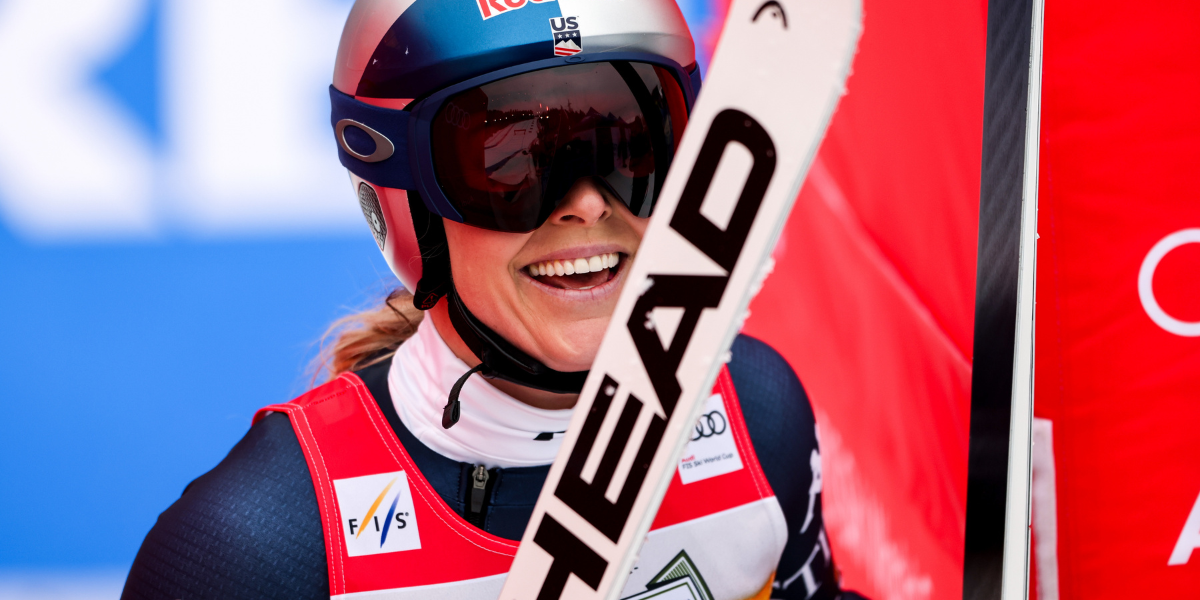
Tommy Ford Sölden 2022 Photo: GEPA pictures/ Mathias Mandl
When asked if he is back to feeling like his old self before the horrific crash in January 2021 that knocked him out and left him with torn ligaments in his knee, wrist and a broken leg, Tommy Ford responds with a definitive “no.”
“My body is not back to where it was pre-injury. It definitely changed,” he says. “I’d say I’ve grown into this new body pretty well … and worked through some mental struggles.”
In Sölden, Austria, this week, Ford is heading into the first race of his second full season since returning from injury. Even if his body and mind have changed, the 34-year-old giant slalom specialist feels more prepared than he has in a while. Although transformed, he is better equipped to race and remember why he’s racing.
“Last season, I didn’t know if I was prepared or not. It dwindled throughout the season,” he says. “The joy factor was down. The struggle factor was up. When I looked, the results were actually pretty good for what I was feeling throughout the season.”
Impressive comeback
Much like he did when his first return to a race course in over a year was at the 2022 Olympics, where he somehow notched an impressive 12th place in the giant slalom and nearly helped the U.S. to a medal with a fourth place in the Team Parallel event, Ford launched into last season with a bang. He took sixth in Sölden, which turned out to be his top finish of the season.
“With the Olympics and with Sölden at the beginning of the season, I didn’t have many expectations,” he says. “I wasn’t sure how I’d race with what I’d been through with my body and mentally. There were old memories of where I was and how I used to do things starting to creep in.”
Following his strong opening last season, the Bend, OR native notched another top 15 on the World Cup, helped the U.S. to a gold medal in the World Championships Team Parallel and won his fourth national GS title. As he says, however, these accomplishments came with a noticeable deficit in the joy department.
“It felt like, if I’m not enjoying what I’m doing, it’s not necessarily what I want to keep doing,” he says.
Taking stock of what’s happening inside and out
Over the summer, Ford began seeing a sports psychologist, reflecting and reaching out to friends and family. In addition, he put in a solid amount of mountain biking, strength building and outdoor dryland training.
“I was able to enjoy those things again even more. I was doing them with more intention,” he says. “I don’t want to have a season like I did last year. I feel confident in the tools I’ve learned, remaining open and curious to see where it goes. I’m looking at and being more open to what’s going on with me. I’m letting myself feel the feels.”
Like most top-level skiers in their 30s, “the feels” include a certain pain level. However, Ford has learned how to roll with what his body is going through.
“It’s a balancing act. It feels pretty good most of the time,” he says. “I’ve got some knee pain, back pain here and there, but I feel strong. I know how to manage it.”
Ford’s long career, which skyrocketed in 2006 with four gold medals at the 2006 Junior World Championships, has been peppered with significant highs and lows. His most soaring moments include his spectacular first World Cup victory on home soil, winning the 2019 GS at Beaver Creek. He followed up with another podium in Niigata Yuzawa Naeba, Japan, and the following season, before his crash, he notched yet another World Cup podium in Santa Caterina.
Gratitude and awareness
Going into this season, however, he’s not aiming for results. He has just one goal: Rediscover the joy.
“I’m obviously a ski racer. I want to go fast. That’s part of it. But to enjoy what I’m doing is the top goal,” he says.
Gratitude is also part of that. Ford emphasizes his appreciation for training on glaciers like Pitztal and Saas-Fee and for being able to continue racing in Sölden in spite of its not-so-slow disappearance. In the nearly 20 years that he’s been competing internationally, Ford has witnessed firsthand the effects of climate change.
“I’m grateful to see these special pieces of ice and ski on them while they last,” he says. “Sölden is historically known as a glacier. It used to go down to the finish. Now the snow stops at the first break. It’s receded a lot. The first time I went to Saas-Fee, it was hundreds of meters lower. Pitztal has lost a couple of training lanes, even from last year. It’ll be interesting to see what happens to the sport in 10, 20 years.”
Awareness of his surroundings and what’s going on inside will be Ford’s M.O. this season. With eyes wide open, he hopes the joy will come.
“Remaining aware and allowing space for feelings is a part of joy,” he says. “Part of it is just living and learning how to live with changes. I’ve gone through a lot of changes in the last couple of years. I’m never going to be the same person forever. None of us are. I just need to learn to be a little more fluid with that.”
About the Author: Shauna Farnell