I have been a fan of alpine ski racing since watching Franz Klammer’s inspiring downhill victory at the 1976 Innsbruck Games. Of course, in the ’70s and ’80s internet streaming and subscription services did not exist, and World Cup ski racing was rarely broadcast on American television.
One notable exception was occasional winter sports coverage by ABC’s Wild World of Sports, which aired “The Thrill of Victory and the Agony of Defeat” on Saturday afternoons. Notwithstanding, ski racing fans had to wait for the Olympic Winter Games, held only every four years. This year marks 40 years since the 1984 XIV Winter Olympic Games were held in Sarajevo, Yugoslavia.
I remember my excitement back then, sitting in my college dorm room with my roommate in front of our 12-inch portable black and white TV, watching ABC’s broadcast of the Games. It seemed like a lifetime since the 1980 Winter Games, but now there would be wall-to-wall television coverage for two weeks. Because of the time difference between the U.S. and Sarajevo, the only difficulty was avoiding learning the events’ outcome before they were aired on prime time.
On February 8th, 1984, I watched the opening ceremony with anticipation and wonder as 50,000 spectators jammed into Koševo Stadium to welcome nearly 1,300 athletes from 49 countries kick off 12 days of winter sports. I continued to be glued to the TV, especially for the alpine skiing events. Now, 40 years later, I was just as excited to talk to some of the American ski racers who were part of the awe-inspiring 1984 team that won an extraordinary five medals (three gold and two silver medals) in six events and won the nations’ medal count for the sport.
The Alpine Ski Races
The Sarajevo Games featured men’s and women’s competitions in the downhill, giant slalom, and slalom. (It would not be until the Calgary games of 1988 that super-G and the combined event would join the list of Olympic medal events.) The Alpine ski races were held about an hour’s drive from Sarajevo. The men skied at Bjelašnica, the region’s highest mountain, located southwest of Sarajevo. At the same time the women’s races were contested at the Jahorina Ski Resort, which included the region’s second-highest mountain located southeast of the city.
As I hear from many Olympic athletes, the opening ceremony is always a highlight of their experience. Two-time U.S. Olympic downhiller Doug Lewis shared fond memories of his first opening ceremony: “It was such an honor and pleasure, and a dream come true to walk in the ceremony alongside the rest of the team wearing our rawhide jackets and the red, white, and blue. To see the flame come in and light the cauldron was exhilarating.” The weather, on the other hand, got the Olympic Games off to a rough start. “You’ve got to remember this was the biggest storm in Europe in 50 years. It kept snowing,”
U.S. alpine ski team member Christin Cooper recalls starting the night of February 8th and lasting through February 9th, a whopping 16 inches of snow fell in Sarajevo and up to 30 inches in some mountain areas. Due to snow and wind, it would be a whole week until the slopes were ready for the start of the competition. Eventually, race officials elected to kick off the competition with the women’s giant slalom and what kickoff it was.
American women come in first, second and fourth in the giant slalom
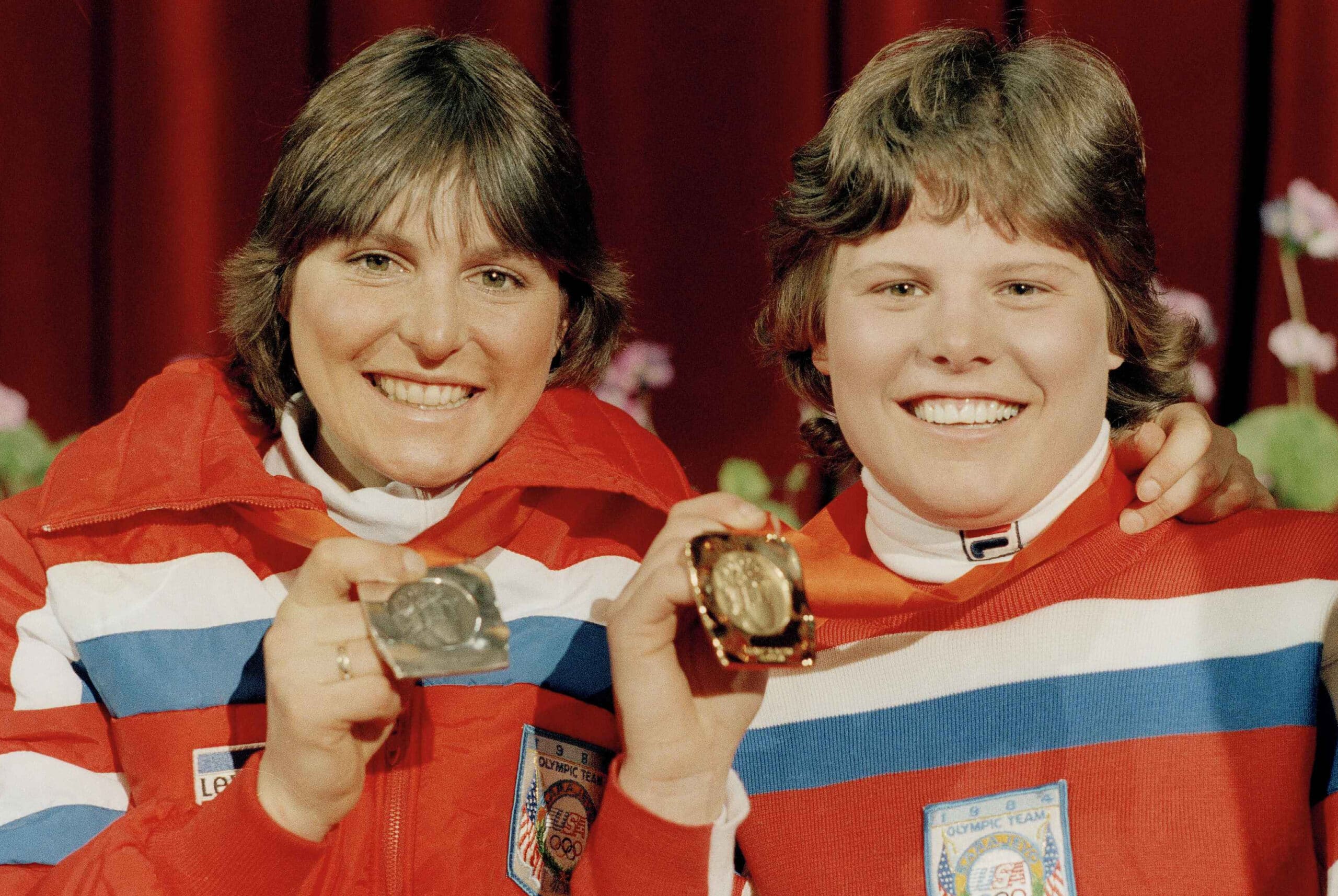
American teammates Deb Armstrong and Christin Cooper won gold and silver in the women’s giant slalom, the first one-two U.S. sweep in an Alpine Olympic event. Teammate Tamara McKinney was just off the podium in an impressive fourth spot (after winning the second run). Fellow teammate and 1976 Olympic Bronze medalist in the downhill, Cindy Nelson, landed in 18th.
Armstrong’s Gold
Armstrong’s win in the giant slalom was unexpected. The American, who had never won a World Cup race. It was an underdog story, but not in Armstrong’s mind. “I was peaking. I had very solid top-ten and top-five results going into the Olympics. I just knew that I was primed and ripe and just on it that my skiing was just hot, and so I was there to win a medal.”
Armstrong recalls. She also felt reassured that day. “I felt supremely confident. I was there to win a medal. More than anything, it was a combination of my mindset and my skiing at the time, which peaked at the right time, moving through December, January, and into February.” She remembers, “As an athlete, it’s not every day when you know you can do something, but then, when it is, you pull it off. I don’t know, everybody talks about the “flow state,” and I don’t really know what the flow state is, but I was in it.”
Cooper remembers the Giant Slalom
Teammate Christin Cooper remembers getting ready for the race after the snow delay. “There was a lot of excitement; all of us have been waiting and training, and then it was like, okay, the race is on!” She described the conditions as “super soft,” not the best conditions for her, but credits teammate Armstrong for catalyzing the team’s spirit and performance. “It was really great to have Deb’s energy on the team because she was just like a ball of energy. Armstrong would say, come on guys, like we’re the first race, like let’s do this, it’s going to be great! She was full of a really good kind of energy, which was really great to have.”
After an incredibly fastest first run, Cooper recalls excitement and nerves. “So here I am at the Olympics and there’s like two or three hours between runs. I remember riding up the lift thinking, oh, my god, I’m in a gold medal position! In some ways, I was horrified, and in other ways, I was like, this is the greatest thing ever, and, oh, so much pressure!” Nerves may have affected Cooper as she kicked out of the gate in run two. “I slipped right out of the start, and I actually fell onto my hip.”
While that cost her some time, she continued to attack the course, skiing aggressively and making up lost time at the bottom of the course. She realized she had won the silver medal when she crossed the finish line. She remembers savoring the moment and the media frenzy that ensued. “By the time I pulled up and stopped, everybody, you know, [was] attacking each other [with excitement] and ABC’s trying to talk to us!”
It was clear: The U.S. Women’s team had made alpine skiing history and kickstarted one of the all-time best showings of an American alpine team.

American “Wild” Bill Johnson wins the downhill
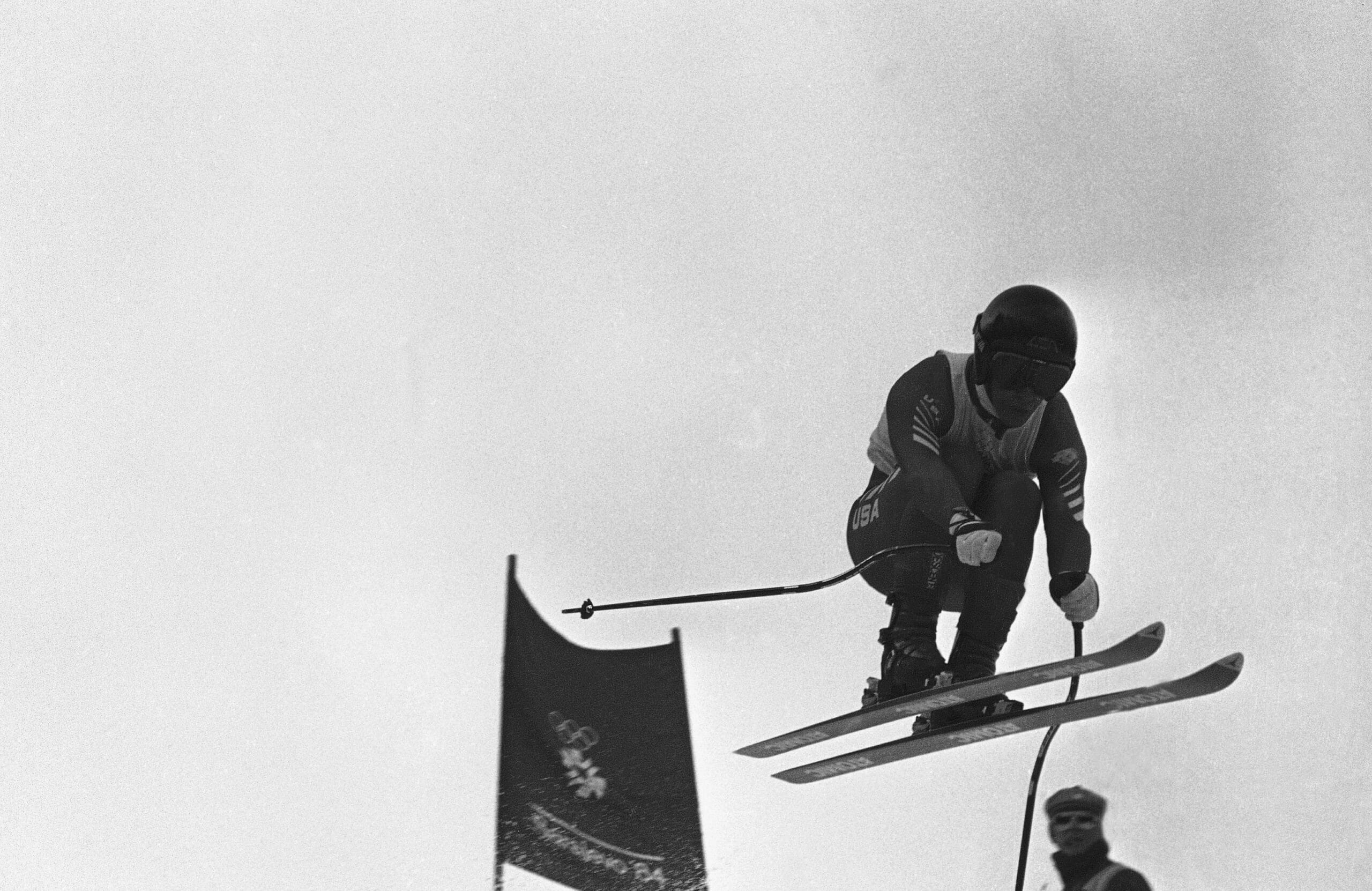
The Men’s downhill competition finally occurred on Thursday, February 16th, under clear skies with cold temperatures and snow conditions providing good track conditions. No American male had won an Olympic gold medal in alpine skiing, but that changed in Sarajevo. First-time Olympian American “Wild” Bill Johnson was victorious, outpacing second-place Swiss star Peter Mueller by 0.27 seconds.
Johnson’s teammate Doug Lewis remembers the conditions and Johnson’s gold medal run that day. He felt the course was “not the toughest or most challenging course in the world but had sections of big turns and fast speeds with a long gliding section.” And while the course did not specifically play to Lewis’s strengths, he knew it was perfect for Johnson, a seasoned glider. “The course fed right into Billy’s strengths. He solved the puzzle of that course immediately and I knew he would win.”
Lewis talked about how the entire team celebrated Johnson’s victory. “It was a blur after the race with Billy. He was surrounded by the press until the medal ceremony, which we all went to. I remember him jumping up onto the podium and raising his hands in victory with the biggest smile ever in his red Levi’s medal ceremony suit! I do remember that we all went out to celebrate that night, and when I came home to the village and went into my room, I expected Billy to come home WAY later than me. But when I arrived, the partier, Billy, was asleep already with his medal around his neck.”
As for Lewis, he credits the Sarajevo downhill race as a launching pad for his success. “I gave it my all. I remember attacking my run but getting late in sections. I was only 20 years old at the time of the Games but gained a ton of experience and used it the following year to win my medal at the 1985 World Championships.”
Mahre brothers win gold and silver in the slalom
In the final alpine event on the last day of the Games, American legends Phil and Steve Mahre dominated the field. Phil won the gold medal and Steve finished in second place just 0.21 seconds behind his brother, the second American alpine ski team’s one-two sweep in the Games.

Steve Mahre’s race
Steve Mahre remembers that day in great detail. He skied a brilliant first run, clocking the fastest time, 0.67 seconds ahead of Jonas Nielsen of Sweden and 0.70 seconds ahead of brother Phil. He felt confident going into the second run, telling himself, “All you have to do is go and ski a clean run and this is your medal.” But then he thought, “You can’t just ski a clean run; you’ve got to win both runs to be the Olympic champion.”
In the second run, Phil skied first and reported to Steve that the course was smooth, “not rolling too bad,” encouraging him to be quick on and off the edge. However, after a tough start and some early miscues, Steve fell behind the course’s rhythm, making wide turns and even breaking a gate. “I mean, I just basically had to throw my feet out to the side to be able to try to turn left because my body was falling to the right side and my skis were railing.” Steve remembers thinking repeatedly, “Ooh, that was a tenth … whatever, don’t worry about it.”
Difficulties on the course and Mahre’s medal run
“Don’t quit now! You’ve come too far,” Mahre told himself as he started feeling the rhythm of the course. “From here to the finish, you’ve got to hump it,” and, with a robust and athletic skate, crossed the finish line just 0.21 seconds behind his brother Phil, taking home the silver medal. He’s not quite sure what went right that day. “Had I not been going out 100%, I probably wouldn’t have been as competitive as I was. I don’t know. I mean, it’s funny because you go there and you have a day when everything goes right, and you don’t feel you did anything different.”
Olympic Games to remember for the U.S. Alpine Team
The Olympics’ closing ceremony is usually bittersweet for me and many others — another four years to wait. But in 1984, it was time to bask in the U.S. Alpine Ski Team’s glory. The Sarajevo Games were a highlight of American alpine skiing, unparalleled in team depth and medal count. There were many American firsts: The first gold medal in the men’s downhill, the first gold medal in the women’s giant slalom in 32 years, the first one-two sweeps in alpine skiing, five total medals, and McKinney’s fourth-place finish.
Jim McKay, ABC’s host of the Sarajevo Games, was full of praise. “[Deb Armstrong] is now a world figure in sports, an Olympic gold medalist, and the first American woman to win the golden giant slalom since Andrea Lawrence did it in Oslo 32 years ago. And she loved every minute of it.” He described Cooper’s comeback from a broken leg as “remarkable” and pointed out that “never before have American women finished one-two in an Olympic alpine event.”
McKay said about Bill Johnson, “They came out for the award ceremonies at the Plaza in front of the Press Center for the downhill race. Bill Johnson still looked cool and collected. It might take a while for it to sink in, but he’s done something that no American has done before; he’s come to Europe unheralded and almost unknown. A Yank with an anonymous sounding name, [he] was ridiculed by the Austrians rather than praised when he won a World Cup race in January.”
McKay continued, “Bill Johnson has also ended a 10-year domination of world Olympic downhill by the Austrians. His name will now appear on the plaque with Toni Sailer, Jean-Claude Killy and Franz Klammer. He was cool from the moment he arrived here.”
During the medal ceremony for the Mahre brothers, McKay observed that “This one ended the Olympics on the highest possible note for the United States and also served notice that the Americans, after two decades of trying, have finally arrived on the world skiing scene.” He continued, “For America, what a week this has been. Remember, up until this week, no American man had ever won a gold medal on skis and not in any kind of skiing event. Then came Bill Johnson, out comes Phil Mahre, and right behind him his brother Steve.”
Deb Armstrong is proud to have been on the women’s team. “I mean, that team was the world’s best and the team that won the Nations Cup later that year.” Christin Cooper also has fond memories of winning the Nations Cup that year. “It speaks to the depth of our team because, to do that, you must have a lot of skiers claiming points in every race and every discipline.”
She remembers, “We all really helped each other. We were just in this mode of everybody raising each other up, and the coaching staff really encouraged that. It created a kind of culture within the team and made it a whole lot more fun!” Deb Armstrong added, “I was on the team with Cindy Nelson, Tamara McKinney, Christin Cooper, Maria Maricich and Holly Flanders. I mean, that team was the world’s best and the team that won the Nations Cup later that year.”
Sarajevo’s brightest moment, war, and rebirth
By any standard, the 1984 Games of Sarajevo were widely considered an overwhelming success and a moment of pride and joy for the country. Some described the Games as “impeccable.” Sarajevo’s rich culture and the country’s passion for sports were on full display as they successfully hosted the world’s largest sporting event.
In his book, The Sarajevo Olympics: A History of the 1984 Winter Games, author Jason Vuic states that “Sarajevo was the unlikeliest of candidate cities, in the unlikeliest country, and accomplished what many had thought impossible: It hosted an international sports competition at the highest level.” Vuic describes how the Yugoslavs look back at the Olympics with nostalgia and that somehow Sarajevo became the center of the sports world and was watched by upwards of two billion people.
Likewise, in the “Remembering Yugoslavia” podcast, host Peter Korchnak remarked that “The Sarajevo ’84 Winter Olympic Games were the greatest sporting event in the history of Yugoslavia. To many ex-Yugoslavs, the Sarajevo Olympics are still the country’s brightest moment on the world stage.”
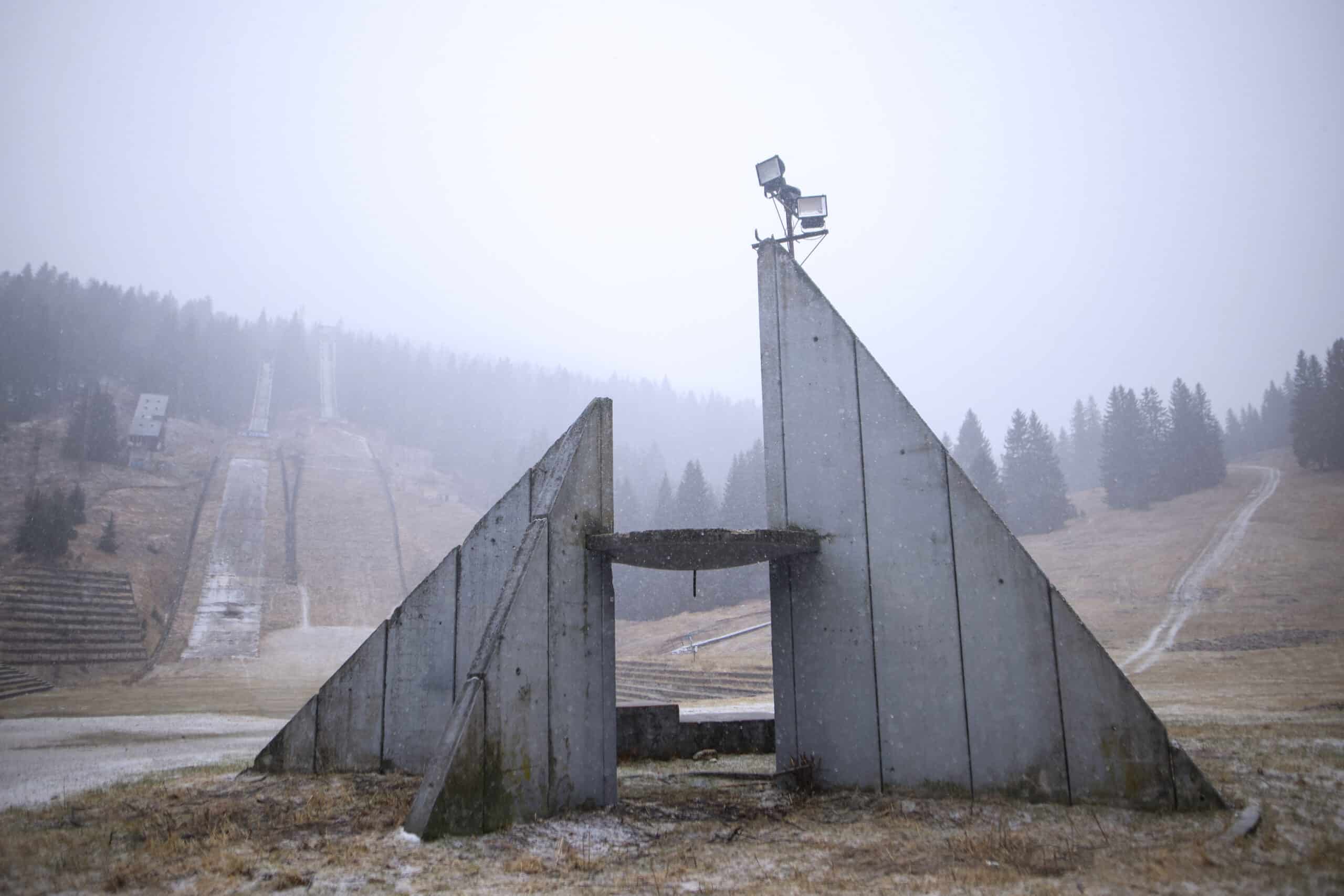
The 1984 Sarajevo Games were undoubtedly a moment of pride and joy for the country. The Games went off flawlessly, and the world was in awe of the beautiful city and the culture of its people. Sadly, less than a decade later, Sarajevo became engulfed in a deadly war. Ethnic tensions and the rise of nationalism divided Yugoslavia into six republics and Sarajevo became the capital of Bosnia and Herzegovina.
There was a profound sadness for those who were there in 1984. Doug Lewis recalls his experience. “While we were there, we never experienced anything but love, kindness and acceptance. We were all different, spoke different languages, played different sports, looked different, but we were all connected through our dedication to our dream of being the best in the world — the best we could be.”
Deb Armstrong remembers that “Sarajevo rolled out the red carpet to the world in the opening ceremonies. Serbs, Muslims, and Croats, all dancing in full color and arm in arm.” Christin Cooper reflected, “I think if you look beneath the surface, tensions were bubbling, but the Olympics always brings out the best in society and in the communities that host the Games. We saw the best of that multiethnic city. It was heartbreaking for all of us to see what happened.”
Unfortunately, the war heavily damaged many of the Olympic facilities. But in the late 1990s, Sarajevo started rebuilding and renovating many of the venues, and in some cases, did it with the support of the International Olympic Committee. Today, Jahorina has become a popular winter sports destination offering alpine skiing, snowboarding, hiking and sledding. It is now the largest and the most popular ski resort in Bosnia and Herzegovina. In 2019, Sarajevo hosted the European Youth Olympic Winter Festival, the first international winter sports event since the 1984 Games.
Despite the brutality of war, Sarajevo’s “brightest moment on the world stage” in 1984 will always be remembered by those who experienced the Games and gathered around the Olympic cauldron for 12 days and in the unity of sport.
As for the highly decorated U.S. Alpine Olympic Team of 1984, their well-deserved legacy lives on. After all, we’re still writing about them 40 years later.

(Photo courtesy of Doug Lewis)
Fourth Row: John Atkins (coach), Chip Woods (Coach), Reuben Macaya (Coach), Conrad Rickenbach (Coach), Ernst Hager (Coach), John McMurtry (Coach), Tom Kelly (Coach)Third Row: Michelle Rudigoz (coach), Theo Nadig (Coach), Tiger Shaw, Steve Mahre, Doug Lewis, Bill Johnson Second Row: Phil Mahre, Maria Maricich, Christin Cooper, Erik Steinberg (Coach) Front Row: Topper Hagerman (Coach), Tamara McKinney, Cindy Nelson, Deb Armstrong and Holly Flanders
About the Author: Rick Bachand