
Haugan Dominates for Victory
A Commanding Win
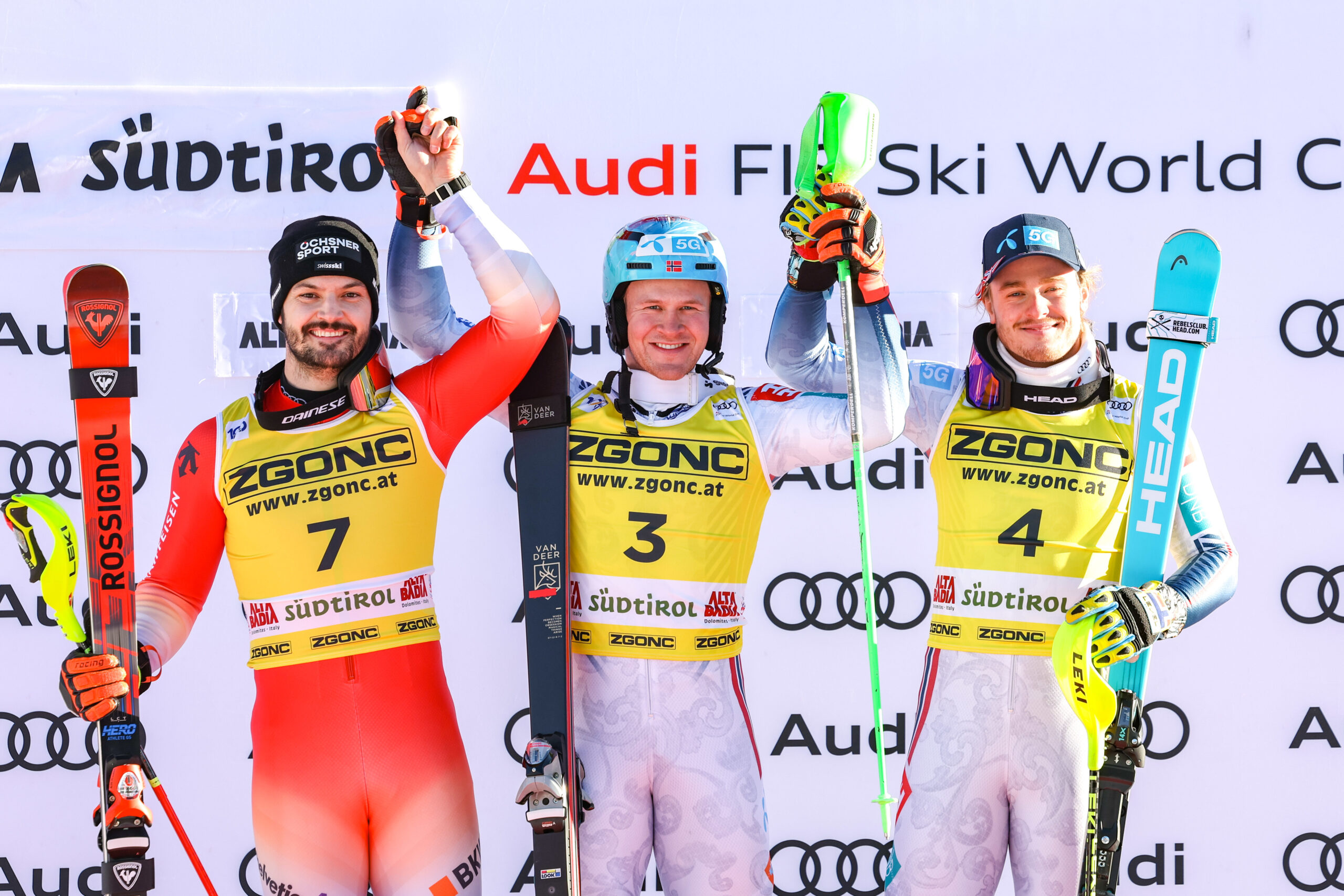
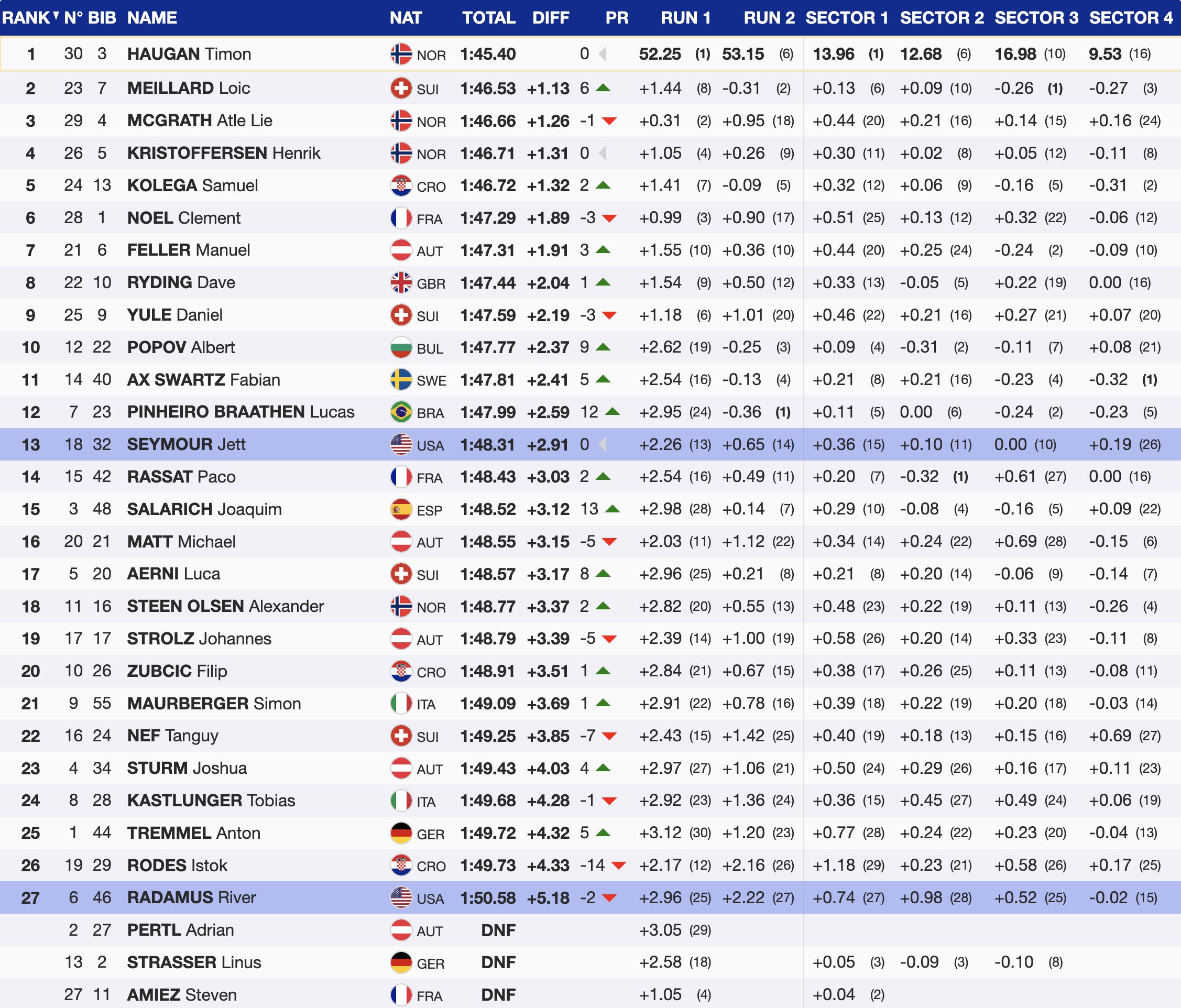
Norway’s Timon Haugan held onto his first-run lead to win the 2024 Alta Badia World Cup Slalom, marking the second slalom victory of his career. Haugan triumphed with a commanding margin of 1.13 seconds over Swiss standout Loïc Meillard, who moved up six positions during the afternoon with the second-fastest time of the day. Norway’s Atle Lie McGrath secured his third slalom podium of the season, finishing third, 1.26 seconds behind his teammate.
“I kept it simple today—clean skiing, full attack, and focusing only on the skiing, not the results. Winning feels amazing, especially heading into the holiday break,” Haugan said.
“Standing on the podium is always special, but having Atle (Lie McGrath) up there with me makes it even better. I’m super stoked and so thankful for this result!” Haugan added.
The Fastest Five Take the Stage
The drama unfolded as the fastest five skiers from the first run tackled the Gran Risa course. First up was World Cup slalom leader Henrik Kristoffersen, who put down a strong run but finished 0.18 seconds behind Meillard.
A Day of Triumph and Disappointment
French rising star Steven Amiez followed but slipped and fell on his hip, ending his race prematurely and leaving three skiers at the start. Clément Noël, the winner of the season’s first two slaloms, was next. Although he skied well and crossed the line in fourth, he ultimately ended the day in sixth as faster racers followed.
Haugan Delivers Under Pressure
Lie McGrath followed with a brilliant effort but fell just short, finishing 0.13 seconds behind Meillard. That left Haugan as the final skier. Under pressure, he delivered an exceptional performance, cementing his place atop the podium and solidifying Norway’s dominance in the slalom discipline.
“I’m a little bit disappointed in my second run,” said Lie McGrath, who has now achieved three consecutive top-three slalom finishes for the first time in his career. “There’s something about knowing you have a big lead and then coming in behind, but I’m still happy to be on the podium, especially alongside Timon.”
“I felt like I lost a little grip and my momentum, especially on a hill where carrying speed is so critical,” Lie McGrath explained. “That’s why I was disappointed—it felt slow coming into the finish.”
Thrilling Second Run Format
The second run of a World Cup tech event delivers unmatched excitement in ski racing. Only the top 30 finishers from the first run earn a spot in the afternoon finale, creating a high-stakes competition. The start order is reversed, with the 30th-fastest skier from the morning running first and the fastest skier tackling the course last. While the race winner isn’t decided until the final skier crosses the line, the early lead battle and the potential for dramatic moves up the standings keep fans on the edge of their seats.
Today, that standout racer was Pinheiro Braathen, the 2023 World Cup slalom champion, returning to competition after a season away. Skiing seventh in the second run, Braathen delivered an exceptional performance, setting the fastest time of the afternoon. His effort allowed him to climb 12 positions to finish 12th, showcasing his ability to compete at the highest level. Only Spain’s Joaquim Salarich, starting with bib 48, moved up more, gaining 13 places to secure 15th.
Early Leaders Set the Stage
The second run began with fierce competition as racers aimed to set an early benchmark. Pinheiro Braathen initially held the lead with a strong run, but Bulgarian Albert Popov soon delivered an outstanding performance to overtake him.
By the halfway mark, Popov led the field, with Sweden’s rising star Fabian Ax Swartz just 0.04 seconds behind. Pinheiro Braathen, despite his solid effort, slipped to third, trailing by 0.22 seconds. With the fastest 15 skiers from the morning still to come, the stage was set for an intense battle for the podium.
Meillard Makes His Move
The afternoon’s drama heightened as last season’s Austrian World Cup slalom champion, Manuel Feller, became the first of the final 10 to ski. Feller delivered a fast second run, taking the lead with nine skiers yet to race.
Meillard, who finished the morning eighth, then put down an outstanding performance to take a commanding 0.78-second lead over Feller. Croatia’s Samuel Kolega followed with a solid run, finishing just behind Meillard, leaving six racers to go.
Swiss racer Daniel Yule was unable to deliver a fast time, and with five skiers remaining, Meillard led the field, followed by Kolega in second and Feller in third.
“This morning I was thinking a top ten would be amazing because, in warm-up, it was impossible. Everything was painful,” Meillard said.
“First run I didn’t have the confidence I needed, so I just said to myself, ‘One more run and then it’s Christmas—let’s push for it,’” Meillard explained.

Good Results for the Stifel U.S. Ski Team
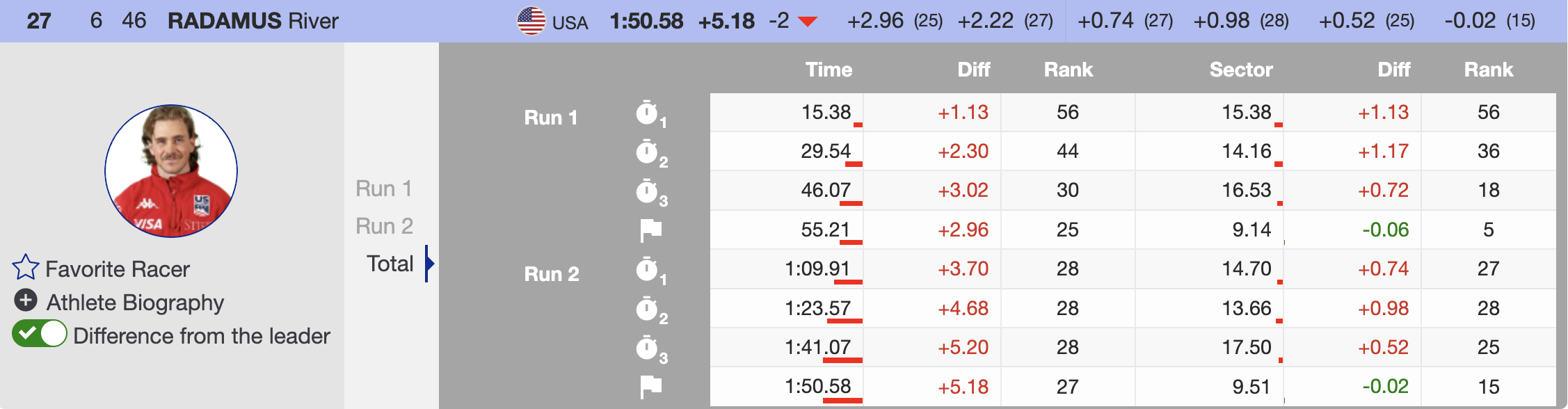
The two Stifel U.S. Ski Team members who qualified for the second run both managed to score World Cup points. River Radamus, skiing sixth in the afternoon, struggled to match the speed he displayed in the first run and finished 27th, earning his first slalom points of the season.
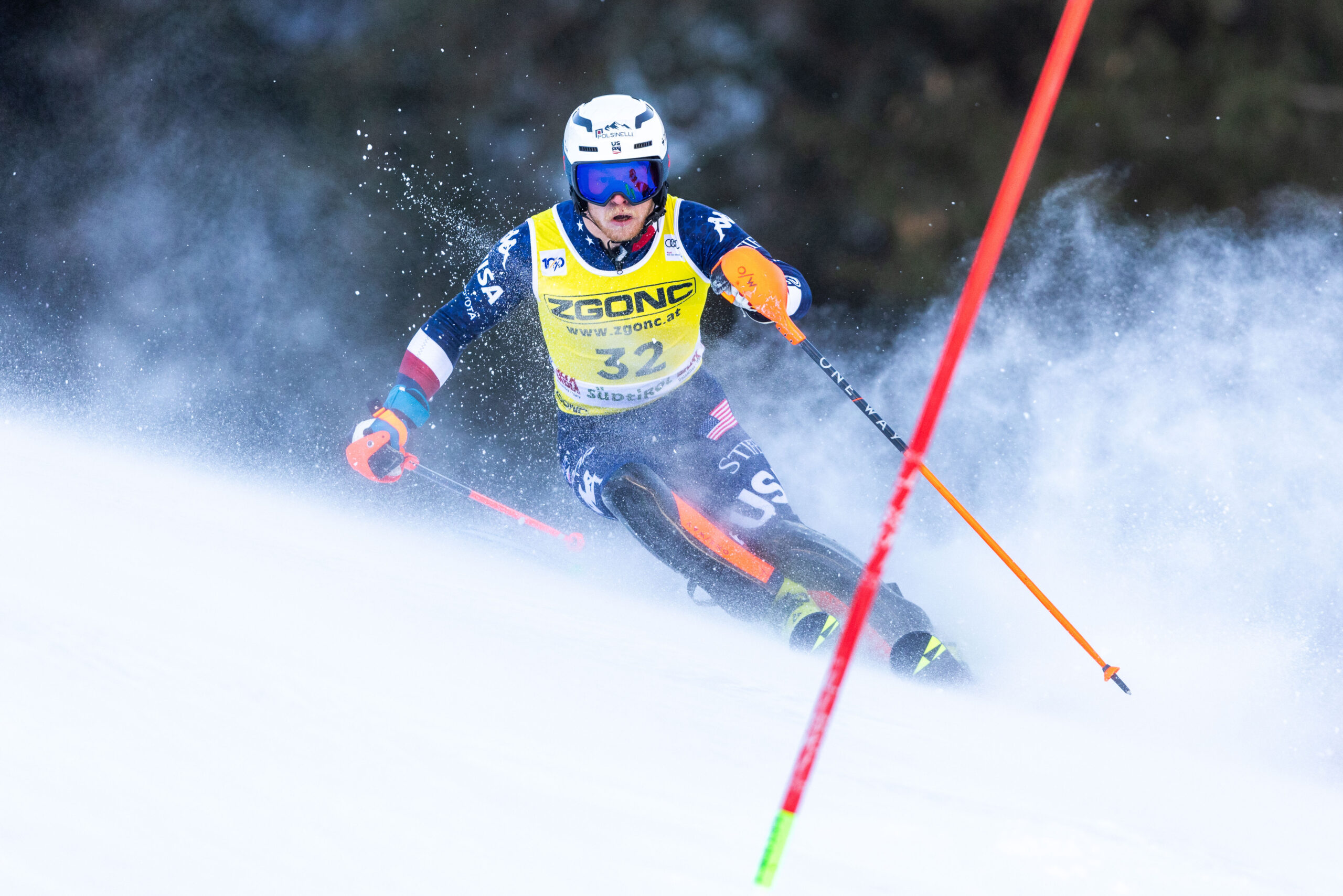
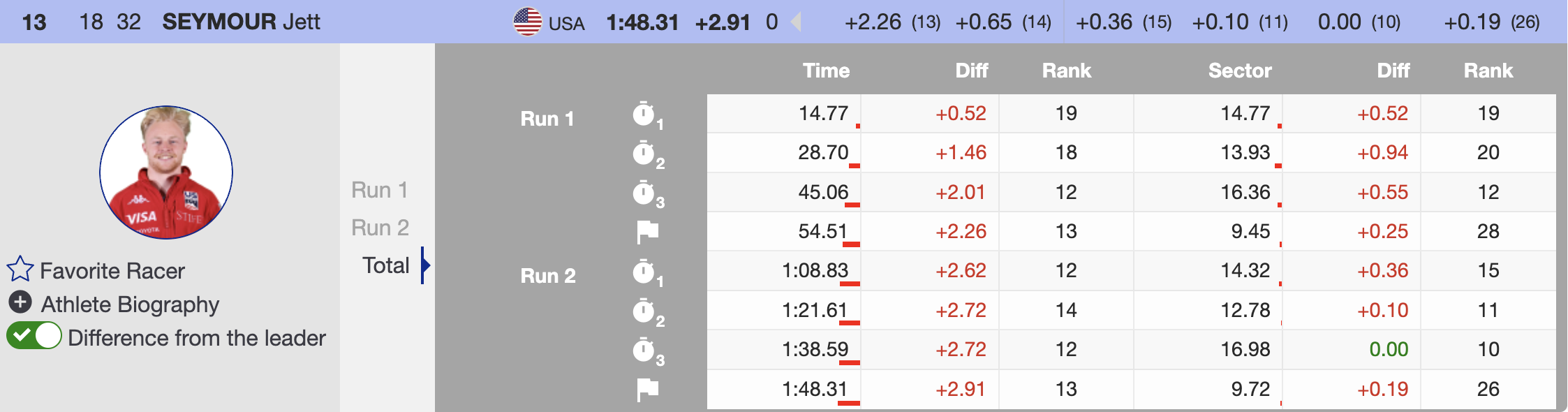
Jett Seymour, however, delivered a stronger performance. Skiing confidently, he slotted into fourth place behind Pinheiro Braathen with just 10 racers left to compete. Seymour maintained his strong form, finishing 13th to match his position from the morning.
Race Results & Analysis of the Fastest Three and Qualified Stifel US Ski Team Members
Click image to enlarge
Analysis of the Fastest Three and Qualified Stifel US Ski Team Members

About the Author: Peter Lange