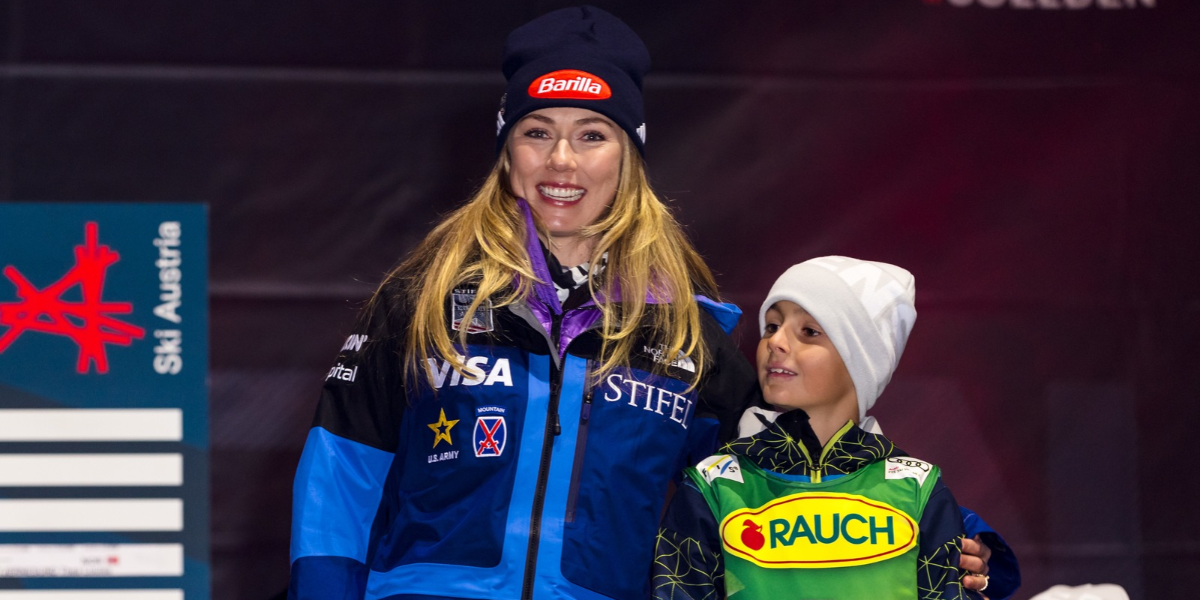
Chris Ernst, Mikaela Shiffrin, and Chris Davenport GoPro Games Photo: Meredith Guinan
Focusing on super G rather than downhill, Shiffrin can’t wait to race the Birds of Prey
VAIL, Colo. – Mikaela Shiffrin confirmed that she plans to compete in the World Cup super-G on the Birds of Prey course in Beaver Creek this December.
Home in Colorado for a couple of weeks, the 29-year-old superstar is doing double sessions at the gym most days and is excited to return to the hill a few miles from her house, where she hasn’t raced since the 2015 World Championships.
“Racing at Beaver Creek again is really exciting,” Shiffrin said. “For a long time, it’s been one of my favorite venues. Before I even raced there, watching the men race there, it looked like so much fun. A few years ago, we had the opportunity to race there. It was such a dream to ski that hill.”
The women’s World Cup first stopped at Beaver Creek in December 2013, when Shiffrin competed in the giant slalom, finishing second. In the 2015 World Champs, she clinched the gold medal in slalom and finished eighth in GS. She did not compete in the speed events, which took place not on the Birds of Prey course but on an adjacent course called Raptor.
“Everything about the 2015 World Champs was special,” Shiffrin said. “Having a World Championships right in my own backyard and sleeping in my own bed, my whole family came out to watch. They rented a couple of different houses. It was like 40 family members. We would go see them in the evenings. I wouldn’t say it was relaxed. There was still a level of stress, but somehow, being home made it familiar enough that I could let go of some of the stress that is normally tied to big events. One of my biggest memories was taking a nap at the start before the second run of the slalom. I remember thinking, this is probably weird if anyone is seeing this, but I’m a little sleepy.”
The napping Shiffrin was displayed live on the big screen for the crowd, making her gold medal performance much more colorful
Click on image to enlarge

The speed plan
Going into next season and still recovering from left leg injuries suffered in a downhill crash in Cortina d’Ampezzo, Italy, this January – the last time she was on a speed hill – Shiffrin is planning on carving out a block of training time for super-G.
“I’m planning on doing more concentrated focus on super G and really quite a bit less focus on downhill, which means I’ll have the time this summer to prep for super-G,” she said. “Last summer, I didn’t actually get any super-G training because every time we’d try to train super G, the weather [curtailed plans]. We had to leave Chile because we were in this insane snowstorm and we were going to get stuck in Portillo for a week without being able to ski.”
At the beginning of last season, Shiffrin crashed during training in Levi, Finland, and suffered a bone bruise on her knee that didn’t slow her down much. She finished first and fourth in the two slalom races there and earned a podium in every subsequent technical race in Killington and Tremblant. She then won the first downhill race of the season in St. Moritz and missed the super-G podium by 0.06 seconds, finishing fourth.
In the following super-G in Val d’Isere, she missed a gate and took a DNF but closed out 2023 with second place in the Courchevel slalom and victories in slalom and GS in Lienz, Austria. Afterward, she got sick for a few weeks, struggled through the tech races in Kranjska Gora, Slovenia, and opted out of the speed races in Zauchensee, Austria. She bounced back strongly in mid-January, winning the slalom in Flachau, Austria, and Jasna, Slovakia, where she also took second in GS. However, a frightening, high-speed crash in the Cortina downhill sidelined her for several weeks until she returned in March to win the season’s final two World Cup slalom races in Åre, Sweden, and Saalbach, Austria.

Cutting down on downhill
“One of my goals for last season was to improve some of my downhill-specific skills – glide work and things like that. I did accomplish that, but at what cost? At the end of the day, I get to show that in two or three downhills throughout the season. Downhill takes so much time with the prep and training runs going into it. Logically, it’s not necessarily worth it for World Cup points,” she said. “My idea this year is that I’ll actually be racing more speed events in super-G than I was able to race last year.
Take the injury out of it, what I’ll be able to do is actually accomplish racing all the races that I want to. This season, I did have to pull back on a few races, especially in the middle of the season. It becomes hectic when you plan a schedule that is sort of inexecutable. So, long story short, I’m doing more speed, but it’s going to be more super-G, less downhill.”
Shiffrin plans to return to Europe in a couple of weeks for the Entertainment Lions for Sport awards in Cannes, followed by a visit with her fiancé Aleksander Aamodt Kilde. Shiffrin will also attend her cousins’ weddings before launching into a training camp at the end of July. Then comes “pretty full-on” training back on snow in South America in August and September.
Kilde’s ‘horrific’ injury
Making a brief appearance on stage at the GoPro Mountain Games in Vail last Saturday, Shiffrin said that she “is still working through some stuff” with her January injury (a re-injured bone bruise and MCL sprain to the knee as well as a high ankle-sprain), but is doing well and grateful to be able to race again. She emphasized that Kilde’s injury – a dislocated shoulder and lacerated calf sustained in a January downhill crash in Wengen, Switzerland – was much worse than many realized.
“He’s got a long way to go, but I’d say he’s doing well, moving ahead of schedule. His injury was horrific,” she said. “Being there in the hospital those first 24 hours was a mind-blowing experience. Honestly, it brought back a lot of memories of when my dad was in the hospital. It was very traumatic on a lot of different levels. He was somehow so positive the whole time. Even when he’s negative, he’s positive. It was amazing to see how tough he was in that scenario.
A lot of people were like, ‘We’re so glad it wasn’t an open fracture. We’re so glad it was just a cut.’ I’m like, you have to share the pictures. Weeks and weeks later, I’m like, I don’t care how bad it is. I can’t stand another person coming up to me at a ski race before my run and saying, ‘We’re so glad that Alex is okay and it was just a cut.’ I’m like, he almost cut his leg off! You guys don’t understand.”
Birds of Prey toughest super G ever?
Getting back to racing at Beaver Creek, where she grew up learning to ski and also hiking, biking, and taking cooking classes with her family in the summer, Shiffrin said competing on the Birds of Prey course – the “super” of which is considered by numerous athletes to be the most technically challenging of any on the men’s World Cup – will be an experience like no other.
“It’s going to be one of the most challenging tracks we ski,” she said. “It has really high-speed sections, a lot of very technical elements. A lot of our speed tracks are a little bit more focused on the glider skill work. The Birds of Prey has a lot of technical features. I’m not sure where we’ll be starting compared to the men. It’s 30 seconds of gliding and tucking for the men. Then, when you drop into the first pitch, you drop into the steep sections and it’s like, holy moly.
You need to be standing on your outside ski and you need to have the right body position here or you’re going 70 mph straight into the fence. I think it’s going to be unique in what it demands from the athletes from a technical perspective, also from a mental perspective. It is demanding mentally. I think there’s going to be a lot to remember since it’s the women’s first-time racing on this slope. It’s going to be really exciting to see how it all plays out.”
About the Author: Shauna Farnell