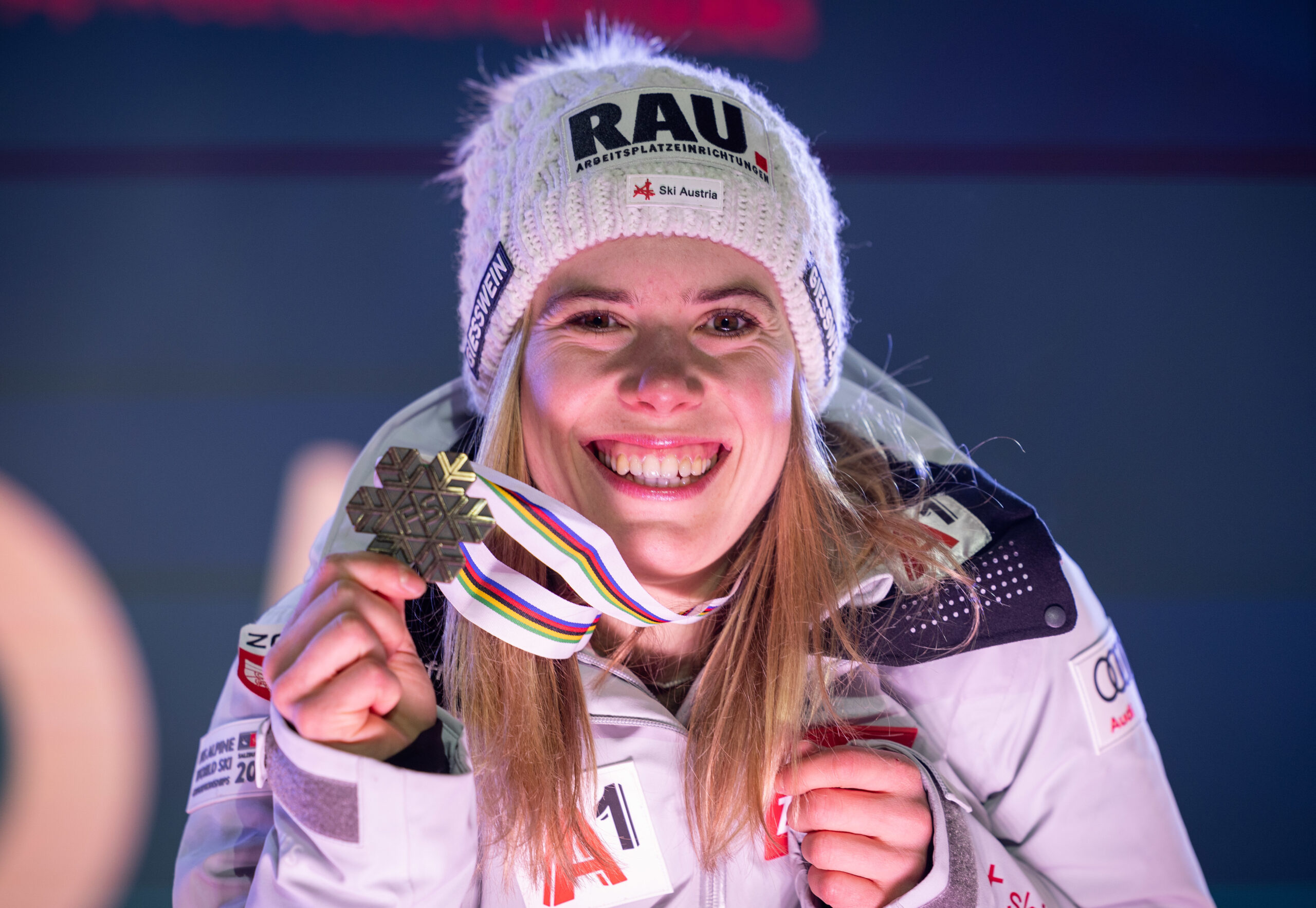
Stephanie Venier: GEPA pictures
The Importance of the Home World Championships to Austrian Skiing
An Entertaining Start
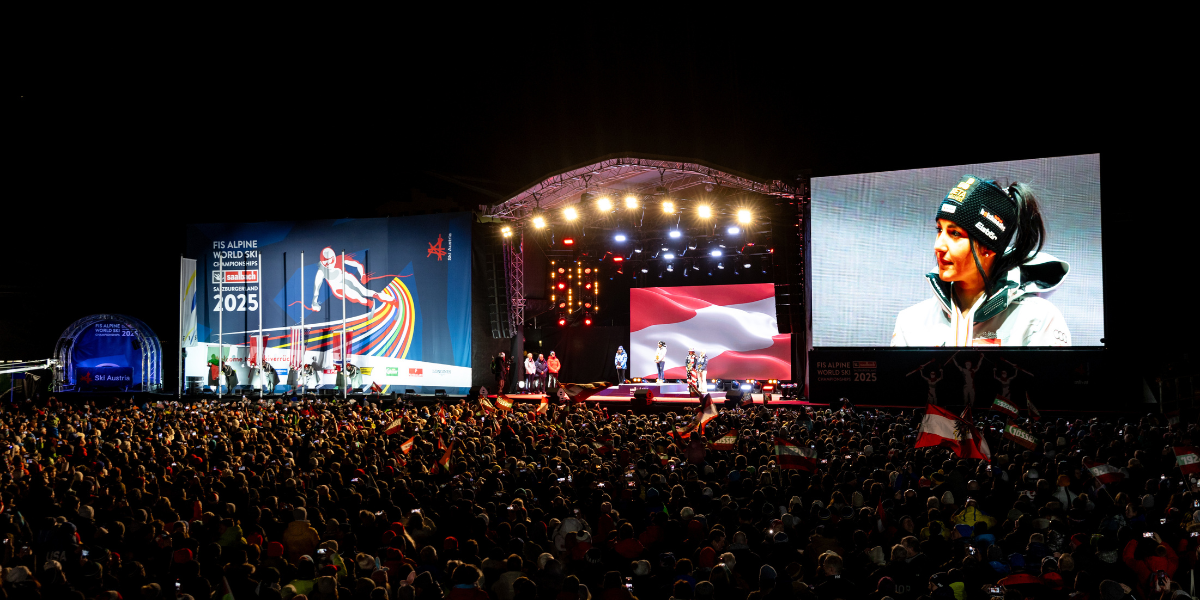
The mixed-team parallel event during the Feb. 4 opening ceremony kicked off the championships with energy and excitement for ski teams and fans.
Although Austria placed sixth, the home crowd enjoyed the opening festivities, which featured several entertainers, including the “ski racers’ band” Masters of Disaster. Band members Ivica Kostelić of Croatia and Jan Hudec of the Czech Republic are well-known ski legends. Austria’s speed racer, Max Franz, recovering from injuries, joined them on drums for the occasion. Collectively, the three racers have won 31 World Cup races and 10 championship medals.
All Competitions on One Mountain
The Saalbach-Hinterglemm race slopes descend the steep Zwölferkogel mountainside, finishing at Hinterglemm’s small village center— an ideal venue for athletes and fans.
Up to 22,500 fans gather in the finish area daily, their cheers echoing up the mountain to welcome every racer, rising to deafening levels when Austrian athletes charge down the final pitch and across the finish line.
Home-Snow Emotions
How does the Austrian team feel about competing in the World Championships at home?
“This is sensational,” said Herbert Mandl, Ski Austria’s alpine director, as the crowd cheered in the background. “The fans are a big help for us. The athletes can feel the atmosphere.”
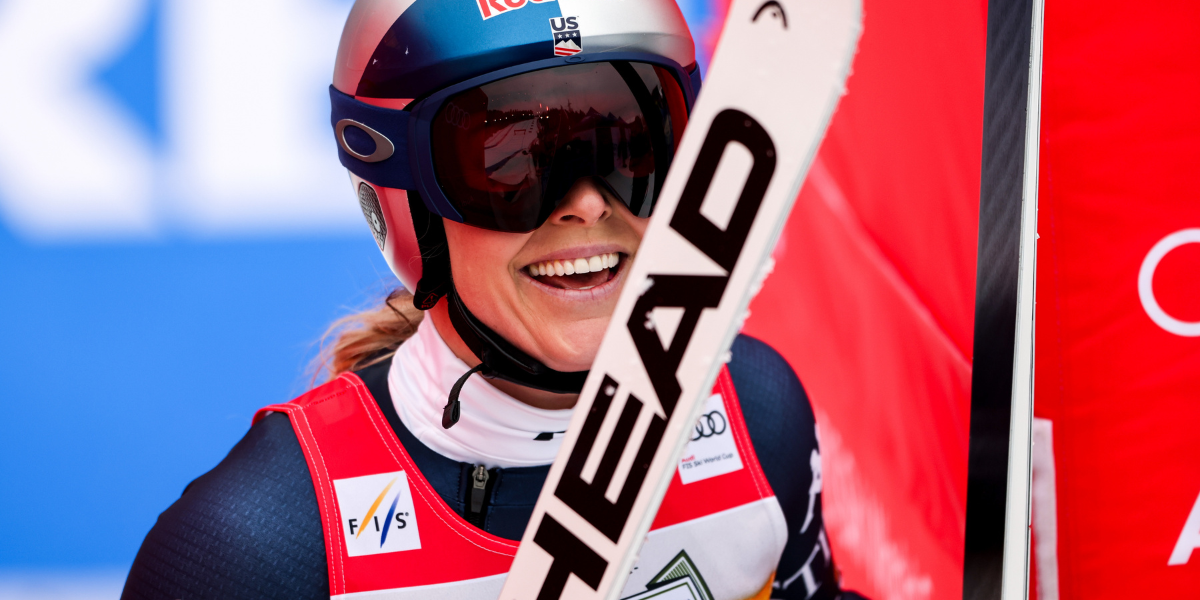
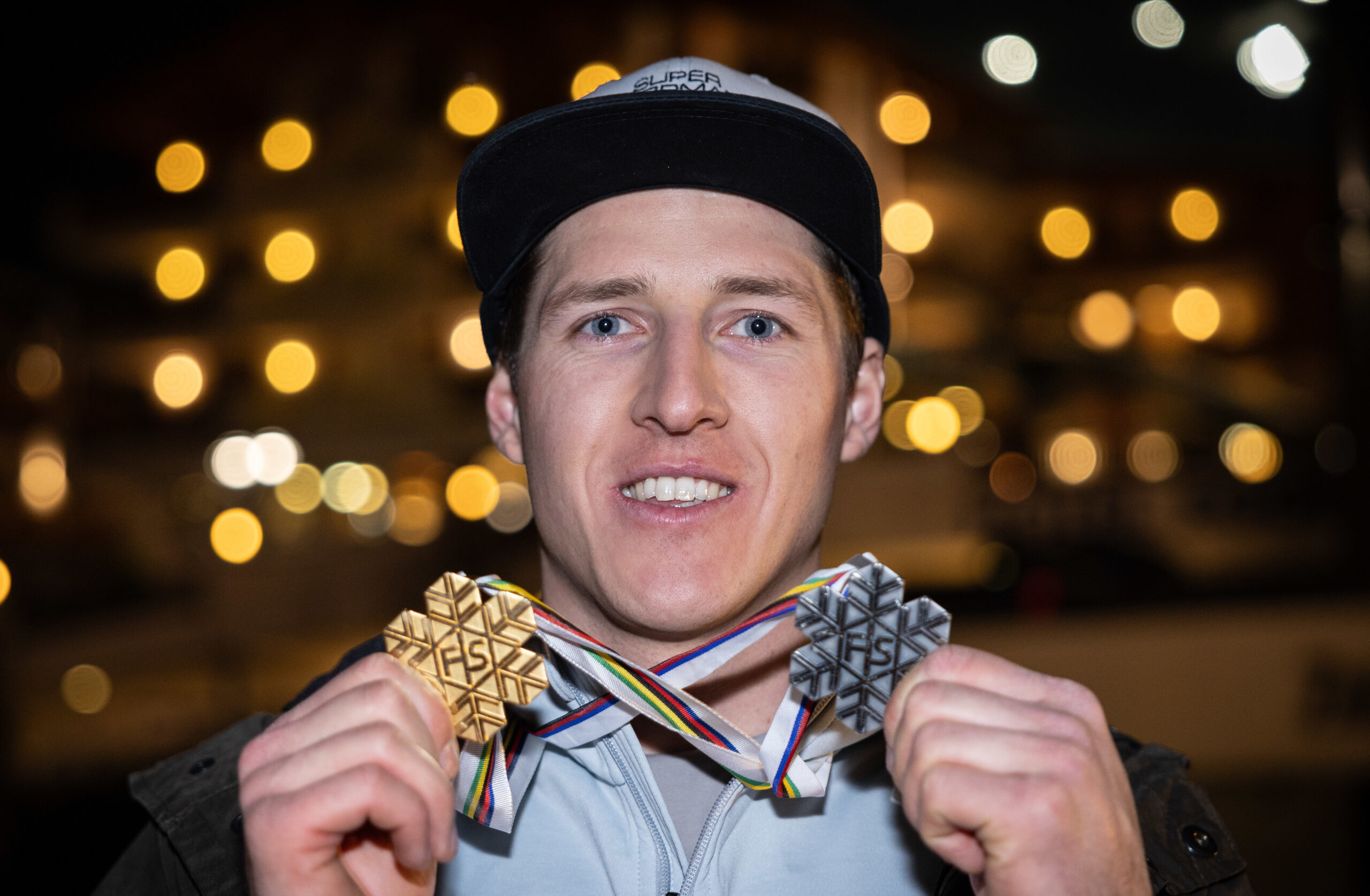
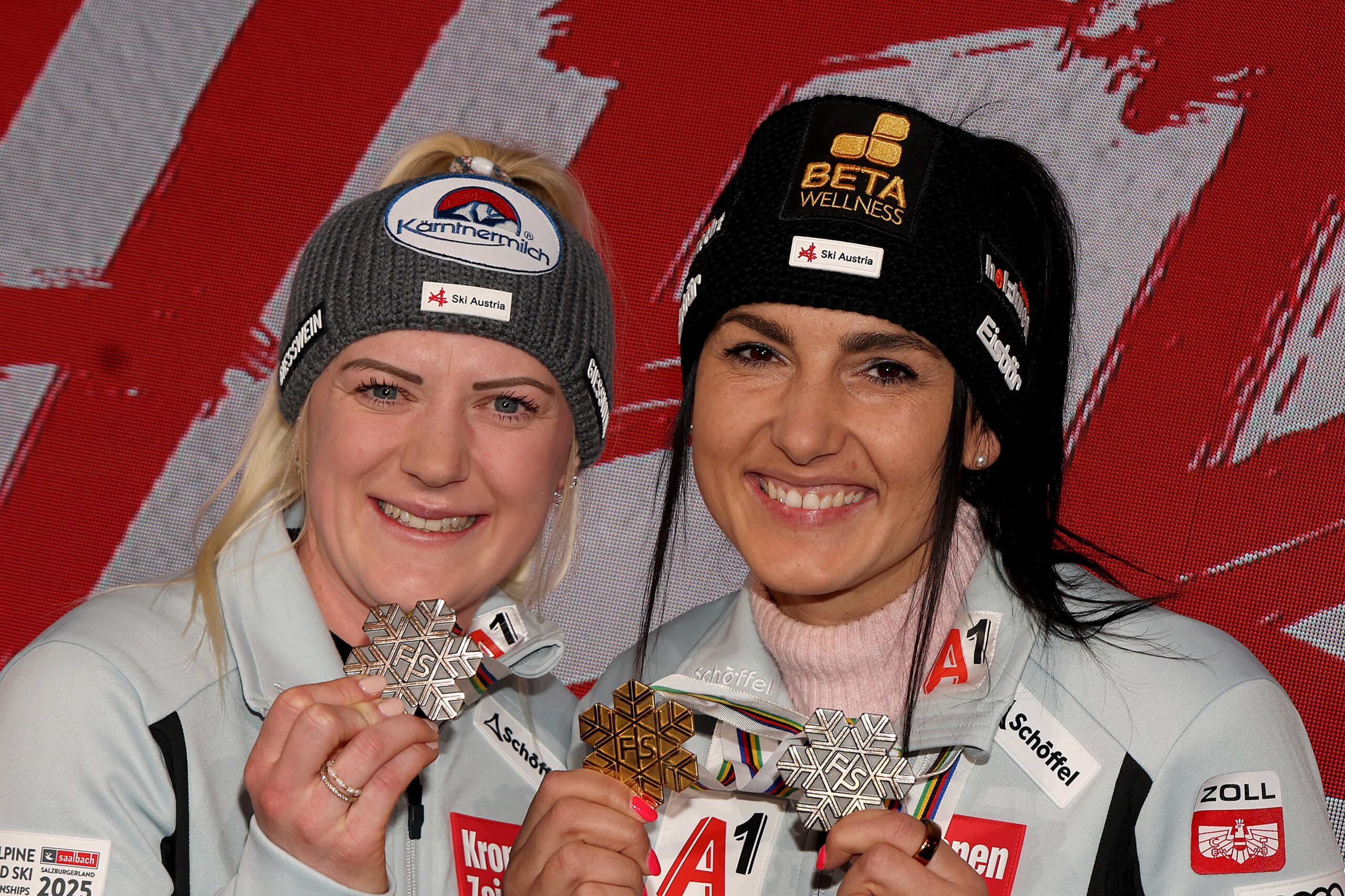
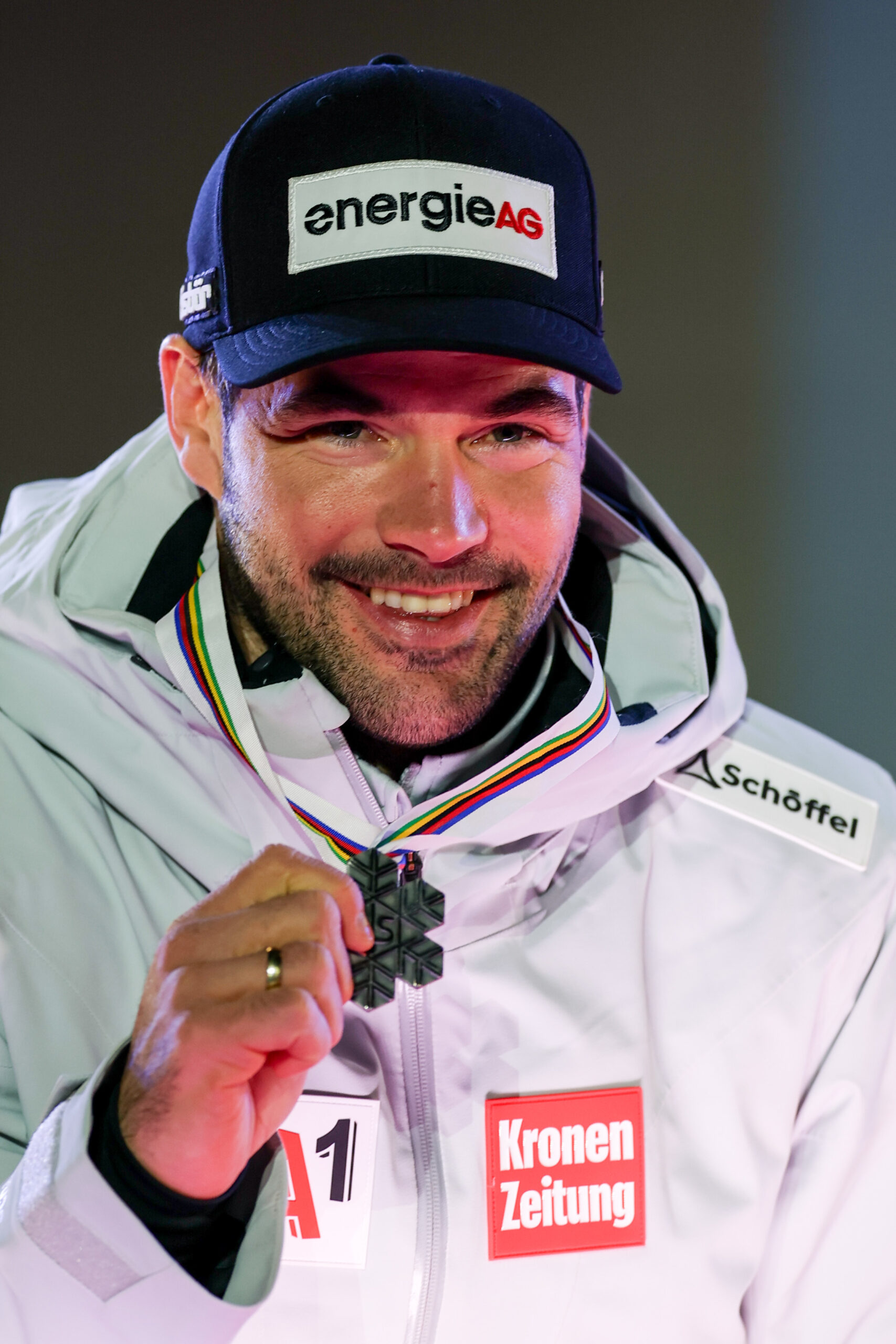
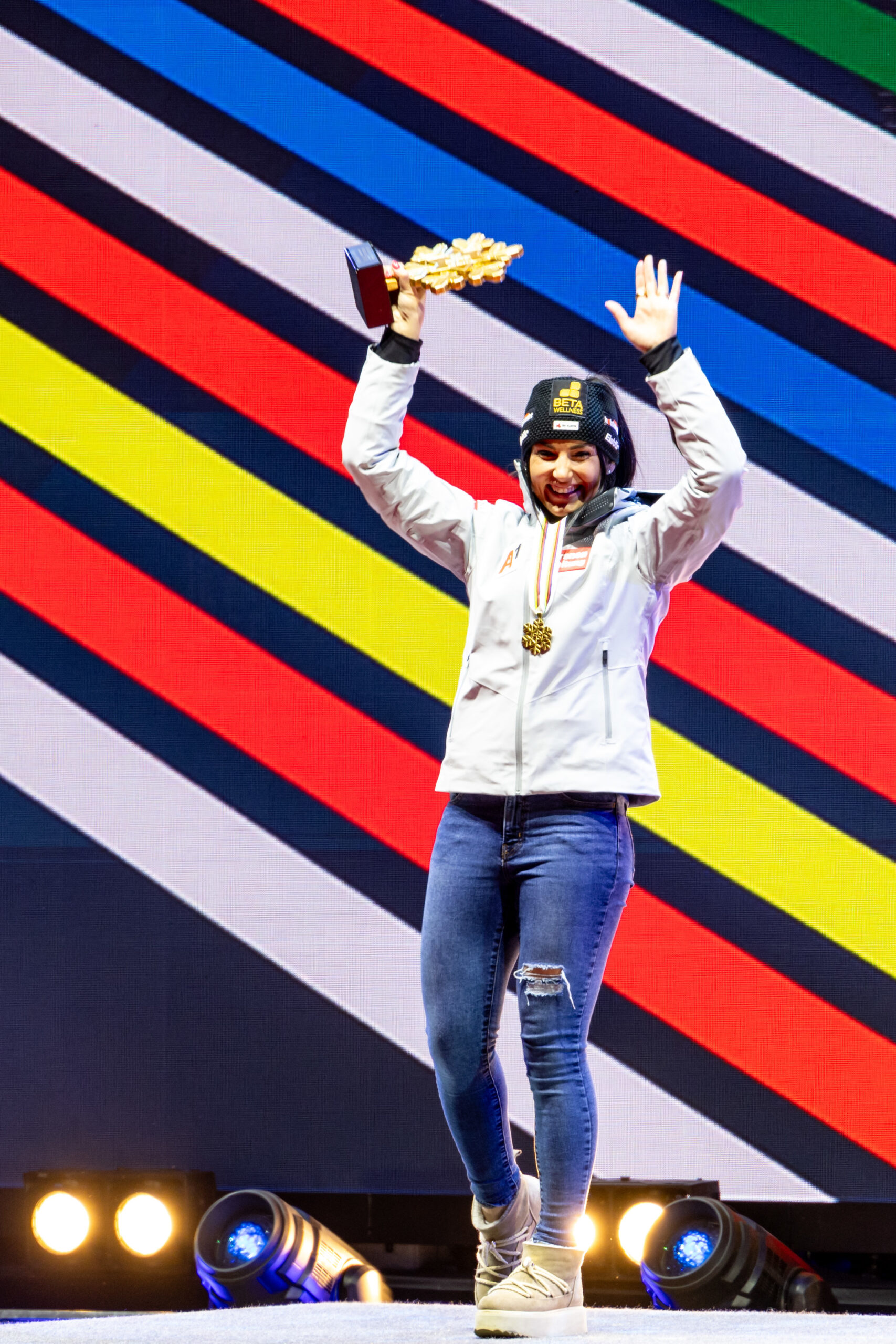
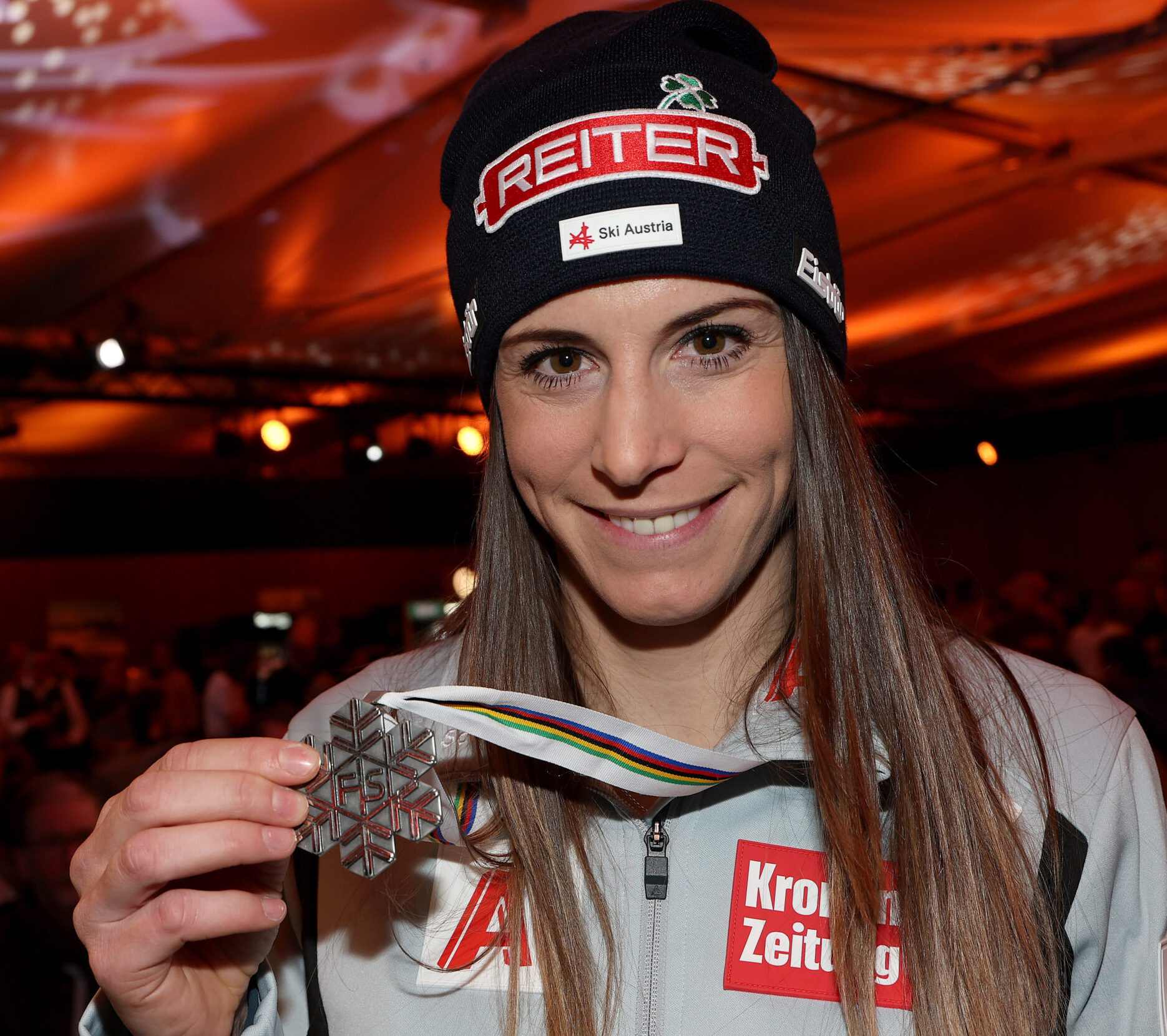
Austria’s Stephanie Venier won the first individual gold medal of the 2025 championships, capturing the women’s super-G title on Feb. 6. More Austrian medals followed in the super-G, downhill, team combined, giant slalom and slalom events: Raphael Haaser (gold men’s giant slalom, silver, men’s super-G), Mirjam Puchner (silver, women’s downhill), and Vincent Kriechmayr (silver, men’s downhill), (bronze Venier / Katharina Truppe team combined), and ( bronze Katharina Liensberger’s slalom).
“We are so happy, especially for the team, for the coaches, and for Steffi because the most important thing is that the athletes perform their best on race day. And she did a great run,” said Ski Austria CEO Christian Scherer after Venier’s victory.
Click images to enlarge
Joy and Pressure
Competing in a home championship involves motivation and pressure, Mandl pointed out.
“We aren’t the big favorites, but I think racing at home is a great motivator. At the same time, I hope our athletes don’t feel too much pressure. That’s the flip side of hosting a championship,” Mandl said. “Other nations are bigger favorites, so the Austrians can be a little more relaxed.”
Scherer noted that Austria’s first gold medal relieved some of the pressure:
“We always believed in our athletes, our team, and the support staff. We knew they were working hard, so it was only a matter of time before they were back on the podium.”
Strong Team, Tough Injuries
Many strong Austrian racers are competing in the 2025 championships, and Mandl sees promise across all disciplines. However, some key contenders had to sit out.
Among them was Ricarda Haaser, who sustained a serious knee injury in the women’s super-G on Feb. 6. Her brother Raphael later said his silver medal in the men’s super-G partially belonged to her.
Another key absence was Felix Hacker.
“Felix won four European Cup races this season, but he was injured in Kitzbühel,” Mandl said. “It’s unfortunate.”
Kriechmayr’s Comeback
Earlier in the season, Vincent Kriechmayr’s mid-January knee injury and short recovery window cast doubt on his championship hopes.
However, Kriechmayr was determined to return. With support from his team, hard work, and advice from his wife, former Austrian downhiller Michaela Heider—who has recovered from multiple injuries—he arrived in top form just in time for the downhill. The result: a sensational silver medal
Fan Club Traditions
The streets of Hinterglemm are filled with ski fans during race time, many waving flags and wearing jackets featuring their idols’ names.
After the women’s super-G, Ski Racing Media met a group of fans waving a “Conny Hütter Fan Club” flag. Some wore jackets bearing the names of Marco Schwarz and Matthias Mayer. Mayer, a retired three-time Olympic champion, foreran the men’s downhill training.
Family Support
Karl Hütter greeted warmly, “Servus,” when asked how it felt to cheer for his daughter at the World Championships.
“This is only 300 kilometers from my home,” Hütter said, adding that he regularly attends races.
Although Conny’s super-G result wasn’t what they had hoped for, he remained optimistic about her downhill performance.
“I’ve been to America many times,” Hütter added, referring to his past as a Daytona 24-hour race mechanic. “Maybe I’ll make it to the World Cup Finals in Sun Valley.”
A Taste of Austrian Culture
As the conversation ended with lighthearted small talk, Hütter smiled and asked, “Would you like a schnapps?”
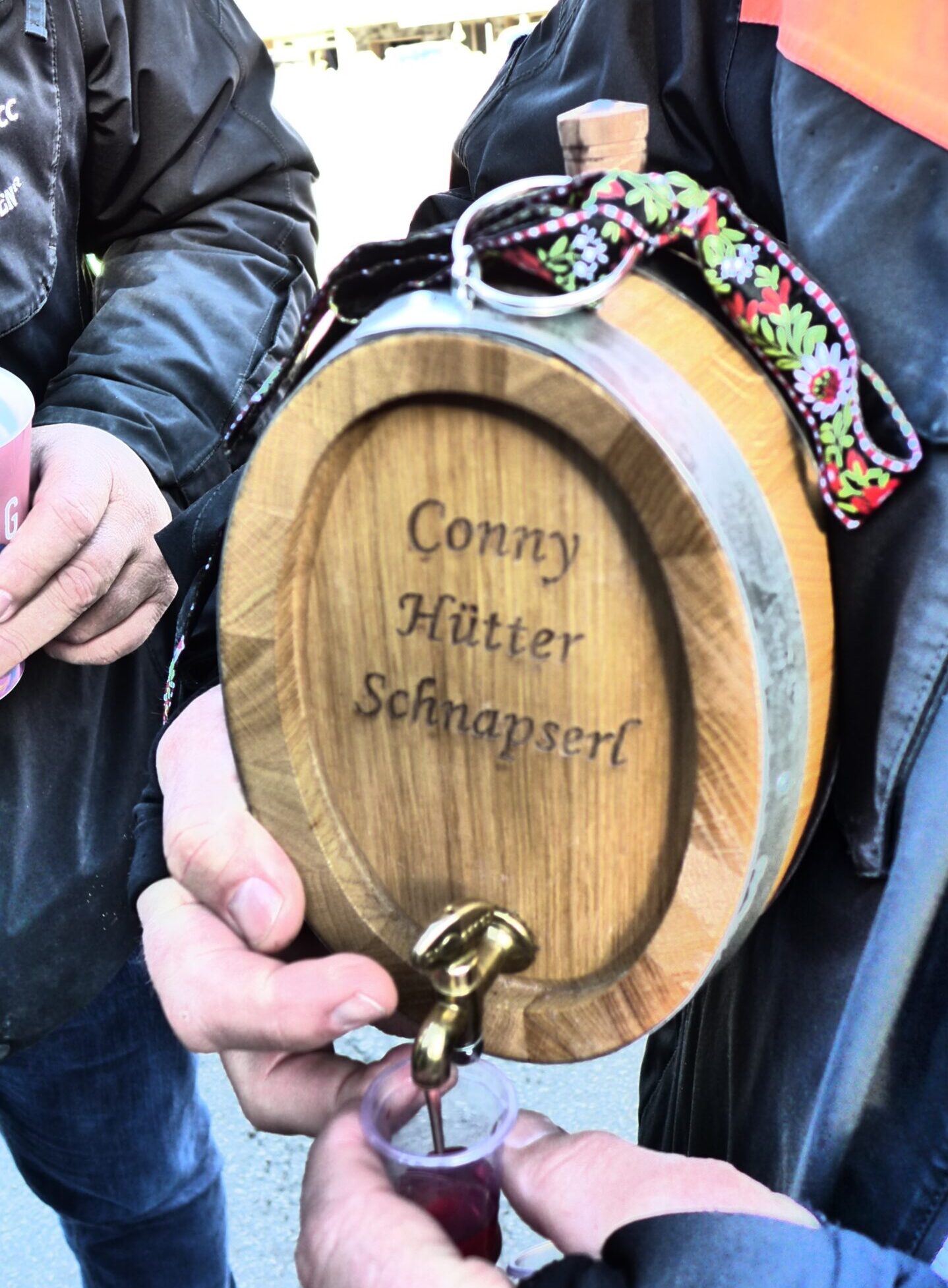
And who could say no when the father of one of Austria’s greatest speed skiers offers a homemade schnapps from a miniature wooden barrel labeled “Conny Hütter Schnapserl”?
The home-brewed schnapps, poured from a tiny tap, had a wonderfully fruity taste. The group explained it was made from flowers that grow naturally on Austrian hillsides.
The Future
What do the Saalbach-Hinterglemm championships and Austrian gold medals mean for the next generation?
“We always wanted these World Championships to inspire younger generations,” Scherer told Ski Racing Media. “Nearly every Austrian squad member also has regional teams or clubs attending. We invited them so they can experience this atmosphere and be close to their role models and heroes. We hope this serves as motivation for younger skiers.”
A few years ago, Alpine Director Mandl told Ski Racing Media he wanted to create a stronger focus on technical development among young Austrian racers. Have there been changes?
“We have adjusted some systems. We always strive to improve. It’s never easy. But younger generations have more alternatives now than in past decades,” Scherer said, implying that skiing competes with many other sports and activities for youth participation.
“Our sport is thriving in Austria. Home World Championships like this create momentum we can build on. We’re confident that sooner or later, we’ll reclaim the Overall Nations’ Cup from the Swiss. For 30 years, it wasn’t even a debate. Now it is. But sooner or later, we’ll turn it around again.”
About the Author: Bente Bjørnsen Sherlock