A nationwide lockdown started in Austria on Monday, Nov. 22 as a reaction to an ongoing, rapid increase in COVID-19 infections and an (as of then) only 66% vaccination rate nationwide, which is among the lower vaccination rates in Europe. The lockdown – which was decided to last for 20 days – applies to unvaccinated and vaccinated persons alike. In addition, Austria’s government is currently working on details regarding Covid-19 vaccination being made mandatory in Austria starting Feb. 1, 2022.
At the same time, top-level sports activities are allowed to go on in Austria during this lockdown – without spectators:
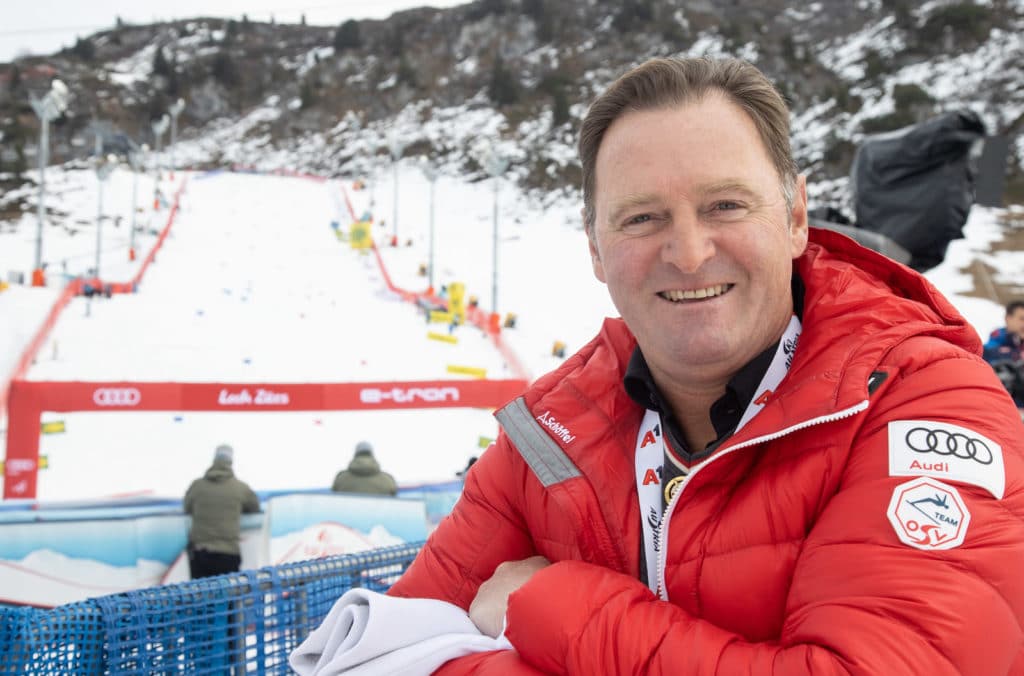
“The problem now for the ski racers, (is that) there are no spectators around at the moment,” says Patrick Ortlieb of the ÖSV in a telephone interview with Ski Racing about a week into the lockdown. The CEO of the Austrian Ski Federation Group, who is responsible for all financial issues and for sports issues regarding alpine skiing, does not think the lockdown has major implications for ski racing in Austria:
“No, absolutely not,” Ortlieb states.
This season’s first Europa Cup race for women took place in Mayrhofen, Austria on Nov. 29, with competitors coming from a variety of nations, and continued in Austrian Pass Turn on Dec. 2-3. The first Austrian stop for the men’s Europa Cup is scheduled for Dec. 19-20 in Glungezer. FIS races are also taking place in Austria during the lockdown.
The alpine ski World Cup is not scheduled to return to Austria until Dec. 28-29, for women’s GS and slalom races in Lienz.
When it comes to the development of young racers, Ortlieb does not think the lockdown will slow down the young skiers:
“Every kid who once raced – (it) doesn’t matter how little (of a) race it was – you get your racing number, like the FIS code or the national ski association code. Once you have a code, you are kind of a professional skier and everybody then is allowed to go to training and racing. We have training from 7 (years) up right now. Until (age) 7, they have to ski with their parents.”
Individual decision
On Nov. 23, a few days before the World Cup races were to start in North America, Austrian national team member and technical skier Franziska Gritsch stated in social media that she has decided not to get vaccinated against COVID-19. As a result of being unvaccinated, she could not travel to North America to participate in the World Cup races in Killington, Vt. She also cannot compete in the Winter Olympics in Beijing in February 2022. Her posts and decision received a lot of attention in social media and also in Austrian media.
During a press conference on Nov. 24, the ÖSV president, Roswitha Stadlober, pointed out that there is a 97% vaccination rate in the ÖSV. Stadlober also said they respect Gritsch’ vaccination decision, and that she herself thereby decided how her path will continue, according to Austrian media.
When asked by Ski Racing to comment in general terms on whether you have to be vaccinated in order to travel and function as a top-level ski racer, Ortlieb makes a comparison:
“I always say it is the same if you want to ride a motorcycle, you have to wear a helmet. If you don’t want to wear a helmet, you are not allowed to ride a motorcycle.
“So it’s your decision to make it or not. If the rules are like this, you have to accept the rules. If you don’t want to accept it, you don’t accept it.”
Valuable experience
During the 20-day, nationwide Austrian lockdown, Ski Racing also asked the International Ski Federation (FIS) about how the lockdown in Austria might affect the racing season. The FIS communications department responded in a Nov. 29 email:
“It is a difficult question to answer as the situation in many European countries, and globally, is changing daily, and even hourly, due to the latest mutation of the virus.
“That being said, FIS and its event organizers gained valuable experience through the last winter in adapting to rapidly changing circumstances and we know that this experience will benefit all stakeholders moving into another challenging winter. FIS will work through the season to find arrangements with local organizers and their countries that meet the local restrictions and keep the strict protocols in place.
“As a key component of the FIS Covid-19 safety protocol, FIS has always stated that ’the National Health Regulations are paramount’ and we will operate with this as a guiding principle.”
ÖSV appeal
In addition to tending to elite-level sports, the ÖSV has expressed its concern regarding the wellbeing of the general Austrian population during national lockdowns. In an appeal to the Austrian federal government on Nov. 19, the ÖSV advocates the importance of allowing the population to perform physical activity and organized club sports outdoors, for example on cross-country ski trails or ski slopes. The letter highlights the importance of protecting the long-term health of all people and points out that sports and a physically active lifestyle strengthen people’s physical fitness, mental health and immune system. “Exercise and sports are essential for EVERYONE, even in times of lockdown,” the letter states.
The appeal also includes the assumption that top sporting events can be organized like last year, followed by an explanation of the importance of such continuity: “We were and are very grateful for this, as this on the one hand cushions the economic consequences for the organizers and top athletes and on the other hand also represents a necessary motivation and promotion for the sport, especially in the current situation.”
Furthermore, the open letter states: “… we would also like to point out that there were no clusters formed at any coordinated training events in the ÖSV disciplines in the past season.”
The appeal, signed on behalf of the Austrian Ski Federation by the ÖSV top management – Roswitha Stadlober, Patrick Ortlieb and Christian Sherer – ends by stating: “Sports and exercise are and will remain the pillars of a healthy society!”
(Quotes from the ÖSV appeal are translated from the original German-language version, which was published on the ÖSV official website on Nov. 19, 2021.)
About the Author: Bente Bjørnsen Sherlock