
Three athletes ride the lift inside SNØ, Norway’s year-round indoor ski training facility near Oslo. Photo provided by SNØ.
For decades, summer skiing meant glaciers, long travel days, and unpredictable conditions. Today, however, an increasing number of clubs, academies, national teams, and World Cup athletes are incorporating indoor training into their annual plans.
One facility at the center of that shift is SNØ, Norway’s year-round indoor ski center located just outside Oslo, Norway.
What began as an ambitious project to bring skiing closer to one of Scandinavia’s largest population centers has grown into one of Europe’s most sought-after training venues. National teams, World Cup racers, ski academies, and youth clubs now travel from across Europe and North America to take advantage of its reliable snow conditions and athlete-focused environment.
The growth reflects a broader shift across alpine skiing. Traditional summer training venues remain essential, but coaches continue to face challenges ranging from rain, fog, and high winds to limited snow coverage following low-snow winters. Even when camps proceed as planned, finding enough high-quality training lanes on glaciers and summer snowfields has become more difficult. Facilities like SNØ offer something that is becoming increasingly valuable: predictable access to race-quality snow regardless of weather or seasonal snowpack.
“We focus first and foremost on the training conditions,” says Kasper Sjøstrand, who oversees race training operations at SNØ. “That’s always the most important thing.”
Why Consistency Matters
For Norwegian World Cup skier Eirik Hystad Solberg, SNØ provides something that can be difficult to find during the summer months: repeatability.
“The consistency of the surface is a huge bonus,” Solberg told Ski Racing Media. “Every run, if you see an improvement—or not—it’s pretty much always you and not the conditions changing.”
That predictability allows athletes to evaluate technical changes, test equipment, and receive immediate feedback in ways that can be difficult outdoors.
For coaches, consistency extends beyond athlete feedback. A glacier camp can be planned months in advance and still be significantly affected by rain, fog, wind, fresh snowfall, or rapidly changing snow conditions. Even after snowstorms pass, soft surfaces can limit the quality of technical training for days. At SNØ, coaches know the surface, terrain, and training environment will remain nearly unchanged from one session to the next.
Years ago, Solberg participated in a research project where athletes repeatedly skied the same course over several days. The indoor environment made it possible to track improvements with unusual precision.
“It’s a really nice opportunity to ski on an injected surface during the summer months,” he said.
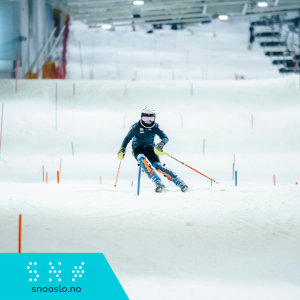
The terrain itself also helps distinguish SNØ from many indoor facilities. Rather than offering a single consistent pitch from top to bottom, the hill incorporates rollers, transitions, and a steeper final section that more closely resembles the terrain athletes encounter outdoors.
“It feels more like outdoor skiing,” Solberg said. “It’s the most like outdoor skiing I’ve skied indoors.”
For younger athletes, he believes the consistency of the environment creates opportunities to experiment and learn.
“Don’t be afraid to fail,” he said. “Try different technical adjustments. The course and surface are going to be the same every run, so it’s a great place to experiment and figure things out.”
Click images to enlarge
More Than Just an Indoor Ski Hill
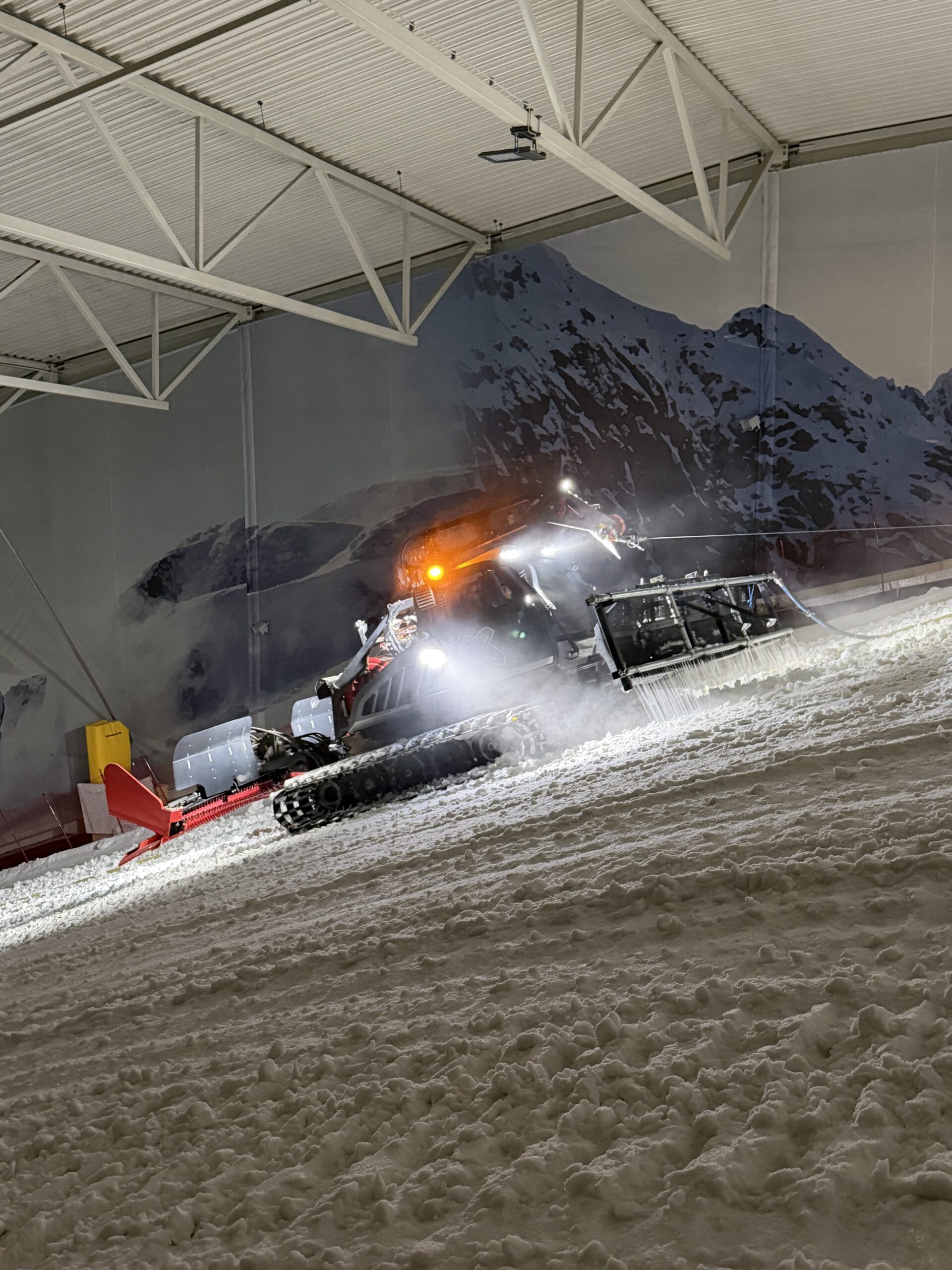
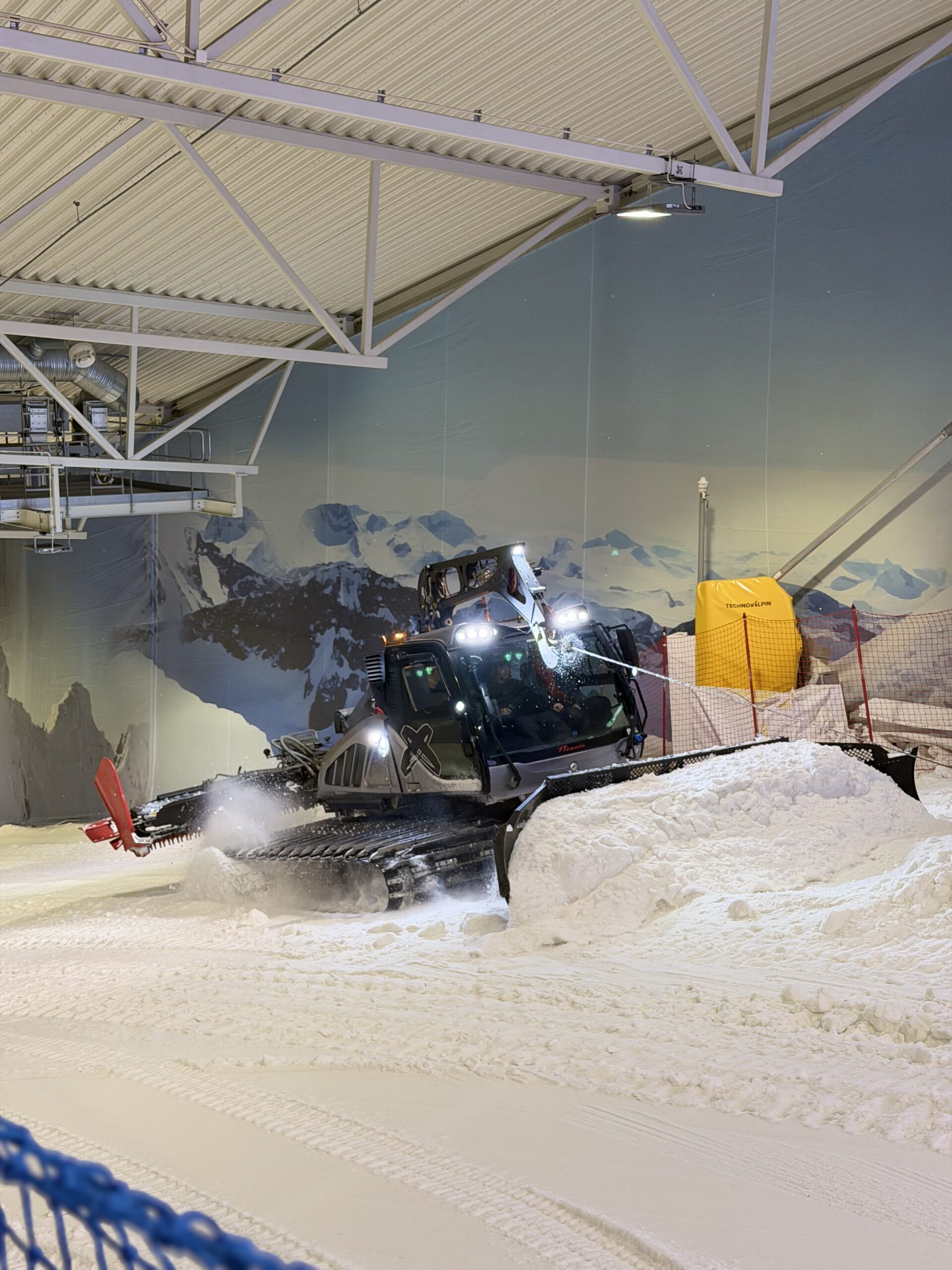
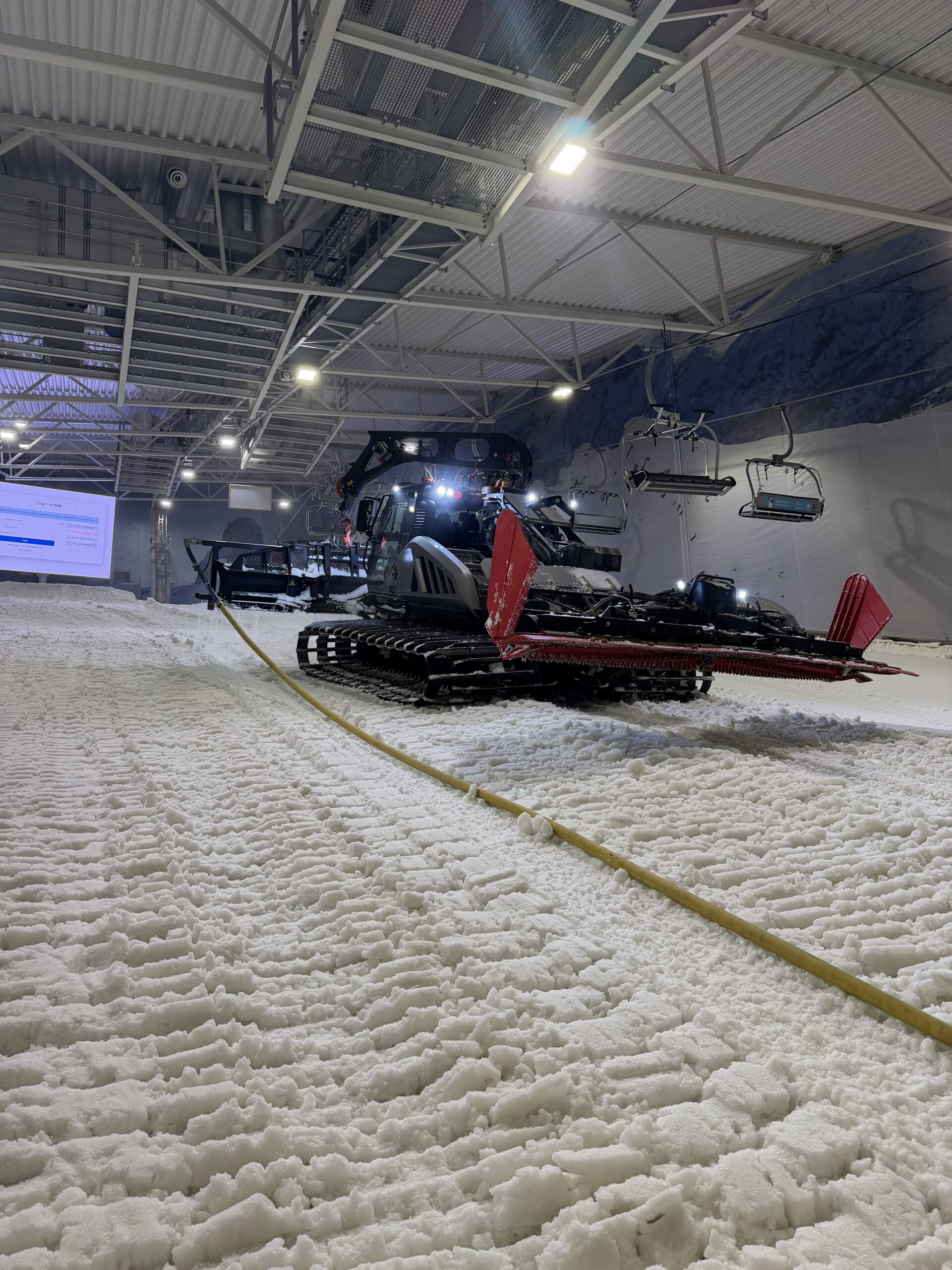
The facility offers up to eight training lanes during each season. Four dedicated race lanes are regularly watered and injected to create hard, race-like surfaces, while four additional lanes provide compact-snow training conditions. Gates are supplied for every lane, reducing one of the major logistical challenges facing visiting teams by eliminating the need to transport or ship gates. Separate from the race lanes, SNØ also maintains a dedicated free-ski lane where athletes can work on technical fundamentals, experiment with movement patterns, and focus on skill development outside of gate training.
The race hill stretches roughly 450 meters and features terrain changes, rollers, and a final pitch that creates a more outdoor-like feel than many indoor venues.
To maintain race-quality surfaces, SNØ uses a watering and injection process similar to what athletes encounter on World Cup race hills. Unlike many indoor facilities that rely on underground cooling systems, SNØ’s snow sits directly on the ground beneath it. The entire dome is cooled from above via ceiling-mounted cooling systems, creating snow conditions that more closely resemble those outdoors. Combined with regular watering and injection, the result is a firm, consistent surface that provides athletes with a realistic training environment throughout the year.

A Tool for Building the Season
For Norwegian World Cup skier Mina Fürst Holtmann, SNØ serves a different purpose.
Rather than replacing traditional on-snow camps, she sees the facility as a bridge between dryland training and the team’s preseason camps in the Southern Hemisphere.
“We start indoor in August before we go to Chile,” Holtmann explained. “It’s really nice because we can stay at home. We can drive there, ski for a couple of hours, and then go back home. It takes some of the travel load away at the beginning of the season.”
The convenience is significant, but the predictability may be even more valuable. Instead of organizing travel and hoping conditions cooperate, athletes can focus entirely on the quality of their skiing. Every session takes place on a known surface in a controlled environment, making it easier to build progression into a training plan.
Developing Skills That Transfer to Racing
Beyond the convenience and predictability, the terrain at SNØ creates opportunities to develop fundamental skiing skills that transfer directly to racing.
Because much of the slope remains relatively flat before transitioning into a steeper pitch, athletes are forced to focus on skills that often separate great racers from good ones.
“You can really work on your flat-skiing skills,” Holtmann said. “You have to learn how to create speed, how to pump terrain, and how to move your body forward as the slope changes.”
Those skills become particularly valuable on World Cup tracks such as Levi, where terrain management and speed generation play major roles in performance.
“It’s always super icy, so you can test equipment, prepare for hard snow, and get used to that feeling again before heading south,” Holtmann added.
The facility’s consistently firm surface also gives athletes opportunities to evaluate equipment and refine technique on snow that closely resembles the hard conditions frequently encountered during the World Cup season.
Her advice to younger athletes visiting the facility is simple: use the terrain.
“The biggest benefit is learning how to create speed on the flats,” she said. “You can also learn how to ski on ice and work on terrain that forces you to adapt.”

Why Coaches Are Paying Attention
For coaches and academy directors, one of the biggest challenges in modern ski racing is maximizing productive time on snow.
Summer camps require significant investments in travel, lodging, staffing, equipment transport, and athlete preparation. When weather disrupts training or available terrain is reduced, valuable opportunities can be lost.
That reality has increased interest in facilities like SNØ. Teams are not choosing indoor skiing because they want to replace glaciers or mountain environments. They are choosing it because predictable training environments allow athletes to work on technical development, equipment testing, and skill acquisition without many of the variables that exist outdoors.
The appeal extends beyond snow quality. Programs know they will have access to dedicated training lanes, race-quality surfaces, supplied gates, video-analysis tools, and performance-review technology throughout their camp. They know training schedules do not need to be adapted due to climate challenges. They know athletes will have opportunities to train, review video, test equipment, and work on technical development every day of camp. For coaches managing limited training opportunities, that level of certainty has become increasingly valuable.
In an era when weather, snow availability, and training-lane access can vary significantly from one camp to the next, facilities like SNØ provide something many programs are seeking: the confidence that scheduled training time will be spent skiing rather than waiting for conditions to improve.
Technology Supporting Modern Coaching
Beyond the snow itself, SNØ continues to invest heavily in athlete-development technology.
One of the newest additions is SnowEye, an AI-powered video analysis system that automatically captures and organizes training runs.
Using multiple fixed high-resolution cameras positioned throughout the hill, the system identifies athletes, records every run, and delivers video shortly after training sessions.
The multi-camera setup gives coaches and athletes multiple viewing angles throughout the course, allowing for more detailed technical analysis than traditional single-camera systems. The platform is also being integrated with timing technology, allowing coaches and athletes to connect video review directly with timing data from every run. Rather than analyzing video and performance separately, teams will be able to evaluate technical execution and measurable outcomes within the same system.
For visiting teams, particularly those traveling internationally, the system reduces the need for additional camera operators and allows coaches to focus on training rather than logistics.
“It’s fantastic,” Holtmann said of the video system. “They’re really trying to make it a good place for athletes to come and train.”
Combined with dedicated slalom and giant slalom training lanes, full gate setups, and injected race surfaces, the technology gives athletes access to many of the same coaching and analysis tools they use throughout the World Cup season.
Beyond the Gates
Part of SNØ’s appeal is that training does not end when athletes click out of their skis.
The facility is directly connected to Thon Hotel SNØ, allowing teams to stay just steps from the hill. Athletes can move from breakfast to training without daily transportation logistics, maximizing time on snow while simplifying camp operations for coaches and team managers.
The complex also includes fitness facilities, ski-tuning areas, race workshops, meeting rooms, restaurants, and recreational activities. Athletes can supplement on-snow training with additional fitness work, use dedicated tuning and workshop spaces, and take advantage of amenities such as the trampoline area, indoor ice climbing wall, and the SNØ Cross-Country Track. Together, those facilities allow clubs and academies to build complete training camps that combine skiing, conditioning, recovery, education, and team-building in a single location.
Those amenities are more than conveniences. Coaches can move directly from training into video review sessions, equipment testing, tuning work, strength training, recovery activities, and team meetings without leaving the facility.
For younger athletes, the fitness and recreational options provide productive ways to spend time between training sessions while helping clubs create camps that balance development, recovery, and team-building.
Sjøstrand recalls one North American academy that combined on-snow training with educational activities, cultural experiences in Oslo, and collaborative sessions alongside local Norwegian ski clubs.
“It showed us that a training camp can be much more than just skiing,” he said.
The Evolution of Summer Ski Training
The growing popularity of facilities like SNØ reflects a broader trend within alpine racing.
For most, glaciers and summer snowfields form the backbone of offseason training. They remain a critical part of athlete development today. At the same time, many coaches have noticed an increase in the variability of available snow resources. Following winters with limited snowfall, some venues also have less terrain available for lane preparation than they once did.
The result is not necessarily fewer camps, but often greater uncertainty. Coaches must remain flexible. Training plans sometimes change. Access to productive training surfaces varies from year to year.
As glaciers face increasingly unpredictable conditions and traditional summer training venues become more difficult to access, indoor skiing is becoming a valuable complement to outdoor training. It is not a replacement for on-snow camps in the mountains, but rather another tool in the athlete development pathway.
That distinction is important. Athletes still need outdoor terrain, changing snow conditions, and the challenges that come with mountain environments. What indoor facilities provide is something different: guaranteed opportunities to work on technique, equipment, timing, and skill development regardless of weather or seasonal snowpack.
That reality is evident in the growing list of teams training at SNØ. Norwegian national team athletes train there regularly. International clubs and academies continue to arrive in increasing numbers. Even World Cup programs from outside Norway have begun incorporating the facility into their preseason plans.
Why Facilities Like SNØ Matter
For Solberg, Holtmann, and countless young racers, the appeal is straightforward.
Reliable snow.
Consistent conditions.
And an environment where every run provides meaningful feedback.
Facilities like SNØ are emerging as part of the prep period solution. They cannot replace mountains, glaciers, or traditional summer camps, nor are they intended to. What they provide is something different: dependable access to race-quality snow, dedicated training lanes, supplied gates, modern coaching technology, and an environment where athletes can maximize every day on snow.
For clubs, academies, and national teams, that certainty is becoming increasingly valued. Training plans can be executed as scheduled. Athletes can focus on development rather than conditions.
As ski racing continues to evolve, facilities like SNØ are becoming more than indoor ski centers. They are becoming an increasingly important part of how athletes prepare, develop, and pursue performance at every level of the sport.
About the Author: Katie Twible