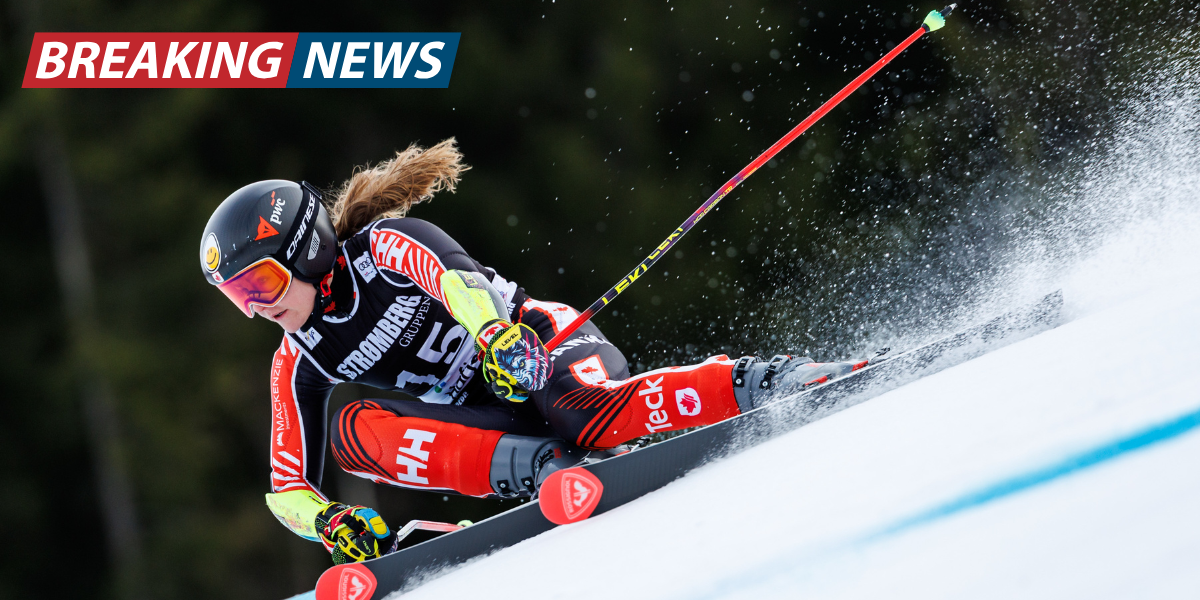

Sara Hector / Kranjska Gora / GEPA Image
When it comes to disciplines, both speed and technical specialists have strong feelings about giant slalom. Many believe it represents the purest, most quintessential form of ski racing.
“It really bridges the gap between slalom and speed, which in my mind, are almost like two different sports,” Mikaela Shiffrin says. “It connects those two pieces, and I feel that every day I’m on the snow, it helps each event. Slalom can even help super-G in that way because, like GS, it is bridging the gap.”
Joining two ends
Although she’s no stranger to success in GS, Shiffrin doesn’t experience the discipline with the same race-after-race rhythm that defines her slalom.
“I find with GS, there are so many different variations in how a course can feel, depending on the setting,” she says. “It can feel really, really fast, and there’s so much time between the gates, or you can feel quick, almost like a slalom course. What I’ve found over my career is that it’s very hard to find the balance of rhythm, timing, and risk in giant slalom.”
Nonetheless, Shiffrin views her GS skiing as a clear benchmark of her overall form.
“When my giant slalom is on, I feel that I can reach my highest level of slalom faster and my highest level of super-G faster,” she says.
Clean turns and struggles with consistency
Fellow racers who excel most in slalom agree that GS is among the most difficult disciplines to dominate consistently.
“It’s probably the most competitive discipline,” says Switzerland’s Camille Rast. “I think it’s the most difficult one to really be on top. You can be in the middle—like 15th—but actually close. To be at the front, you really have to give everything and train hard every day. I like it, but sometimes I say, oh my God, it’s so difficult.”
Her teammate Wendy Holdener has landed podiums in GS, as well as in super-G and combined. However, compared to slalom, she believes GS leaves less room for error.
“I think I just like the short turns more,” Holdener says. “The giant slalom you have to ski really, really clean. I’m more of an aggressive skier, so I often start the turn too early on GS turns.”
No sliding allowed
Speed skiers also say that making strong, clean carves on every turn is mandatory, but it requires a specific kind of skill and confidence on any GS course.
“It’s the moments where you know your ability, you can go into the turn committed and make a clean arc, but there’s that barrier when you also know it would be easier to slide and be safe,” says Ryan Cochran-Siegle, who hopes to re-add GS to his racing repertoire. “You can get away with it in downhill, maybe. That’s the difference between the top GS skiers and the rest—how they pressure the ski without holding onto the bottom of the turn. It’s about that efficiency and then the release, making these incredible arcs.”
‘It’s fundamental’
One such skier is Brazil’s Lucas Pinheiro Braathen, who has demonstrated that arcing skill on the World Cup’s most demanding GS tracks.
“Giant slalom is the combination of everything,” Pinheiro Braathen says. “You can hit velocities well up to speed disciplines’ speeds, but you need to be able to, in a matter of one or two turns, level all the way down to maybe 60, 70 kilometers an hour and figure out that type of momentum.”
“I find it’s the medium. It’s really the base,” he says. “It doesn’t matter what discipline you specialize in; you still practice GS because it’s fundamental. When a GS course is long, technical, and at high elevation, you figure out who was in the gym this summer. That’s why it is the fundamental pillar of skiing.”
About the Author: Shauna Farnell