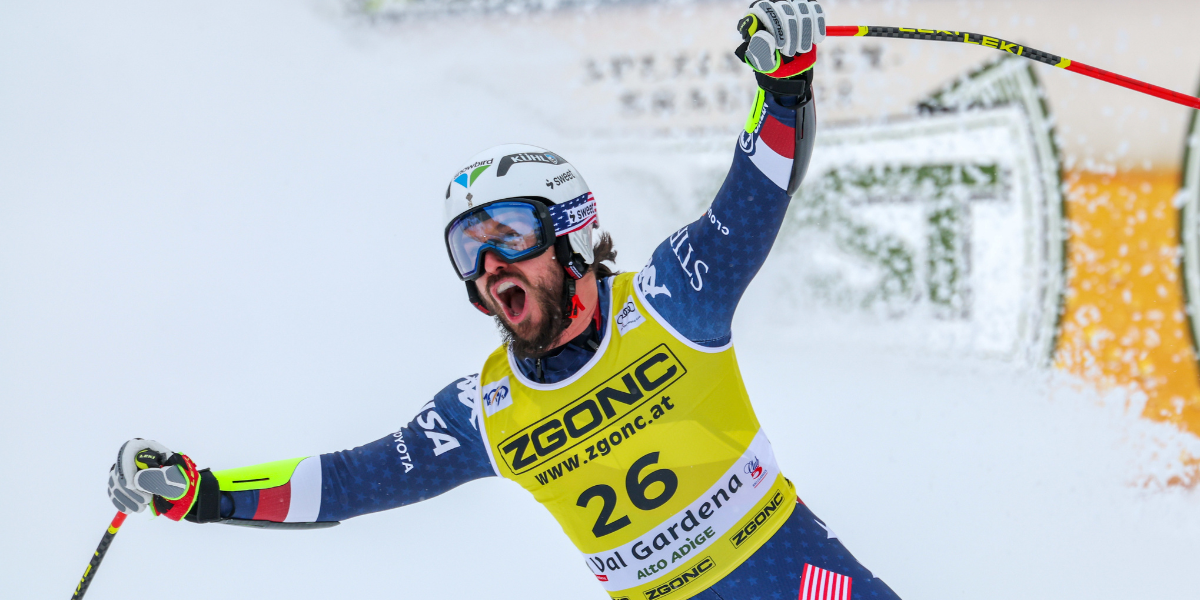
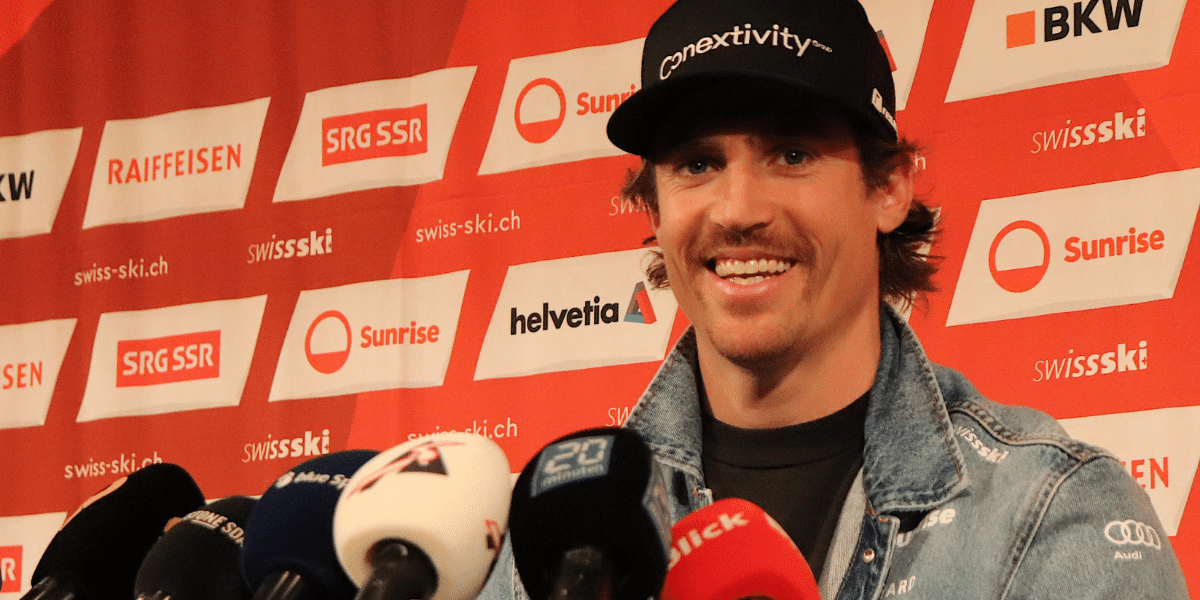
Marc Rochat Photo: Peter Gerber Plech
Marc Rochat hopes to compete in his first Olympics. As the 2025-26 winter approaches, the Lausanne native faces a dual challenge — being both a father and a top-level athlete. Mental strength plays a central role in his approach.
From a Nightmare Start to a Strong Finish
The 2024–25 season began as a nightmare for Rochat. Between Nov. 17 in Levi and Jan. 8 in Madonna di Campiglio, he failed to finish four of five World Cup slaloms during the first run. In Madonna, at least, he reached the finish — but his time left him 44th, 0.62 seconds short of qualifying for the second run.
Then came the turnaround — six straight World Cup slaloms with points, a World Championship bronze medal in the team combined with Stefan Rogentin, and finally his first Swiss national title.
“It feels good to end such a difficult season with a title,” Rochat told skinews.ch. “This win means a lot to me, even if it’s not a World Cup victory. I’ve learned a lot from this special season.”

Learning from a Difficult Season
During Swiss Ski’s annual media week in Stettbach, Rochat explained what he took from that up-and-down winter. Relaxed and smiling behind a “forest” of microphones, the 32-year-old looked ready for new challenges.
“Many people told me to forget the 2024–25 season,” he said. “I see it differently. I want to learn from it. My career has never been linear, and I’ve always learned from low points.”
At the start of that season, it was difficult to turn things around once momentum went the wrong way. But after carefully analyzing it all, Rochat felt healthy again and confident on his skis. “That’s what matters most,” he said.
Working with a Sports Psychologist
A key part of his progress came from ongoing work with a sports psychologist who has supported him for more than five years — even using hypnosis.
“He helped me handle frustration and negative emotions much better,” Rochat said.
Because he races only slalom, he lacks the backup of a second discipline to rebuild confidence after poor results. “Having just one discipline, and that being slalom, is tough,” he said. “Confidence and mental strength are everything. One mistake can ruin a whole season — there are plenty of examples.”
That is why his mental work is so essential. “Being able to open up completely to someone was probably the most important step in my career,” he said. “I could talk about doubts, fears, and positives. Together we tore down a wall that kept me from showing emotions. I had to reach 25 to learn that.”
Now Rochat hopes to pass that knowledge to younger athletes. “I want them to understand how important mental work really is,” he said.
A Summer of Change — and Motivation
“The summer of 2025 was different,” Rochat said. “I became a father in May, and that changed a lot.”
Athletically, training went well, highlighted by a strong camp in New Zealand — his first in six or seven years completed without back or knee pain. “That’s hugely motivating. At 32, I’m not the youngest, but I still have to compete with the young guys.”
In New Zealand he benefited from mostly icy conditions. He already knew he was fast on soft or salted snow; now he needed to prove it on ice. “The videos and my feeling say the same thing,” he said. “Now I just need to do it in a race.”
The first World Cup slalom in Levi on Nov. 16 will provide the first real test.
Balancing Fatherhood and Racing
Rochat’s son Lupo also occupies much of his time. Traveling to New Zealand was not easy. “He’s growing so fast,” Rochat said. “I miss some moments, but thanks to FaceTime I can still follow along.”
His focus, however, remains intact. “When I’m in the gym, I think about skiing fast, not family. When I’m home, I’m a dad, not a skier.”
Eyes on the Olympics — But One Step at a Time
A debut at the 2026 Milan-Cortina Olympics would fulfill a long-held dream. But Rochat insists it hasn’t changed his summer training.
“There are nine important World Cup slaloms before the Olympic race,” he said. “There’s no point in speculating now. The evaluation comes at the end of January.”
He remains proud of his World Championship bronze from Saalbach. “That medal symbolizes our sport. Bringing it home gives meaning to all the work over the years. It shows I didn’t waste my time.”
If he can draw the same conclusion at the end of the 2025–26 season, Marc Rochat will once again have done many things right.
About the Author: Peter Gerber Plech