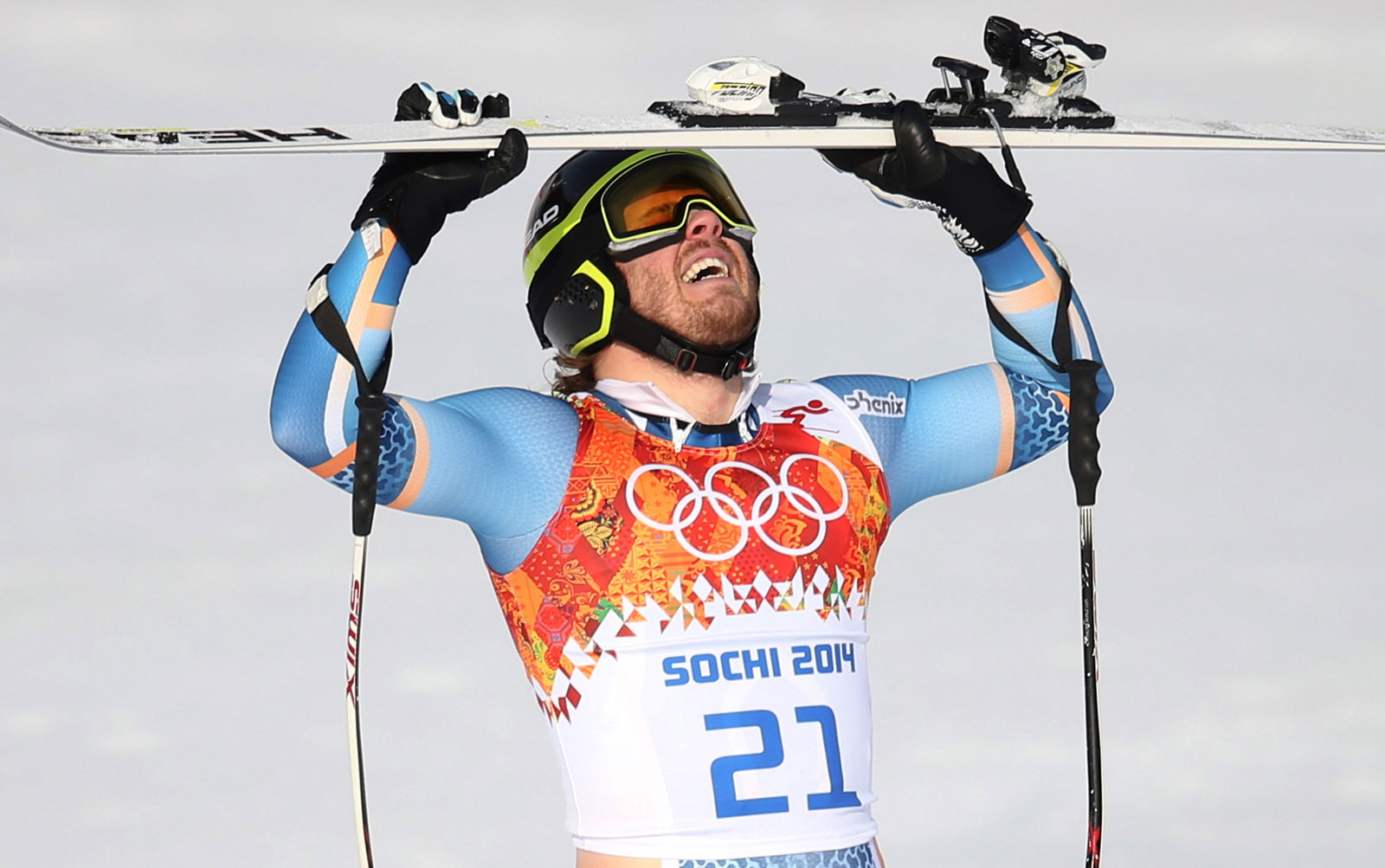
Kjetil Jansrud of Norway celebrates his gold-medal-winning run in the SG. (GEPA/Christian Walgram)
ROSA KHUTOR, Russia – Quite a podium in the men’s super G at the Olympics. It even had an extra guy.
In one of the most exciting and surprising finishes in recent Olympic history, Andrew Weibrecht of the U.S. came from the 29th start in today’s super G to grab a silver medal, just 0.30 seconds behind gold medalist Kjetil Jansrud of Norway. The bronze medals – yes, medals – went to Bode Miller of the U.S. and Jan Hudec of Canada, who were both 0.53 seconds out.
Weibrecht, 28, who had barely been heard from on the international stage since he captured a bronze medal in the same event at the Vancouver Olympics four years ago, charged all the way down the tough Rosa Khutor course and barged his way on to a podium that was already something of a surprise.
Miller had come down from the 13th start position to take the lead, which had been held by Peter Fill of Italy. Several quality super G skiers took their best shots, but no one could quite match Miller’s characteristically wild but fast run. Austrians Max Franz and Otmar Streidinger came close, but were both just a few hundredths back, in second and third.
Then came Jansrud, 28, bronze medalist in the downhill to start these Olympics, who skied a clean, fast run that was more than a half second better than the field. And the next skier was Hudec, who tied Miller in second. It appeared that would be the podium: one gold, two silvers. Until Weibrecht got on course. Attacking right out of the start on a course so soft that one mistake put you out of the running, he just didn’t make any. He was in podium position at every interval, and crossed the finish line, remarkably, in second place.
So they’re awarding four medals in today’s race. Gold to Jansrud, silver to Weibrecht, bronze to Miller and Hudec. It’s the second time here in Sochi that there’s been a tie for an alpine medal. Switzerland’s Dominique Gisin and Tina Maze of Slovenia tied for gold in the women’s downhill. Jansrud, who won a silver medal in giant slalom at Vancouver, now has three Olympic medals, one of each color.
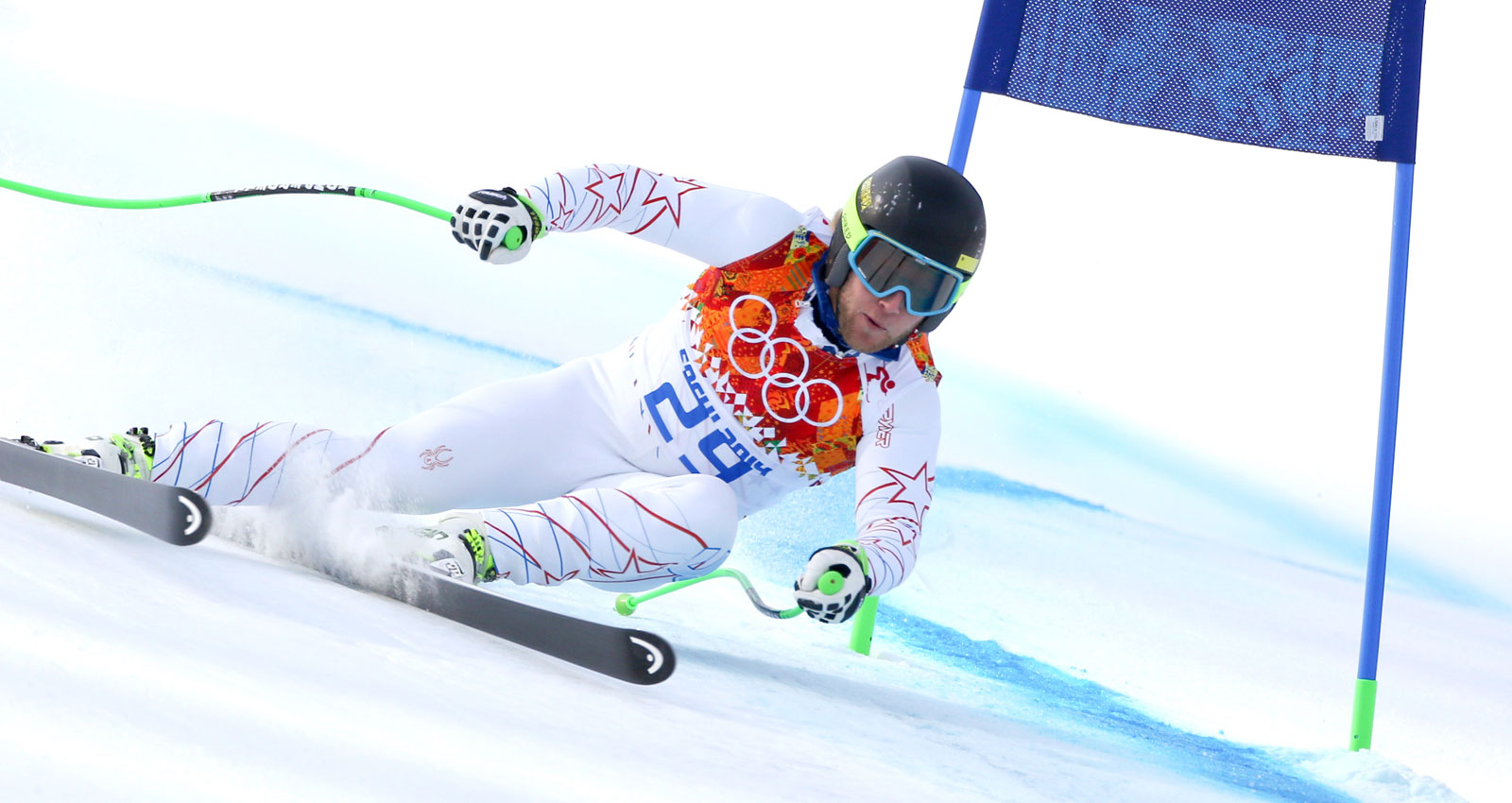
Andrew Weibrecht on his way to a silver medal in SG, his second Olympic medal. (GEPA/Andreas Prantner)
For Weibrecht, his second Olympic medal was vindication for the work that he’s put in over the past four years to recover from multiple injuries. “This is probably the most emotional day of ski racing I’ve ever had,” he said in the finish. “It’s just all the issues and troubles that I’ve had to come back from, and to be able to have a really strong result like this, it reminds me that all the work I did to come back from the injuries, just kind of dealing through all the hard times, that’s all worth it, it all makes sense.”
While folks were saying after his run that he had come from nowhere, or even east of nowhere, to the podium at the Olympics, his teammates said that was, basically, nonsense. Both Miller and Travis Ganong, who wound up 23rd on Sunday after making a couple of mistakes, said Weibrecht’s teammates and competitors know he’s capable of this kind of skiing, even though he hasn’t shown it recently on race day.
“You know, I probably am one of the people who did think he had a real good chance,” said Miller. “I’ve skied with Andrew a lot, and he’s so much better than his results show on the World Cup. I mean he’s one of those guys who could consistently win in three events. … The one thing he sort of loses out on is the intensity. And you put him in the big games, that’s why he does so well at the Olympics. Everybody’s focused on him, he has tons of emotion, and he kind of lets his emotion out. He’s usually really pretty reserved emotionally, and he doesn’t connect skiing with emotion, he just skis with huge intensity normally. And I think here he really connects the emotion to it and that’s why he gets such crazy performances out of himself.”
The bronze medal was a welcome result for Miller, 36, who had some disappointments in the downhill and the combined at these Games. It also made him the oldest man ever to win a medal in alpine skiing.
“The intensity was good today,” he said. “The intensity’s been good all of these days, but the mistakes are what’s been offsetting that. Today, I came out and skied really aggressive, too aggressive for this hill. I made a mistake at the bottom; it was just stupid. There’s nothing really to do after you come off the Lake Jump, you basically just get in your tuck and go to the finish. My mind was still looking for hundredths of a second, and I pushed too hard and probably cost myself half a second or six tenths. That’s always tough, but to hang on for a medal today, I feel really lucky, very fortunate.”
Miller’s medal was his sixth at the Olympics, adding to his American record. He’s second all time in alpine skiing medals, trailing only Kjetil Andre Aamodt of Norway, with eight. For American Olympians, his six medals is tied for second all time with speedskater Bonnie Blair, and trails only short track specialist Apolo Ohno, who had eight.
For the U.S. team, which had garnered some criticism for its showing so far in these Olympics, today’s silver and bronze medals should take off a bit of the pressure. The team now has three medals, including Julia Mancuso’s bronze in super combined.
Sasha Rearick, U.S. men’s head coach, was understandably thrilled with the level of skiing and teamwork that went into the race. “All I asked them to do is go hard and earn it,” he said. “I’m extremely proud of the whole team, the coaching staff and the athletes. Ted threw down an amazing run, and gave a great course report to Bode. Bode threw down harder, and where Ted had made a mistake, Bode skied that great. Bode made another little mistake, and it cost him on the bottom. He radioed that up to Andrew, and Andrew put it all together by just going for it. Amazing skiing.”
Jan Hudec, 32, gave North America three skiers on the podium. The Canadian said he was happy to share the bronze medal with Miller “as long as I don’t just get half of a medal.” Hudec’s result ended a 20-year Olympic medal drought for the Canadian team which hadn’t collected an alpine medal since Ed Podivinsky picked up downhill bronze at Lillehammer in 1994. Surprisingly enough, the drought was broken by a skier who had to take a break from World Cup racing this season in order to rest his troublesome back.
Hudec said that a week ago in the downhill, “I was trying to ski carefully so I wouldn’t injure my back. Today to be confident was just incredible. In the start I just felt so excited and so positive. I took a lot of risks and it worked. Two days ago I really felt I could do something in the super G, so I just went for it.”
Weibrecht, who’s from the Olympic town of Lake Placid, N.Y., and grew up skiing at Whiteface, was asked in the finish area whether he had considered hanging up his skis when the results hadn’t come in the last couple of years. “Yeah, I mean, there’s been times when I’ve had to evaluate if this is really what I want to do,” he said. “I mean, as recently as yesterday …”
Injuries had been the big problem for Weibrecht, and stretching over several years. “Going back to Vancouver,” he said, “I really built through a lot of years, and my skiing built up and I won the medal there because of that. And a month after that I went in for my first set of surgeries, and then a year after that more surgeries, and then more surgeries. The last four years have been really tough because everything’s been so disruptive to the continuity of my training.
“But really in the last few months my skiing’s kind of turned on again. I started to figure things out, and started to train quite a bit faster. Today I came into it and I wasn’t that pleased with my start number. I thought that was going to be a tough thing. But I made a promise to myself last night that that wasn’t going to affect the way that I raced, or my mood, or my outlook or anything like that.
“Today was about putting down a solid run that I could be proud of. And I came through the finish and I knew that I’d skied well, and had a really good run.”
Weibrecht’s nickname is Warhorse, for his attacking style, but after watching him ski in tough conditions at Beaver Creek this year, another coach described him as being built like a wombat, which Webster’s defines as “any of several stocky, burrowing Australian marsupials, resembling small bears.” The new nickname stuck, of course.
So when Sasha Rearick was waiting for Weibrecht to start, he said, “I was just screaming, ‘Let the wombat out of the cage. Come on, dude, go!’ He’s got mad skills that he learned growing up in Whiteface. Those skills, when he just goes, and just skis, and doesn’t think about anything else, that’s when it comes out. … He had to go hard at the top. When I saw him come into my view, where his skis were pointing, it was a very, very aggressive line. I was excited and I was nervous, and I was just waiting to hear the time.”
See more photos from today’s race here.
Today’s press conference
THE SCOOP
Men’s Olympic super G, Sochi, Russia, Feb. 16, 2014. … It is the sixth of 10 alpine events at the 22nd Winter Olympics, the third for men. …It is the 16th Olympic super G… the eighth for men.
It is the third Olympic medal and first gold for Kjetil Jansrud. … He has earned medals in three separate disciplines also earning silver in GS in 2010 and bronze in downhill Feb. 9.
It is the second Olympic medal for Andrew Weibrecht. … He won bronze in super G in 2010. … It is easily his best result of the season; his previous best was 20th in SG from Beaver Creek Dec. 7.
It is the first Olympic medal for Jan Hudec, his previous best Olympic finish was 21st in downhill Feb. 9. … It is his second best result of the season; he was second in SG at Val Gardena Dec. 20.
It is an American record sixth Olympic alpine medal for Bode Miller. … He has medaled in five different Olympic Games.
It is the career-best Olympic result for Morgan Pridy, eclipsing his 20th from combined Feb. 14. … It is the career-best Olympic super G finish for Ted Ligety. … It is the second Olympic finish for Travis Ganong, both from these Games. … It is the second best Olympic SG finish for Manuel Osborne-Paradis; he was 20th in Sestriere 2006.
Alpine medal count:
Austria, 4: two gold, one silver, one bronze
Canada, 1: one bronze
Croatia, 1: one silver
Germany, 2: one gold, one silver
Italy, 2: one silver, one bronze
Norway, 2: one gold, one bronze
Slovenia, 1: one gold
Switzerland, 3: two gold, one bronze
USA, 3: one silver, two bronze
RESULTS, Men’s Super G
Winter Olympic Games, Rosa Khutor, Russia
February 16, 2014
| Rank | Bib | FIS Code | Name | Year | Nation | Total Time | Diff. | FIS Points | ||
|---|---|---|---|---|---|---|---|---|---|---|
| 1 | 21 | 421483 | JANSRUD Kjetil | 1985 | NOR | 1:18.14 | 0.00 | |||
| 2 | 29 | 530939 | WEIBRECHT Andrew | 1986 | USA | 1:18.44 | +0.30 | 4.03 | ||
| 3 | 22 | 102271 | HUDEC Jan | 1981 | CAN | 1:18.67 | +0.53 | 7.12 | ||
| 3 | 13 | 532431 | MILLER Bode | 1977 | USA | 1:18.67 | +0.53 | 7.12 | ||
| 5 | 15 | 54005 | STRIEDINGER Otmar | 1991 | AUT | 1:18.69 | +0.55 | 7.39 | ||
| 6 | 14 | 53817 | FRANZ Max | 1989 | AUT | 1:18.74 | +0.60 | 8.06 | ||
| 7 | 16 | 421328 | SVINDAL Aksel Lund | 1982 | NOR | 1:18.76 | +0.62 | 8.33 | ||
| 8 | 8 | 292455 | FILL Peter | 1982 | ITA | 1:18.85 | +0.71 | 9.54 | ||
| 9 | 34 | 150398 | BANK Ondrej | 1980 | CZE | 1:19.11 | +0.97 | 13.03 | ||
| 10 | 6 | 103612 | PRIDY Morgan | 1990 | CAN | 1:19.19 | +1.05 | 14.11 | ||
| 11 | 20 | 192746 | THEAUX Adrien | 1984 | FRA | 1:19.35 | +1.21 | 16.26 | ||
| 12 | 19 | 511139 | KUENG Patrick | 1984 | SUI | 1:19.38 | +1.24 | 16.66 | ||
| 13 | 24 | 422139 | KILDE Aleksander Aamodt | 1992 | NOR | 1:19.44 | +1.30 | 17.47 | ||
| 14 | 9 | 534562 | LIGETY Ted | 1984 | USA | 1:19.48 | +1.34 | 18.01 | ||
| 15 | 2 | 192504 | MERMILLOD BLONDIN Thomas | 1984 | FRA | 1:19.53 | +1.39 | 18.68 | ||
| 16 | 27 | 291459 | PARIS Dominik | 1989 | ITA | 1:19.70 | +1.56 | 20.96 | ||
| 17 | 26 | 191964 | POISSON David | 1982 | FRA | 1:19.74 | +1.60 | 21.50 | ||
| 17 | 11 | 292514 | HEEL Werner | 1982 | ITA | 1:19.74 | +1.60 | 21.50 | ||
| 19 | 5 | 191740 | CLAREY Johan | 1981 | FRA | 1:19.75 | +1.61 | 21.63 | ||
| 19 | 3 | 380292 | ZRNCIC-DIM Natko | 1986 | CRO | 1:19.75 | +1.61 | 21.63 | ||
| 21 | 18 | 50858 | STREITBERGER Georg | 1981 | AUT | 1:19.77 | +1.63 | 21.90 | ||
| 22 | 28 | 511313 | JANKA Carlo | 1986 | SUI | 1:20.01 | +1.87 | 25.13 | ||
| 23 | 25 | 530874 | GANONG Travis | 1988 | USA | 1:20.02 | +1.88 | 25.26 | ||
| 24 | 30 | 102899 | OSBORNE-PARADIS Manuel | 1984 | CAN | 1:20.19 | +2.05 | 27.55 | ||
| 24 | 1 | 380260 | KOSTELIC Ivica | 1979 | CRO | 1:20.19 | +2.05 | 27.55 | ||
| 26 | 33 | 481327 | TRIKHICHEV Pavel | 1992 | RUS | 1:20.62 | +2.48 | 33.32 | ||
| 27 | 7 | 511383 | FEUZ Beat | 1987 | SUI | 1:20.65 | +2.51 | 33.73 | ||
| 28 | 51 | 700830 | ZAMPA Adam | 1990 | SVK | 1:20.95 | +2.81 | 37.76 | ||
| 29 | 32 | 561217 | KOSI Klemen | 1991 | SLO | 1:21.27 | +3.13 | 42.06 | ||
| 30 | 37 | 670058 | KOSHKIN Dmitriy | 1986 | KAZ | 1:21.50 | +3.36 | 45.15 | ||
| 31 | 49 | 481006 | ZUEV Stepan | 1988 | RUS | 1:21.54 | +3.40 | 45.69 | ||
| 32 | 50 | 110324 | VON APPEN Henrik | 1994 | CHI | 1:21.88 | +3.74 | 50.26 | ||
| 33 | 40 | 150495 | VRABLIK Martin | 1982 | CZE | 1:22.01 | +3.87 | 52.00 | ||
| 34 | 42 | 20324 | OLIVERAS Marc | 1991 | AND | 1:22.02 | +3.88 | 52.14 | ||
| 35 | 35 | 370022 | JENOT Olivier | 1988 | MON | 1:22.20 | +4.06 | 54.56 | ||
| 36 | 61 | 700879 | ZAMPA Andreas | 1993 | SVK | 1:22.42 | +4.28 | 57.51 | ||
| 37 | 52 | 660021 | DANILOCHKIN Yuri | 1991 | BLR | 1:22.45 | +4.31 | 57.92 | ||
| 38 | 39 | 430429 | BYDLINSKI Maciej | 1988 | POL | 1:22.51 | +4.37 | 58.72 | ||
| 39 | 57 | 92534 | CHONGAROV Nikola | 1989 | BUL | 1:22.59 | +4.45 | 59.80 | ||
| 40 | 44 | 670052 | KHUBER Martin | 1992 | KAZ | 1:22.60 | +4.46 | 59.93 | ||
| 41 | 55 | 90131 | GEORGIEV Georgi | 1987 | BUL | 1:22.72 | +4.58 | 61.54 | ||
| 42 | 53 | 700868 | FALAT Matej | 1993 | SVK | 1:22.81 | +4.67 | 62.75 | ||
| 43 | 43 | 700878 | BENDIK Martin | 1993 | SVK | 1:23.06 | +4.92 | 66.11 | ||
| 44 | 48 | 670037 | ZAKURDAEV Igor | 1987 | KAZ | 1:23.13 | +4.99 | 67.05 | ||
| 45 | 56 | 110320 | CLARO Eugenio | 1993 | CHI | 1:23.31 | +5.17 | 69.47 | ||
| 46 | 46 | 170131 | FAARUP Christoffer | 1992 | DAN | 1:23.34 | +5.20 | 69.87 | ||
| 47 | 38 | 30149 | SIMARI BIRKNER Cristian Javier | 1980 | ARG | 1:23.36 | +5.22 | 70.14 | ||
| 48 | 41 | 310426 | VUKICEVIC Marko | 1992 | SRB | 1:23.88 | +5.74 | 77.13 | ||
| 49 | 54 | 30246 | BIRKNER KETELHOHN Jorge F. | 1990 | ARG | 1:23.89 | +5.75 | 77.27 | ||
| 50 | 58 | 710320 | LAIKERT Igor | 1991 | BIH | 1:24.20 | +6.06 | 81.43 | ||
| 51 | 63 | 230147 | SYKARAS Konstantinos | 1984 | GRE | 1:26.32 | +8.18 | 109.92 | ||
| 52 | 62 | 690722 | MYTSAK Dmytro | 1995 | UKR | 1:28.51 | +10.37 | 139.35 | ||
| Disqualified 1st run | ||||||||||
| 59 | 230659 | VALCAREGGI Massimiliano | 1995 | GRE | ||||||
| 36 | 491129 | TERRA Ferran | 1987 | SPA | ||||||
| 23 | 102263 | GUAY Erik | 1981 | CAN | ||||||
| Did not finish 1st run | ||||||||||
| 60 | 550022 | RODE Roberts | 1987 | LAT | ||||||
| 47 | 370031 | ALESSANDRIA Arnaud | 1993 | MON | ||||||
| 45 | 910003 | LINDNER Georg | 1983 | MDA | ||||||
| 31 | 491151 | DE LA CUESTA Paul | 1988 | SPA | ||||||
| 17 | 53902 | MAYER Matthias | 1990 | AUT | ||||||
| 12 | 293006 | INNERHOFER Christof | 1984 | ITA | ||||||
| 10 | 510727 | DEFAGO Didier | 1977 | SUI | ||||||
| 4 | 481705 | GLEBOV Alexander | 1983 | RUS | ||||||
About the Author: Tim Etchells