Mikaela Shiffrin / GEPA pictures
Mikaela Shiffrin just delivered one of the most dominant Olympic performances in alpine skiing history. But when the conversation turned to 2030, the greatest skier the sport has ever seen didn’t offer a declaration — she offered perspective.
“Four years feels like a lifetime,” Shiffrin told Sports Illustrated. “So it feels so far away, but also I know, I know how fast that time can go. So I won’t say no, but I’m not going to say yes either.”
It wasn’t a farewell. It wasn’t a promise. It was the answer of an athlete who understands both the weight of time and the speed of it.
A Gold That Changed the Conversation
In Cortina, Shiffrin reminded the world exactly who she is.
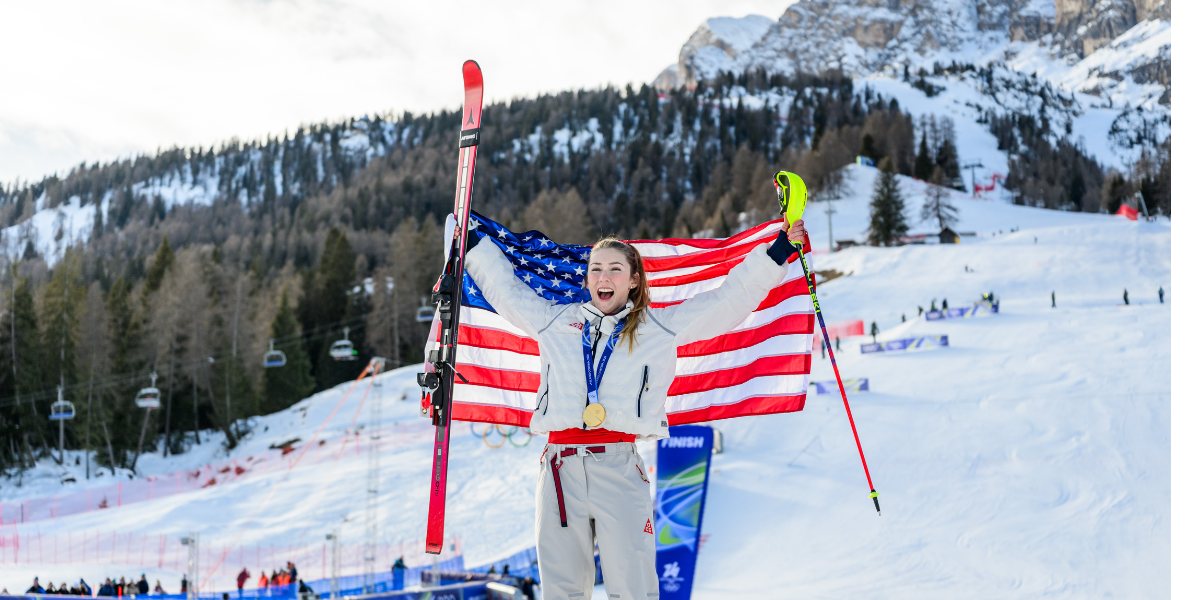
On the Olimpia delle Tofane, Shiffrin attacked with authority, posting a combined time of 1:39.10 and winning by 1.5 seconds over Switzerland’s Camille Rast. According to reporting from EssentiallySports, the margin was the largest in any Olympic alpine skiing event since 1998. At age 30, she also became the oldest American alpine skier to win Olympic gold.
The victory carried even greater historical weight. By claiming her third career Olympic gold medal, Shiffrin set a new U.S. record for most Olympic gold medals in alpine skiing, further separating herself in American ski racing history.
The performance didn’t just secure another medal. It reshaped the narrative
Four years earlier in Beijing, Shiffrin left without a medal after a campaign marked by visible emotional strain. Cortina was redemption — deeply personal.
And yet, even in victory, the future remains uncertain.

Nothing Left to Prove — Except to Herself?
Shiffrin already owns four Olympic medals and 108 World Cup victories. Her résumé stands alone. There is no external validation left to chase.
So why even consider 2030?
Part of the answer may lie in something far more human than medals.
In an interview with EssentiallySports, Shiffrin spoke candidly about the fear that accompanies elite competition.
“I think I have so much fear. I really feel, you know, I’m afraid to get injured. I’m afraid to feel pain. I’m afraid to fail,” she said. “So all of these things come into my mentality. And these are all things that I have to sort of digest and understand on a daily basis.”
Those fears are not abstract.
In November 2024, Shiffrin suffered a brutal crash during a World Cup race in Killington, Vermont. The accident left her with a five-centimeter puncture wound in her abdomen that narrowly missed her colon and required surgery. Physically, she returned. Mentally, the memory remains.
The scars are not always visible. But they are real.
The Weight of Two Decades
Shiffrin has lived at the limit of alpine skiing for nearly 20 years. Every turn demands strength, timing, and total commitment. Mistakes cost time. Sometimes they cost more.
That is the reality behind her hesitation.
By 2030, she would be 34 years old. Still capable? Absolutely. But the sport extracts a toll. Recovery takes longer. Risk never decreases.
“Four years feels like a lifetime,” she said. That statement carries the perspective of someone who understands how much can change in a single season — let alone an Olympic cycle.
And yet, she also knows how quickly it passes.
The Door Remains Open
For now, there is no countdown clock. No retirement tour. No definitive plan.
Just an athlete who refuses to box herself into a decision she doesn’t have to make.
Shiffrin’s slalom gold in Cortina proved she can still push the limit further than anyone else in the field. Her fears prove she is still human. The tension between those two truths may ultimately determine whether we see her in the French Alps in 2030.
She won’t say no.
She won’t say yes.
And for now, that’s exactly where things stand.
About the Author: SR Staff Report