Mikaela Shiffrin has stood on just about every podium imaginable. With 108 World Cup victories, multiple Olympic medals, and a résumé that redefined what dominance looks like in alpine skiing, she no longer needs results to validate her place in history.
And yet, as she arrived in Cortina d’Ampezzo ahead of the Olympic Games, the most decorated skier of all time didn’t sound like someone reflecting on legacy. She sounded like an athlete still deeply in love with the work.
“I’m still wide-eyed,” Shiffrin said, smiling as she addressed the media just hours after landing in Italy. “I’m just as excited and motivated as the first Games.”
It is a striking statement from an athlete competing in her fifth Olympics, one that sets the tone for how Shiffrin is approaching this moment, not as a coronation but as a continuation.
Redefining Success
When asked how she defines success at these Games, Shiffrin resisted the easy answer. Medals, after all, have never been the full measure for her.
“I don’t have an exact answer for how to define success right now,” she admitted. “For me, the most successful thing would be to continue the work we’ve been doing—showing up every day with our values, our work ethic, and our motivation.”
That theme, process over outcome, echoed throughout the press conference. After racing 17 World Cup starts already this season and rebuilding confidence in giant slalom following injury and trauma, Shiffrin sees success less as a finish line and more as consistency in effort.
“It’s been a real privilege to work with my coaches, my staff, and my teammates every single day,” she said. “That’s what I want to carry into these Games.”
Momentum Built the Hard Way
Shiffrin arrives in Cortina with tangible momentum. This season marked her return to the GS podium for the first time in two years, a milestone that once felt unimaginable during her comeback from injury.
“Last year, I couldn’t imagine skiing faster,” she said. “I couldn’t imagine contending for top tens, let alone podiums. So to be back there again—it’s pretty spectacular.”
Still, she’s honest about where she stands.
“My top pace is among the fastest in the world,” Shiffrin said. “But my baseline still has room to improve. I see the athletes who are consistently winning—they push harder, they stretch that rubber band of comfort further. I’m still working on that.”
It is that self awareness, equal parts confidence and humility, that has defined Shiffrin’s career as much as her results.

Familiar Ground, Olympic Weight
Cortina itself offers a rare sense of familiarity. Unlike previous Olympic venues that required long-haul travel and cultural adjustment, this Games feels like an extension of the World Cup circuit.
“I’ve been in Europe since October,” Shiffrin explained. “Driving into Cortina feels different than flying halfway around the world. It still looks like Cortina—and that’s really comforting.”
But the Olympics are never just another race. “There’s a different look, a different flow, more logistics, more security,” she said. “It’s never point A to point B—it’s point A to D to F to C and then maybe B.”
Experience has taught her how to manage that chaos. Gratitude, she says, is the anchor.
Representing More Than Results
One of the most powerful moments of the press conference came when Shiffrin was asked about representing the United States during a time of global hardship and division. She paused, then read from something she had written the night before, inspired by a quote from Nelson Mandela shared during the Opening Ceremonies. “Peace is not just the absence of conflict,” she said, “but the creation of an environment where we can all flourish regardless of race, color, creed, religion, gender, or class.”
For Shiffrin, the Olympics are a chance to represent values as much as medals.
“I want to show up with inclusivity, kindness, tenacity, and work ethic,” she said. “My greatest hope is that these Games are a beautiful show of cooperation and competition.”
It was a reminder that her platform, massive and global, is something she carries with intention.
Legacy, Pressure, and Perspective
The question of legacy inevitably surfaced. For an athlete whose Beijing Olympics were marked by heartbreak, the contrast with her current position is unavoidable.
Shiffrin didn’t shy away from it.
“I wish more people who tune in every four years understood what happens day-to-day in this sport,” she said. “We’ve been racing nonstop since October. This isn’t a restart—it’s the middle of a very long journey.”
Still, she embraces the spotlight. “The Olympics give us the chance to showcase our sport to the world,” she said. “Whether you watch every weekend or once every four years, that connection is a gift—even if there’s pressure.”
Then came the line that felt like the emotional thesis of the day: “Pressure is a privilege,” she said, quoting Billie Jean King. “And right now, it really does feel like one.”
Still Chasing the Craft
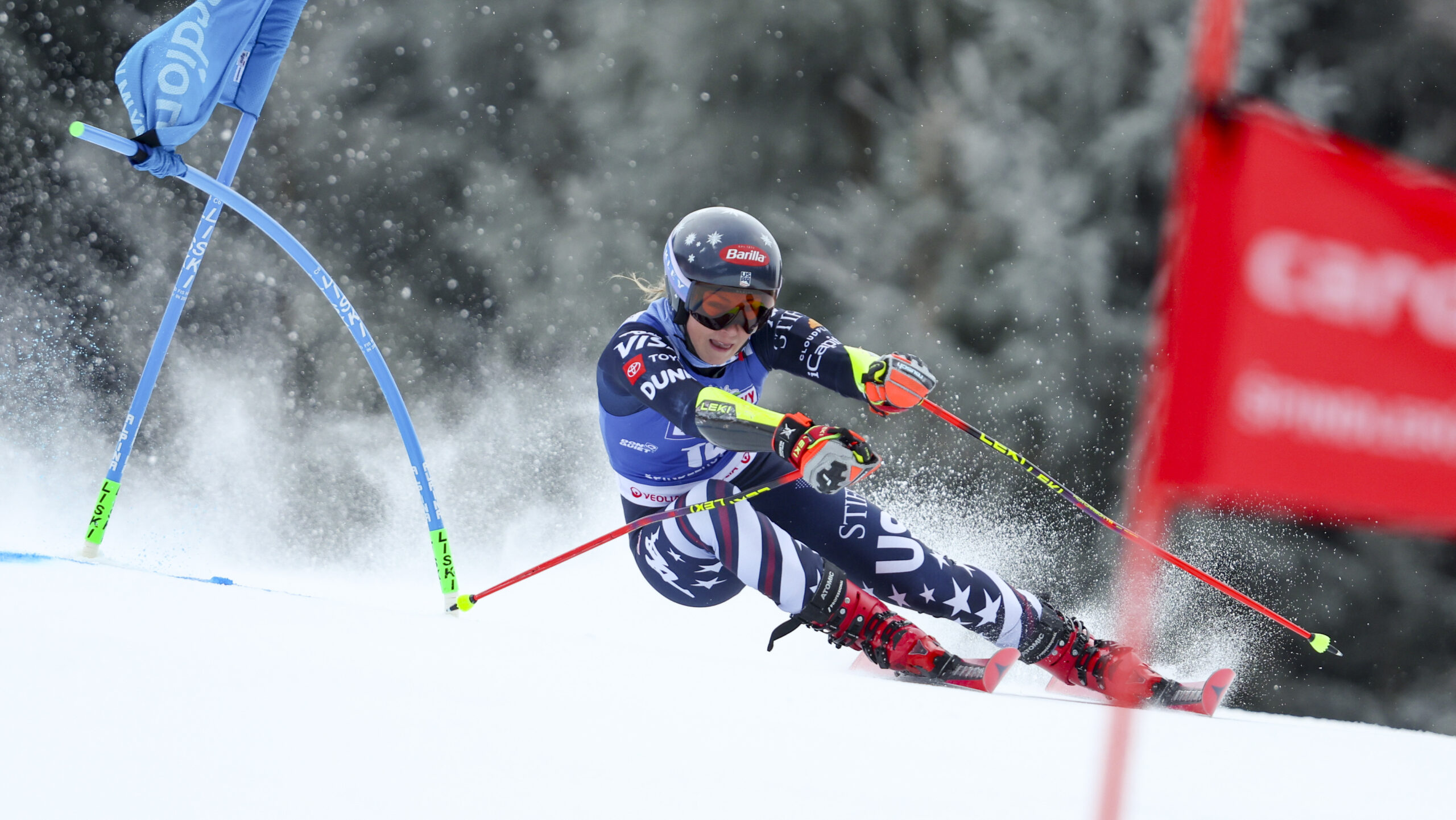
When asked how past setbacks have made her a better skier, Shiffrin turned technical, because for her, progress always lives in the details. “I want to be more committed to my outside ski,” she explained. “That’s the boss. That’s the driver’s seat.”
It’s an ongoing focus born from hard lessons, including injury. And it speaks to something deeper: even after rewriting the record books, Shiffrin is still chasing precision.
Still chasing better turns.
Still chasing growth.
Still chasing the joy of skiing fast.
As she heads into competition in slalom, giant slalom, and team combined, Shiffrin isn’t chasing validation or redemption. She’s chasing the work.
And for the winningest skier the sport has ever known, that might be the most inspiring part of all.
About the Author: Katie Twible