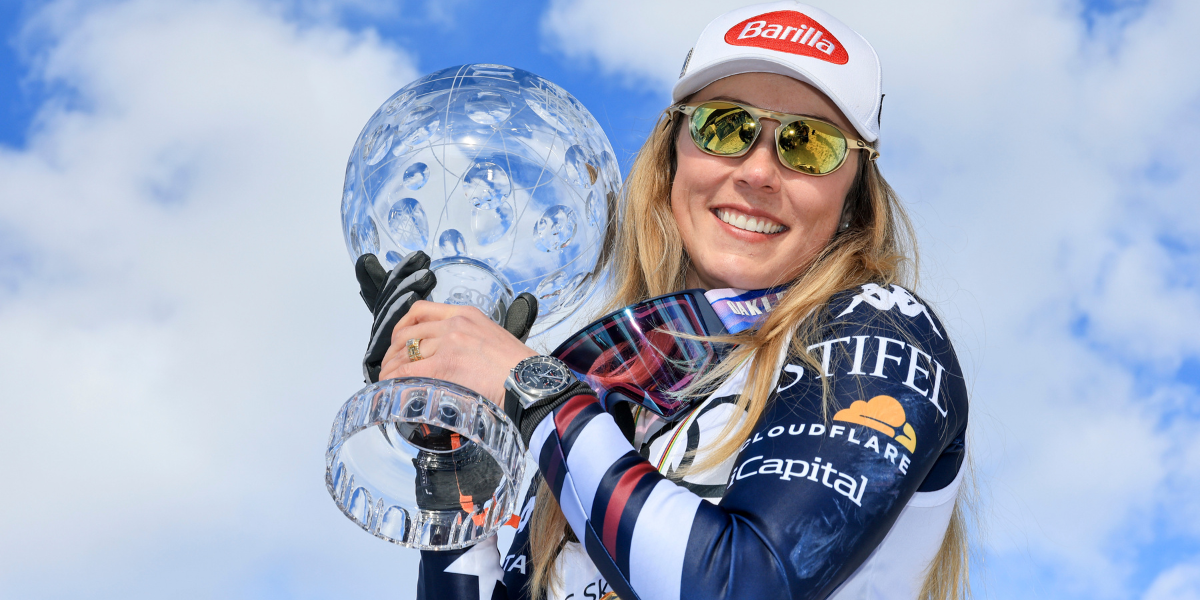
Mikaela Shiffrin’s 2026 season did more than add another title to an already unmatched résumé; it reaffirmed why the Stifel U.S. Ski Team star remains the defining athlete of her era.
At 31, Shiffrin won the overall title, captured Olympic slalom gold in Cortina, and secured another season slalom crown. Those results alone would define a career for most athletes. For Shiffrin, they add to a body of work that stands alone in alpine skiing history: 110 World Cup victories, 168 World Cup podiums, three Olympic gold medals, and eight World Championship gold medals across five disciplines.
The numbers demand context. Reaching 100 World Cup podiums already places a skier among the sport’s all-time greats. Shiffrin has gone far beyond that. The most revealing number may be this: 110 of her 168 podiums have been victories. In a sport defined by razor-thin margins and constant risk, that level of conversion is not just rare—it is unprecedented.

Yet, when asked what still drives her after everything she has accomplished, Shiffrin emphasized process rather than records or medals.
“I think it’s all built around curiosity and exploration,” Shiffrin said in written responses. “I like to feel like I’m improving somehow, or that I have the capability to improve. That improvement really happens in the day-to-day work, rather than the races.”
That mindset has carried her through 15 consecutive seasons scoring World Cup points, but sustaining it has required change. The most significant adjustments, she explained, have come in how she manages her body.
“As I’ve gotten older, I’ve had to adjust my expectations for what my body can handle,” she said.
Progress now depends on efficiency and awareness—understanding not just how to train, but how her body responds to it. Shiffrin said a key part of that evolution has been learning to distinguish between muscular fatigue and deeper structural stress, particularly in her back, and communicating those differences clearly with her team.
That level of awareness has changed how training is planned, how intensity is managed, and how she sustains performance across a full season.
“Understanding my body and the impacts and demands of the sport—that’s what has changed the most.”
That evolution defined her sixth overall title. While her capacity to train more has decreased, her ability to reach a high level of skiing more quickly has improved.
“I’ve also gotten more efficient at reaching a higher level of skiing more quickly with experience,” she said.
This season, however, required more than efficiency—it required precision under pressure.
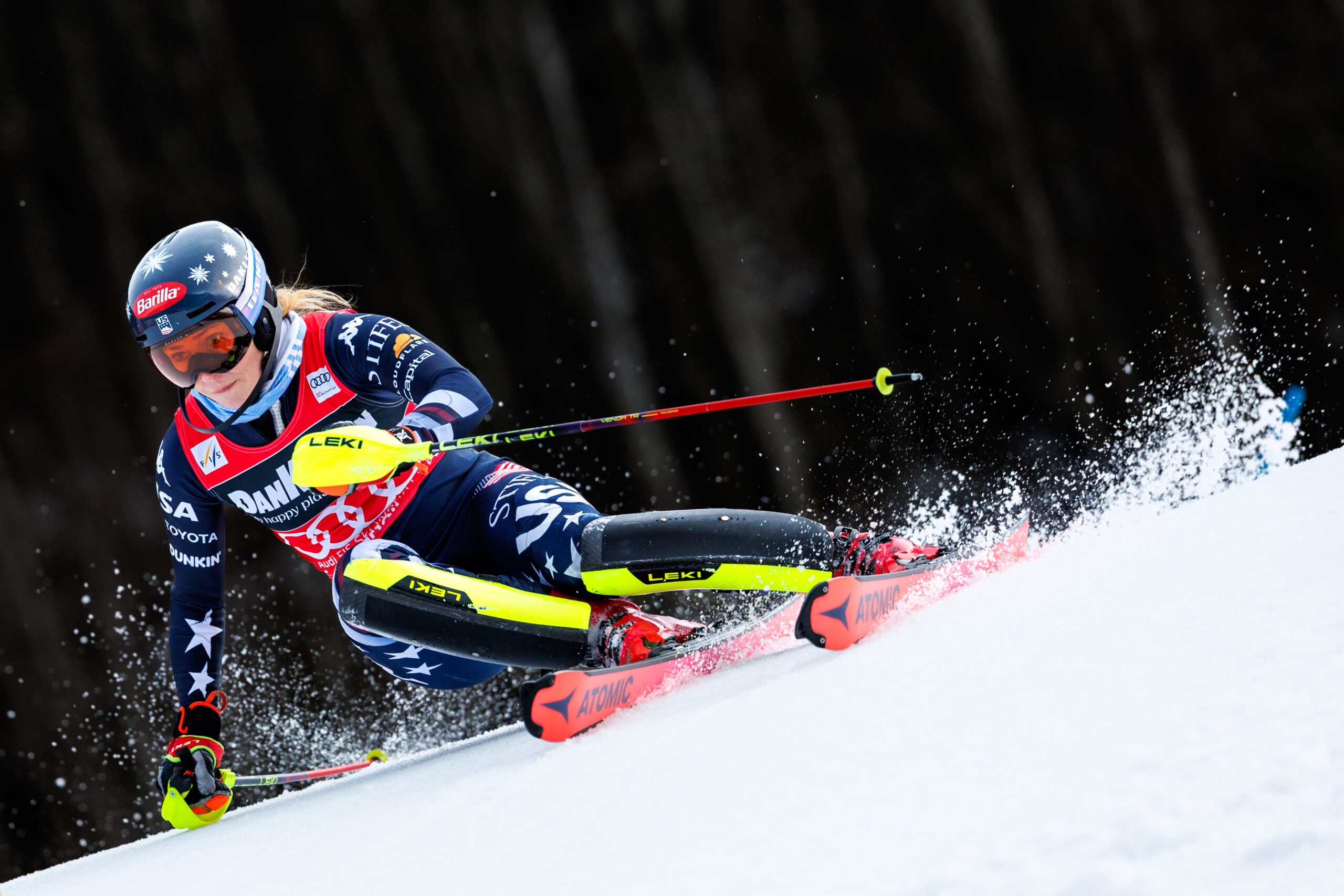
Shiffrin’s results came almost entirely from slalom and giant slalom, not as a strategic narrowing of focus, but as a necessity shaped by Olympic preparation. Super-G remained part of the long-term picture, but she did not have the time to bring all of its elements to a competitive level.
“I didn’t have that time this year, and I put focus where it made the most sense,” she said.
That narrower path left no margin for error in the overall race.
“I never thought, ‘Oh, I’ve got this,’” she said. “It was really possible for Emma to take that lead as we got towards the end of the season.”
The pressure came from a very different kind of threat. Germany’s 22-year-old Emma Aicher emerged as the most complete skier on the 2026 World Cup circuit, winning five races in 2026—three Super-Gs and two downhills—and consistently contending across all four disciplines. Her versatility kept the overall race tight deep into the season, especially as Shiffrin built her points almost exclusively in technical events.
That contrast defined the battle: Shiffrin’s dominance in slalom versus Aicher’s range across the speed and technical spectrum.
In slalom, Shiffrin delivered one of the most dominant stretches of her career, winning nine of ten races and capturing Olympic gold in Cortina. But the results, she said, came from something more precise than speed or aggression.
“I felt like technical precision and my understanding of how the turnshape really needs to feel was on another level this year,” she said. “More like I could get to the good turns pretty quickly and find repetition of those good turns—basically, only repeating high-level skiing and very few ‘bad turns.’”
That ability—to access high-level skiing faster and sustain it—may be the clearest explanation of her dominance at this stage of her career. With less training than in earlier years, Shiffrin is no longer building form through repetition alone. She’s arriving at it more quickly and holding it longer, run after run.
Even so, she made clear that level of performance comes at a cost.
“You don’t get a single day to recover or take it easy,” she said. “You need to have the after-burners on every single moment that you’re on skis. That is just so draining, rewarding of course, but definitely draining.”
She was direct about its sustainability.
“I don’t think a season like that is repeatable,” she said.
The Olympic season added another layer. For Shiffrin, the biggest shift was mental rather than physical. Preparation began months before Cortina, with a deliberate focus on managing the emotional demands of the Games.
“I really shifted my focus in my psychology sessions toward Olympic emotions, feelings, fears, expectations, in the middle of the summer,” she said.
That work extended beyond individual preparation. Shiffrin emphasized building connection across her entire team—coaches, technicians, and staff—through group sessions leading into the Olympics.
“We had group therapy sessions with my whole team. I wanted to feel connected to everyone and really unified when we went into Cortina,” she said.
That level of preparation reflects a broader evolution in how she approaches the sport. The physical demands remain extreme, but so does the need for communication, awareness and trust across the entire team.
The result was her third Olympic gold medal, 6th overall title, and another season that reinforced her place at the top of the sport.
At 31, Shiffrin is not just maintaining greatness—she is redefining how it is sustained. The training intensity has changed. The preparation has changed. The approach has changed.
The standard has not.
Driven by curiosity, shaped by adaptation, and executed at the highest level, she continues to push the limit—turn after turn, season after season.
About the Author: Peter Lange