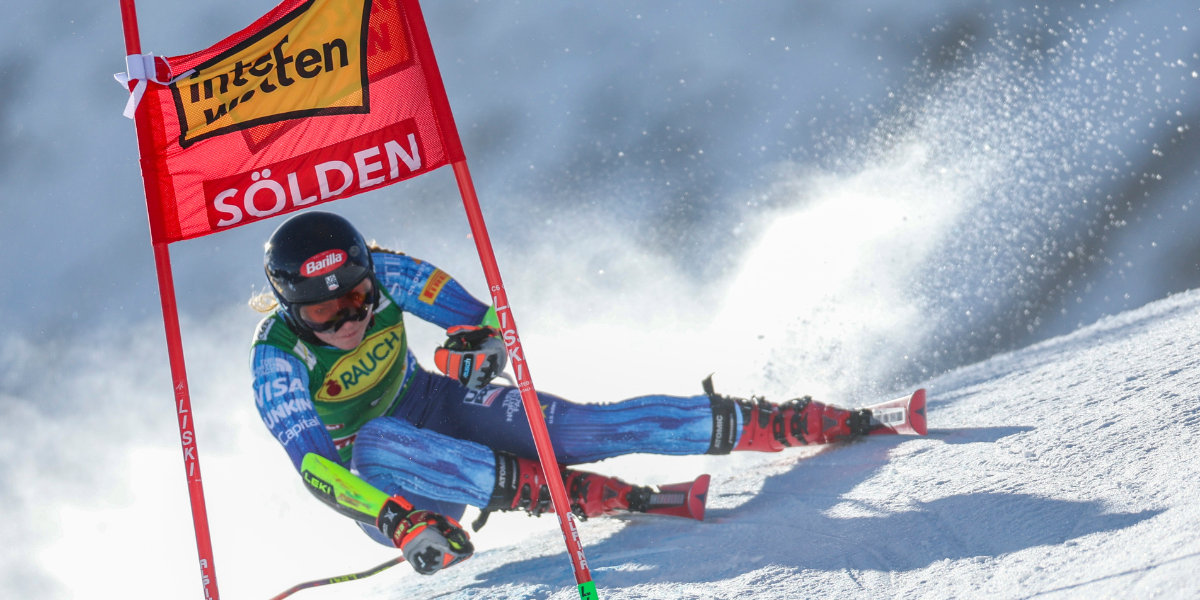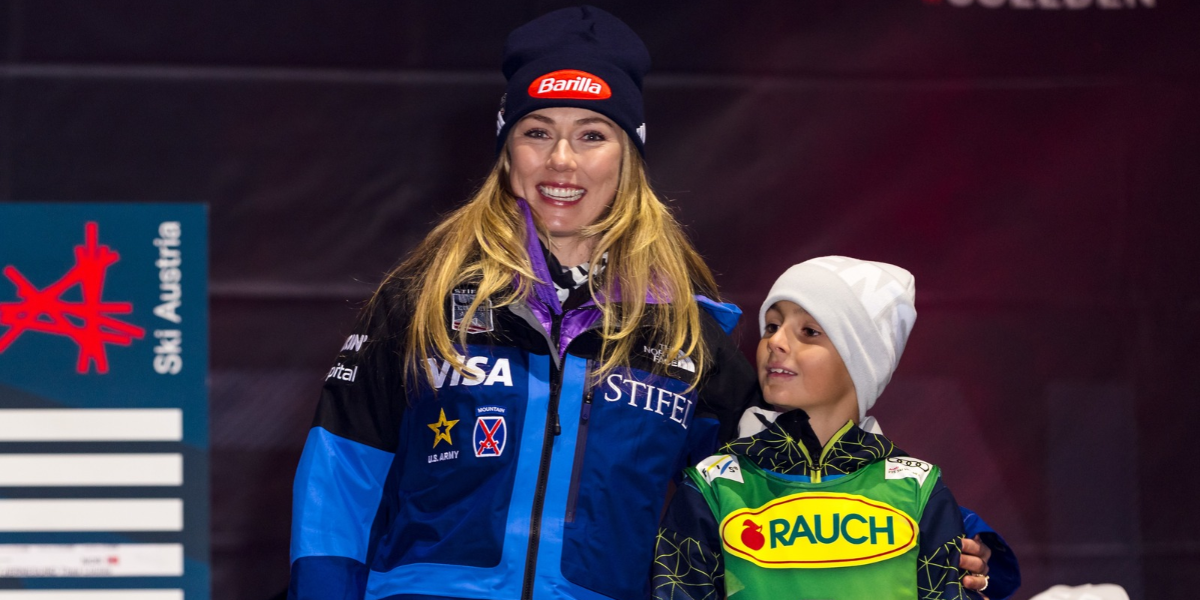
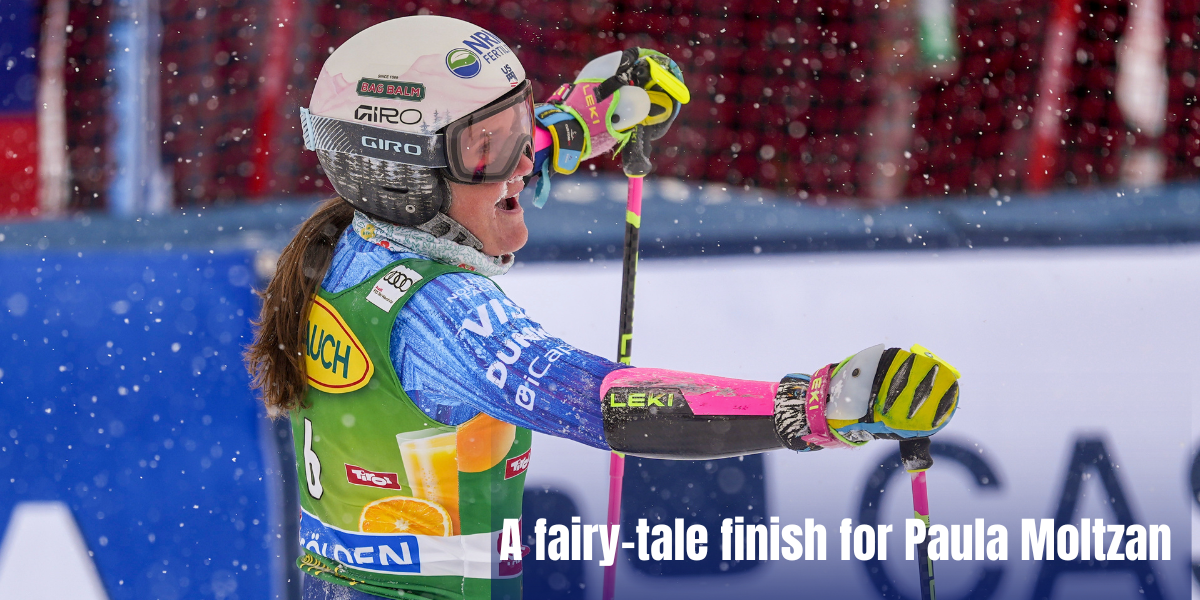
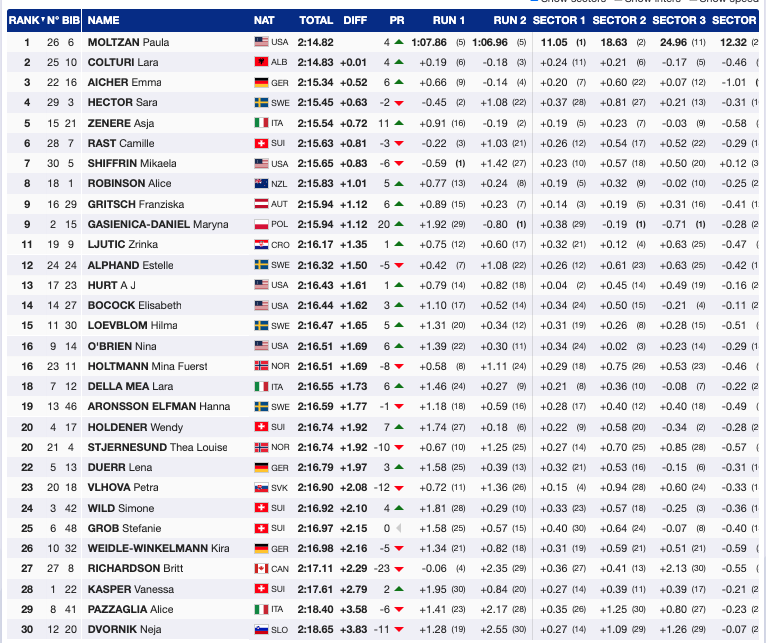
Paula Moltzan captured her first World Cup victory in the Sölden women’s giant slalom, climbing from fifth after the opening run to win in 2:14.82. The American edged Lara Colturi by just 0.01 seconds, with Emma Aicher completing the podium at 0.52 back.
Paula Moltzan has worked a long time for this moment. On Saturday in Sölden, the American finally stood on the top step of a World Cup podium, delivering a performance full of determination, speed and belief. She fought through mistakes, carried momentum where it mattered and then watched her time survive the final challengers. After years of chasing the world’s best, Moltzan opened the season with an unforgettable breakthrough.
Albania’s Lara Colturi finished second in 2:14.83 (+0.01), beginning her first World Cup season on HEAD equipment with a podium. Germany’s Emma Aicher took third in 2:15.34 (+0.52), opening her pursuit of the Overall Globe with a strong giant slalom result as she tackles all four disciplines this winter.
The final podium looked completely different from the morning standings. Mikaela Shiffrin, Sara Hector and Camille Rast occupied the leading three positions after the first run, but none could hold off the charge from behind.
Moltzan Delivers When It Counts
Sitting fifth after the opening run, Moltzan came out with intent, carrying strong speed toward the breakover and onto the pitch. A few low turns cost her some of that advantage, but she kept fighting and brought enough speed onto the flats to edge Colturi by just 0.01 seconds. It wasn’t perfect, and she left time through the final section, but her 1:06.96 second run, the fifth-fastest of the afternoon, was enough to put her in the lead.
“When you see green lights and by a hundredth, you never know what’s gonna happen,” Moltzan said afterward. “But I think the weather was maybe a bit on my side, in that the visibility wasn’t getting better. There was more snow coming.”
Moltzan knows the steep pitch suits her skiing, allowing her to attack and create speed, while the flats remain an area she wants to improve. This time, she had done enough. With four racers still to come, she watched each cross the line behind her, finally securing the victory she had worked so long to reach.
“It feels like a fairy tale right now. It’s pretty unreal, and I think it’ll take a minute to settle in,” she said.
At 32, the moment meant more than a strong start to the season. It was reaching a goal she admitted had sometimes felt uncertain, even as she continued working toward it.
“Of course. I think everyone has doubts in their brain. I think we’re all human. We all are athletes. We all have goals, and sometimes you don’t reach those goals,” Moltzan said. “I think you set big goals to scare yourself a little bit, but I also think that it inspires you to push harder and keep working.”
A Brand Switch and the Pressure Behind the Win
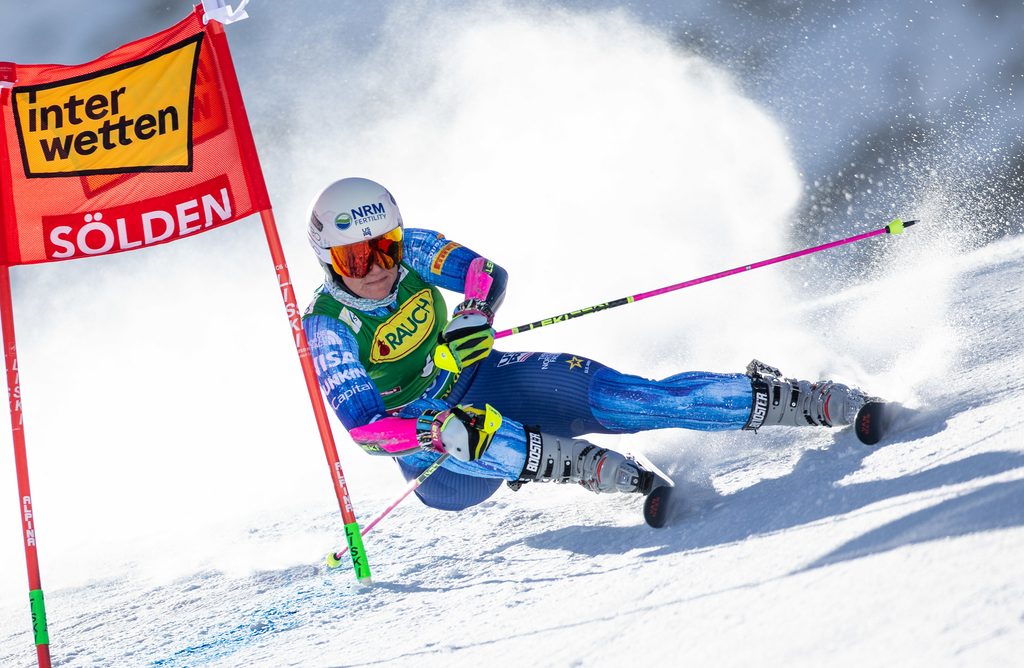
The doubts had been there as recently as the day before the race. On the drive to training, Moltzan became emotional, questioning whether she had done enough over the summer and whether everything would come together when it counted. Her equipment switch brought added pressure, knowing how many people had invested time and work into developing the skis she would race on.
“I have a standard I want to uphold. And so that felt like a lot yesterday,” she said. “But I was happy to get that out of the way because today it felt just like a normal day.”
Her husband helped her talk through those feelings on the drive, giving her space to be upset while reminding her of the reasons to trust herself. The switch had been a big decision, but it also gave Moltzan the opportunity to help develop equipment from the beginning and take an active role in the process.
“It was also this really awesome and cool adventure that we’ve gone through this summer to start kind of from scratch and develop an entire women’s line,” Moltzan said. “And I’m really proud to be a part of that, and it feels kind of fake right now.”
After finishing second in Sölden last season, returning on new equipment and taking her first victory made the result especially meaningful. It also came in a discipline she had not always expected would bring her to the top step.
“I always thought my first victory would come in slalom. I’ve been known as a slalom skier for a really long time, but I’ve come into my own in GS,” she said.
A Victory Shared with the Team
The celebration in the finish reflected how much the result meant to the people around her. Moltzan was quick to share the credit with her teammates, friends and staff, describing a group whose belief extends well beyond any one athlete.
“It’s definitely a team victory. We operate as a whole, and I have a great team that surrounds me with my friends and my teammates, but also the staff that’s around me,” she said. “They’re all super supportive, and they all believe in the team as a whole.”
With five Americans finishing inside the top 16, there was plenty for the group to celebrate. Moltzan hopes her breakthrough is just the beginning.
“It’s just kind of just the start of our season. So I see a lot more podiums and victories for our little tech team.”
Colturi Comes Within a Hundredth
Colturi delivered one of the most precise performances of the afternoon. Sixth after the opening run, she found a clean rhythm down the pitch and carried strong speed through the final transition. Her 1:06.78 second run, third-fastest of the afternoon, put her into the lead before Moltzan edged ahead by just a hundredth. She finished second in 2:14.83 (+0.01), opening the season with a podium after a summer of significant changes.
Despite coming so close to her first victory, Colturi was focused on how she had skied, particularly through the steep section. “I have to say I was really happy with my skiing, especially on the steep. So it doesn’t matter how it was going. I was already happy like this,” she said afterward. “But when I was going down, I was just happy and enjoying the moment, so that’s the main thing.”
She was so caught up in the race that the podium took a moment to register. Colturi had already taken off her bib and started removing her equipment when she was told to put it back on. “Until the last moment, I didn’t realize that I was on the podium,” she said.
The result followed a summer in which Colturi made more room for strength training, changed equipment and added Johan Clarey to the coaching team alongside her parents. Five weeks of training in New Zealand helped her settle onto the new skis and arrive in Sölden feeling prepared.
“This season, I said, ‘OK, I will just put all my energies into skiing, all my energies into my physical training, and then let’s see how it goes,’” Colturi explained. “With the skis, I adapted pretty quickly, and we’ve done really great work in five weeks in New Zealand.”
Clarey has also brought valuable support to the small team, sharing the coaching workload with her parents and contributing to her technical development in GS. For Colturi, second place offered an encouraging first indication of how those changes are coming together.
Aicher Opens Strong
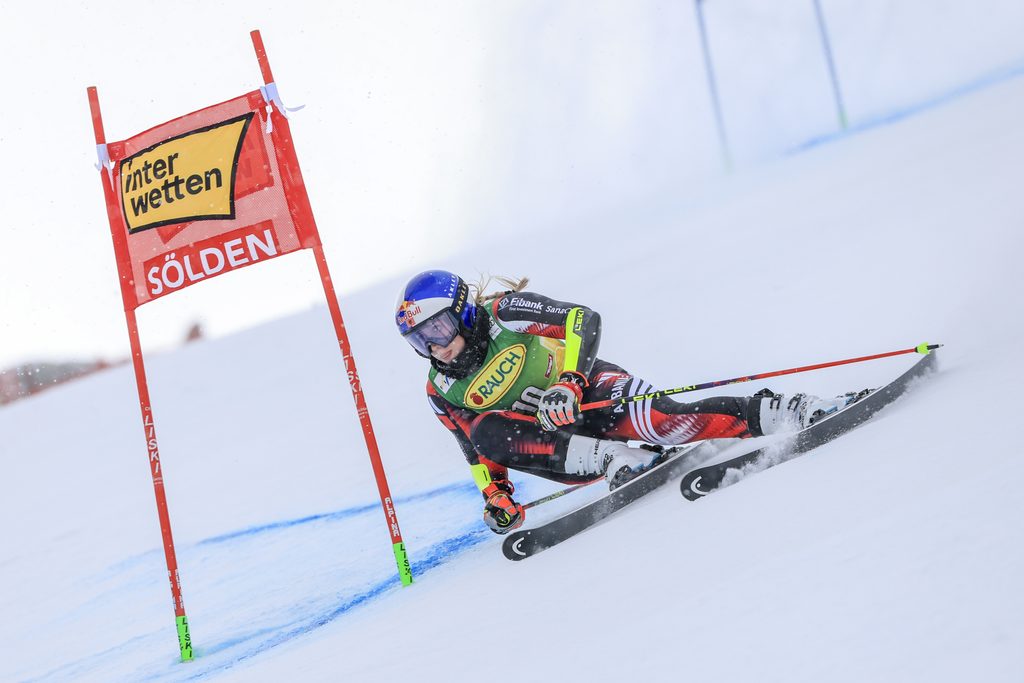
Aicher’s performance stood out for her touch on the snow. Even as the wind picked up near the start, she remained composed, linking clean turns and carrying speed through the lower flats. Ninth after the morning, she delivered the fourth-fastest second run in 1:06.82, climbing six places to finish third in 2:15.34 (+0.52).
For Aicher, finding that speed on a hill where she has struggled made the podium particularly rewarding. “I feel great. It was very surprising, to be honest. I mean, because it’s Sölden, and Sölden is hard, and I’ve always struggled here,” she said afterward. “So it’s, yeah, it’s really nice and cool to see that it works here as well.”
The steep pitch demanded a balance between attacking and staying clean, something Aicher managed well before letting her skis run onto the flats. She also acknowledged catching a better window of visibility as the afternoon conditions changed. “In the second run, it got a bit darker and snowy. But I was a bit lucky, I think, because it was a bit brighter, and I could use that.”
A GS podium gives her a strong start to another busy winter, with her approach remaining much the same as last season. “I want to ski as much as possible and race a lot,” Aicher said. “And then, I mean, we’re gonna see how I feel and how I’m doing after each week.”
Top 5 Today
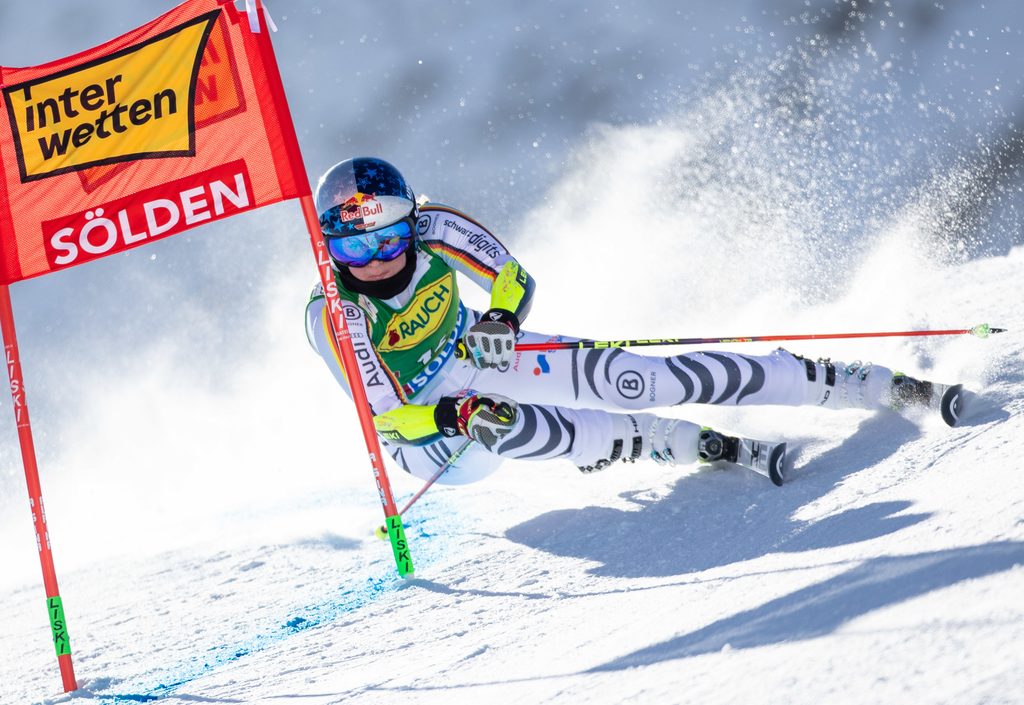
- 1st 🇺🇸 Paula Moltzan (USA), Bib 6 — 2:14.82
- 2nd 🇦🇱 Lara Colturi (ALB), Bib 10 — +0.01
- 3rd 🇩🇪 Emma Aicher (GER), Bib 16 — +0.52
- 4th 🇸🇪 Sara Hector (SWE), Bib 3 — +0.63
- 5th 🇮🇹 Asja Zenere (ITA), Bib 21 — +0.72
Changing Light and a Demanding Finish
Cloud cover moved in for the second run, leaving flatter light across the Rettenbach glacier. Wind was noticeable on the exposed upper section, while the transition from the steep pitch onto the lower flats remained critical.
A bump on the bottom section gave racers more lift than in the opening run, adding another challenge just when they needed to settle onto their skis and carry speed. Small corrections proved costly. Racers who over skied the course or struggled to absorb the terrain lost momentum they could not recover before the finish.
First-Run Leaders Lose Ground
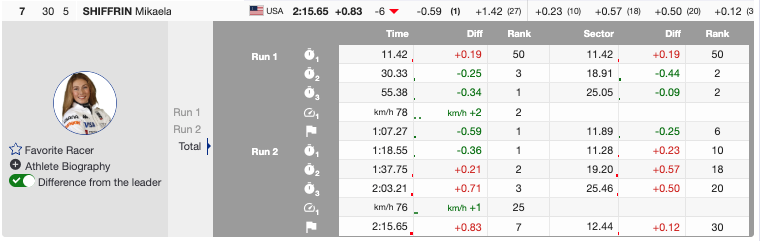
Shiffrin left the start with purpose, finding a compact tuck and attacking the opening section. But she could not reproduce the clean execution that had given her the morning lead.
Mistakes interrupted her rhythm, and she arrived on the lower flats without the speed needed to challenge Moltzan. Her 1:08.38 second run ranked 27th, dropping her six places to seventh in 2:15.65 (+0.83).
“For my run, it was very, very hard to see and that makes it tougher to be really aggressive,” Shiffrin said after the race. “And it felt like the light was going in and out a little bit. But I think the snow conditions were okay.”
“You can learn how to time it when you can’t see as well. And sometimes I get that, sometimes maybe I didn’t quite nail it today, so it’s something to work on,” Shiffrin said.
Hector also struggled to protect her advantage. Corrections cost her through the course, while over-skiing on the bottom section further reduced her speed. Second after the opening run, she finished fourth in 2:15.45 (+0.63), just 0.11 seconds off the podium.
Rast could not match her first-run attack either. A rounder line left her spending more time in the turn and gradually losing ground. She slipped from third to sixth in 2:15.63 (+0.81).
On a course that demanded precision on the pitch and carrying that speed onto the flats, the morning’s leading three all left the door open.
American Depth Behind Moltzan’s Victory
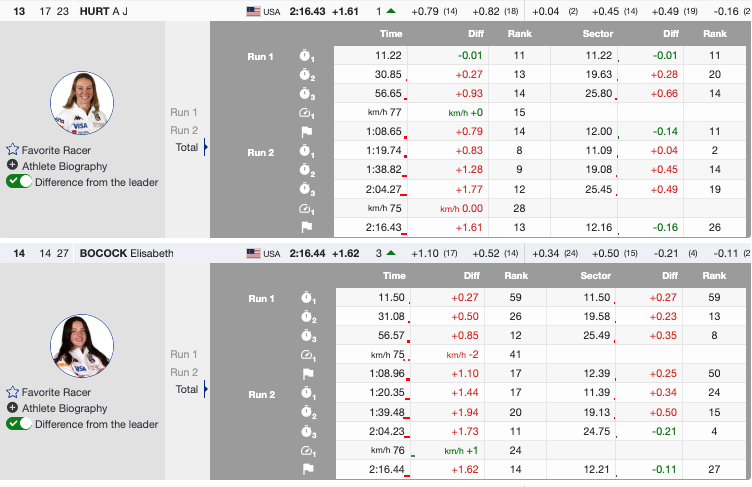
A.J. Hurt looked strong and more grounded on her skis, showing encouraging control through much of the course. A few bobbles interrupted her momentum, but she gained one position to finish 13th in 2:16.43 (+1.61).
Elisabeth Bocock also showed strength, completing both runs and collecting points. The lower section offered room for more speed, particularly through a tighter aerodynamic position and a more active push toward the finish. She moved up three places to 14th in 2:16.44 (+1.62), just 0.01 seconds behind Hurt.
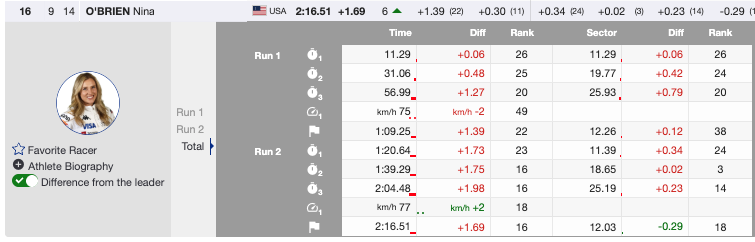
Nina O’Brien brought her familiar commitment out of the start, immediately looking to build speed. Several small mistakes kept her from putting together the clean run needed to challenge the leaders, but she still climbed six places to a tie for 16th in 2:16.51 (+1.69).
With Moltzan leading the way, five Americans finished inside the top 16.
Richardson’s Speed Meets a Costly Mistake
Canada’s Britt Richardson entered the second run in fourth, with a real opportunity to challenge for the podium. A major mistake on the pitch changed her afternoon.
Richardson lost her outside ski and nearly came to a stop, giving away valuable time and the momentum needed for the sections below. She fought to stay in the course, but the recovery left too much ground to make up.
Her 1:09.31 second run dropped her to 27th in 2:17.11 (+2.29).
The opening run showed her speed. Connecting that pace through two complete runs will be the next step, but Richardson left Sölden having demonstrated that she can compete with the leading group. I’m excited to watch her this season and see her settle in among the best Giant Slalom skiers.
Vlhová Returns with Points and Perspective
Petra Vlhová’s return was one of the most meaningful moments of the day. The Slovakian sat 11th after a strong opening run, showing that her speed is still there, before a more hesitant second run dropped her to 23rd in 2:16.90 (+2.08). In the flatter afternoon light, she held onto her turns longer and struggled to find the same freedom in her skiing.
“Of course, second run was a bit difficult for me because I’m still struggling with the visibility, with the confidence. When I don’t see under my feet, I’m a little bit unsure,” Vlhová said after the race.
There is still work ahead, but getting back into the start gate, putting two runs together and scoring points gave her something to build on. After everything it took to return, it was good to see her back racing and happy to be there.
Gąsienica-Daniel and Zenere Charge Up the Standings
Poland’s Maryna Gąsienica-Daniel delivered the fastest second run of the day, charging from 29th to a tie for ninth in 2:15.94 (+1.12).
She looked freer and more decisive in the afternoon, attacking with a cleaner line and linking her turns with greater confidence. Her 1:06.16 was 0.61 seconds faster than anyone else in the second run, producing a remarkable 20-place climb.
Italy’s Asja Zenere followed with the second-fastest afternoon time, 1:06.77, moving from 16th to fifth in 2:15.54 (+0.72).
Even with a few mistakes, Zenere kept her skis moving and maintained momentum through the lower section. She took the combined lead from Gąsienica-Daniel at the time and ultimately gained 11 positions.
Both performances showed how much opportunity remained for racers willing to attack and carry that commitment all the way to the finish.
Gritsch Carries Austria into the Top 10
Franziska Gritsch carried Austria’s hopes into a tie for ninth in 2:15.94 (+1.12), finishing as the host nation’s only skier in the top 30.
She looked confident and committed, showing encouraging signs following her move to Atomic. While there was more speed available through her aerodynamic position on the flats, she delivered the seventh-fastest second run in 1:07.19, climbing six places.
Ninth did not surpass her career-best World Cup GS result of seventh, but it gave Austria a top-10 finish on a difficult day at home. For a nation with such depth and expectations in the discipline, having just one skier in the second run was a stark opening to the winter.
Race Results
Race Analysis: Top Three and North Americans


About the Author: Katie Twible