
Muscular mechanics and function under ski-specific loading have long been of interest to the scientific community. However, the transfer of gains from conventional strength and conditioning into on-snow performance remains an ongoing challenge. Despite clear improvements in general strength capacities, research has consistently shown only modest relationships to ski performance outcomes, with correlation values often in the range of r = 0.3–0.4.
As a result, this gap continues to raise important questions: What does optimal muscular development for ski racing actually look like, and how should we train for meaningful performance transfer?
Within the ski racing community, a distinct performance phenomenon has been observed for decades—one that modern neuromuscular research is only now beginning to explain. Coaches, athletes, and practitioners have consistently recognized that certain athletes are able to produce a clean, quiet ski on the snow, often with what appears to be lower ground reaction forces, yet with greater efficiency through the turn.
These athletes seem to conserve and recycle elastic energy more effectively, dissipating less energy throughout the phases and radius of the turn. Accordingly, this observation shifts the discussion away from absolute force production and toward how force is managed, absorbed, and reapplied within the system.
DYNAMIC STABILITY UNDER VIBRATION
A key insight is that a “clean ski” under high load is not the result of static stability, but rather a dynamically stabilized system maintained through rapid oscillations between eccentric and concentric muscle actions under vibration.
When a ski is loaded in a turn, particularly on hard or injected surfaces, the system encounters high-frequency vibration (often in the 10–50+ Hz range), rapid fluctuations in edge pressure and snow feedback, and micro-instabilities that propagate up through the kinetic chain.
These disturbances are not isolated. Instead, they create continuous perturbations that the neuromuscular system must resolve in real time.
ECCENTRIC-CONCENTRIC COUPLING
In this context, the traditional view of muscular action as a simple sequence—eccentric followed by concentric—is insufficient. Rather, high-level skiing is characterized by continuous micro-cycles of eccentric-concentric coupling occurring at very high speeds.
Eccentric actions absorb sudden increases in load, while concentric actions immediately re-establish pressure, alignment and control. As a result, this process repeats continuously and can be understood physiologically as reflex-driven stretch–shortening cycles under load.

REFLEX-DRIVEN CONTROL
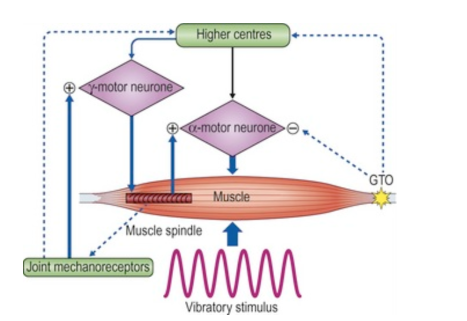
Importantly, these adjustments occur largely outside of conscious control. At racing speeds, the system relies on muscle spindle reflexes, short-latency reflex loops (~30–50 ms), and feed-forward (anticipatory) activation strategies.
When the ski vibrates or chatters, the musculature rapidly lengthens under load, triggering reflexive contractions that stabilize the system. Consequently, this loop operates faster than voluntary correction and forms the foundation of dynamic stability in high-performance skiing.
SYNCHRONIZATION AND FORCE MANAGEMENT
What distinguishes elite athletes is not the absence of vibration, but their ability to manage it efficiently. They develop a tunable stiffness within the system through refined co-contraction, creating a structure that is stiff enough to transmit force while remaining compliant enough to absorb perturbations.
They dissipate and redistribute energy effectively through coordinated muscle-tendon behavior and connective tissue involvement. Most critically, they appear to synchronize with the oscillatory behavior of the ski, operating “in phase” with the ski-snow interaction rather than reacting to it.
When this synchronization is lost, edge grip becomes inconsistent, ski chatter increases, and energy is dissipated rather than conserved.
CELLULAR AND TISSUE-LEVEL ADAPTATIONS TO VIBRATION
These neuromuscular demands create a significant challenge for training design. If performance depends not only on force production, but on high-frequency oscillatory control, reflex-driven stability, and efficient energy management, then traditional strength development alone is insufficient.
This, in turn, creates a central question for coaches and practitioners: How do we develop these qualities, and at what stage of an athlete’s progression should this begin?
Research and applied observations suggest that elite ski racers possess a distinct ability to absorb and dampen oscillations as vibration frequency increases. Compared to less experienced skiers, higher-level athletes show a more refined capacity to manage these perturbations, indicating that adaptation occurs not only at the technical level, but deep within the neuromuscular and connective tissue systems.
NEUROMUSCULAR AND CONNECTIVE ADAPTATION
These adaptations reflect the body’s response to the unique muscular environment of alpine skiing, where repeated exposure to high-frequency vibration and eccentric loading provides a highly specific stimulus. Over time, the system adjusts to handle these demands more efficiently.
Neurologically, coordination between afferent and efferent signaling becomes increasingly refined. Muscle spindles continuously detect rapid changes in length and tension, sending feedback to the central nervous system, which, in turn, adjusts motor output with greater precision.
This ongoing loop then enhances both the disinhibition and timing of force application and absorption, allowing the athlete to regulate load more effectively under rapidly changing conditions.
TISSUE-LEVEL AND METABOLIC ADAPTATION
At the tissue level, repeated exposure leads to structural adaptations within the connective system. Fascia and tendinous structures become more organized and mechanically efficient, improving their ability to transmit force while simultaneously damping oscillations.
As a result, this reduces the amount of mechanical “noise” reaching the muscle fibers, enabling more precise and economical control. In parallel, the muscle-tendon unit improves its capacity for elastic energy storage and release.
The neuromuscular system also becomes more predictive. With repeated exposure, feed-forward activation strategies improve, allowing the athlete to anticipate perturbations rather than react to them.
BIOLOGICAL COST AND ADAPTATION
At the same time, the biological cost of loading decreases. The inflammatory response becomes more controlled, with reduced cellular migration and less tissue disruption following repeated bouts of similar stress.
Consequently, this helps explain why elite athletes can tolerate high mechanical demands with relatively low levels of soreness—the system has adapted to manage the load with minimal internal disturbance.
ELITE VS. DEVELOPING ATHLETES
In contrast, less experienced skiers often lack these adaptations. They tend to respond to instability with excessive co-contraction, creating rigidity rather than functional stiffness.
Their neuromuscular responses are slower and less well timed, placing them out of phase with the ski-snow interaction. Additionally, insufficient eccentric strength during key phases limits their ability to effectively absorb load.
As a result, oscillations are not managed, but amplified. Instead of being controlled and productive, they become chaotic and energy-leaking, leading to inconsistent edge engagement and reduced efficiency.
TRAINING METHODOLOGY: DEVELOPING OSCILLATORY CONTROL AND DYNAMIC STABILITY
If alpine ski performance is understood as the ability to manage high-frequency perturbations through coordinated eccentric-concentric oscillations, then training methodology must extend beyond traditional models centered on maximal force production and linear movement patterns.
While general strength remains an important foundation, it does not sufficiently address the neuromuscular demands of ski racing, particularly the requirement to regulate force under rapidly changing and unpredictable conditions.
FORCE PRODUCTION VS. FORCE MODULATION
The objective of training is therefore not simply to increase force capacity, but to develop a system capable of absorbing, modulating, and reapplying force with precise timing under high-frequency disturbance.
Accordingly, this represents a shift from viewing strength as an output to understanding it as a continuously regulated process.
A central distinction emerges between force production and force modulation. Traditional strength training emphasizes peak output and rate of force development, often in controlled and predictable environments.
In contrast, ski racing demands constant adjustment of force magnitude, rapid transitions between absorption and production, and the ability to maintain alignment under shifting loads.
DEVELOPING ADAPTABILITY AND PREDICTIVE CONTROL
Training must reflect this reality by introducing variability and perturbation, requiring the athlete to adapt in real time rather than execute pre-planned movements.
Within this framework, eccentric strength takes on a fundamentally different role. In skiing, the ability to accept and control load precedes the ability to produce force.
As these adaptations develop, control shifts from reactive to predictive. At higher levels of performance, the system no longer relies primarily on delayed corrections but instead anticipates incoming perturbations through refined feed-forward activation.
PRACTICAL APPLICATIONS
Translating these neuromuscular principles into training requires a shift away from isolated strength development toward environments that challenge the athlete to continuously absorb, modulate, and reapply force under perturbation.
Off snow, this begins with exposing the athlete to irregular and unpredictable loading patterns. Training should introduce variability through external perturbations, oscillating loads, and reactive environments.
On snow, these principles become most evident in how the athlete manages the ski-snow interaction. Emphasis should be placed on the early phase of the turn, where eccentric control determines the quality of initial engagement.
CLOSING PERSPECTIVE
The challenge for coaches is not simply to build stronger athletes, but to develop systems that can operate efficiently within the specific constraints of alpine skiing.
Ultimately, by designing training environments that reflect these demands, we move closer to bridging the gap between physical preparation and on-snow performance.
For more content from the Rowmark Science Corner, click here
References
1. Vibration, neuromuscular response, and damping
- International Society of Biomechanics (field context)
- Nigg, B.M., and Wakeling, J.M. (2001). “Impact Forces and Muscle Tuning: A New Paradigm.” Journal of Biomechanics.
- Wakeling, J.M., and Nigg, B.M. (2001). “Modification of Soft Tissue Vibrations in the Leg by Muscular Activity.” Journal of Applied Physiology.
2. Stretch-shortening cycles and eccentric-concentric coupling
- Paavo Komi (key figure)
- Komi, P.V. (2000). “Stretch-Shortening Cycle: A Powerful Model…” Journal of Biomechanics.
- Nicol, C., Avela, J., and Komi, P.V. (2006). “The Stretch-Shortening Cycle…” Sports Medicine.
3. Reflexes and neuromuscular control
- Enoka, Roger M.
- Enoka, R.M. (2008). Neuromechanics of Human Movement.
- Dietz, V. (2002). “Do Human Bipeds Use Quadrupedal Coordination?”
4. Ski-specific biomechanics
- Supej, M., and Holmberg, H.C. (2019)
- Gilgien, M., et al. (2014)
5. Connective tissue adaptations
- Robert Schleip
- Schleip, R., et al. (2012)
- Kjaer, M. (2004)
6. Repeated bout effect and adaptation
- Clarkson, P.M., and Hubal, M.J. (2002)
- Hyldahl, R.D., and Hubal, M.J. (2014)
- Peake, J.M., et al. (2017)
- Latash, M.L. (2012)
About the Author: Per Lundstam