Nor-Am Cup speed racers need an activated airbag protector before they enter the starting gate this season — including for official downhill training.
The 2026-27 FIS equipment rules require airbags for downhill and super-G at all Continental Cup competitions and higher levels, including the World Cup. For athletes preparing for the North American season, the first deadline is Dec. 7, when official downhill training begins at Copper Mountain, Colorado.
Athletes who do not wear an activated airbag at competitions requiring one cannot start or face disqualification. Simply wearing the protector without activating its electronic system does not satisfy the rule.

What the FIS airbag rule requires
Section 3.5.2.4 of the 2026-27 FIS equipment specifications, page 31, makes airbag systems mandatory for alpine speed competitions at race levels 0 and 1.
That includes Nor-Am and the other Continental Cup circuits. The requirement covers both competition and official training.
The airbag protector must carry a nonremovable conformity label stating that it meets FIS airbag specifications. Officials must be able to access the label before an athlete starts competition or official training.
FIS also requires athletes to wear the airbag protector beneath their competition suit. The system must detect a crash and trigger automatically, without the athlete’s intervention.
Be ready for Copper Mountain on Dec. 7
The Nor-Am speed season opens at Copper Mountain, an Ikon Pass destination, with women’s and men’s downhill training on Dec. 7. Racing follows Dec. 8-11.
Athletes should arrange their equipment early enough to confirm fit, complete registration and setup, and learn the manufacturer’s operating instructions before arriving.
The scheduled 2026-27 Nor-Am speed dates are:
| Venue | Dates | Training or racing |
|---|---|---|
| Copper Mountain, Colorado | Dec. 7, 2026 | Women’s and men’s downhill training |
| Copper Mountain | Dec. 8 | Two women’s downhills |
| Copper Mountain | Dec. 9 | Two men’s downhills |
| Copper Mountain | Dec. 10 | Two women’s super-Gs |
| Copper Mountain | Dec. 11 | Two men’s super-Gs |
| Whiteface Mountain, New York | Feb. 8-9, 2027 | Women’s and men’s super-G, one race per gender each day |
| Kimberley, British Columbia | March 17-18 | Women’s and men’s downhill training |
| Kimberley | March 19-20 | Women’s and men’s downhill, one race per gender each day |
| Kimberley | March 22-23 | Women’s and men’s super-G, one race per gender each day |
The dates appear on the FIS calendar. Kimberley also lists national championship downhills on March 21, separate from the Nor-Am races.
Schedules remain subject to change. Readers can check the FIS Nor-Am calendar and Ski Racing Media’s full 2026-27 schedule for updates.
More than a decade of ski-airbag experience
Both companies bring years of airbag development to ski racing.
According to Dainese’s company history, its D-air concept originated in 1995, and the company publicly presented a motorcycle-airbag prototype in 2000. It later introduced its first ski-airbag prototype in 2012. The D-air Ski system made its World Cup debut in 2015.
Meanwhile, In&motion began in 2014 with skiing central to its development. The company built its first airbag with the French ski cross team and received FIS approval in 2015. Its technology subsequently expanded into alpine racing.
Those histories give athletes useful context: both manufacturers have worked with ski-racing airbags for more than a decade.
Where to order a FIS-approved airbag
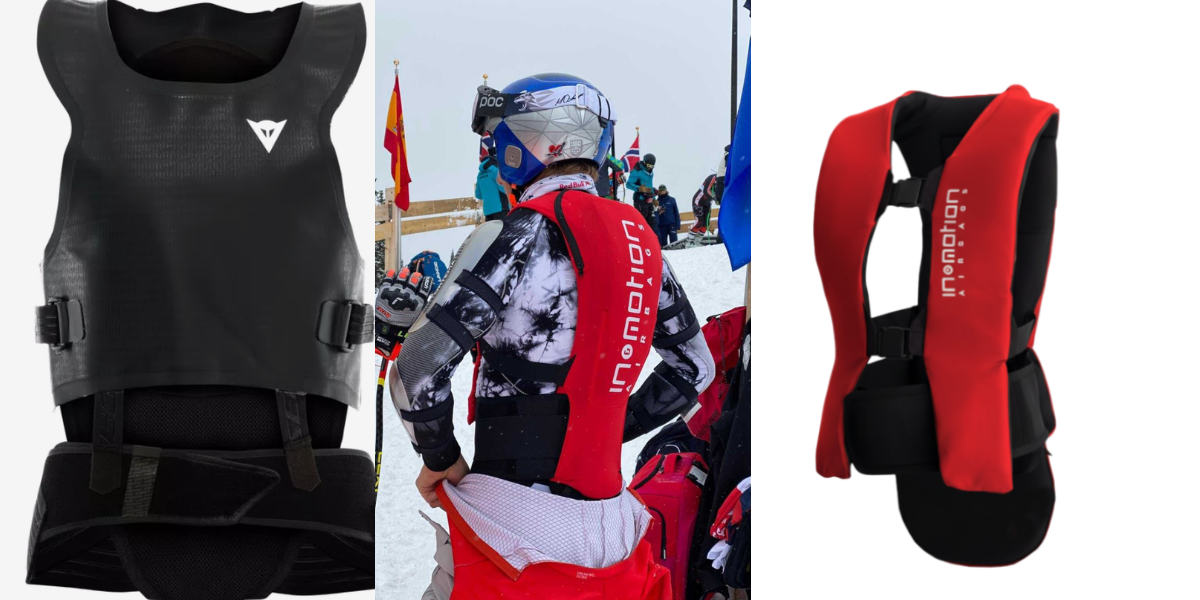
Dainese and In&motion offer FIS-approved ski-racing airbag systems. Dainese Racing Director Marco Pastore confirmed that the two companies currently produce ski-racing airbags in information provided to Ski Racing Media.
Dainese D-Air Ski 2 Evo
Athletes can order through the Dainese D-Air Ski 2 Evo product and purchase page.
The product page identifies the system as FIS-approved and provides sizing information, setup guidance and the user manual.
FIS-registered athletes can also complete Dainese’s athlete purchasing program form to inquire about purchasing options.
Dainese specifies that the D-Air Ski 2 Evo is for downhill and super-G competition. It is not intended for other competitive disciplines, including ski cross.
In&motion
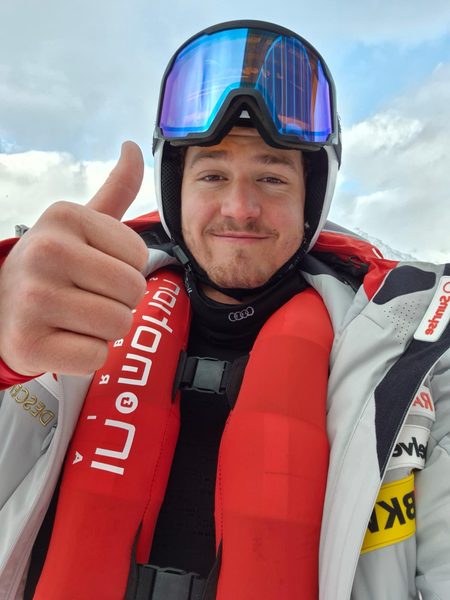
In&motion has provided Ski Racing Media with information about its APS-2 package for the 2026-27 alpine season.
For ordering instructions, sizing, delivery to North America and current availability, email alpine representative Roger Infanger at roger.infanger@inemotion.com. Ask him to confirm the appropriate FIS-conforming model for the intended competition.
The company has not yet supplied Ski Racing Media with a direct APS-2 online purchase link. Readers can learn more about its technology on In&motion’s ski-airbag website.
For ski cross athletes, In&motion explicitly identifies its APS-1 model as compliant with FIS 2024 requirements for both alpine skiing and ski cross. That confirmation is specific to the APS-1; Ski Racing Media has not yet confirmed the APS-2’s ski cross status.
Follow setup and servicing instructions
Athletes should follow their manufacturer’s instructions for fitting, activation, function checks and maintenance. They should also understand the steps required after deployment before using the system again.
Dainese provides a how-to playlist and a video on replacing the gas generator. Its product information says the D-Air Ski 2 Evo allows up to three deployments before the airbag requires replacement.
In&motion’s APS-2 brochure recommends maintenance after every three inflations. Athletes should request the complete maintenance and function-check instructions when ordering.
Before the season, confirm the servicing schedule, replacement parts needed after deployment and where to obtain support.
Cut-resistant pants required at every FIS alpine level
Airbags are not the only equipment requirement athletes need to address.
For 2026-27, FIS requires cut-resistant undergarment pants at all FIS alpine races, across all disciplines and race levels. The pants must provide at least three-star protection under the FIS-DITF standard throughout the area from the top of the pelvis to the top of the ski boots.
The pants must carry the required conformity label. Athletes must follow the manufacturer’s sizing and use instructions and must not alter the garment.
Cut-resistant shirts or full-body suits remain strongly recommended.
The requirement appears in Section 3.5.3.4 of the FIS equipment specifications, pages 32-33.
A third manufacturer may enter the market
Ski Racing Media has been informed that a third ski-airbag manufacturer may enter the market soon. We are not identifying the company at this point, and we have not confirmed a release date or FIS approval status.
Athletes preparing for this season can contact Dainese and In&Motion now. For racers attending the Copper Mountain opener, their equipment needs to be ready before official training begins on Dec. 7.

About the Author: Peter Lange