Sam Morse Val Gardena/Gröden GEPA pictures/ Mathias Mandl
In an exclusive interview with Ski Racing Media, Stifel U.S. Ski Team member Sam Morse sheds light on the influence of past success on his mindset approaching the Val Gardena/Gröden series. “Success on a track means you’ve definitely figured out a few sections, dialed in the race line and your plan,” Morse shares. This familiarity instills a sense of confidence that lets him push the limits, a stark contrast to approaching a track where success has been elusive.
As Morse envisions his return to Gardena, a strategic plan unfolds: “I know my plan through the Moro and through Ciaslat,” he notes. This knowledge gained from past successes gives him the confidence to push extra hard, ensuring he knows precisely where he needs to be on the challenging course.
Arc to Arc
Delving into the specifics of the Saslong course, Morse emphasizes the elements that align with his strengths as a ski racer. “It’s arc to arc, pretty much arcing the entire course,” he points out. The absence of excessive sliding and steep technical turns plays to Morse’s strengths. “I love when I get to bend the ski up clean, generate a lot of power in the ski, and take it to the hill,” he adds.
However, it’s not just the smooth arcs that favor Morse’s style. He highlights the presence of big jumps on the course, a feature that requires comfort in the air and confidence to take speed off those jumps. Morse addresses a common misconception, stating, “It’s sometimes a common misconception that we’re always trying to absorb the jumps.” He clarifies that on mid-size jumps, around the 30-meter range, the goal is often to project and take speed off—a crucial skill he has honed over the years.
Click on Image to enlarge
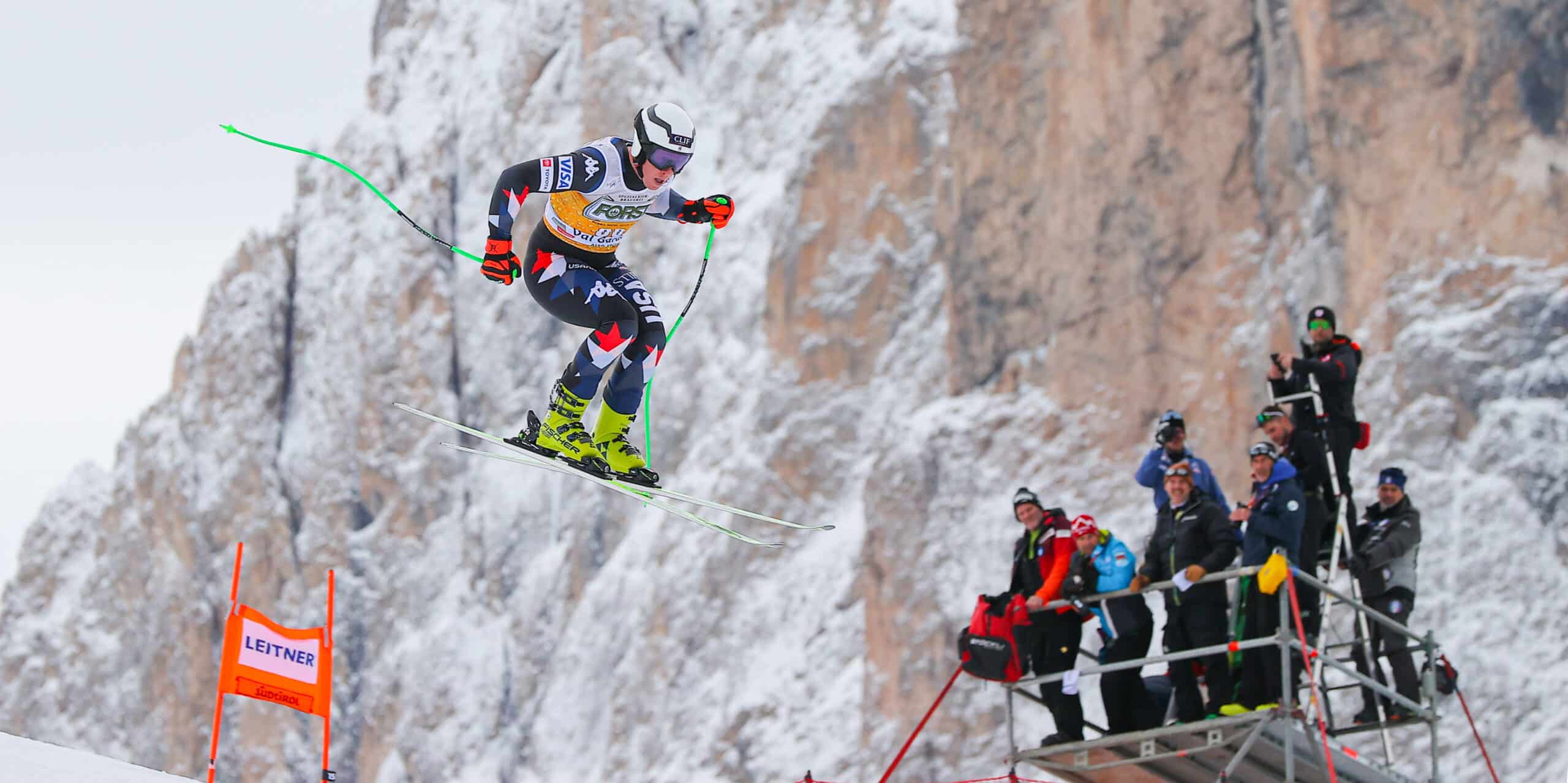
Camel Jump
Ski Racing Media asked Morse about the famous Camel Jump. He gives a vivid description, highlighting the TV cameras’ inability to truly capture its magnitude. With a 60-meter gap and a lengthy straightaway preceding the jump, Morse emphasizes the mental challenge. “You have way too long to think about, ‘Oh, my gosh, this is a bad idea,” he shares. Negotiating a preliminary roller further complicates the approach, requiring skiers to maintain balance and composure before soaring through the air. Morse simplifies his approach: “I try to keep it really simple, just like exhaling. It’s not a jump that you need to necessarily put a huge press on. It’s more important that you’re just balanced and compact in the air.”
Ciaslat
Ski Racing Media asked Morse about the diverse challenges posed by the Saslong course. Morse shares his excitement about a specific section known as the Ciaslat, also dubbed the motocross section. “There’s truly nothing like it that we ever train on any other downhill courses,” he remarks. Describing the unique set of rolls, Morse details the intricate maneuvers involved, from a left foot double to navigating a right foot switch down into a hole. The potential to double or absorb adds an element of unpredictability, making it a thrilling spectacle for both the racers and fans.
Morse compares navigating this section to “skiing on eggshells.” Constantly gauging speed and evaluating the gap to clear, he emphasizes the real feel that comes with time and experience. Allowing himself to be creative has been a breakthrough for Morse, stepping out of the conventional ski racer mode. “If I were just to approach these rolls out on a day of free skiing, how would I ski them?” he questions, highlighting the importance of an open mindset in tackling the challenges of the Ciaslat.
Favorite Venue
We should also delve into Morse’s fondness for Val Gardena/Gröden. When asked if he considers Val Gardena/Gröden’s Saslong his favorite among the multitude of race venues, Morse responds emphatically, “Yeah, it’s definitely my favorite.” Morse attributes this sentiment to the team’s recent successes in Gardena, fostering a fantastic team atmosphere. “Everyone’s fired up for it, and we often have good results,” he adds, underscoring the camaraderie that contributes to the team’s success.
U.S. Success
Reflecting on the broader success of American skiers in Gröden, Morse provides an interesting perspective. While he acknowledges the consistent excellence of American skiers, he shares insights from conversations with older American downhillers like Daron Rahlves and AJ Kitt, who had contrasting experiences in Gardena. Despite historical variations in U.S. athlete preferences, Morse points to Steven Nyman as the “godfather of Gröden,” paving the way for subsequent American successes. Bryce Bennett and Ryan Cochran-Siegle have continued this legacy, with Bryce claiming his first victory on the track.
Morse identifies key factors contributing to American success on the challenging course. Firstly, he highlights the prevalence of jumps on the Saslong, presenting a unique demand for air awareness. “There’s a lot of jumps, probably the most jumps of any course we ski,” he notes. This, Morse believes, plays to the strengths of American skiers, who often come from a free skiing background that cultivates air awareness.
Secondly, Morse emphasizes the importance of creativity on the Saslong. While acknowledging it’s not the hardest track in terms of technicality or steepness, the need for creativity arises due to the presence of mid-size jumps and a surface that isn’t excessively icy. “You have to be creative as to where you’re going to find speed,” he explains, emphasizing the ability of the American team to excel in these conditions.
“Lick the Stamp and Send It“
In a final nod to the daring spirit required on the Saslong, Morse quotes Daniel Ricardo: “Sometimes you just have to lick the stamp and send it.” This encapsulates the fearless approach that defines successful performances on the challenging Val Gardena/Gröden course.
As Stifel U.S. Ski Team member Sam Morse embarks on his journey back to Val Gardena, the intricate dance between familiarity, strategy, and sheer courage unfolds on the iconic Saslong. The anticipation builds, and fans eagerly await the spectacle that Morse and his fellow skiers are poised to deliver on the slopes of Val Gardena/Gröden.
Val Gardena/Gröden will host three races this season. On Thursday, December 14th, there’s a men’s downhill race, followed by a men’s super-G on the 15th, and another men’s downhill on Saturday the 16th.
About the Author: Peter Lange