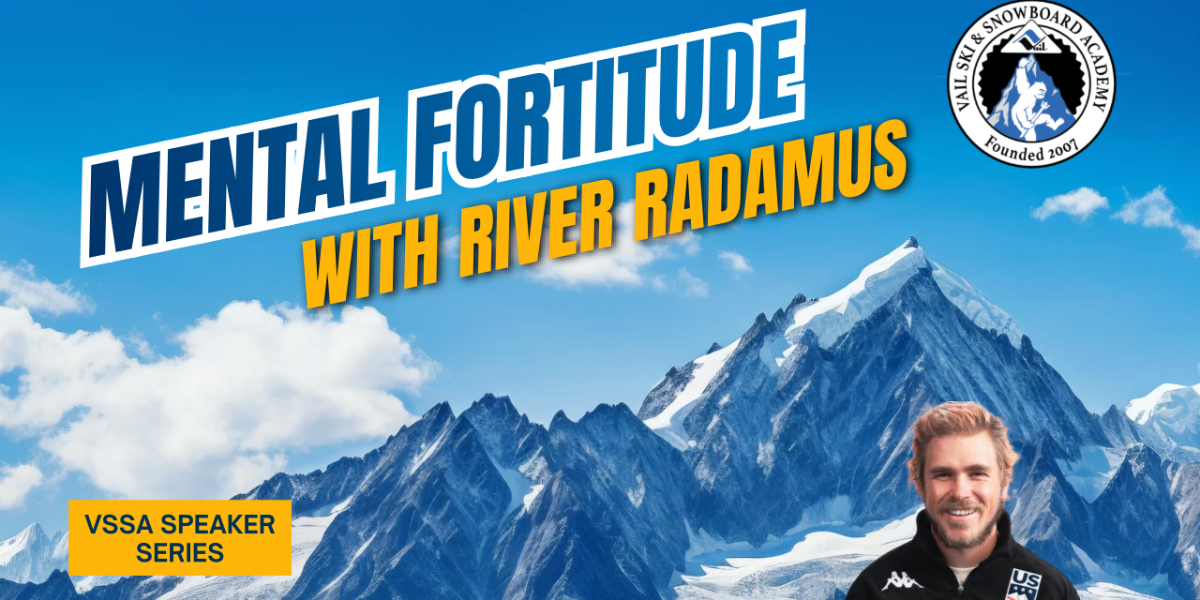
For River Radamus, one of the most important lessons of his ski racing career came after one of its most painful results.
At the 2022 Beijing Olympics, Radamus arrived as the 20th-ranked giant slalom skier in the world and produced two of the best runs of his career. He sat eighth after the first run, then attacked the second despite a long weather delay and moved into the lead. As the final racers came down, Radamus watched his name remain at the top of the board until three skiers ultimately moved ahead of him.
He finished fourth, one-tenth of a second away from an Olympic medal.
Speaking recently to students at Vail Ski & Snowboard Academy (VSSA), Radamus described what followed and how that experience eventually changed the way he thought about results, fulfillment and his career.
“I remember sitting in that finish line,” Radamus said. “I watched that medal ceremony and I just thought, this was what I’ve spent my entire life for.”
Radamus had grown up dreaming about the Olympics, with American ski racing stars on his walls and the goal of someday becoming an Olympic champion. Finishing that close made it difficult not to think about everything that had gone into reaching that moment: the missed birthdays, vacations, early mornings and years of training.
Then, a few days later, something happened in the Olympic Village that gave him a different perspective.
Radamus was standing in a buffet line behind one of the athletes who had finished ahead of him and won a medal. The athlete was complaining about the food at the salad bar. At first, Radamus was angry. This skier had accomplished exactly what Radamus had spent his life chasing, yet a medal had not suddenly made everything perfect.
Months later, the meaning of that interaction started to settle in.
“He did it. I didn’t do it, but his life hasn’t changed,” Radamus said. “And if he’s not satisfied with an Olympic medal, why would I have been satisfied with an Olympic medal?”
It forced Radamus to confront something that can be difficult for athletes in a result-driven sport. There is always another goal. Win a race and there is another race. Win again and there is a season title to chase. Reach one benchmark and another quickly takes its place.
“There’s never going to be the moment that I’m hoping for that just fulfills me,” he said.
Learning to Find More Than a Result
That realization did not make results less important to Radamus. He still wants to win, and he still believes athletes should pursue those goals with everything they have. What changed was his understanding of where fulfillment had to come from.
Radamus told the VSSA students that one of the most important things he has learned during more than a decade with the U.S. Ski Team is to separate what he can control from what he cannot. For him, the controllable pieces are relatively simple: effort and attitude.
“How I race, what the weather is, what my competition does, it’s completely out of my control,” he said. “I can show up, give my absolute best effort, have the right attitude, and still get beat by three guys.”
That mindset also changed the way he viewed the enormous amount of preparation that goes into a relatively small amount of actual racing.
Radamus estimated that he spends more than 240 days a year training, with much of the remaining time devoted to the gym, conditioning and other preparation. During a season, he may race roughly 30 times, yet his cumulative time actually competing on a race course amounts to only about an hour.
For years, that hour could determine how he felt about everything that came before it.
“If that hour goes great, I feel great. If that hour goes bad, I feel bad,” he said.
Eventually, he began looking at the process differently. Instead of treating race day as the only test, the training itself became part of how he measured success: how he approached the gym, how he worked on difficult days and what he did when nobody was watching.
“If I do that to the very best of my ability, show up every single day, then I can be at the start gate and know everything I can do has been done,” Radamus said. “It’s out of my hands.”
Competition, in that sense, became less of a judgment on the previous year and more of an opportunity to see what all of that work had produced.
Finding a Reason That Goes Beyond Racing
Radamus also encouraged the young athletes to understand why they are pursuing the sport in the first place.
Making the U.S. Ski Team, becoming an Olympian or winning a race are worthwhile goals, he said, but they are also moving targets. Once one is reached, another inevitably appears.
For Radamus, part of his “why” is finding out what he is capable of. When his career eventually ends, he wants to know he gave himself every possible opportunity to reach his potential.
The other piece comes from recognizing how many people helped him reach the World Cup. Parents, coaches, teammates and supporters all contributed along the way, and that realization helped inspire him to create the ARCO Foundation and give opportunities back to the ski racing community.
“None of us get to where I am, or even where you guys are, alone,” Radamus told the students. “You have parents and coaches and supporters and maybe people that have helped you that you don’t even know along the way.”
That purpose matters on the days when training is cold, dark and difficult. It gives him something to come back to that exists beyond a finish list.
‘Do It Scared’
After years on the World Cup, Radamus said another lesson has been accepting that fear and doubt do not disappear simply because an athlete becomes more successful.
He used to believe the goal was to eliminate negative thoughts before he could perform at his best. Experience taught him otherwise.
“Those bad thoughts never go away,” he said. “If you’re the best guy in the world, you always have those doubts. You always have those reservations. You always feel scared at the start.”
Instead of trying to bury those feelings, Radamus has learned to recognize them and then decide how he wants to respond.
“Do I want to run away from those thoughts, or do I want to run towards who I want to be, what I want to do, what I want to achieve?” he said.
The phrase “do it scared” has become one way of thinking about that choice. The fear can still be there. The athlete does not have to wait for it to disappear before pushing out of the start.
‘It’s Worth It’
One of the stories Radamus shared with the students came from former U.S. Ski Team teammate Sam DuPratt, whose career included repeated injuries, surgeries and comebacks.
The two were together in Bormio, Italy, for the notoriously demanding men’s downhill. Radamus recalled sitting in the lodge after watching multiple athletes leave the course by helicopter. He was frightened and questioning whether he wanted to be there.
DuPratt, who had already endured significant injuries during his own career, looked at him and said three words: “It’s worth it.”
The words stayed with Radamus.
Later that season, Radamus arrived at the World Cup giant slalom at Palisades Tahoe and put together the best first run of his World Cup GS career to that point, sitting third in front of a home crowd. The opportunity also brought enormous pressure.
Before the second run, Radamus spotted DuPratt in the crowd. DuPratt was still on crutches from another injury.
As Radamus passed, DuPratt repeated the message: “It’s worth it.”
Radamus remembers riding the lift afterward with tears in his eyes, thinking about the opportunity in front of him, the work it had taken to get there and the people who had helped him along the way.
He went on to earn his first World Cup podium.
“That’s something that just sort of always sticks with you,” Radamus said. “Next time you’re doubting yourself, you want to give up, you want to shirk away from the fear or the danger signal that’s ringing in your brain, remember, it’s worth it.”
Looking Toward Another World Cup Season
During a question-and-answer session after his presentation, Radamus also spoke about the 2026 Olympics and his preparation for the upcoming World Cup season.
He finished 15th in the Olympic giant slalom and did not finish the super-G, results that were difficult after another four-year build toward the Games. This time, however, he felt better equipped to process the disappointment because he knew he had done everything he could to prepare.
“Sometimes it goes your way and sometimes it doesn’t,” he said.
Radamus told the students he was preparing to return to Europe and felt ready for the season ahead. He said he had accumulated 95 days on snow since the end of the previous season, training at Copper Mountain before traveling to Ushuaia, Argentina, and then New Zealand. His preparation has also included five days a week in the gym, with a focus on leg strength, core strength and aerobic capacity.
Despite all that experience and preparation, one thing has not changed. Radamus still gets nervous before every race.
Rather than trying to fight those nerves, he has developed a simple routine in the start gate. He looks toward the horizon and the mountains around him and takes a moment to think about how fortunate he is to still be doing what he loves.
“I just think about how lucky I am to be able to do this, do the thing that I love the most, and how I want to do it justice,” he said. “I want to honor the opportunity that I have.”
Then he pushes out of the start and lets the skiing take over.
Click the link below to watch the whole speech from River Radamus to the students of Vail Ski & Snowboard Academy.
About the Author: SR Staff Report