
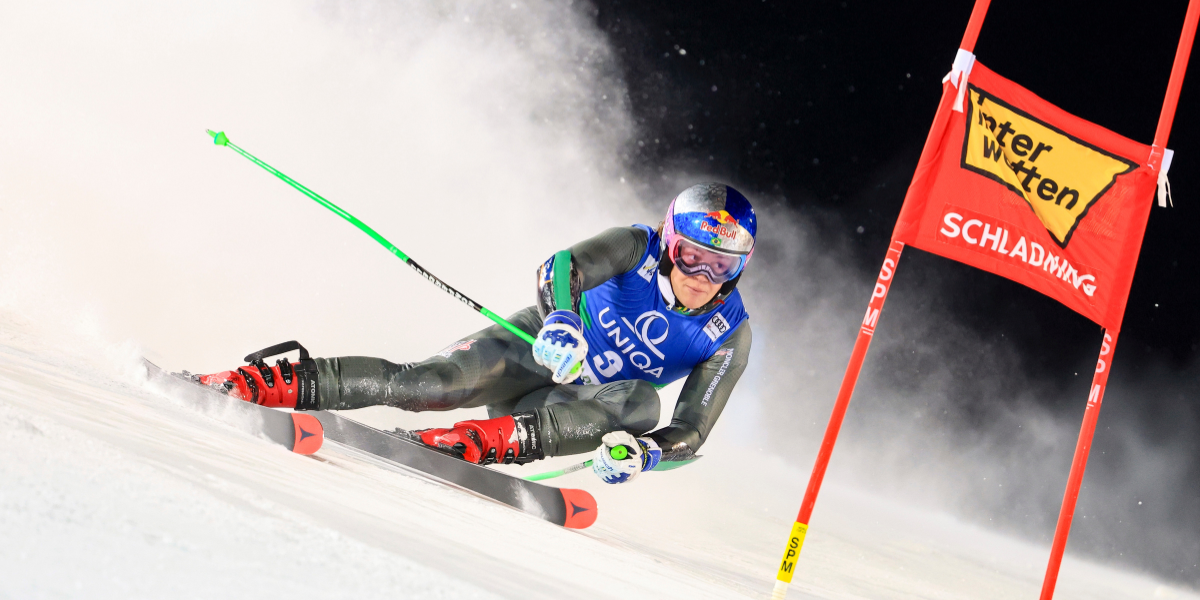
Lucas Pinheiro Braathen / Schladming GS / GEPA pictures
SCHLADMING, Austria — There is nothing like a night race, and nowhere in alpine skiing delivers it like Schladming.
Under the lights on the Planai, in front of an estimated crowd nearing 50,000, Lucas Pinheiro Braathen of Brazil delivers a commanding first run to lead the men’s giant slalom in the only night GS on the World Cup calendar. His time of 1:08.21 sets the standard on a hard, icy surface that immediately exposes hesitation and rewards skill.
The noise level can only be understood live.
Top five — first run
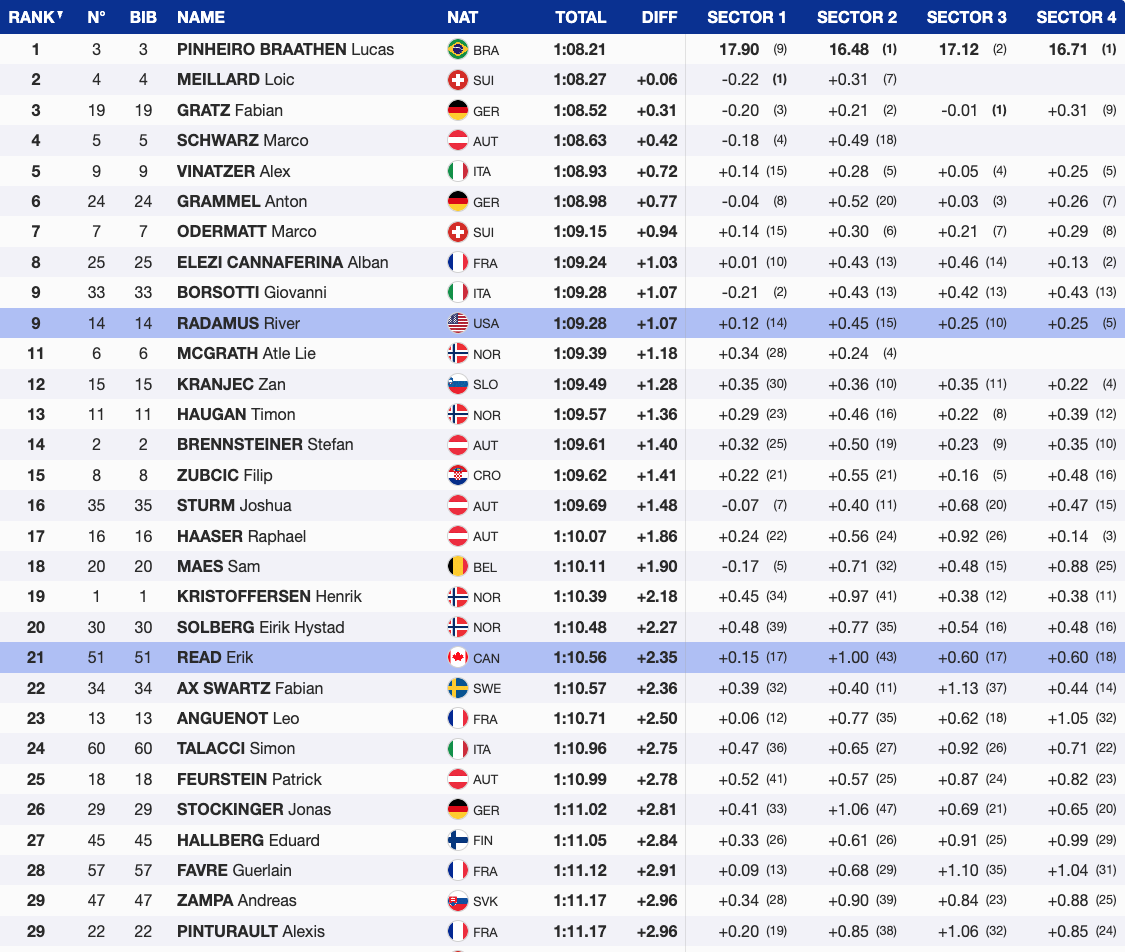
- Bib 3 — 1st Lucas Pinheiro Braathen 🇧🇷 (BRA), YOB 2000, Atomic, 1:08.21
- Bib 4 — 2nd Loïc Meillard 🇨🇭 (SUI), YOB 1996, Rossignol, +0.06
- Bib 19 — 3rd Fabian Gratz 🇩🇪 (GER), YOB 2003, Völkl, +0.31
- Bib 5 — 4th Marco Schwarz 🇦🇹 (AUT), YOB 1995, Atomic, +0.42
- Bib 9 — 5th Alex Vinatzer 🇮🇹 (ITA), YOB 1999, Atomic, +0.72
Magnificent seven set the tone
Norway’s Henrik Kristoffersen, the veteran of the opening group, leads off the race and immediately reveals the conditions. The surface is icy but fair — a track that allows speed if the ski is pressured early and cleanly.
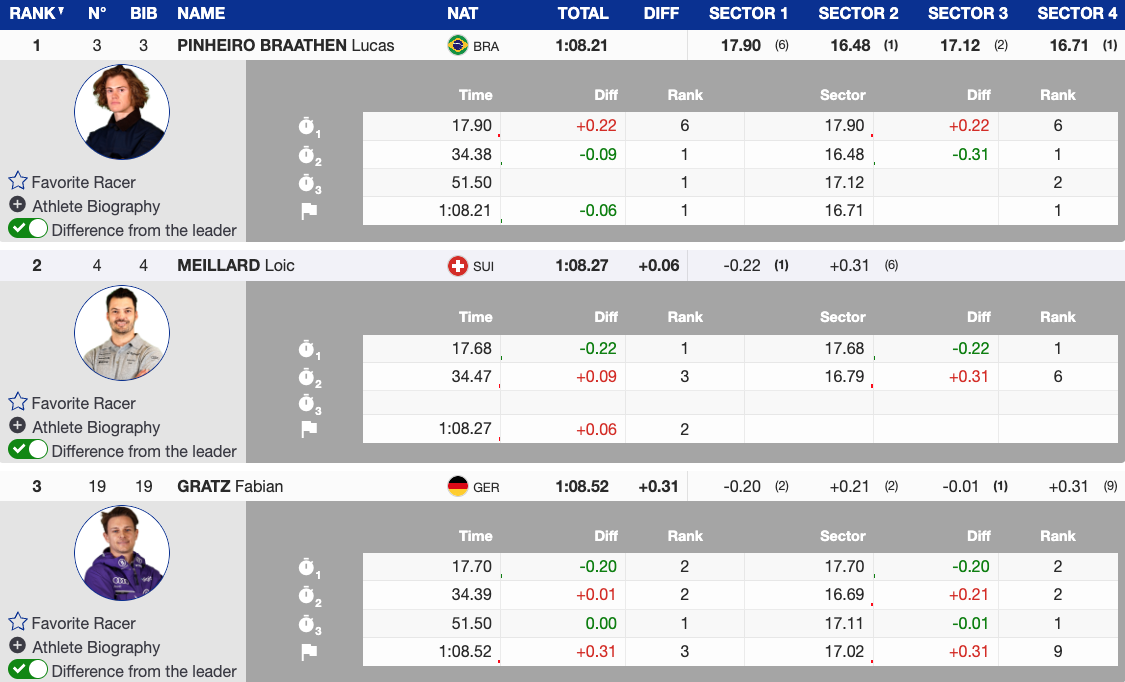
Austria’s Stefan Brennsteiner ignites the stadium with an exceptionally powerful run, briefly taking the lead and sending the home crowd into full voice. Moments later, Pinheiro Braathen delivers the defining run of the night, giving up time early before dominating through the middle and bottom of the course to seize control.
Switzerland’s Loïc Meillard responds with intensity, matching Pinheiro Braathen through much of the run and crossing just 0.06 seconds back. Austria’s Marco Schwarz, also a winner this season, skis with authority and keeps himself firmly in podium contention at +0.42, sending the crowd into another roar.
The stadium then falls quiet for Marco Odermatt. The world No. 1 shows flashes of brilliance but loses time early on the ice and crosses 0.94 seconds back. Seeing Odermatt outside the top five is striking, but his skill keeps him firmly in the podium conversation.
Germany becomes a central storyline
As the race moves beyond the opening group, the story widens.
Germany’s Fabian Gratz (bib 19) delivers the upset of the first run, skiing with authority and composure on the edge of control to charge into third place, just 0.31 seconds back. His run makes him an immediate podium contender and places Germany squarely in the spotlight.
That momentum continues when Anton Grammel (bib 24) follows with another elite performance, crossing 0.77 seconds back and into the top six. Germany now places multiple skiers among the contenders on one of the most technically demanding surfaces of the season.
Conditions expose hesitation
The speed of the course and the ice define the race. On a steep, icy slope like Schladming, late pressure below the gate does not work. Pressure applied early, into and through the fall line, allows the ski to hold. Straight and late lines become a recipe for mistakes.
There is no doubt the fastest skied the best in the first run.
DNFs accumulate quickly, opening space inside the top 30. Opportunity exists, but on ice this hard, there is no hiding a lack of skill.
USA & Canada — first run
- Bib 14 — T-9th River Radamus 🇺🇸 (USA), YOB 1998, no partner equipment, +1.07
- Bib 51 — 21st Erik Read 🇨🇦 (CAN), YOB 1991, Atomic, +2.35
Radamus continues a strong season with another fast first run. He skis aggressively but gives away time with small mistakes, finishing tied for ninth. With several skiers now ahead of him, podium chances narrow, but he remains well positioned for a strong second run.
For Canada, Erik Read delivers one of the most impressive high-bib runs of the night. The veteran executes cleanly on a surface that punishes indecision.
“It was very shiny ice, but when you committed to it, it really grabbed the skis,” Read said. “It was really hard to nail it down today.”
Read adjusts his setup after watching conditions unfold.
“I had two setups ready, and once I saw how it was skiing, I went with something less extreme,” he said. “It was a turning course. You had to be active and clean, and you had to have your setup dialed.”
Experience proves decisive on the Planai.
“If it’s tight and turning like this, you still have to be clean — just more active,” Read said. “You really have to trust it and go for it.”
High-bib impact (bib 31+)
With DNFs opening space inside the top 30, several skiers with bibs 31 and higher take advantage on a hard, icy surface that rewards only clean, committed skiing. Experience and execution prove decisive on the Planai.
Winner time: 1:08.21 (Lucas Pinheiro Braathen)
- 9th — bib 33 🇮🇹 Giovanni Borsotti (1990) — +1.07
- 16th — bib 35 🇦🇹 Joshua Sturm (2001) — Atomic — +1.48
- 21st — bib 51 🇨🇦 Erik Read (1991) — Atomic — +2.35
- 22nd — bib 34 🇸🇪 Fabian Ax Swartz (2004) — +2.36
- 24th — bib 60 🇮🇹 Simon Talacci (2001) — +2.75
- 27th — bib 45 🇫🇮 Eduard Hallberg (2003) — +2.84
- 29th — bib 47 🇸🇰 Andreas Zampa (1993) — +2.96
Highest bib to score points: bib 60 — Simon Talacci (24th, +2.75)
Fastest finisher among bib 31+: bib 33 — Giovanni Borsotti (9th, +1.07)
First Run Top 30 Results
click image to enlarge
First-Run Analysis: Fastest Three and Qualified North American


About the Author: Peter Lange