Camille Rast SUI / GEPA pictures
Camille Rast Sets the Benchmark as Semmering Slalom Turns Brutal
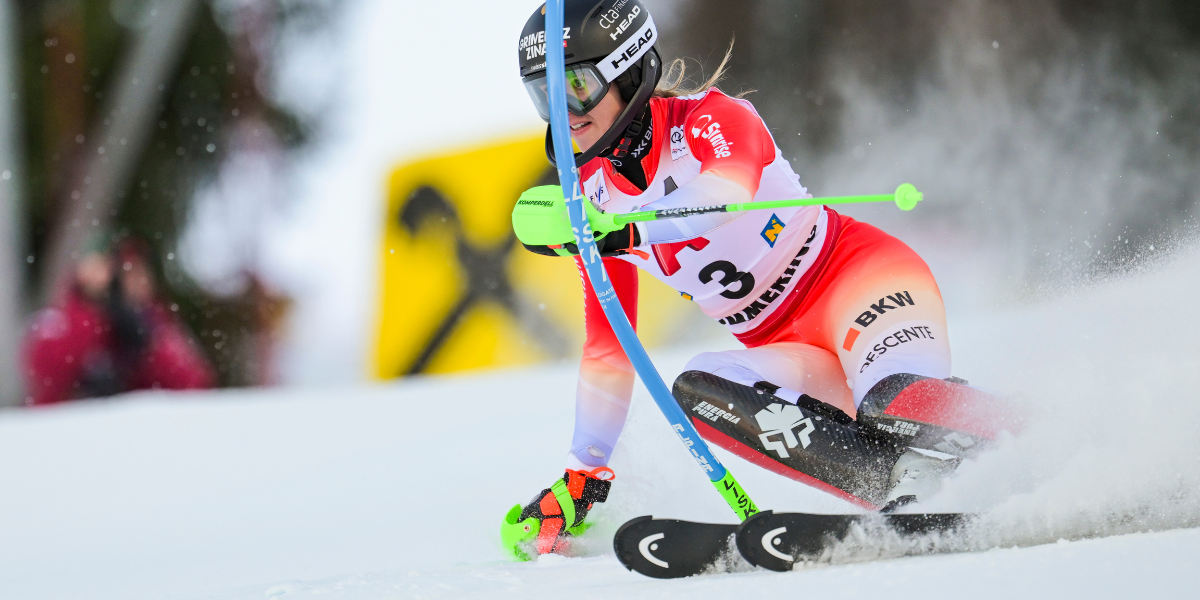
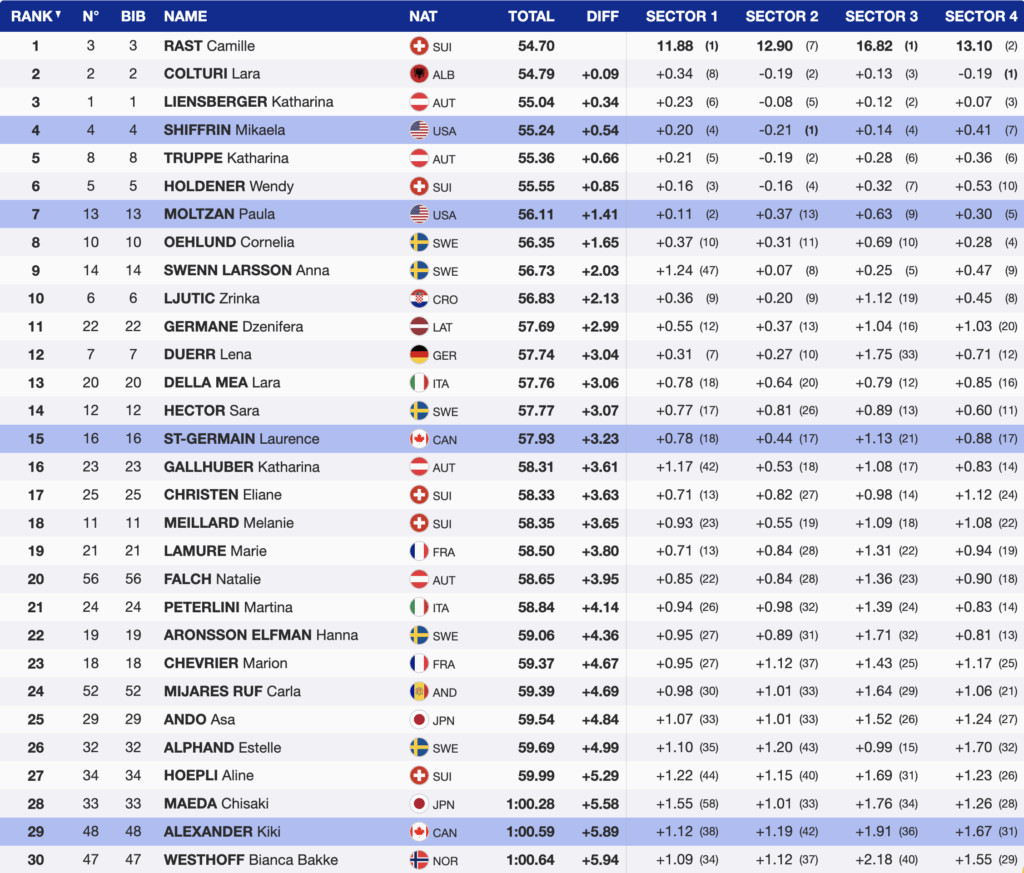
SEMMERING, Austria — Camille Rast’s (SUI) aggression defined the first run of the women’s World Cup slalom in Semmering on Saturday. Reigning slalom world champion Camille Rast set the standard early and never relinquished it, leading in 54.70 seconds as attrition ripped through the field. By the end of the run, only 40 of 73 starters finished, an extreme DNF rate.
Rast Finds the Formula on a Deteriorating Track
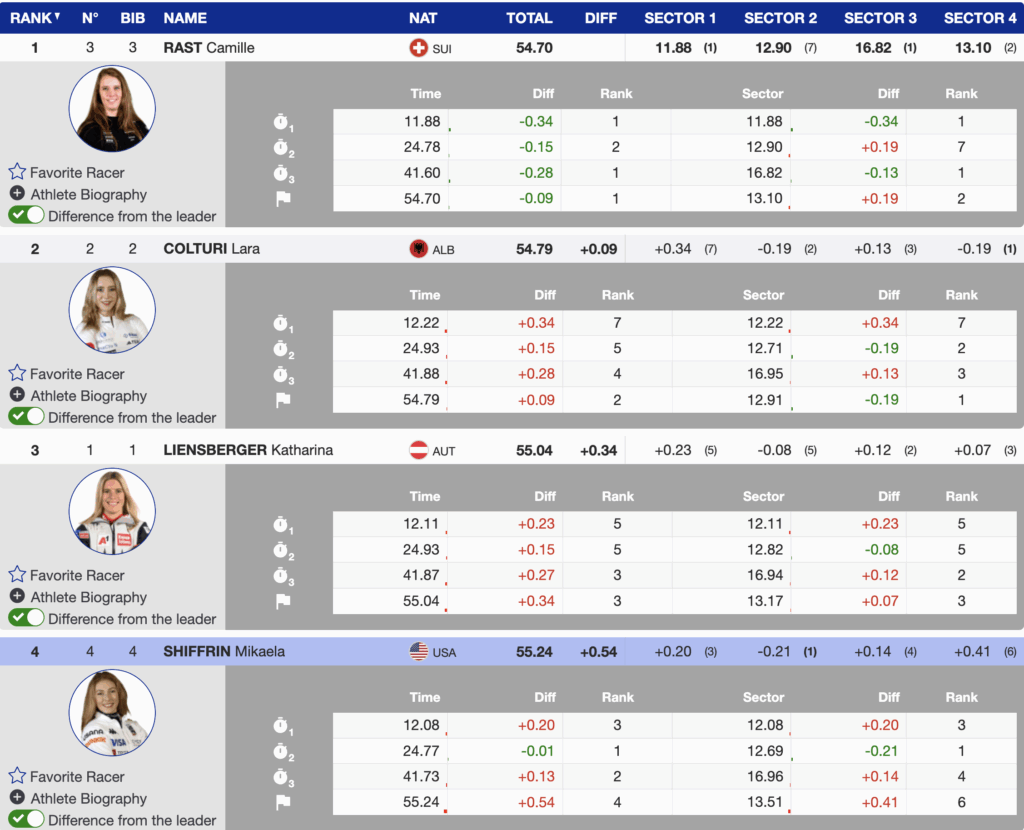
Starting third, Rast delivered the most complete run of the morning. She attacked decisively, stayed direct in the rhythm sections, and carried speed onto a lower pitch that punished hesitation. As conditions worsened, her fun held while others unraveled — a reflection of why she arrived in Semmering as the reigning world champion from Saalbach 2025.
Teenager Lara Colturi (ALB) kept pressure on throughout the first run. After matching the pace up top, she accelerated late to sit second, just 0.09 seconds back.
Austria’s home favorite Katharina Liensberger drew loud support from the opening gate and delivered a composed 55.04, ranked third (+0.34) — solid, but not quite aggressive enough to threaten the lead.
Shiffrin Not Leading — and Still the Story
The defining headline followed.
Mikaela Shiffrin did not lead a World Cup slalom first run — a rarity for the sport’s most accomplished technician. Shiffrin briefly moved into a small advantage through the middle of the course but lost momentum on the roughening lower section, crossing fourth, 0.54 seconds back.
Despite the gap, she still delivered the strongest first run for the Stifel U.S. Ski Team and remained the favorite with a second run that rewards courage, timing and strength.
“It’s a pretty tough one,” Shiffrin said. “I haven’t seen the video yet, but it felt like I was overskiing a little compared to what’s possible. Camille is so direct on the gates — when she manages that, it’s just incredibly quick and straight down the hill.
“The surface is very inconsistent, and the course setting is quite quick. It forces a small pivot every turn, and with the setting and the surface together, it’s going to get quite rough.”
Podium Contenders Stack Up Behind the Leader
Austria’s Katharina Truppe, bib 8, delivered one of the strongest runs outside the elite seven seed, jumping into fifth (+0.66) and positioning herself squarely in the podium fight.
Swiss veteran Wendy Holdener followed in sixth (+0.85), close enough to remain dangerous with the start order reversed.
Behind them, the course began to dictate terms.
Attrition Becomes the Defining Theme
As the start list pushed deeper, the race shifted from speed to survival. DNFs mounted rapidly across every seed group. After 45 starters, only 28 skiers had reached the finish. It ultimately took bib 48 to finally fill out the top 30 — and critically, every skier who started among the first 30 qualified for the second run.
By the end of the first run:
- 40 of 73 starters finished
- 33 skiers did not reach the bottom
- The time spread inside the top 30 stretched to nearly six seconds.
The contrast to Friday’s giant slalom — where high bibs thrived — was striking, despite racing on the same venue.
🇺🇸 🇨🇦 North American Qualifiers — First Run
Shiffrin led the North American effort, with solid contributions from both U.S. and Canadian skiers who managed the conditions.
🇺🇸 United States
- 4th — Bib 4 — Mikaela Shiffrin — +0.54
- 7th — Bib 13 — Paula Moltzan — +1.41
Moltzan attacked aggressively one day after a heavy giant slalom crash and put herself in position for another meaningful second-run move.
Logan Grosdidier, a World Cup rookie, made her first World Cup start Saturday in Semmering. The 17-year-old, the youngest athlete on the Stifel U.S. Ski Team, started 38th and was inside the top 15 through the third sector before skiing out in the final sector — a tough end on a demanding course, but an encouraging debut that showed she has the speed to compete at this level.
🇨🇦 Canada
- 15th — Bib 16 — Laurence St-Germain — +3.23
- 29th — Bib 48 — Kirk Alexander — +5.89
For Alexander, qualifying 29th from bib 48 marked a career milestone — her first World Cup second-run start in 14 appearances, achieved on the most unforgiving first runs of the sport’s history.
High-Bib Impact — Qualified from Bib 31+
Even on a day that favored early starters, several late bibs fought into the top 30:
- 20th — Bib 56 — Natalie Falch (🇦🇹 AUT) — +3.95
- Fastest finisher among bibs 31+
- 24th — Bib 52 — Carla Mijares Ruf (🇦🇩 AND) — +4.69
- 26th — Bib 32 — Estelle Alphand (🇸🇪 SWE) — +4.99
- 27th — Bib 34 — Aline Höpli (🇨🇭 SUI) — +5.29
- 28th — Bib 33 — Chisaki Maeda (🇯🇵 JPN) — +5.58
- 29th — Bib 48 — Kirk Alexander (🇨🇦 CAN) — +5.89
- Career milestone: first World Cup second run (14th start)
- 30th — Bib 47 — Bianca Bakke Westhoff (🇳🇴 NOR) — +5.94
- Highest bib to qualify

First Run Top 30 and Ties
click images to enlarge
Run Analysis: Leaders & Qualified North Americans



About the Author: Peter Lange