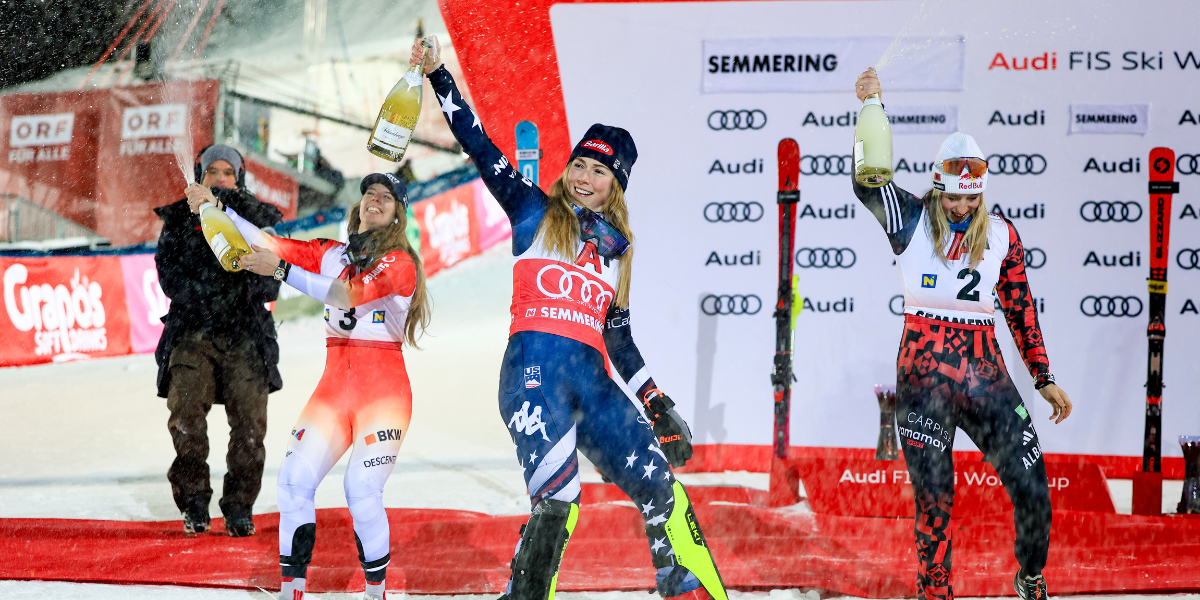
Rast, Shiffrin, Colturi / Semmering Podium / GEPA pictures
Shiffrin Erases First-Run Deficit to Win Semmering Slalom as Conditions Finally Open the Door
In the end, the story in Semmering belonged to Mikaela Shiffrin — again.
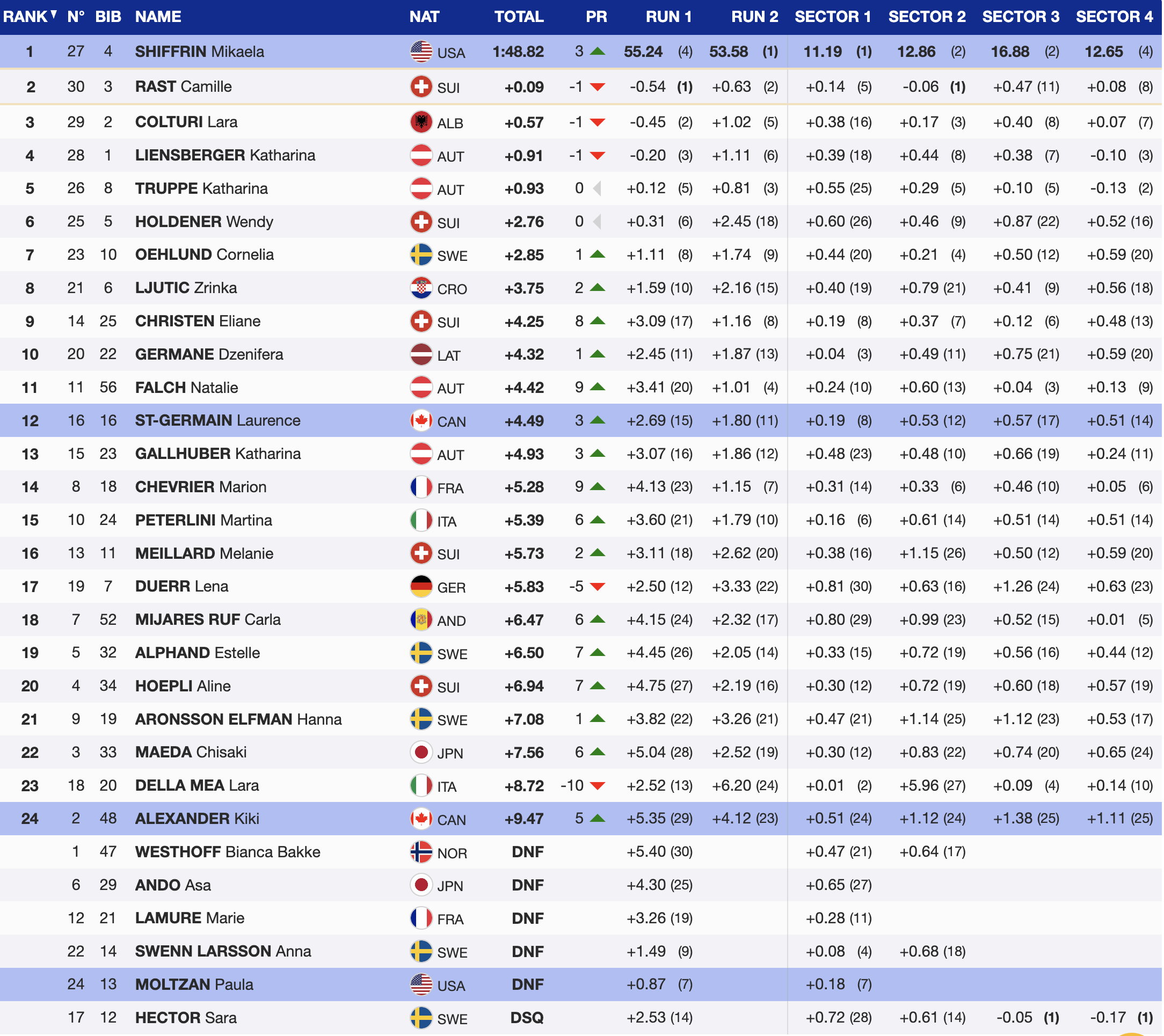
After conceding 0.54 seconds in a brutally difficult first run, Shiffrin delivered the fastest second run of the night to storm back and win the women’s World Cup slalom by 0.09 seconds, proving once more why she stands alone as the most successful skier in the sport’s history.
Shiffrin stopped the clock in 1:48.82, edging Switzerland’s Camille Rast, with 19-year-old Lara Colturi completing the podium 0.57 seconds back. Austria’s Katharina Liensberger finished fourth (+0.91), followed closely by Austrian teammate Katharina Truppe in fifth (+0.93).
The victory marked Shiffrin’s sixth consecutive World Cup slalom win, her 69th career slalom victory, and her 106th World Cup win overall — achieved through excellence and tireless work.
Two Runs, Two Very Different Races
Semmering delivered two completely different tests.
The first run was defined by extreme deterioration, forcing athletes into survival mode as deep ruts formed quickly, particularly for skiers starting later in the field. Shiffrin said the surface crossed into unsafe territory for many competitors and made the day difficult to manage mentally.
“For me, don’t question it — before on the first run, it’s not a problem,” Shiffrin said. “But for these women already starting 13, 15, 18, in the 60s, this was not okay.”
She described the day as “very challenging and distracting,” explaining that while she was relieved there were no major injuries, ski racing should test athletes without creating fear.
“It should be a good show,” she said, “but it should be something the athletes want to do — not be terrified on the start looking at the first two turns with these enormous holes.”
The second run told a different story.
Under the lights, conditions were significantly better, opening the door for athletes to attack. The proof was immediate: the combined-time lead changed hands 12 times in the second run, a clear signal that the race had shifted from survival to execution.
Chaos Early, Depth Everywhere
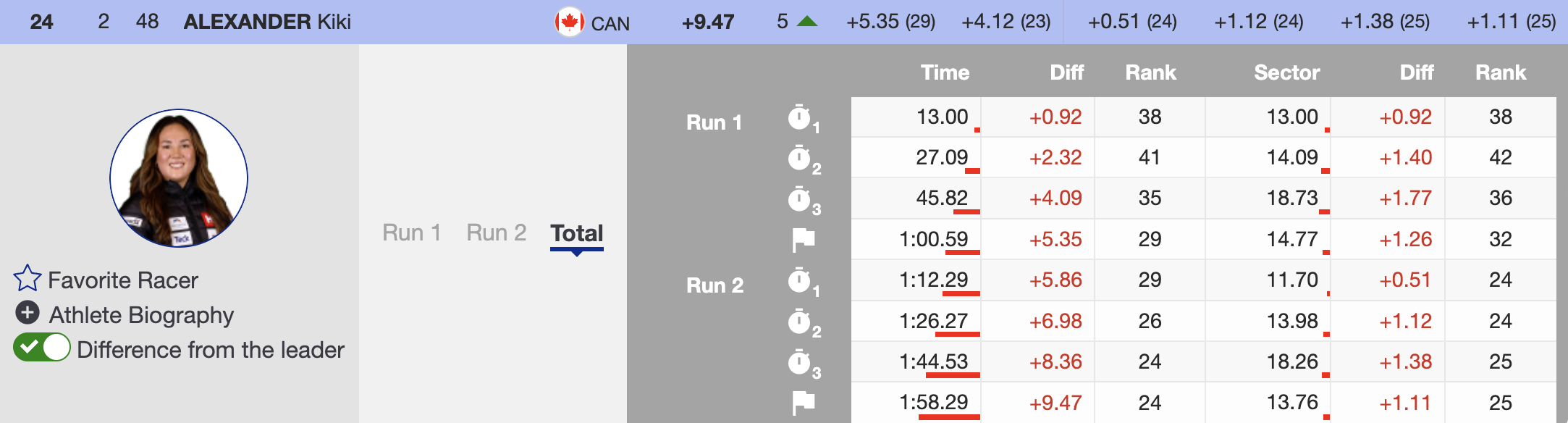
Early starters took advantage of the improved surface, reshaping the leaderboard repeatedly. Canada’s Kiki Alexander qualified for the second run for the first time — a significant milestone — though she finished too far back to score World Cup points.
France’s Marion Chevrier became the first skier whose time truly held, while Austria’s Natalie Falch thrilled the home crowd with a major charge up the standings. Switzerland’s Eliane Christen delivered one of the defining runs of the race, climbing six positions and holding the lead deep into the start order.
The breadth of the discipline was unmistakable. Thirty skiers from 14 countries advanced to the second run, illustrating just how global and competitive women’s World Cup slalom has become.
Execution When It Mattered Most
As the final contenders arrived, volatility returned — then sharpened.
Truppe ignited the finish area with an inspired run that built a 1.83-second lead, drawing the loudest response of the night. But Shiffrin answered with authority.
She said she was satisfied with her second run, even if it never felt comfortable. “Today was hard,” Shiffrin said, calling the race a “really big fight” under pressure. Despite posting the fastest run of the night, she admitted she did not expect to see the green light, explaining that it was one of those days where she had to refocus, stay positive, and commit fully.
Her run reclaimed the lead by 0.93 seconds, guaranteeing at least fourth with three skiers remaining.
Liensberger, the fastest Austrian in the first run, could not match Shiffrin’s pace on the second run surface and settled into second at the time. She ranked third overall after the first run, with only Rast and Colturi ahead of her.
Colturi followed with another poised, aggressive performance, finishing 0.57 seconds back to secure her fourth slalom podium of the season and guarantee Shiffrin would finish no worse than second.
Rast: Hundredths Decide It
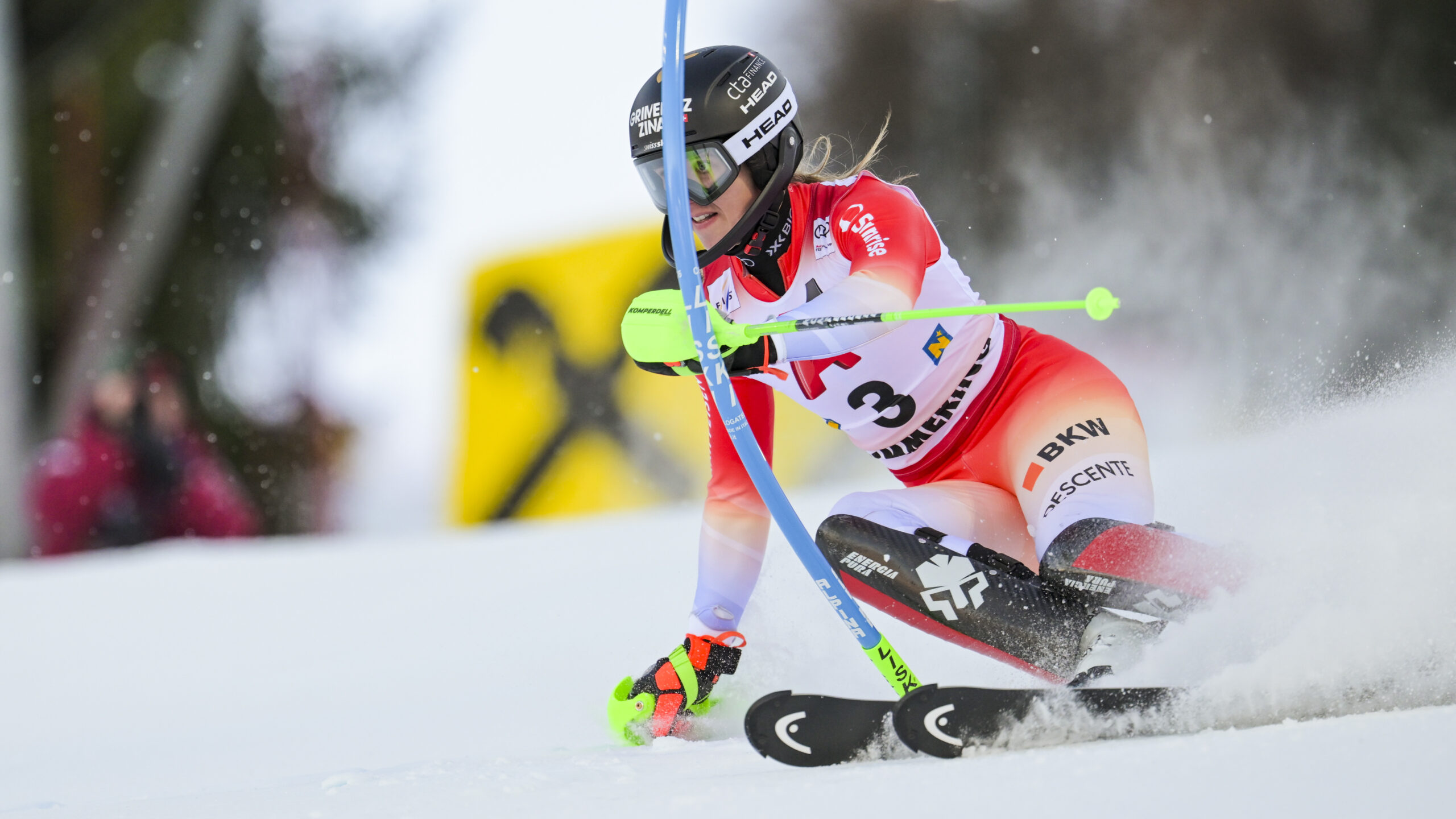
Switzerland’s Camille Rast left Semmering encouraged despite missing the victory by the narrowest of margins, saying the difference came down to precision rather than pace on a demanding course.
Rast attacked from the start of the second run and carried speed deep into the course, but a small mistake in the final sector proved decisive in a race where margins were microscopic. She described the day as one that required perfection from top to bottom, especially as conditions evolved between runs.
“0.09 is not a lot,” Rast said, summing up the result with perspective rather than frustration. She said continued consistency is the key, noting that when the level is this high, “the smallest mistake, and first place is there.”
Rast said pushing for two clean runs remains the standard at the top of women’s slalom. “You need two runs without mistake from top to bottom,” she said, adding that the work continues as the season builds.
The second-place finish reinforced her momentum in the discipline. Rast has now reached six World Cup slalom podiums in her last 14 starts, establishing herself as one of the most reliable challengers to Shiffrin as the season heads into the new year.
Colturi: Closing the Gap
Nineteen-year-old Lara Colturi continued her rapid rise at the top of women’s slalom, delivering another composed, powerful performance to secure her fourth podium in five races and further cement her place among the discipline’s most consistent contenders.
Colturi said improved conditions in the second run allowed her to ski with greater intent, even if the margin to the top remained just out of reach on the day. She described her approach as focused on commitment rather than calculation.
“The snow was a little bit better in the second run, so the mindset was to go fast and just do what I’m doing in training,” Colturi said. She added that she pushed her limits without overthinking the result. “It was impossible to win, but I just tried to do my best.”
Colturi said confidence has been building steadily as the season progresses, driven by strong training and a clearer sense of rhythm on challenging surfaces.
“I’m getting close each race,” she said. “I’m feeling really good in training. I’m really fast, with a good mindset and power.”
The podium marked another step toward a potential breakthrough victory for Albania, a milestone Colturi continues to chase with patience and belief. She also pointed to Shiffrin as a lifelong reference point.
“She is really amazing,” Colturi said. “I’m trying to copy everything about her. Since I was five years old, I’ve been trying.”

Race Results
click images to enlarge
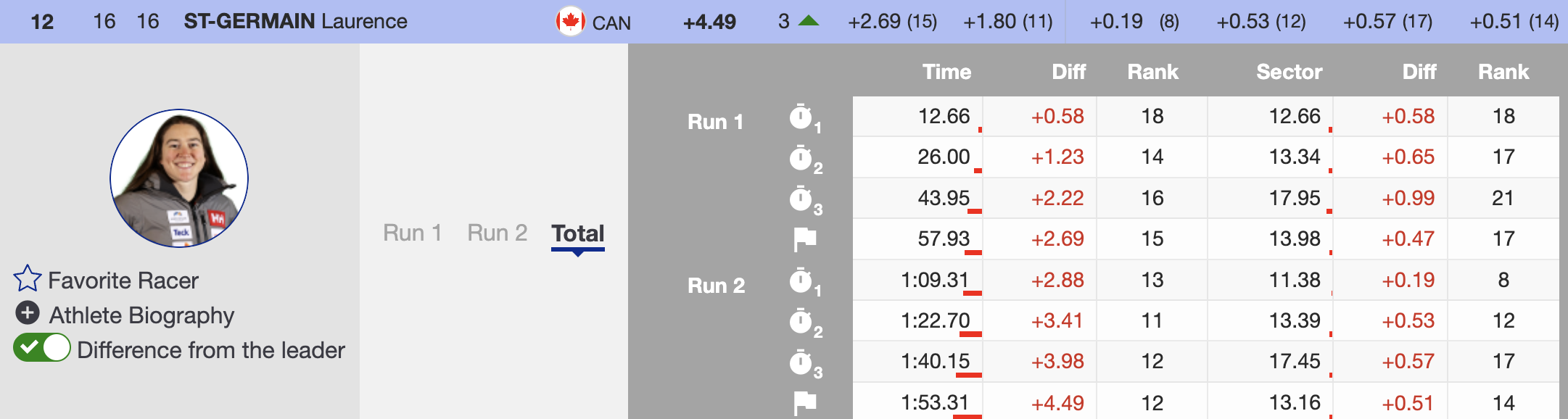
Run Analysis: Leaders & Other North Americans

About the Author: Peter Lange