

Featured Image: Wengen, Switzerland. Captured by Mathias Mandl/GEPA.
Ski racing is a sport defined by speed, courage, and precision. But behind the thrill and glory, the risks are very real. Several tragic incidents in recent years have shaken our community and raised pressing questions. Are we doing enough to make ski racing safe? How do we move from being reactive after tragedy to becoming a sport that prioritizes proactive safety measures?
The Progress So Far
To its credit, the sport has already taken meaningful steps to protect athletes.
Protective Equipment: Cut-resistant long underwear is now standard to prevent lacerations, airbag systems are used for speed events, and back protectors are also now standard for many. Helmets, shin guards, and bracing continue to evolve with new technology.
Course Setup: Improved fencing, B-netting, and start-stop systems enable immediate race halts in hazardous situations. Strict course setting criteria are not only there to maintain the integrity of the discipline, but also to ensure speed control and safety. Furthermore, FIS and equipment suppliers design their products with these metrics in mind.
Medical Protocols: On-site trauma-trained medical teams at higher-level races, plus FIS injury surveillance studies to track and respond to injury trends.
Upgraded Safety Standards: The Italian Ski Federation (FISI) recently approved urgent steps to strengthen safety, responding to the tragic death of Matteo Franzoso in a training crash in Chile.
These advancements show that the sport is capable of innovating. But too often, the focus has been on what an athlete wears. Safety cannot stop at equipment; it must extend to the environments in which athletes train and race.
The Gaps That Remain
Empowering Coaches
Coaches are often placed in impossible positions. If they pull an athlete from the start, they risk criticism from parents, organizations, or even peers. A cultural shift is needed where coaches are not only supported but congratulated for making tough calls in the name of safety. Employers and governing bodies should adopt clear, non-punitive policies that protect coaches’ discretion. Empowering coaches to act decisively without fear of repercussion is one of the most immediate ways we can put athlete safety first.
Race vs. Training Environments
Ironically, the race environment is usually safer than the training environment. Races have strict hill-width standards, fencing, medical teams, and technical delegates verifying course setting. Training, on the other hand, often lacks critical oversight and resources. There are no official rules that prevent, for example, a U14 athlete from skiing a 30m giant slalom course with little offset. Recipes for disaster come in many forms, and too often it comes down solely to the coach’s discretion.
And while races have medical staff and officials on site, training sessions, where athletes spend the majority of their time, may have only a handful of coaches present. How often do we see qualified medical personnel at training sessions, especially at the development levels? How many times do we see the same level of fencing or preparation? Emergency action plans are required for coaching certification in many countries; however, they are not consistently enforced or audited.
If cost is part of the reason training environments lag, then we need to recognize that investment in safety is non-negotiable. The resources dedicated to training should reflect the true proportion of where injuries are most likely to occur.
Raising the Standard of Preparedness
The responsibility of coaches extends well beyond setting courses and running training sessions. It must also include a thorough education in safety systems and emergency preparedness. Coaches should understand how many rows of fencing are needed, how deeply a drill must anchor a safety system, and that different systems require different installation methods. Many coaches can recite the specifications for setting up the specific brand of safety netting they use, as it is part of their job.
Equally important, the coaching staff must be trained and certified in basic medical skills. CPR, bleeding control, and laceration management should be baseline requirements. Coaches should also be equipped with and trained to use tourniquets and other essential supplies. This is baseline training and many organizations set up training programs for certification and add seminars for those who are interested in educating themselves further.
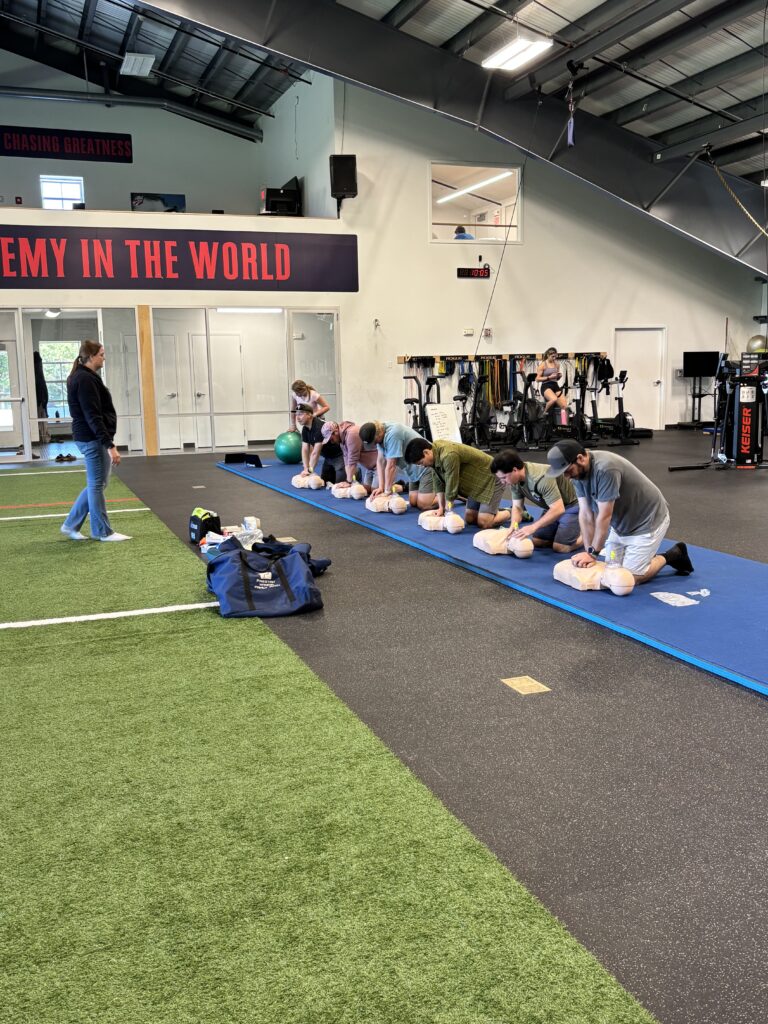
A well-prepared coaching staff can mean the difference between a quick response and a preventable tragedy. Even with medical teams on site, it is often the coach who is first to reach an injured athlete. Their readiness is a frontline defense in risk mitigation. Many clubs and national teams are making progress in this area. Athletes at development levels deserve training environments that reflect the same commitment to safety as the sport’s highest stage.
Risk Perception and Acceptance
Alpine ski racing is, at its root, inherently dangerous. This cannot be eliminated. But it must be openly acknowledged and accepted by parents, coaches, athletes, and organizations alike. From there, risk mitigation and threat-and-error management require deliberate training and support.
Not everyone perceives risk the same way. What one coach considers an acceptable course set or safety system, another may see as too dangerous. Without consistent standards, safety becomes subjective.
Emergency Response Systems
Even when safety systems are in place, geography and logistics can compromise them. Some races are held at venues where the nearest hospital is 45 minutes away via air ambulance. Acceptable response times can be compromised, for example deterioration of weather and that air ambulance can no longer be dispatched. Roads closed… are the coaches, organizers and athletes notified? While emergency action plans are routinely read aloud, coaches and athletes are not always fully aware of what resources are actually available.

Proceeding with a race when adequate medical evacuation cannot be guaranteed is unacceptable. We must be willing to make the hard decisions to cancel or postpone, even when inconvenient. Cancellations and postponements are regular in ski racing competition, are we seeing the same in the training area? Athlete safety must never take a back seat to schedules or financial pressures.
Proactive Organizations Leading the Way
The push for safety in ski racing is not just coming from governing bodies. It is being championed by organizations dedicated to preventing injuries before they happen.
The Kelly Brush Foundation (KBF) stands out as a leading advocate for proactive safety. Founded in 2006 after Kelly Brush sustained a spinal cord injury during a collegiate ski race, the foundation has been instrumental in promoting safety standards across the sport. KBF provides grants to ski clubs for purchasing safety equipment like B-netting, supports trail widening projects, and educates coaches and athletes on proper safety practices.
Their commitment to eliminating preventable injuries demonstrates what is possible when safety becomes a priority at every level of the sport.
A Needed Cultural Shift
For too long, ski racing has celebrated toughness and resilience in ways that blur the line between courage and recklessness. True strength lies in building a culture where speaking up about unsafe conditions is responsible, not weak.
If an athlete says they do not feel safe, their voice must be respected. If a coach delays, modifies, or cancels training, that decision should be applauded as a commitment to well-being. If an official stops a race, they should be supported, not pressured to continue.
Changing culture does not mean pointing fingers. It means embracing shared responsibility: officials, organizers, coaches, parents, and athletes together.
Proactive vs. Reactive
Too often, our sport follows the same cycle. A tragedy occurs, committees convene, incremental changes are made, and then we move on until the next incident. Breaking this cycle requires embedding safety into every decision: venue selection, course setting, training protocols, equipment rules, and emergency planning.
Encouragingly, international bodies like FIS and national federations like FISI are pushing harder on safety reform. But progress only matters if it filters down consistently to the development levels.
Closing Call to Action
Ski racing will never be risk-free; that is part of its essence. But accepting risk does not mean accepting preventable tragedies. By empowering coaches, raising training standards, improving emergency readiness, and shifting our culture, we can move from a reactive model to a proactive one. When incidents occur, we need to be at a level that the safety environment can not be questioned.
We owe it to the athletes, and to those we have already lost, to act urgently. The question is no longer if safety should be prioritized. It is how urgently we are willing to act.
About the Author: Katie Twible