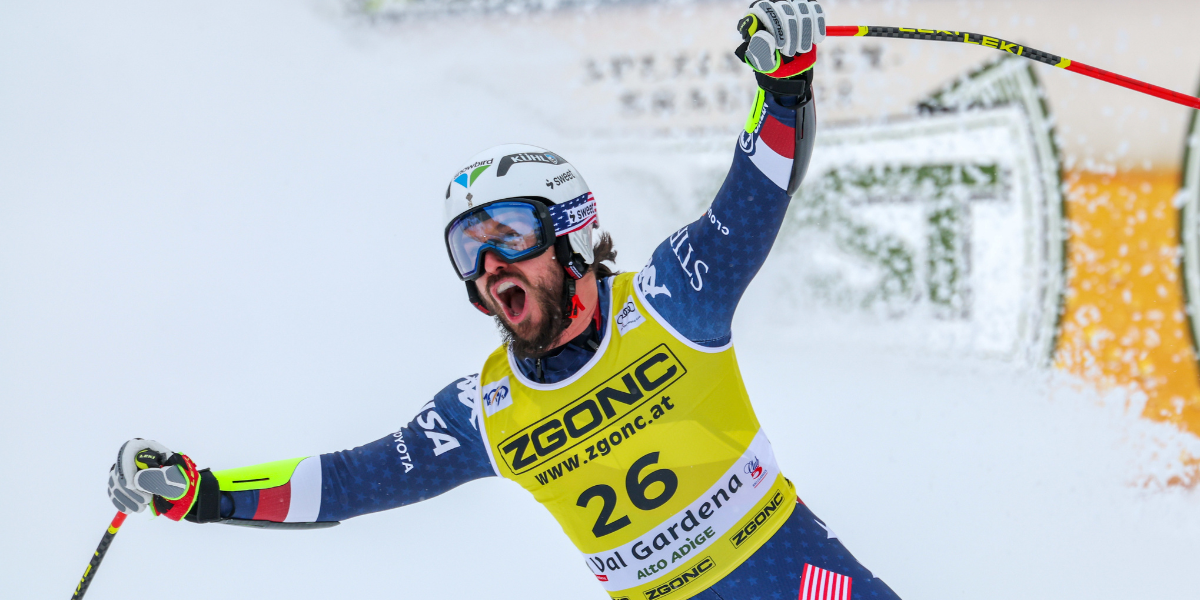
A racer I’m working with recently won the first run of a big race, but he struggled in his second run and missed out on a potential victory. His race day reminded me of a similar experience in my first college carnival as a freshman at Middlebury. I won the first run of the UVM carnival and was so freaked out with my lead (I didn’t win many races back in the day, so it was a new thing for me!) and so nervous and distracted that I skied my second run poorly and ended up 6th. My client’s experience got me thinking about how I might help other racers who have a fast first run (even if they don’t win it) and want to have an equally good second run.
One of the biggest challenges racers face in slalom and GS is putting together two fast runs unless your name is Marco Odermatt or Mikaela Shiffrin!
The million-dollar question you may ask yourself is: “Why does this happen to me?” It all comes down to what changes mentally from run to run. Most commonly, particularly below the World Cup and especially in the junior ranks, racers will have a great first run but then screw up the second.
What contributes to skiing fast
Let’s start with what helps you have a fast race run. How racers approach race runs mentally varies (e.g., some are chill, others get fired up, some are super focused before their race runs, while others like to distract themselves until just before they leave the gate). Regardless, I have found most of the best racers in the world share common attitudes that free them to ski with confidence without fear, worry, or doubt:
- Trust that their body will do what they trained it to do without overthinking.
- Focus on the process and the present.
- Positive attitude (“You’ve got this!”).
- See the race run as a challenge to pursue.
- “Bring it” mindset.
I have also found common attitudes and mental approaches that are the “kiss of death” for ski racers:
- A preoccupation with results.
- Comparison with others.
- Outcome expectations.
- Negative attitude.
- Overthinking.
- Fear of failure.
- Threat reaction.
- Pre-race anxiety (because of all of the above).
Now let’s connect these two very different mental approaches to how you ski on your first and second race runs. If you had a fast first run, you probably had the first mental attitude – free your body to do what you’ve trained it to do. It also minimizes the difference between a training run and a race run because, though race runs matter more, this mental approach prevents you from getting bogged down in those differences (e.g., results, points, rankings, beating other competitors). Instead, you can focus on just skiing as fast as you can.
Repeat what worked
Ideally, you tell yourself, “I just had a great first run, so I should repeat everything I did for my second run.” Unfortunately, many racers work against themselves without intending to. They change their approach against their best interests. I am sure you agree that’s plain dumb! If something is working, you should keep doing it. But after that first run, here is where your skiing may go south.
Again, ideally, your first thought after a fast first run should be: “I’m skiing fast, so let’s do it again!” Unfortunately, a more common first thought after a fast first run is: “OMG, what if I blow my second run and miss my chance?!” With this kind of doubt, your thoughts, emotions, and physiology turn against you and guarantee a poor second run.
You perceive the second run as a threat rather than a challenge. You worry about whether you can have another good run – your focus shifts from skiing fast to not skiing slow. Your overall attitude is to protect your first run rather than ripping your second run. You feel fear and trepidation instead of embracing the excitement and opportunity. Your body gets anxious and tense. These reactions either cause you to ski cautiously to protect that fast first run (this never works!), or you’re so tight physically and unfocused mentally that you make a mistake after mistake and either DNF or barely make it to the finish line.
Ironically, with this “bad” attitude, you increase your chances of having a slow second run, the thing you fear the most. That doesn’t make sense. But nothing is rational or logical when it comes to a second run after a fast first run.
Understand and then address the issues
The next million-dollar question is: “Okay, I now understand what happens to me mentally and physically. So, what can I do about it?”
In my first bullet list above, I’ve shown you what attitudes and mental approaches you need to adopt to have a fast second run after a fast first run. But, as every racer knows, that’s easier said than done.
Making this mental shift that will allow for fast second runs starts with an awareness of what you’re doing wrong (see the second bullet list above) and recognizing that it just doesn’t help you ski fast on your second runs.
The next step is to realize what worked in your first run that helped you ski fast and to repeat it rather than going down the “bad road” on your second run (again, see the first bullet list).
Then, because most racers have a natural tendency to go down that bad road, you must make a conscious commitment between runs to take the “good road.” Taking the good road means doing what will set you up for an equally fast second run. You also need to recognize that “—hit happens” in ski racing (e.g., catch an edge, hip out, get hit with a gust of wind, hook a tip). So, even your best efforts at a good second run aren’t always rewarded. Here are a few practical things you probably did on your first run that you should repeat on your second run:
- Avoid looking at live-timing.
- Focus on your race routine to ensure maximum physical and mental preparation.
- Distract yourself by talking to your friends and/or listening to music.
- Imagine skiing fast for your second run.
- Take deep breaths.
- One goal on your second run: Bring it!
Pursue the good road
In reality, getting off the bad road of disappointing second runs won’t be easy or immediate. And you can’t just decide on race day to take the good road. Having the right attitudes and mental approaches begins with training. It also involves ensuring that your race day routine supports the good road (e.g., again, don’t look at live-timing between runs!).
However, by repeating the good road, you ingrain those attitudes, mental approaches, and habits that encourage fast skiing so that, on race day, you take the good road on both of your race runs, and, if the almighty ski racing gods are looking kindly on you that day, then you prepare yourself to ski fast on both runs. By repeating the good road, the bad road becomes an old habit and useless. There is only one road to take—the good road!—and you can give it your all every time you slide into the starting gate, although there are no guarantees. You’ll likely get the desired results and achieve your race day goals.
About the Author: Dr. Jim Taylor