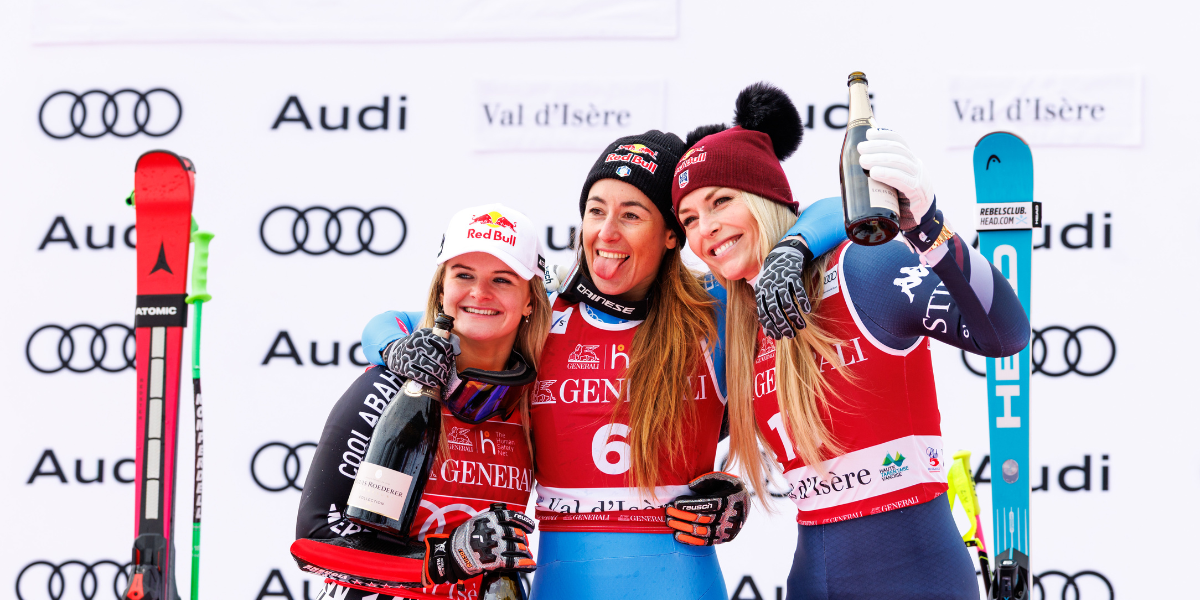
Robinson, Goggia, Vonn / Val d’Isère podium / GEPA pictures
Women’s Super-G: A Slow Start, Big Stakes in an Olympic Season
The women’s World Cup super-G reached the Christmas break with the lightest schedule of any discipline. Only two of the eight races on the calendar have been completed, leaving the standings compressed and the Olympic stakes rising fast.
That slow start has created urgency. With just three super-G races remaining before the Olympic break and three more after the Games, athletes fighting for Olympic selection or chasing stronger Olympic start seeding have little room to wait. Every start now carries outsized importance.
The discipline also entered the season without several established stars, similar to the women’s downhill field. Injuries and pregnancy sidelined multiple athletes, including reigning world champion Stephanie Venier. As a result, three of the four athletes who earned super-G medals at the 2025 World Championships have not raced this season, with four medalists awarded due to a tie for third.
Women’s World Cup Super-G Podium Table — 2025–26 Season
| Race | 1st | 2nd | 3rd |
|---|---|---|---|
| St. Moritz (SUI) | Alice Robinson (NZL) | Romane Miradoli (FRA) | Sofia Goggia (ITA) |
| Val d’Isère (FRA) | Sofia Goggia (ITA) | Alice Robinson (NZL) | Lindsey Vonn (USA) |
Women’s World Cup Super-G Standings — Christmas Break
- Alice Robinson (🇳🇿 NZL, 2001) — 180 points
- Sofia Goggia (🇮🇹 ITA, 1992) — 160 points — Atomic
- Lindsey Vonn (🇺🇸 USA, 1984) — 110 points — HEAD, Oakley
- Romane Miradoli (🇫🇷 FRA, 1994) — 109 points
- Elena Curtoni (🇮🇹 ITA, 1991) — 90 points — HEAD
With so few races completed, the standings reflect early consistency rather than separation, and the margins remain tight heading into January.
Three Storylines Define the Discipline
Three narratives already shape the women’s super-G picture.
Alice Robinson has long ranked among the world’s elite giant slalom skiers. At 24, her rapid ascent in super-G marks a significant evolution. She no longer treats the discipline as a secondary focus. She attacks it with confidence, speed, and tactical maturity, and her early results suggest her upside remains high.
Sofia Goggia has delivered one of the season’s most encouraging signals. After returning from injury, she has re-established the dominant form that defined her pre-injury peak. Her eighth career World Cup super-G victory in Val d’Isère confirmed that her power, aggression, and race instincts remain intact in an Olympic winter.
Then there is Lindsey Vonn. Now 41, Vonn continues to defy conventional limits. Coming out of retirement at 40 and returning to the super-G podium against the deepest field in the world borders on the extraordinary. Her comeback is not symbolic. It is competitive, and it continues to reshape the discipline.
United States: Depth, Breakthroughs, and Momentum
Five U.S. women have already scored World Cup super-G points this season.
- Lindsey Vonn (🇺🇸 USA, 1984) — 110 points — HEAD, Oakley — Ranked 3rd
- Keely Cashman (🇺🇸 USA, 1999) — 42 points — HEAD — Ranked 8th
- Tricia Mangan (🇺🇸 USA, 1997) — 17 points — HEAD — Ranked 20th
- Mary Bocock (🇺🇸 USA, 2002) — 13 points — Ranked 23rd
- Haley Cutler (🇺🇸 USA, 1996) — 8 points — Atomic — Independent — Ranked 26th
Four of the five point scorers are Stifel U.S. Ski Team members, while Cutler has scored as an independent. Both Cutler and Bocock earned the first World Cup super-G points of their careers, with Bocock’s result also marking the first World Cup points of her career overall—a significant milestone.
Canada: Limited Opportunities, One Early Score
As in downhill, Canada’s early super-G picture reflects opportunity more than depth.
- Valérie Grenier (🇨🇦 CAN, 1996) — 14 points — Ranked 22nd
Grenier stands as the only Canadian woman to score super-G points so far, with just two races contested before the Christmas break.
Calendar Pressure Builds Toward January
With 25 percent of the women’s super-G season already completed, the calendar now accelerates with races on January 11 in Zauchensee, Austria, January 18 in Tarvisio, Italy, and January 31 in Crans-Montana, Switzerland, the final super-G before the Olympic break.
For athletes chasing Olympic selection and for contenders seeking the strongest possible Olympic start positions, the margin for patience has already disappeared. The women’s super-G season may be young, but the pressure is very real.

Men’s Super-G: Shock, Emotion, and a Familiar Favorite
The men’s World Cup super-G reaches the Christmas break with three of nine races completed. The discipline has already delivered dominance at the top, historic surprise, and emotional breakthroughs beneath it. In an Olympic season, those early swings matter. With only three super-Gs left before the Olympic break, time is no longer neutral.
Men’s World Cup Super-G Podium Table — 2025–26 Season
| Race | 1st | 2nd | 3rd |
|---|---|---|---|
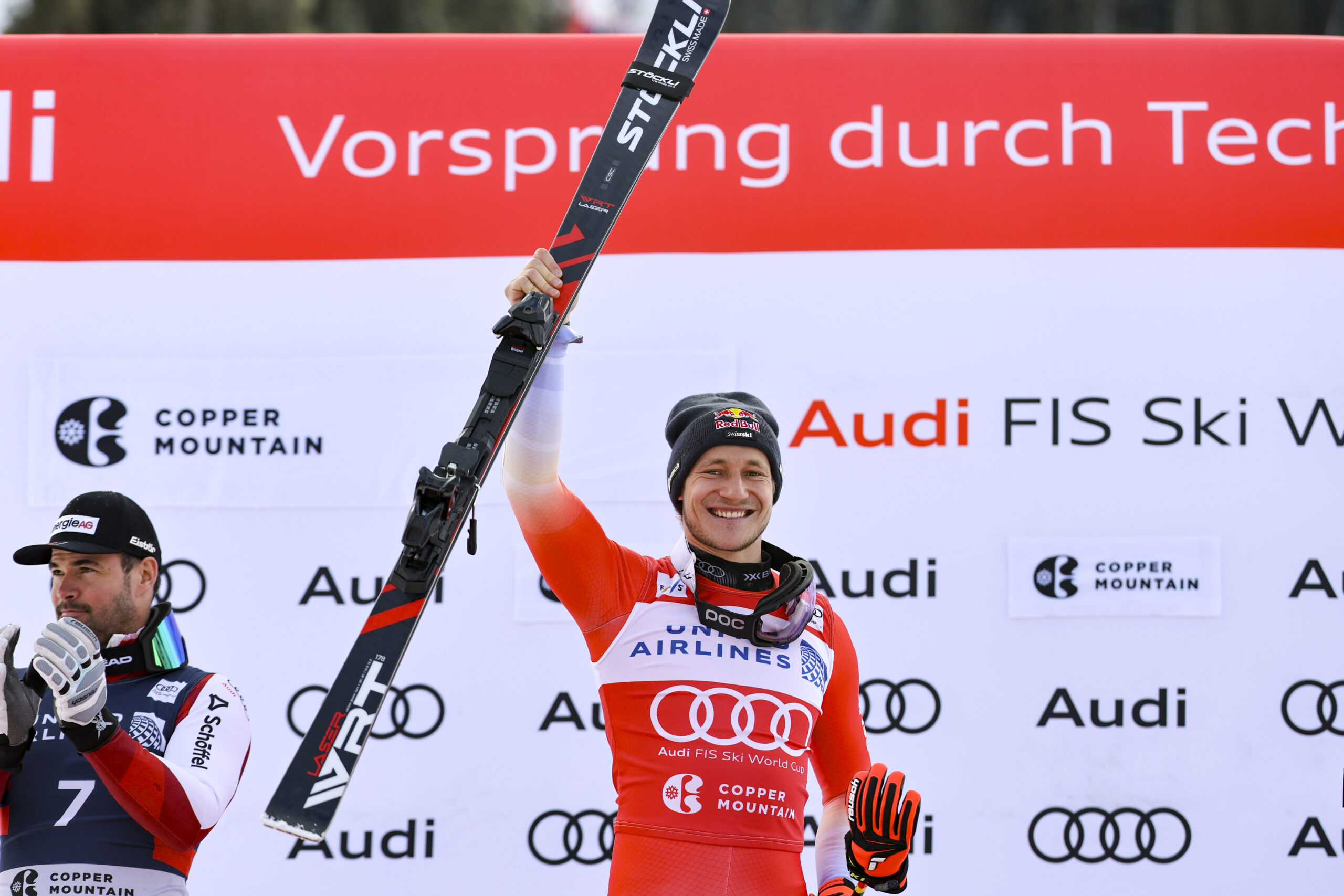
| Copper Mountain (Stifel Copper Cup) | Marco Odermatt (SUI) | Vincent Kriechmayr (AUT) | Raphael Haaser (AUT) |
| Beaver Creek | Vincent Kriechmayr (AUT) | Fredrik Møller (NOR) | Raphael Haaser (AUT) |
| Val Gardena/Gröden (ITA) | Jan Zabystran (CZE) | Marco Odermatt (SUI) | Giovanni Franzoni (ITA) |
Men’s World Cup Super-G Standings — Christmas Break
- Marco Odermatt (🇨🇭 SUI, 1997) — 225 points — Stöckli — Ranked 1st
- Vincent Kriechmayr (🇦🇹 AUT, 1991) — 209 points — HEAD — Ranked 2nd
- Raphael Haaser (🇦🇹 AUT, 1997) — 146 points — Atomic — Ranked 3rd
- Fredrik Møller (🇳🇴 NOR, 1999) — 125 points — Atomic — Ranked 4th (out with injury)
- Jan Zabystran (🇨🇿 CZE, 1998) — 123 points — Ranked 5th
- Giovanni Franzoni (🇮🇹 ITA, 2001) — 106 points — Ranked 6th
With Møller sidelined for an undetermined period, the effective fight beneath the top two now extends deeper into the standings.
Odermatt Remains the Constant
Marco Odermatt defines men’s super-G. When he starts, he sets the reference. He has won the last three World Cup super-G titles, sets the benchmark in every race, and continues to ski at an elite level this season. As the reigning 2025 world champion, Odermatt’s combination of power, precision, and tactical execution remains the standard the rest of the field measures itself against.
A Historic Shock in Val Gardena
Starting bib 29, Jan Zabystran stunned the field in Val Gardena/Gröden to earn his first career World Cup podium and the first men’s Alpine World Cup victory in Czech history. His program works closely with the German team, and the groups marked the moment with a Joyous shared podium photo.
An Emotional Italian Podium
Giovanni Franzoni finished third on home snow in a deeply emotional moment. He dedicated his season and his Val Gardena podium to close friend Matteo Franzoso, who died earlier this year at a training camp in Chile.
United States: Broadest Depth of Any Discipline
Men’s super-G has produced the largest group of U.S. point scorers of any discipline this season. After three races, six Stifel U.S. Ski Team athletes have already scored.
- Ryan Cochran-Siegle (🇺🇸 USA, 1992) — 46 points — HEAD — Ranked 16th
- River Radamus (🇺🇸 USA, 1998) — 31 points — Ranked 22nd
- Kyle Negomir (🇺🇸 USA, 1996) — 19 points — Atomic — Ranked 28th
- Jared Goldberg (🇺🇸 USA, 1991) — 6 points — Ranked 42nd
- Bryce Bennett (🇺🇸 USA, 1992) — 5 points — Oakley — Ranked 43rd
- Sam Morse (🇺🇸 USA, 1996) — 1 point — Ranked 44th
The group reflects depth rather than dominance, with opportunity still ahead.
Canada: Depth Beyond the National Team
Canada has also produced five men’s super-G point scorers this season.
- James Crawford (🇨🇦 CAN, 1997) — 51 points — HEAD — Ranked 13th
- Brodie Seger (🇨🇦 CAN, 1996) — 18 points — Atomic — Ranked 29th
- Riley Seger (🇨🇦 CAN, 2000) — 16 points — Ranked 30th
- Cameron Alexander (🇨🇦 CAN, 1997) — 15 points — Ranked 31st
- Jeffrey Read (🇨🇦 CAN, 1998) — 14 points — Ranked 32nd
- Raphael Lessard (🇨🇦 CAN, 2001) — 11 points — HEAD — Ranked 36th
Lessard’s 20th place in Val Gardena/Gröden marked the first World Cup points of his career, earned while racing as a member of the University of Utah ski team, outside the Alpine Canada Alpin structure.
Men’s Calendar Pressure Builds
The men have nine World Cup super-G races this season. With three completed, only three remain before the Olympic break, followed by three after the Games. The remaining pre-Olympic races come in Livigno — a new venue — Wengen, and Kitzbühel. With the men’s Olympic Alpine events scheduled for Bormio, every remaining super-G now carries direct Olympic consequence.
With limited races completed and Olympic selection already in view, World Cup super-G enters the heart of the season with little margin for error. Athletes skiing well must convert momentum immediately, while others face a narrowing path as the calendar accelerates.
About the Author: Peter Lange