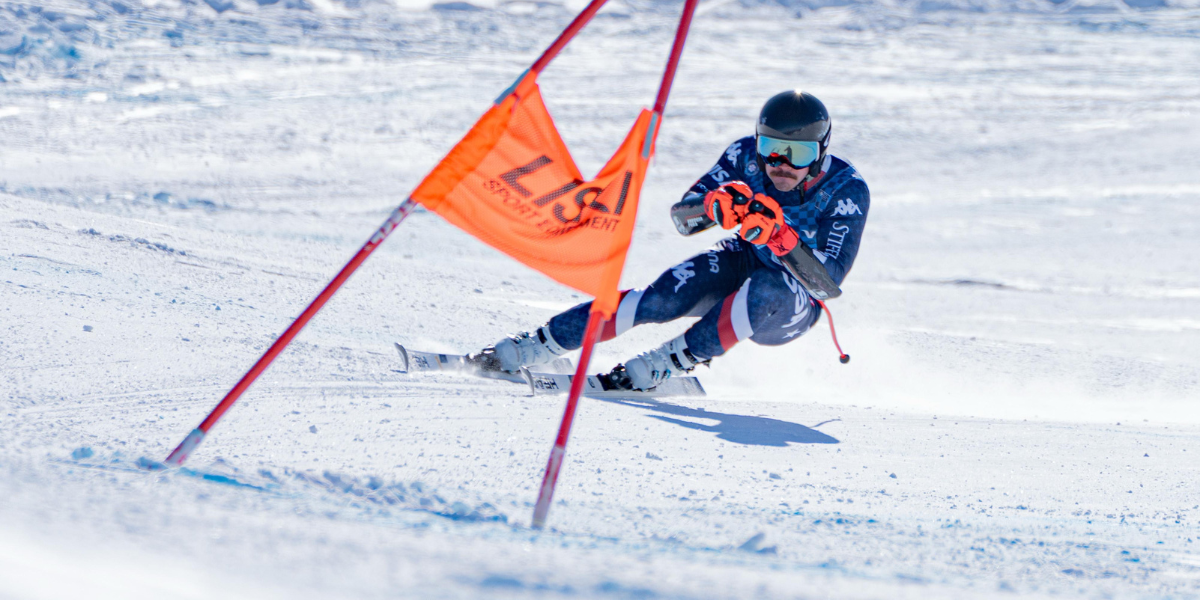
Photo U.S. Ski & Snowboard
The Charter Member of the Full Plate Club Is Ready to Roll
Anyone looking for a primer on the power of belief this Thanksgiving can tune in to the opening World Cup super-G at Copper Mountain. Near the end of the running order, you’ll find Tanner Perkins, a 24-year-old U.S. Ski Team rookie, stepping into his first World Cup start.
Perkins earned season-long World Cup super-G starts by finishing second in the 2025 NorAm super-G standings. By pairing that result with a top-five overall finish, he also earned a spot on the U.S. Ski Team’s C Team. He did all that while attending MSU full time, racing on the NCAA circuit, and keeping current with his work as an EMT and firefighter.
In explaining how he manages it all, he states the obvious: “I like to stay busy.”
THE LONG AND WINDING ROAD
To say that Perkins has taken an unconventional path is an understatement. He started ski racing at age seven at Powderhorn Mountain in Colorado, then moved to Crested Butte when he was ten. There, he built his passion for racing—along with all things mountain-related, like mountain biking, hiking, hunting, fishing, motorcycling, and going very, very fast.
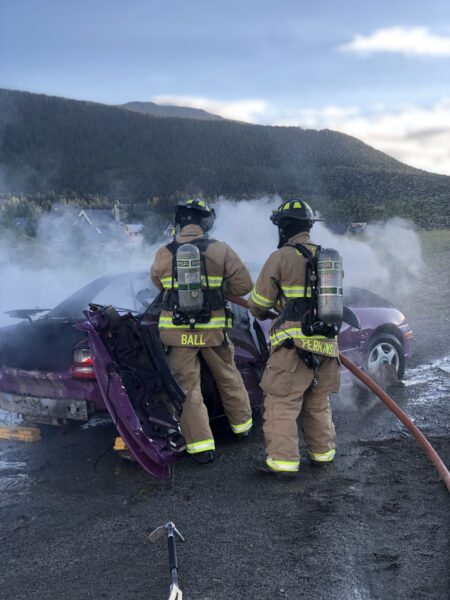
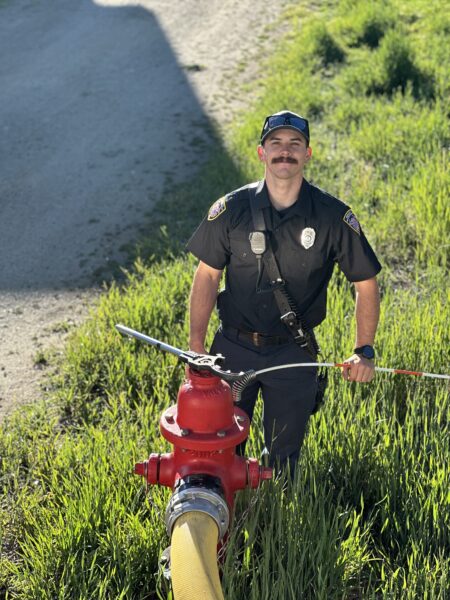
In high school, he also started what would evolve into his EMS career through a program in Crested Butte that allowed kids to work with the fire department. He later earned his fire certifications, EMT qualification, and several advanced first responder certifications.
By 16, he had moved to Aspen to train with AVSC, taking classes remotely and living on his own with older roommates. After graduating from high school in 2020—with no NCAA roster spot and COVID restrictions swirling—Perkins built out a van and took his skiing show on the road. After that season, having missed U.S. Ski Team criteria and still drawing no interest from colleges, he saw no viable path to keep racing. He sold the van and enrolled at the University of Utah to study paramedicine and remote rescue.
THE SECOND CHANCE
That’s when his luck turned. Weeks before the ski season started, and with encouragement from friends, he reached out for help and received a $10,000 donation facilitated through World Cup Dreams. While managing freshman classes—and still without a coach—he attended a U.S. Ski Team camp in Copper and found additional training in Aspen. He raced NorAms and NCAA events, doing well enough to qualify for the 2022 World Junior Championships and catch the attention of MSU coach Kris Shampeny.
Perkins didn’t have an impressive FIS profile, but Shampeny noticed his positive attitude and the GS start position he had earned for the following season. Perkins signed with MSU that spring, securing another four years of ski racing.
“He just kind of flourished in the college circuit,” recalls Shampeny. “Last year, he figured some things out in his skiing throughout the prep period, and then it really just started clicking for him at the NorAms in Panorama.” They had already discussed pursuing the NorAm super-G title before the season. “We have goal meetings with every athlete each fall,” says Shampeny. “We try to support them as much as we can in their pursuit of making their national team.”
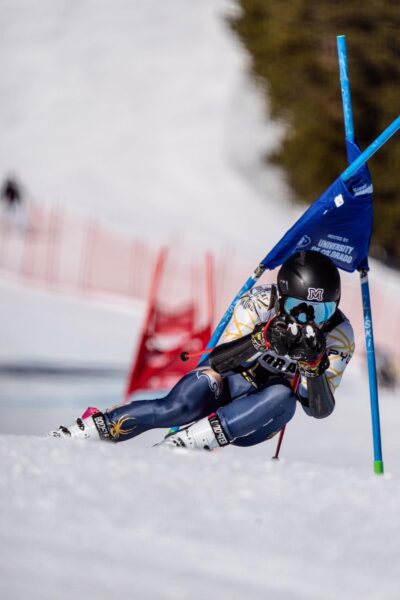
Perkins skipped some college races to hit the NorAms, which took him out of NCAA Championship contention but allowed him to maintain his NorAm ranking and be named to the C Team at season’s end.
Shampeny adds that Perkins also strengthened the team dynamic: “He’s just a solid guy. He holds people accountable to the hard work he puts in, and the team needs to put in to be successful. And he likes to have fun with it, too.”
MOVING TO THE BIG LEAGUES
His transition to the U.S. Ski Team has been overwhelmingly positive, starting last spring with a camp at Copper. “It was my first project as a named athlete—meeting my ski technician and the whole nine yards. That was quite a learning curve.” The biggest change has been the level of support. “I’ve been doing this alone for a long time. I haven’t really been in a position like this ever in my life.”
During the summer he spent time in Park City for testing but was mostly in Bozeman, where he continued working for Livingston Fire Rescue. Then came a long, 40-day training block in Chile with the Europa Cup group before he joined the World Cup speed team this fall for final prep. “That group is really cool for me, and a little bit surreal to be with these guys that I’ve been watching for so long.”
He has also enjoyed working with his coaches and his technician, Marco Costa, who works “insanely hard for our group. It’s just really special to have all these people working around the clock for us.”
After Copper, his season will evolve based on what best supports his development. “On paper, I can start any World Cup super-G I want.” Still, he knows there is work to do, especially in downhill. “Really our group is focused on Europa Cup. But all of us have higher hopes than that. It’ll be a lot of moving pieces, but I think we’re all ready for it.”
He hopes to race as much GS as possible. “That’s really the foundation for being a good super-G skier. We put a lot of emphasis on that this summer.” Yet he remains a speed skier at heart. “Ultimately, when it comes to World Cup, I only really care about racing speed. I just like to go fast.”
AN ATTITUDE OF GRATITUDE
Perkins is incredulous that he’s gone from living in a van just to keep racing to fulfilling his dream of starting a World Cup. He describes his journey as a series of miracles and the result of a generous ski community.
“I’ve been raised by the Rocky Central community and the college community and a lot of people.”
He lists them: Crested Butte coach Conor Lynch, who instilled his love for speed and jumping; Torey Greenwood and Johno McBride, who helped shape him at AVSC; Miha Kürner—then a Vail coach and now with the U.S. Ski Team—who encouraged him through the toughest days of van life; the donor whose $10,000 gift saved his career; and Shampeny, who opened the door at MSU. Finally, he shouts out longtime friends Asher Weinberg and Selby Hall, who let him stay in their basement for free while he chased his World Cup dream “broke as can be.”
…AND A DOSE OF PERSPECTIVE
His work at one of Montana’s busiest fire stations also grounds him. “We’re running about 3500 calls with a crew of five guys and gals out of one station, so we’re busy. We see things that the average person is never going to see, and we see a lot of it.” That perspective keeps the sport in balance. “It’s always a reminder that ski racing is pretty awesome.”
When results haven’t gone his way, he leans on that understanding. “When I’m not making a flip or I’m out of the 60 in a NorAm—which has been me pretty much all of my life until the last two years—at least I’m not in another position. I feel lucky to be where I am, especially now.”
THE NEXT GOAL
This season, Perkins has a pragmatic objective: meet B Team criteria. It’s the only option available for his age next year—and the only realistic path to continue racing. “I need to be top 30 in World Cup three times, or top 10 in Europa Cup three times, or any combination of that,” he says. “But we’re all wanting to be a lot better than that.”
For his first World Cup start, he plans to stay true to what brought him here.
“It’s hard not to think about the results, but I’m really focused on the skiing. My goals are to ski loose and ski fast and to just own the day. I hope to show that I can hang with these guys. I know I can. I’ve just got to show it.”
About the Author: Edie Thys Morgan