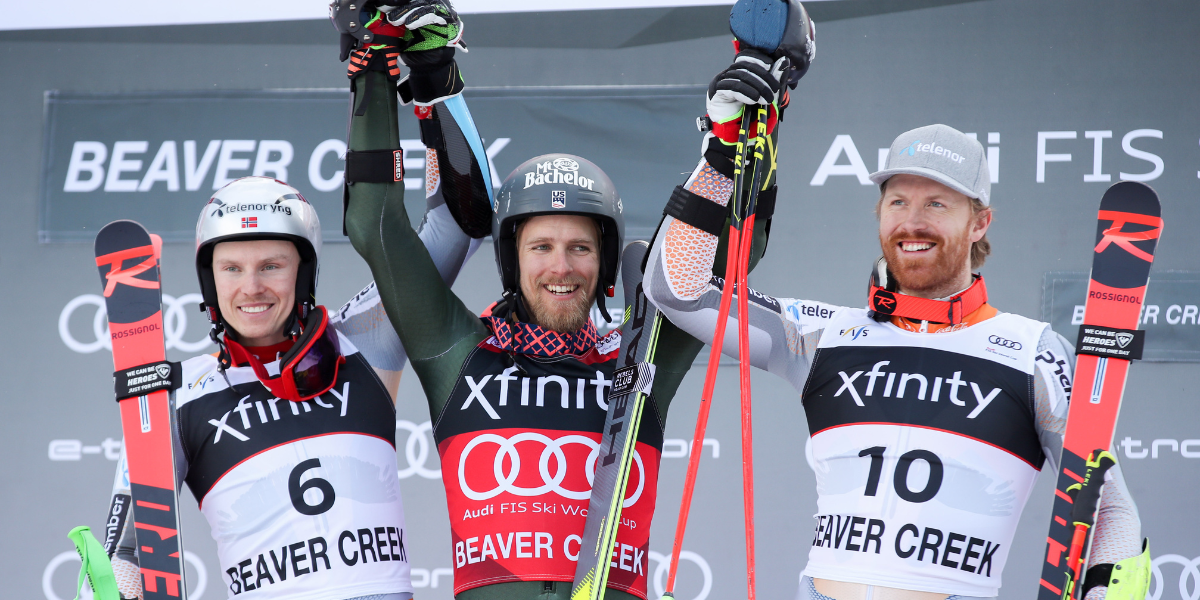
Kristoffersen, Ford and Nestvold-Haugen BC GS podium 2019 GEPA pictures
The U.S. veteran is making a point not to force anything as he approaches the site of his most triumphant day on skis
The last time Beaver Creek hosted a World Cup giant slalom race was in 2019 when Tommy Ford notched the best day of his career.
Starting with bib No. 5, he held an early lead through the entire first run, leading by two-tenths of a second with only five competitors within a second of his first leg time. As the pressure built, he stayed cool throughout the second run. When he stepped into the start house as the last racer on the course, the cheers from of the crowd below consumed him.
“The crowd that day was really pretty memorable,” Ford recalls. “I was standing in the start for the second run and I could hear it just vibrating. It was a little hard to concentrate, but I was able to stay calm.”
Insisting he “did nothing extra,” crossing the finish line that day will resound in his memory forever.
“I wasn’t trying to win. I wasn’t trying to repeat. I just skied, just trusted it,” he says. “When I got down, I was hit by the energy of that crowd. I’ll never forget that.”
He crossed the line with an .80-second lead on runner-up Henrik Kristoffersen, well over a second on the next three closest finishers and more than two seconds on everyone else. It was a mind-blowing victory. While it was Ford’s first World Cup podium despite competing on the circuit for a decade, it wasn’t all that shocking.
Two years earlier, in 2017, he threw down his first top 10 result at Beaver Creek. Also, he’d started that 2019 season with a fourth place in Soelden, missing the podium by less than a tenth of a second.
Fuel for more success
Following the huge Beaver Creek victory, the Oregon native laid down an unprecedented string of consistent top results. Before the world shut down with the COVID-19 pandemic later that season, Ford landed another World Cup podium in Japan in February 2020. The following December, at a pair of World Cups in Santa Caterina, Italy, he took sixth place, then second, and followed up with a fifth in Alta Badia a couple of weeks later. Then, Ford’s streak — and career — hit a painful standstill.
He suffered a horrific crash during the GS in Adelboden in January 2021 that knocked him out and left him with torn ligaments in his knee and a broken wrist and leg.
Fighting back to a flow state
His recovery and return to racing would take more than a year. While still capable of fast skiing, his results were erratic. He launched into the 2022-23 season with an impressive sixth place in Soelden, followed by a series of DNFs and DNQs, and not another top 10 until last December. Last season, Ford admitted that his mind and body had not yet returned to their pre-crash condition.
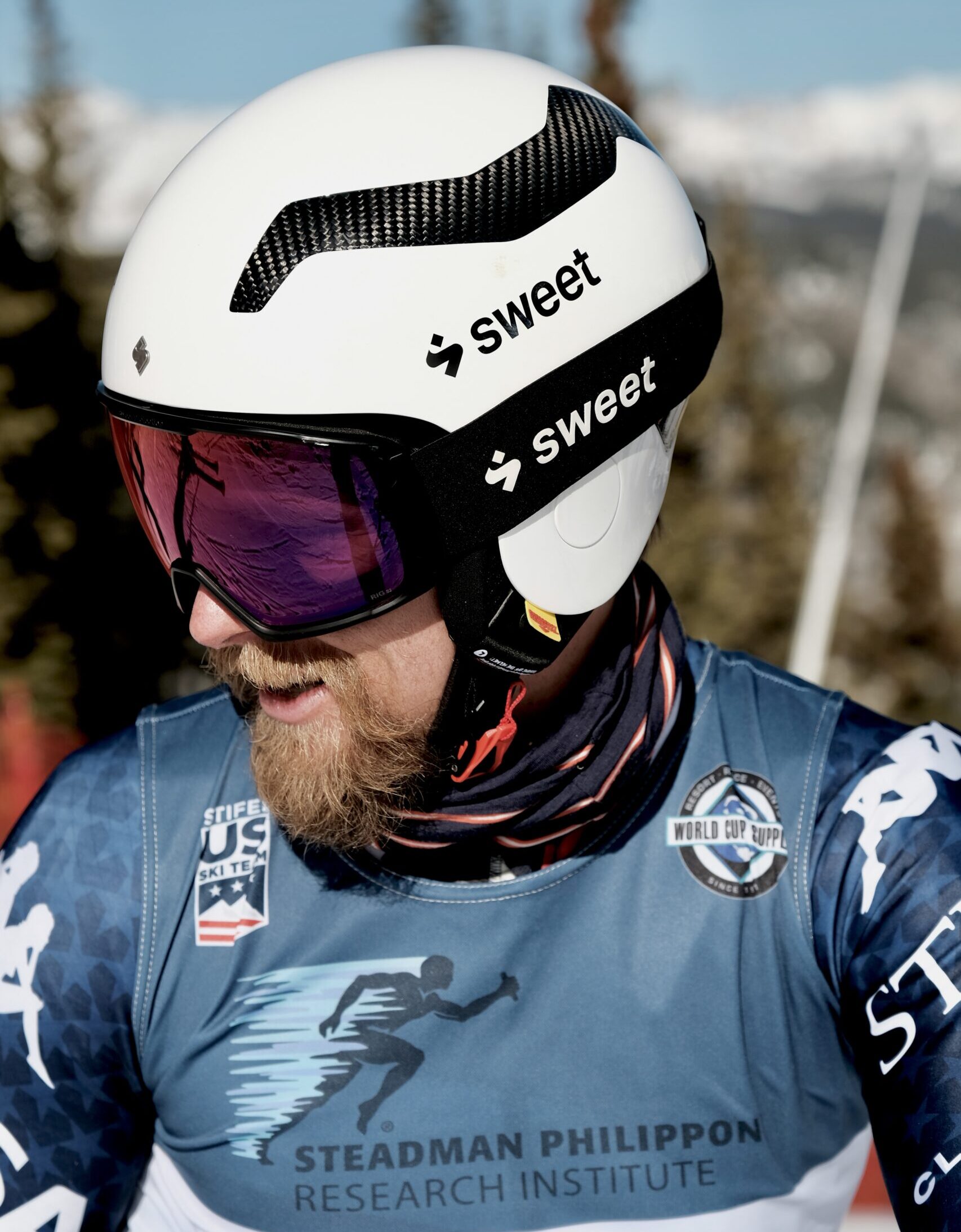
At age 35, Ford, the oldest U.S. Men’s Alpine Team member, says he’s coming into this season feeling markedly improved.
“I feel more at ease where I’m skiing,” he says. “The last couple years I’ve been maybe pushing a little too hard. When I push, I tend to overdo it and make mistakes. I can trust that there are going to be ups and downs. My mental elasticity is better now, being able to bounce back more easily.”
Although it’s been five years since he’s competed at Beaver Creek, Ford recalls the nuances and challenges of the Birds of Prey GS course.
Behold, the Birds of Prey GS
“It’s a cool hill,” he says. “Out of the gate, it’s a perfect pitch to arc like five perfect GS turns. It’s not too steep, not too flat. Then it turns and it’s a side hill that you don’t see that often in a World Cup. It’s really quick. There’s a big tempo change with lots coming at you. It sets you up for the parking lot, which is dead flat for like 10 gates. You don’t see that in World Cup GS that much, either. That’s tricky mentally, because you can feel your legs, feel your breath, think about whatever you want. The altitude is another part of it. You get down to Red Tail [finish] and it’s like, ‘Oh, God.’ The lungs are burning. The legs are burning. The length is real at this altitude.”
Thinking back to his victory at Beaver Creek, one of his most cherished memories is that he had so many friends and family members in the crowd. He says a similar crew will be cheering him on when he returns to the home race this December, but when asked if he can channel the winning magic from his previous race here, he says it will have to be something that just comes naturally, as it did before.
“Weeks leading up to that race, months, it was about not forcing things, not overextending myself, staying within my bounds and staying steady,” he says. “Who knows what’s going to happen next month? I’ve learned a lot from skiing over the years. That was a cool year, accumulating a win and a couple of podiums. I’ve had that experience and I know what that’s like. I feel like I’m getting closer to that point. I’m just excited to ski tomorrow and to keep that stoke alive throughout the year.”
About the Author: Shauna Farnell