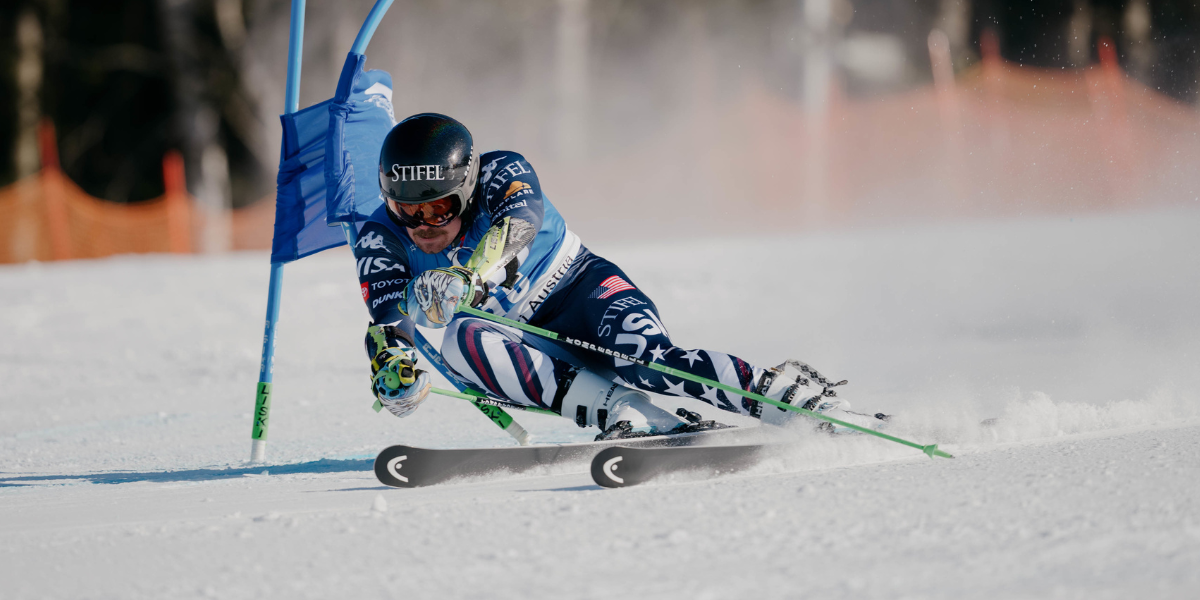
Bridger Gile Stifel USST / GEPA pictures
Every ski racer knows the feeling.
You’re skiing fast in training. Loose. Aggressive. Confident. Lines click. Timing feels automatic. Then race day arrives, and suddenly everything changes. You feel tight. Cautious. A half-step behind. The run that felt easy in training now feels forced, and the clock confirms what you already know: you’re slower.
Most ski racers assume the problem is technical. Something must be missing. In reality, it usually isn’t. The difference between training speed and race speed is rarely physical. It’s psychological.
Training Feels Safe. Racing Does Not.
In training, ski racers operate in an environment that feels safe. Mistakes are expected. Nothing important is on the line. Coaches give feedback, not judgment. Speed feels exploratory, not evaluative.
Because there’s little emotional cost to failure, racers ski instinctively. They take risks without overthinking. They let their bodies do what they’ve trained to do. Confidence grows because nothing is being measured in a way that feels permanent.
Race day changes the context entirely.
Suddenly, performance is ranked, judged, compared, and remembered. A run is no longer just a run. It becomes evidence. Ski racers aren’t only skiing the course anymore; they’re skiing with expectations attached. That shift alone is enough to change how the body responds.
The course hasn’t changed. The skis haven’t changed. But the meaning of the moment has — and meaning creates pressure.
How Pressure Changes the Brain
When pressure rises, the brain interprets the situation as a threat. The body reacts with a survival response — the same fight-or-flight system designed to protect us from danger.
In ski racing, that response backfires.
Instead of trusting automatic movement, racers start thinking their way through the course. They try to control every turn, force speed, and avoid mistakes. The body tightens. Timing slows. Feel disappears. What once felt natural now feels mechanical.
The survival system isn’t designed for high-performance skiing. It’s designed to keep you safe. When it takes over, speed becomes secondary to protection. Flow vanishes, and skiing fast becomes nearly impossible.

Why Trying Harder Slows You Down
This is why racers often say they “tried too hard” on race day.
Over-trying isn’t about effort. It’s about where that effort goes. Instead of focusing on execution, the racer starts chasing the result. Speed becomes something to force rather than something to allow.
The harder the racer pushes mentally, the more disconnected the skiing becomes. Muscles tighten. Reactions slow. The body stops responding freely.
Ironically, the desire to ski fast creates the very tension that prevents it.
When Results Threaten Identity
For many ski racers, the pressure goes deeper than performance.
Results can feel tied to self-worth, approval, or belonging. Thoughts like I need to prove I belong here or I can’t let people down turn a race into a personal evaluation. When skiing feels like a judgment of who you are, not just what you do, the brain defaults to survival mode.
In that state, the priority is no longer speed. It’s safety. The racer subconsciously protects against embarrassment, disappointment, or failure — even if that protection costs time.
What the Fastest Racers Do Differently
The racers who ski fastest on race day aren’t the ones who want it more. Everyone wants it.
They’re the ones who trust their preparation, believe in their abilities, and understand that a single result doesn’t define them. In the start gate, their focus is simple: ski the course as fast as possible.
They also accept risk. They know that skiing on the edge doesn’t always work out. Mistakes, DNFs, and crashes are part of the sport. But they understand that meaningful success only comes from commitment, not caution.
They’re willing to go all in — even when the outcome isn’t guaranteed.
Training the Mind for Race-Day Reality
The solution isn’t to “try harder” on race day or to “find another gear.” If you haven’t skied that way in training, it won’t suddenly appear in a race.
The real solution is training the mind to tolerate pressure without changing how you ski.
That means bringing emotional realism into training. Timed runs. Simulated races. Competitive challenges with teammates. Anything that introduces stakes helps narrow the gap between training and racing.
Just as important is separating identity from results. A race is something you do, not who you are. You are no less worthy of respect, love, or value if you finish 50th than if you finish third — or don’t finish at all.
When ski racers truly believe this, doubt loosens its grip. Confidence replaces fear. Commitment replaces caution. And that’s when racers are free to ski as fast as they are capable of.
At the end of the day, that’s all any ski racer can do.
About the Author: Dr. Jim Taylor