Featured Image: Richard Rokos, retired University of Colorado Head Coach on a roller board in 1977. Photo courtesy of Richard Rokos.
Various training methods have been used as an alternative to on-snow alpine training. A popular method used to mimic alpine racing during dryland has been using rolling devices, such as rollerblades, roller boards, and inline skates.
Unfortunately, roller skates are not conducive to training due to their different mechanics. Experiments with roller boards in the late 1970s did not satisfy protocols either. Roller boards placed the feet in a static and permanent position, so they didn’t translate well to alpine racing. Nevertheless, after experimentation, inline skates were seen to correlate the best with alpine training during dryland.
The History Behind Inline Skates
Inline skates have been a popular supplement during off-snow alpine training for approximately four decades. The Nordic roller skis served as the original basis for the inline skate, which was subsequently modified and tailored to enhance its suitability for alpine skiing. The activity is similar to grass and artificial surface skiing, so the popularity of inline skates boomed.
Inventors Harald Harb and Herman Gollner, who worked in the alpine ski industry, noticed the potential benefits of inline skates. So, Gollner took the invention to Stratton Mountain School (SMS) to test the off-season training with younger athletes.
In the meantime, in the early 1990s, Harald Harb began manufacturing the two-track “inlines,” with bindings that accommodated regular ski boots. These inline skates were coined “Harb Carvers.”
Harb set up a training course on the frontage road, off Colorado’s i-70, in Dumont. The embedded pipes on the surface of the asphalt offered an alternative course opportunity, which became almost as popular as the Dubai indoor arena!
As inline skates became widely known, The University of Colorado hosted the first official inline skating slalom competition in the fall of 1991. The competition was sponsored by Coors Light and Paul Mitchell Cosmetics and televised on ESPN. It was a huge success, and the CU Ski Team called it a World Championship. Eric Archer, a CU Alumni and the Head Coach of the Ascend Ski Cross Team became the first champion of the inline roller slalom.
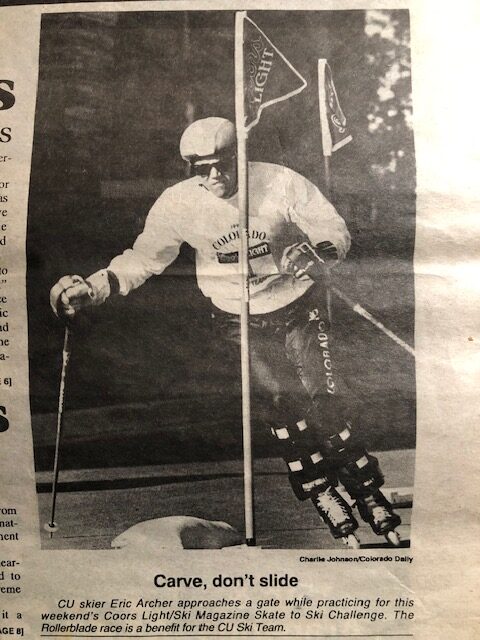
Unfortunately, the event ended when Paul Mitchell Cosmetics started focusing on Snowboarding as an emerging sport.
Two-track inline skates supplied athletes with a carving sensation, and the benefits were evident for off-season training.
Bringing Back Inline Skates as Temperatures Rise Globally
As the perceived need for ski training during the spring, summer, and fall has gained favor, most teams began frequently traveling to places like Mt. Hood, Colorado, the Southern Hemisphere, European glaciers, and indoor ski halls. These opportunities have leveled the playing field for the athletes and have provided year-round training venues.
However, inline training could provide a beneficial alternative because of the frequent fluctuating summer snow conditions at traditional off-season ski training destinations. It can contribute an answer to alpine skiing programs’ search for new training methods to enhance off-season progression.
So, in search of new training methods, we should consider older methods and dust off the inline skates. The inline skates will need technological improvements to match modern training needs, but it might be a great time to bring back the good, old, and existent. This method will assist in ensuring that athletes are accessing beneficial off-snow training.
Just like Bob Beattie used to say, “Make it local, inexpensive, and fun.” This great motto is one for alpine skiing to follow as the world continues to bring new challenges to winter sports.
Inline Skating Progression Rocks!
Inline skates bring undeniable benefits to balance training. Comprehensive alpine progressions can be executed on any slope, parking lot, or driveway.
Inline skates are equally beneficial for lateral direction (easy to carve) and lineal (forth – aft) balance. The platform is about a foot, or a little less, which challenges the athlete’s ability to remain centered. The athlete must focus on their center of mass because they do not want to be too far forward or back in their stance. On alpine skis, the athlete has more support in the (forth-aft) direction due to the length of the ski, but with inline skates, the small length of the surface contact is unforgiving. The inline skates excel at developing a fine sense of center balance and being “above the boots!”
Outstanding Benefits of Dry Terrain
Adding different types of terrain, such as a flat parking lot, angled driveway, or rolling hills, will force the athlete to consistently adjust their center of mass.
Alpine coaches want their athletes to focus on creating “pressure at the top of the turn.” One way to enhance that skill is inline skating on rolling hills because forward pressure is an essential move. The pressure and aggressive forward motion at the beginning of each new turn are crucial for a fast, safe, and correct execution.
Practicing on wave-like terrain known as “whoop dee doos” is a priceless tool for athletes to learn forward pressure and balance.
When athletes start inline skating, keeping their balance can be challenging. However, after practicing, the athlete’s confidence will increase, and the phenomenon of active forward movement will become natural. The goal is to put enough pressure on the front of the skate while on the back side of the roller (the top of the turn) so that gravity and pressure can propel the athlete. That movement then provides the primary momentum throughout the turn.
Alpine ski racing is a sport where the margin of victory is measured by hundreds of seconds, so every detail counts! Inline skates have a long history of benefitting dryland and off-season training.
Strengthening a racer’s balance is a critical component of success; this alternative training method can be a great way to reinforce that skill. The industry is looking at different training methods to improve due to the uncontrollable challenges that alpine racing is experiencing.
These methods will ensure that athletes get the training needed to improve in the sport. Inline skates are a great way to train off-snow, so we should not neglect an inexpensive and easy opportunity to “polish” crucial skills for racing!
About the Author: Richard Rokos