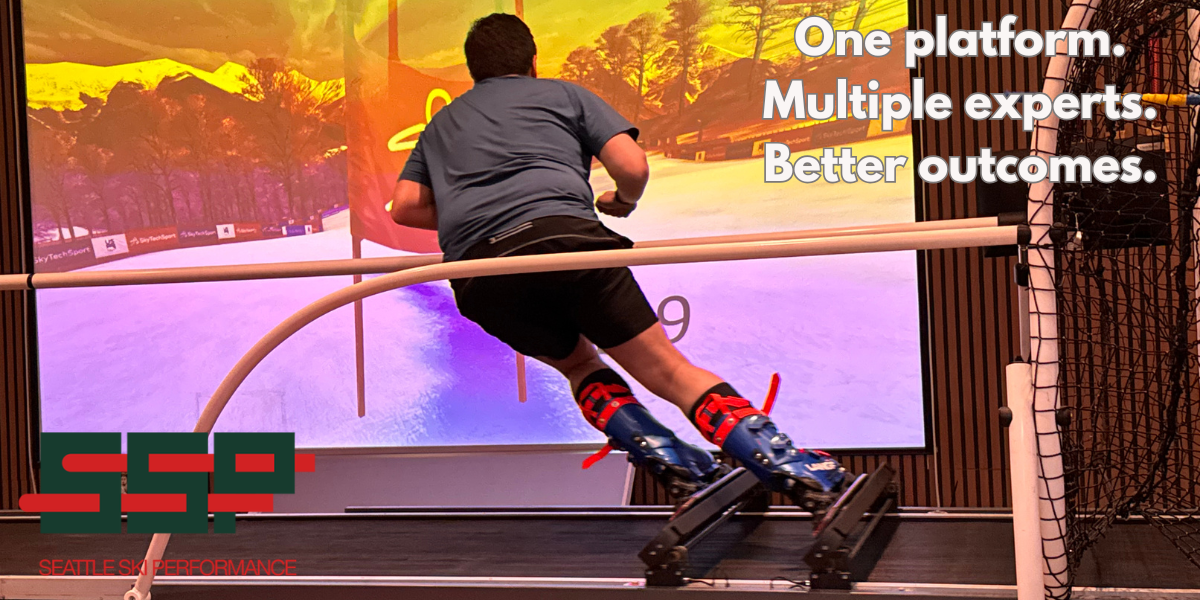
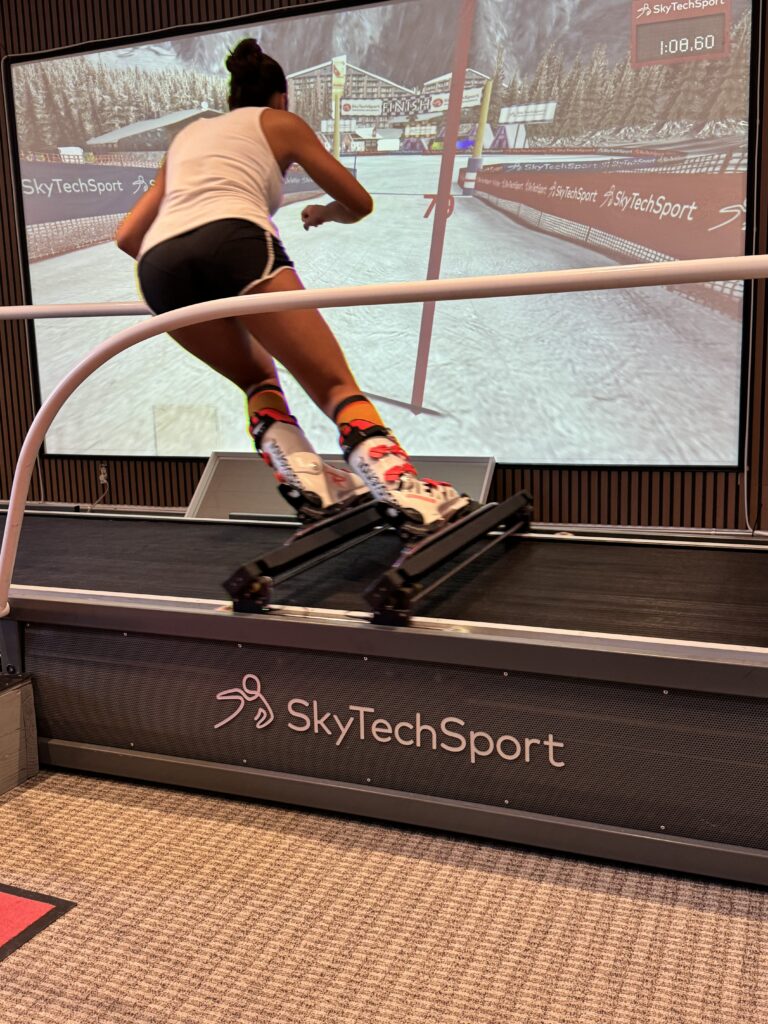
Featured Image: An athlete trains on the SkyTechSport Ski Simulator at Seattle Ski Performance, owned by Matt Lyall. Photo courtesy of Matt Lyall.
For years, ski racing has treated equipment, rehabilitation, coaching and training as separate conversations.
An athlete gets injured and works with a physical therapist. They eventually visit a boot fitter before returning to snow. A coach steps back in once training begins. Each person plays an important role, but they often work independently.
What if those pieces could come together?
That was the thought I kept coming back to after spending time talking with Matt Lyall, owner of Seattle Ski Performance, and Greg Louie, a Seattle-based physiotherapist better known throughout the ski community as The Ski PT.
At first glance, this looks like a story about a ski simulator. But after spending time talking with both of them, I realized it’s really about what that simulator makes possible. It has become the common platform where equipment, movement, rehabilitation and coaching all come together to help athletes improve.
More than a boot shop
Walk into Seattle Ski Performance and it feels exactly how you’d expect a serious ski workspace to feel. Boots line the walls, skis are scattered throughout the shop, and racers, recreational skiers and families move in and out throughout the day.
Matt jokes that he sometimes apologizes for the shop looking busy, but customers quickly reassure him that it feels exactly how a working ski shop should.
“I’d rather people walk into a place that looks like people actually work here,” he said.
That philosophy extends far beyond the appearance of the shop. Seattle Ski Performance isn’t built around selling the latest ski gear. It’s built around solving problems.
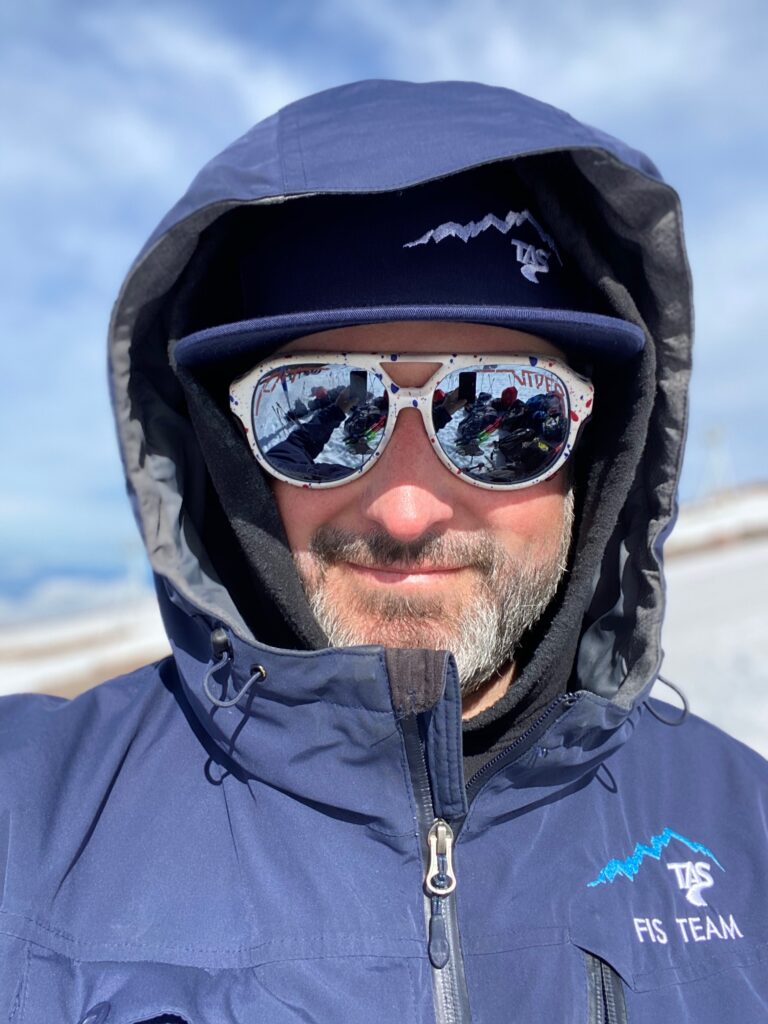
Matt Lyall’s journey to opening Seattle Ski Performance began in British Columbia, where he grew up skiing at Tod Mountain, now Sun Peaks. Over the years he worked as a snowboard instructor, ski instructor, technician, boot fitter and industry representative before eventually making his way to Seattle. Along the way, he discovered his passion wasn’t simply selling equipment. It was helping people ski better.
“There were plenty of places selling boots,” Lyall said. “There weren’t many places dedicated to true performance boot fitting.”
Instead of focusing on what was newest or most popular, he wanted to create a place where every conversation started with the skier standing in front of him.
“People don’t always know what they need,” he explained. “The conversation shouldn’t start with what boot is popular. It should start with how you ski, where you ski and what you’re trying to accomplish.”
Seeing movement before the mountain
One of the biggest additions to Seattle Ski Performance is the SkyTechSport ski simulator.
Most people think of a ski simulator as a training tool. Lyall sees it as something much more.
For decades, boot fitting has relied on educated guesses. A skier tries on boots, adjustments are made in the shop, and the real test doesn’t happen until they get on snow. If something still feels off, the process starts over.
The simulator changes that.
Instead of waiting for snow, Lyall can watch skiers make hundreds of turns immediately after making adjustments. He can evaluate stance, balance, edge engagement and movement patterns in real time.
Subtle issues that may have taken weeks to identify can often be spotted within minutes.
“We make boot fitting really complicated,” Lyall said. “At the end of the day, can you stand centered? Can you transfer energy from one ski to the other? That’s really what we’re trying to accomplish.”
The simulator doesn’t replace skiing. It provides immediate feedback that allows Lyall to make more informed decisions before an athlete ever leaves the shop.
One space, many experts
One thing Lyall wanted to make clear is that Seattle Ski Performance isn’t a physiotherapy clinic. It’s a performance facility where a variety of independent professionals use the space to support their own athletes and clients.
Throughout the year, physical therapists, coaches, boot fitters and movement specialists bring athletes into the facility because the simulator provides an environment they simply can’t recreate anywhere else. More importantly, it gives everyone a shared platform for evaluating movement, communicating with athletes and collaborating toward the same goal. Each professional brings a different area of expertise, but they’re all working from the same real-time information.
One of those professionals is Greg Louie, better known throughout the ski community as The Ski PT.
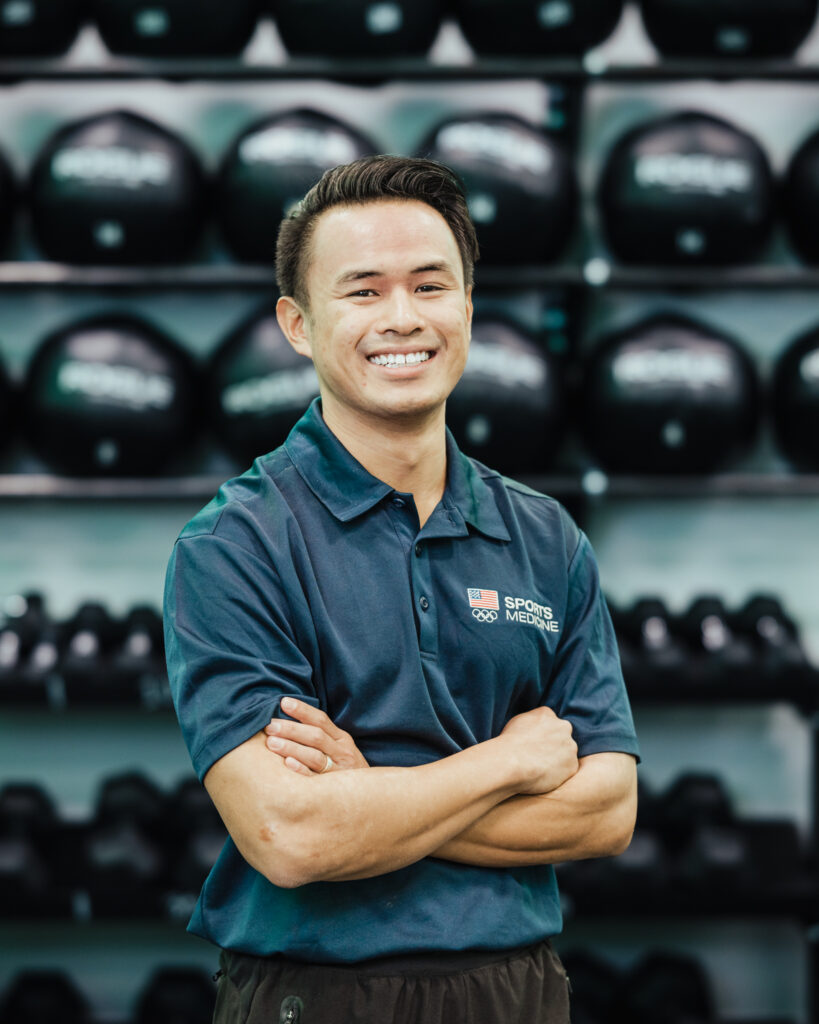
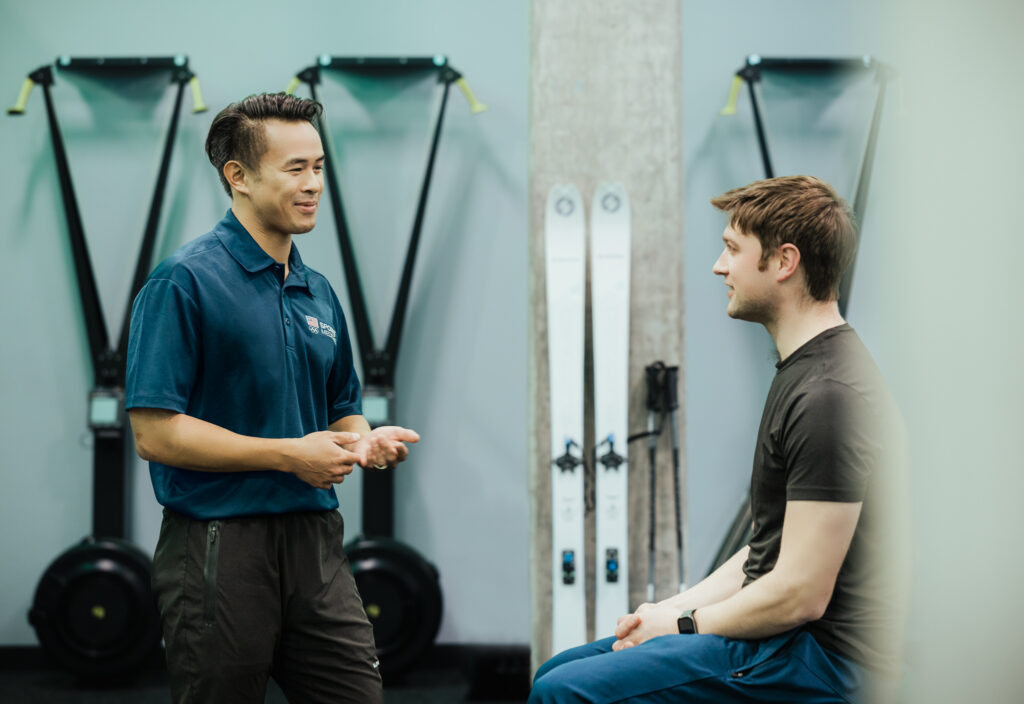
Greg runs his own independent physiotherapy practice and works with everyone from recreational skiers to members of the U.S. Ski Team and U.S. Para Team. Through his ongoing partnership with Seattle Ski Performance, he regularly uses the simulator to help athletes progress through rehabilitation, retrain movement patterns and confidently return to skiing.
It’s a model that works well because everyone brings something different. Lyall provides the facility, equipment expertise and the SkyTechSport simulator. Greg brings his background in physiotherapy and rehabilitation. Coaches contribute technical development, while other movement specialists add their own perspectives. The simulator becomes the common thread, allowing everyone to evaluate movement through the same lens while applying their own expertise.
The result is a collaborative environment where athletes benefit from multiple perspectives while working toward the same goal: getting back on snow stronger, more confident and better prepared to ski.
Bridging the gap back to snow
Greg believes one of the biggest challenges in skiing isn’t recovering from an injury.
It’s returning to snow with confidence.
“Getting back to skiing isn’t the same as getting back to normal life,” he explained.
Traditional rehabilitation often ends once someone can walk, run or return to everyday activities. But skiing demands much more than everyday movement.
The simulator helps bridge that gap.
Because every turn can be repeated and measured, Greg can identify side-to-side differences, monitor fatigue, rebuild confidence and progressively challenge athletes in a controlled environment before they ever click into their skis on snow.
One athlete recovering from a significant knee injury initially couldn’t generate enough edge angle for meaningful data to be collected.
Over multiple sessions, those numbers steadily improved.
The physical progress mattered.
The confidence that came with it mattered just as much.
More turns. Better feedback.
Ask almost any ski coach what athletes need more of, and the answer is almost always the same: more turns.
The reality, though, is that quality repetitions are hard to come by. Training days are limited by weather, lift lines, changing snow conditions and the simple fact that time on snow is expensive.
On the simulator, those limitations disappear.
Athletes can make hundreds, and in some sessions more than a thousand, turns without ever riding a chairlift. That amount of repetition gives coaches something they rarely get on the mountain: the chance to watch patterns develop instead of trying to analyze a single turn.
For Lyall, that’s where some of the best learning happens.
He thinks coaches often feel the need to jump in after every mistake. Instead, he prefers to let athletes ski.
“Sometimes you just need to step back,” he said. “Let them make turns. Let them figure things out.”
Rather than stopping after every run to offer another correction, athletes can spend several minutes experimenting with movement on their own. They begin to recognize what feels balanced, what doesn’t and how small adjustments change the outcome. By the time a coach offers feedback, the athlete has already started solving the problem themselves.
“It’s not about talking less,” Lyall explained. “It’s about giving athletes enough repetitions to actually feel the change.”
That kind of uninterrupted repetition is incredibly difficult to recreate on snow, and it’s one of the reasons Lyall believes the simulator has become such a valuable coaching tool.
More than racing
Although Seattle Ski Performance has become a resource for junior racers and high-level athletes throughout the Pacific Northwest, the clientele is far more diverse than many people might expect.
On any given day, Lyall and Greg might be working with a FIS racer preparing for the season, a skier returning from ACL surgery, or someone simply hoping to ski more comfortably with their family on a winter vacation. Others walk through the door after years of battling persistent boot pain, looking for answers they haven’t been able to find elsewhere.
That’s what stood out most to me after talking with both Lyall and Greg.
The simulator isn’t designed for one type of skier. It’s a versatile platform that supports many different goals, whether that’s refining equipment setup, rebuilding confidence after injury, accelerating technical development or simply helping recreational skiers move more efficiently.
Lyall uses it to evaluate stance, alignment and equipment. Greg uses it to help clients rebuild confidence and movement after injury. Coaches use it to give athletes hundreds of quality repetitions, while recreational skiers gain a better understanding of how they move and where they can improve.
Everyone arrives with a different objective, but they all leave with the same advantage: immediate feedback that simply isn’t available in most ski shops, clinics or training environments.
It’s a reminder that better skiing isn’t reserved for elite racers. Whether you’re chasing a World Cup start or simply hoping to enjoy more comfortable days on the mountain, understanding how you move is the first step toward improving.
Looking ahead
As technology continues to evolve, both Lyall and Greg believe we’re only beginning to understand how it can improve skiing.
Greg sees a future where better movement analysis and more objective data help athletes recover from injury with greater confidence and make smarter decisions about when they’re ready to return to snow. Lyall sees something just as important. He wants to give skiers answers before they become problems on the mountain.
After spending time with both of them, I realized the simulator is much more than a piece of equipment. It’s the catalyst that brings coaches, boot fitters, physiotherapists and movement specialists together around a common platform. The technology creates the opportunity, but it’s the collaboration that ultimately benefits the athlete.
Seattle Ski Performance has become a place where a boot fitter, a physiotherapist and a coach can all look at the same athlete through a different lens. Lyall focuses on equipment and how a skier moves in their boots. Greg focuses on rehabilitation and rebuilding confidence. Coaches focus on technique and performance. Together, those perspectives give athletes a more complete picture than any one of them could provide on their own.
Whether someone walks through the door preparing for a race season, returning from an injury or simply trying to enjoy skiing a little more, they’re all looking for the same thing: a better experience on snow.
The simulator is an impressive piece of technology, but what makes Seattle Ski Performance unique is how it’s being used. Rather than existing as a standalone training tool, it has become the centerpiece around which coaches, boot fitters, physiotherapists and other specialists collaborate. That combination of technology and expertise gives athletes something that’s difficult to find elsewhere: a truly integrated approach to improving performance and returning to snow with confidence.
About the Author: Katie Twible